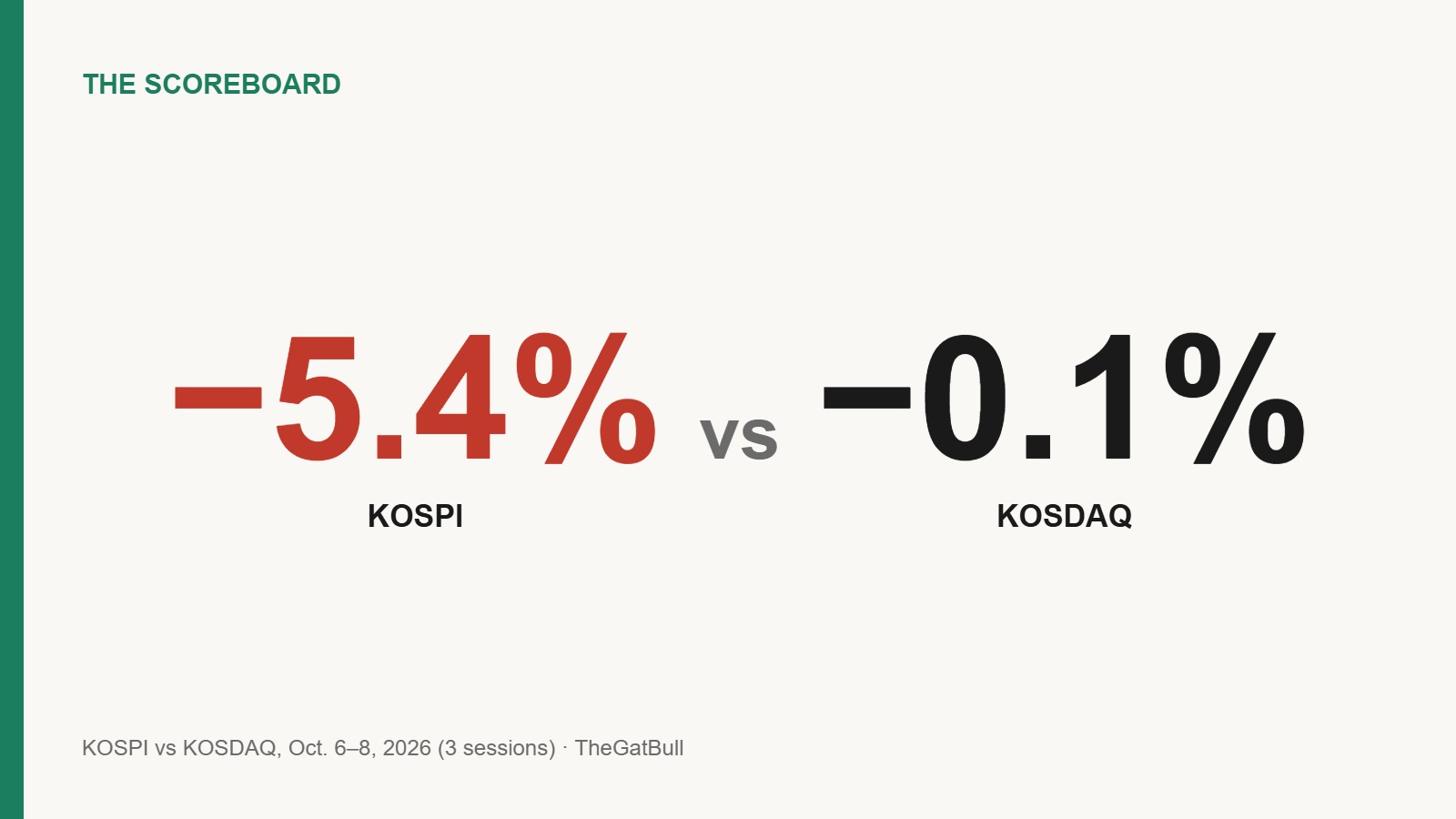
TL;DR — If you hold EWY. In a three-session week (Oct. 6–8), KOSPI, Korea’s main stock index, fell harder each day and lost 5.39%, while KOSDAQ, Korea’s market for smaller and growth companies, ended down 0.11%. Samsung Electronics and SK hynix, 46.10% of EWY (iShares, as of Oct. 7), fell 5.07% and 8.69%; EWY’s own −7.63% covers five U.S. sessions in dollars, so don’t subtract one figure from the other.
Not financial advice.
How much did Korean stocks fall this week? KOSPI lost 5.39% in three sessions. KOSDAQ, the smaller growth market, did not.
The Korea Exchange (KRX) was closed on Monday, Oct. 5, the substitute holiday for Gaecheonjeol (National Foundation Day), and on Friday, Oct. 9, Hangul Day. That left three sessions: Oct. 6, 7 and 8. From its last close before the break (Friday, Oct. 2: 7,003.74), KOSPI fell 0.89%, 1.98% and 2.62%, a bigger drop each day, and closed on Thursday, Oct. 8 at 6,625.93. That is its lowest close since Sept. 3, according to Yahoo Finance daily data. On the last two days the index closed at or just above its low of the day (0.09 points above it on Wednesday, exactly at it on Thursday), which suggests selling continued into the final minutes.
Over the same three sessions, KOSDAQ went from 893.29 to 892.27: −0.11%.
What this means if you hold EWY. About 46% of EWY is two stocks, SK hynix (23.17%) and Samsung Electronics (22.93%), per iShares as of Oct. 7; in Seoul this week they fell 8.69% and 5.07%. EWY’s −7.63% is five U.S. sessions in dollars, so it can’t be subtracted from Seoul’s three-session won figures.
Every Seoul price here is the KRX regular-session close (15:30 Seoul time; trades on Nextrade, a separate Korean exchange, are not included); the intraday lows mentioned above are the only exception. The latest close is Thursday, Oct. 8, and Seoul reopens on Monday, Oct. 12. Dollar conversions are for scale only, at the Oct. 8 Seoul 15:30 rate of ₩1,338.5 per dollar (press-reported).
The scoreboard: three sessions
| Seoul close | KOSPI (daily change) | KOSDAQ (daily change) |
|---|---|---|
| Fri, Oct. 2 (before the break) | 7,003.74 | 893.29 |
| Tue, Oct. 6 | 6,941.39 (−0.89%) | 919.92 (+2.98%) |
| Wed, Oct. 7 | 6,803.90 (−1.98%) | 898.43 (−2.34%) |
| Thu, Oct. 8 | 6,625.93 (−2.62%) | 892.27 (−0.69%) |
| Three sessions | −5.39% | −0.11% |
(Daily changes compound, so they don’t add up exactly to the three-session totals.)
| Stock (KRX close) | Oct. 2 → Oct. 8 | Three sessions |
|---|---|---|
| Samsung Electronics (005930) | ₩276,000 → ₩262,000 (≈$196) | −5.07% |
| SK hynix (000660) | ₩1,841,000 → ₩1,681,000 (≈$1,256) | −8.69% |
- KOSPI is now 27.30% below its June 22 close of 9,114.55, the highest close in the past year of Yahoo Finance daily data.
- Both chip stocks closed at their low of the day on Oct. 8.
- On the morning of Oct. 8, Samsung Electronics reported preliminary third-quarter operating profit of ₩107.4 trillion (about $80 billion). The stock fell 2.42% that day. We read those numbers in a separate piece.
It fell harder each day. Foreign selling didn’t grow each day.
Last week (Sept. 28–Oct. 2), foreign investors sold on all five days, but less each day (last week’s piece). This week the index went the other way: it fell harder each day. The natural guess is that foreigners sold more each day. The numbers don’t line up that way.
| Date | KOSPI daily | Foreigners, net | Individuals, net |
|---|---|---|---|
| Tue, Oct. 6 | −0.89% | −₩1.75 trillion | +₩0.74 trillion |
| Wed, Oct. 7 | −1.98% | −₩2.60 trillion | +₩2.56 trillion |
| Thu, Oct. 8 | −2.62% | −₩1.99 trillion | +₩2.91 trillion |
| Three sessions | −5.39% | about −₩6.3 trillion (≈ −$4.7 billion) | about +₩6.2 trillion (≈ +$4.6 billion) |
(“Net” is value bought minus value sold, in the KOSPI market. Press reports citing Korea Exchange data; Oct. 7 and Oct. 8 exclude the Nextrade venue, and some figures come from a single outlet, as listed in “How sure are we?” below. Including Nextrade, one outlet reported larger foreign selling: about ₩3.11 trillion on Oct. 7 and ₩2.44 trillion on Oct. 8.)
Of the three sessions, foreigners sold the most on Wednesday and the index fell the most on Thursday. Earlier in the week, outlets had cited higher U.S. long-term yields (Oct. 6) and oil above $90 (Oct. 7). On Thursday, institutions also net sold about ₩1.67 trillion (single outlet). Outlets pointed to several things that day: program selling around the monthly options expiry, the end of Samsung Electronics’ share buyback, profit-taking, and worries that chip earnings are peaking. Those are press-reported interpretations; we can’t confirm which, if any, decided the day.
On the other side were individual investors, who bought almost the same amount. Over the three days, foreigners net sold about ₩6.3 trillion and individuals net bought about ₩6.2 trillion.
Under the Gat (our take). “Last week this column’s headline was ‘less each day.’ This week it’s the mirror image: ‘harder each day.’ But the mirror isn’t perfect. Of the three days, foreigners sold the most on Wednesday; the index fell the most on Thursday. That’s a reason to doubt any one-line explanation.”
KOSPI −5.39%, KOSDAQ −0.11%: same Seoul, different numbers
Korea has two main stock markets. KOSPI is the main board, home to large companies such as Samsung Electronics and SK hynix. KOSDAQ is a separate market weighted toward smaller growth companies in biotech, IT and battery materials.
This week the gap between them was 5.3 percentage points (both are won-denominated indexes, so the subtraction is fair). The first day showed the widest gap of the three: on Oct. 6, KOSPI fell 0.89% while KOSDAQ rose 2.98% and closed above 900 for the first time since July 1, according to Yahoo Finance daily data (that day in detail). Both fell over the next two days, but KOSDAQ gave back roughly all of Tuesday’s gain, while KOSPI lost ground in all three sessions.
Not a perfect parallel: The nearest U.S. picture is a week when the S&P 500 and the Russell 2000 move differently, with a few megacaps dragging the headline index while small caps go their own way. But KOSDAQ is a separate listing market rather than a small-cap index, and the two-stock concentration Korea investors face (46.10% of EWY) is far heavier than in a typical U.S. large-cap index; we did not look up an exact U.S. figure.
The structural fact this week shows: a headline like “Korean stocks fell 5%” is largely a story about two chip heavyweights. They fell 5.07% and 8.69%, while KOSDAQ, which holds neither, ended flat; we did not compute their exact share of KOSPI’s drop. KOSDAQ ending flat means Korean stocks broadly did not fall as fast as KOSPI. That is an index-level observation; we didn’t collect how many individual stocks rose or fell.
If you hold EWY: five U.S. sessions, three Seoul sessions
EWY (iShares MSCI South Korea ETF) trades in New York even when Seoul is closed. Over its five U.S. sessions this week (Oct. 5–9), EWY went from $191.88 (Oct. 2 close) to $177.24 (Oct. 9 close), −7.63%. It traded on Friday, Oct. 9, while Seoul was shut, and rose 0.54% that day. SKHY, the U.S.-listed ADR for SK hynix (a U.S. receipt for the Korean shares), fell from $195.13 to $169.03 over the same five U.S. sessions, −13.38%, a different window from Seoul’s three.
- Different clocks. U.S. sessions open after Seoul has closed. Don’t pair an EWY day with a KOSPI day; compare only the two ends of the week. For what EWY reflects while Korea is shut, see What Moves EWY When Korea Is Closed?
- Different currencies. EWY is priced in dollars, KOSPI in won. Over the three sessions the won strengthened about 0.9% against the dollar (₩1,350.6 on Oct. 2, as in last week’s scoreboard, to ₩1,338.5 on Oct. 8; Seoul 15:30 closes, press-reported). A stronger won raises the dollar value of Korean shares, which is one reason dollar and won returns differ. Don’t subtract 5.39% from 7.63% and conclude that “EWY fell more.”
SK hynix and Samsung Electronics, both KOSPI stocks, are 46.10% of EWY (iShares, Oct. 7). We did not total how much of EWY is listed on KOSDAQ, so we won’t put a number on it. What we can say: with nearly half the fund in two KOSPI stocks that fell 5–9% this week, KOSDAQ’s flat week could reach EWY holders only through the rest of the fund. More on that concentration in our EWY concentration guide.
Access, in one line: the two U.S. routes named in this piece are EWY for the basket and SKHY, the U.S.-listed ADR, for SK hynix alone; for KRX-listed shares themselves, you need a broker with direct access to the Korean market.
What to watch next week
| Date (Seoul time) | Event | How sure we are |
|---|---|---|
| Mon, Oct. 12 | Seoul reopens; Bank of Korea appears at the National Assembly audit | Reopening confirmed; audit date press-reported |
| Tue, Oct. 13 | Bank of Korea releases minutes of its last rate meeting | Press-reported |
| Mon, Oct. 19 | Brokers’ per-stock limits on margin loans take effect (how the cap works) | Covered in our earlier piece |
| Thu, Oct. 22 | Bank of Korea rate decision | Scheduled |
Two things to watch: whether foreign net selling shrinks again, as it did last week, or keeps going; and whether the KOSPI–KOSDAQ gap narrows.
Bottom line

Under the Gat. “If you hold EWY, nearly half your fund is two stocks, Samsung and SK hynix, and both fell hard this week. KOSDAQ holding up isn’t comfort. It’s information: one more week that showed what your fund is really betting on.”
In a three-session week, KOSPI fell harder each day and lost 5.39%, but that was the drop of an index in which two chipmakers carry heavy weight. KOSDAQ ended the same week down 0.11%, and the roughly ₩6.3 trillion foreigners sold was matched almost exactly by Korean individuals.
FAQ
Why did KOSPI fall this week?
KOSPI fell 5.39% over three sessions (Oct. 6-8). Outlets cited higher U.S. long-term yields, oil prices, program selling around the options expiry, the end of Samsung Electronics’ share buyback, profit-taking and worries that chip earnings are peaking. These are press-reported interpretations; no single cause is confirmed.
What is the difference between KOSPI and KOSDAQ?
KOSPI is Korea’s main board of large companies, including Samsung Electronics and SK hynix. KOSDAQ is a separate market weighted toward smaller growth companies. This week KOSPI fell 5.39% and KOSDAQ fell 0.11%.
Was the Korean stock market open on October 9, 2026?
No. Friday, Oct. 9 was Hangul Day and the KRX was closed. Monday, Oct. 5 was also closed, as the substitute holiday for Gaecheonjeol (National Foundation Day). U.S.-listed Korea ETFs such as EWY traded normally.
How much of EWY is Samsung and SK hynix?
46.10% as of Oct. 7, 2026, per iShares: SK hynix 23.17% and Samsung Electronics 22.93%.
Sources
- Index and stock closes: Yahoo Finance chart data (^KS11, ^KQ11, 005930.KS, 000660.KS), retrieved Oct. 11 (KST), KRX 15:30 regular-session closes; EWY and SKHY via the same route, U.S. trading-day closes in USD.
- EWY weights: iShares EWY holdings, as of Oct. 7, 2026.
- Investor flows, Oct. 6: Businesskorea, Seoul Shinmun, Shinailbo, Ajupress.
- Investor flows and the won, Oct. 7: Shinailbo, Kangwon Domin Ilbo.
- Investor flows, Oct. 8: Seoul Shinmun.
- The won: Businesskorea, Maeil Ilbo and Shinailbo, plus Newspim (below).
- Flows including Nextrade, and the won on Oct. 8: Newspim (Oct. 7), Newspim (Oct. 8).
- Samsung Electronics preliminary Q3 2026 results: DART filing 20261008800004.
- Next week’s Bank of Korea schedule: Edaily (Oct. 10).
How sure are we?
| Item | Confidence |
|---|---|
| Index, stock, EWY and SKHY prices | Computed from vendor price data (Yahoo Finance); KRX regular-session closes |
| “Lowest close since Sept. 3,” the June 22 one-year closing high, and KOSDAQ’s first close above 900 since July 1 | According to Yahoo Finance daily data; not checked against KRX index files |
| Investor flows | Press-reported, citing Korea Exchange data; Oct. 7 and Oct. 8 partly single-outlet; not checked against the exchange’s table |
| Reasons for the fall | Press-reported interpretations, not confirmed |
| The won | Press-reported Seoul 15:30 closes; Oct. 7 and Oct. 8 each matched by two outlets |
| Oct. 5 and Oct. 9 closures | Confirmed: KRX closed both days |
Not financial advice. TheGatBull is an independent publication; nothing here is a recommendation to buy or sell any security.
 Written by Mr.Gat — TheGatBull
Korean market coverage from a Seoul-metro-based operator who reads the filings in the original language. Every price on this site is the KRX regular-session close (15:30 Seoul); every figure states whether it came from a primary filing, the press, or our own calculation. Drafts are AI-assisted, then verified against the original Korean documents and edited by a human before publishing.
Found an error? Tell us — corrections get priority. How we work →