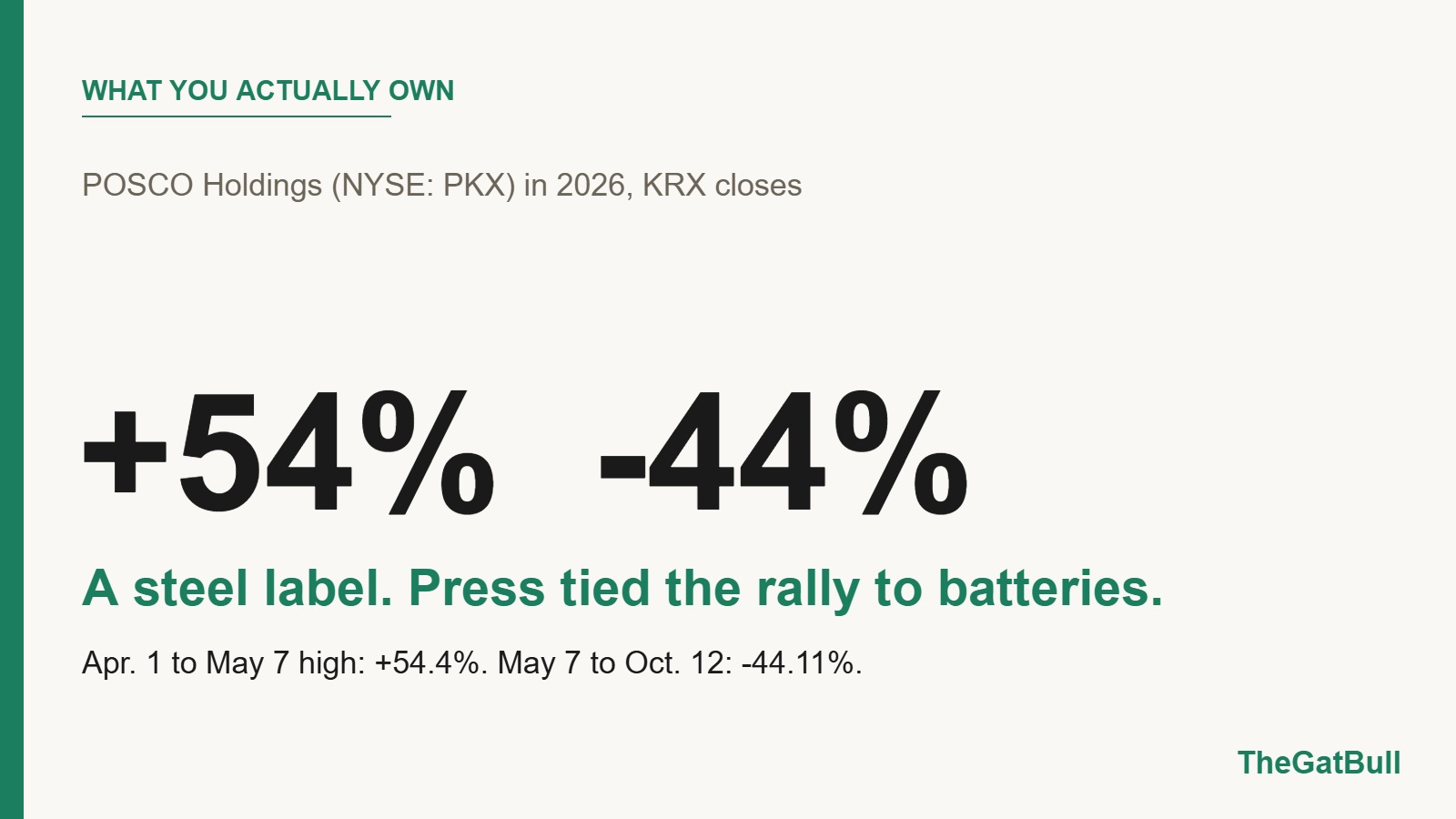
TL;DR — If you own PKX. POSCO Holdings, which trades in New York as PKX, is a holding company for steel, battery materials, construction and trading, not just a steelmaker, and press reports tie its 2026 rally to the battery side. Its Seoul shares rose 54.4% in five weeks this spring, then gave all of it back: at ₩299,000 on Oct. 12 they sit 44.11% below the May 7 one-year closing high.
Not financial advice.
Is POSCO just a steel stock? No. What you buy with PKX is a holding company, a parent that owns operating businesses, including a separately listed battery-materials company, and press reports tie this year’s price moves to battery materials, not steel.
From Wednesday, April 1 to Thursday, May 7, POSCO Holdings (005490) went from ₩346,500 to ₩535,000 on the Korea Exchange (KRX), a gain of 54.4% in five weeks. Five months later it closed at ₩299,000 (about $224 at ₩1,335 per dollar) on Monday, Oct. 12, 44.11% below the May 7 close, which is its one-year closing high in Yahoo Finance’s daily data. The next date to watch is POSCO’s third-quarter report; we have not yet seen the company confirm the date.
What this means if you buy PKX. PKX is an ADR (American depositary receipt): a U.S.-traded certificate that stands for shares of a foreign company. Each PKX share represents one-quarter of a Seoul share, per POSCO Holdings’ Form 20-F for 2025. PKX trades in dollars, so its return adds the won-dollar exchange rate to the move in POSCO’s Seoul price: the same company can show one return in won and another in dollars.
Seoul share prices and index levels in this post are KRX regular-session closes (15:30 Seoul time for 2026 dates). PKX prices are New York closes. Dollar conversions are for scale only, at about ₩1,335 per dollar, the Oct. 12 Seoul 15:30 rate (press-reported, single outlet).
Steel profits fell. The stock rose 54% anyway.
On April 30, POSCO Holdings reported first-quarter operating profit of ₩707 billion, up 24.3% from a year earlier and about 20% above market expectations, according to Maeil Business Newspaper (May 4, press-reported). The growth did not come from steel. The same report said profit in the core steel business fell, squeezed by raw-material costs as the won weakened, while two subsidiaries swung to a profit: POSCO Future M, which makes battery materials, and POSCO E&C, the construction arm. Hopes of a recovery in lithium prices added to the story, and brokers raised their price targets. The brokers’ forecast of ₩3.12 trillion in operating profit for 2026 is an analyst estimate, not company guidance.
The five-week run from ₩346,500 to ₩535,000 straddled that report. We have not split the gain into what came before and after April 30, so we don’t treat the earnings report as the sole cause.
Then it gave the rally back
After the May 7 high, the shares spent five months handing the whole gain back. Over the full year so far:
| Dec. 30, 2025 → Oct. 12, 2026 (KRX close, won, price return) | Change |
|---|---|
| KOSPI, Korea’s main index | +51.50% |
| POSCO Holdings | −1.97% |
In a year when KOSPI rose by more than half, POSCO is slightly below where it started. Read with the first-quarter report, the spring spike looks less like a turn in the steel cycle and more like battery-materials hopes moving into the price and then back out.
PKX holders see a different number. PKX’s price return is +8.02% this year in dollars, through its Oct. 9 New York close. That can’t be subtracted from the Seoul figure: the periods end on different days and the currencies differ. So the gap between the two is not a measurement of the won’s effect. What it does show is why the currency matters at all: owning PKX means owning POSCO and the won.
Where policy and prices hit the business
- Costs (steel): POSCO imports iron ore and coal, so a weaker won means paying more won for the same shipment. The first-quarter coverage cited this channel: raw-material costs rising with the exchange rate.
- Sales (steel): U.S. tariffs on steel affect export prices and volumes. We don’t cover the current rates here because we have not checked them against a primary source.
- Valuation (battery materials): the value of the lithium and cathode business depends on electric-vehicle demand and lithium prices. The press reading is that most of the spring spike, and the fade after it, happened on this line (press-reported; the one article we cite is dated May 4).
PKX holders have a fourth line: the exchange rate. All else equal, a stronger won helps the cost line, and it also raises the dollar value of each PKX share, because the same won share price converts into more dollars.
Monday: Seoul fell 3.65%, POSCO fell less
On Monday, Oct. 12, the first session after the Hangul Day national holiday (Friday, Oct. 9), KOSPI closed at 6,384.24 (−3.65%), its fourth straight decline. Foreign investors were net sellers of about ₩2 trillion on KOSPI, their 10th straight session of net selling (press-reported, single outlet), with the selling concentrated in SK hynix (−4.52%) and Samsung Electronics (−4.39%). POSCO Holdings fell 2.45%.
We could not get Monday’s foreign flows for POSCO itself, so we don’t claim foreigners sold it less. A fairer reading puts Monday’s smaller drop beside the fact that POSCO has lagged the index by a wide margin this year.
What to watch next
- POSCO’s third-quarter results: the first quarter set off the spring rally, so look at the battery-materials subsidiaries and the steel business separately. Is the subsidiaries’ profit holding, and where is steel? (Date not yet confirmed by the company.)
- The won: about ₩1,335 per dollar at 15:30 on Oct. 12, 7.7 won stronger than the previous session (single outlet). For PKX holders, this is a second variable on top of the share price.
- Bank of Korea rate meeting, Thursday, Oct. 22 (per press reports of the schedule): an upcoming event for the whole market.
One old industrial leader, 19 years on
Set POSCO against 2007 and the same story runs longer.
| End of Sept. 2007 → Oct. 12, 2026 (month-end close → close, won, price return, dividends excluded) | Sept. 2007 | Now | Change |
|---|---|---|---|
| KOSPI | 1,946.48 | 6,384.24 | ×3.28 |
| POSCO Holdings | ₩673,000 | ₩299,000 | −55.6% |
In Yahoo Finance’s monthly data, the end of September 2007 is POSCO’s highest month-end close. Nineteen years later the index is more than three times that level, and POSCO is below half. (This leaves out dividends. POSCO has paid them steadily, so the total-return gap is smaller, but it points the same way.)
What POSCO suggests about the Korean market (one company, not a survey): some of Korea’s old industrial leaders could not keep up with the index on their core businesses alone, and moved toward adding new businesses under a holding company. The result is a stock priced on hopes for the new business rather than on results from the old one. POSCO’s +54% and −44% in 2026 are what that looks like. If you sort Korean stocks by industry label, it is easy to miss what you are actually exposed to.
Under the Gat. “The ticker says steel. The price said lithium. Before you buy a Korean ‘old economy’ name, check what’s sitting under the holding company.”
How to get POSCO from the U.S.
From lightest exposure to most direct:
- EWY: if you already own it, you hold POSCO at 0.86%, plus POSCO Future M at 0.47% (iShares, as of Oct. 9). A 10% move in POSCO would move EWY by about 0.09 percentage points (our calculation: 0.86% × 10%). If you want POSCO exposure, EWY barely gives you any. More on what EWY holds: EWY’s concentration.
- PKX (NYSE ADR): buy it in dollars in a U.S. brokerage account. One share equals one-quarter of a Seoul share (per the company’s Form 20-F). Its last close was $57.48 on Friday, Oct. 9, a U.S. session on a Seoul holiday. Because New York and Seoul trade at different hours, don’t line the two up day by day.
- Seoul shares (005490): you need a broker that offers direct trading on the KRX. ₩299,000 is about $224 at ₩1,335. Step by step: how to buy Korean stocks from the U.S.
A U.S. comparison, with a caveat. Picture Nucor with a listed subsidiary in lithium and battery materials attached, and you are close to POSCO’s shape. Not a perfect parallel: POSCO’s battery-materials business sits in a separately listed company (POSCO Future M), construction and trading are in the group too, and we know of no U.S. company that matches it exactly. This is an illustration of structure, not a comparison of the two companies’ results.
Bottom line

PKX’s label says steel. But by the press account and the price data, what PKX holders lived through in 2026 seems to have come from lithium, battery materials and the won. Before you buy, check what sits under the holding company, not the industry label. The next checkpoint is the third-quarter report: look at steel and materials separately.
FAQ
Is POSCO a steel stock?
Steel is where it started, but POSCO Holdings is a holding company for steel, battery materials, construction and trading. Its 2026 spring rally was led, according to press reports, by battery-materials subsidiaries turning profitable and hopes for a lithium price recovery.
What is the easiest way to buy POSCO stock in the U.S.?
Its NYSE-listed ADR, ticker PKX. One PKX share equals one-quarter of a Seoul share and trades in dollars.
Why is PKX’s return different from POSCO’s Seoul return?
PKX trades in dollars, so changes in the won-dollar rate are added on top, and New York and Seoul trade on different days and hours. Don’t compare the two until they cover the same period in the same currency.
If I own EWY, do I own POSCO?
Yes. POSCO Holdings was 0.86% of EWY in the iShares holdings file as of Oct. 9, 2026. At that weight, POSCO’s moves barely affect EWY’s return.
Sources
- Prices: Yahoo Finance chart data for 005490.KS, ^KS11 (KOSPI), 005930.KS, 000660.KS and PKX, retrieved Oct. 12, 2026. KRX regular-session closes (15:30 Seoul time for 2026 dates); U.S.-listed prices are New York closes.
- EWY holdings: iShares MSCI South Korea ETF, fund holdings as of Oct. 9, 2026.
- Oct. 12 market close and flows: Asia Economy, Global Economic (Oct. 12, 15:45), BusinessKorea (market close and the won at 15:30).
- First-quarter results and the spring rally: Maeil Business Newspaper, May 4, 2026.
- PKX ratio: POSCO Holdings Form 20-F for fiscal 2025 (SEC EDGAR).
How sure are we?
| Item | Confidence |
|---|---|
| POSCO, KOSPI, Samsung, SK hynix and PKX prices; returns | Computed from vendor price data (Yahoo Finance); KRX regular-session closes (PKX: New York closes) |
| “Highest month-end close” in Sept. 2007 | According to Yahoo Finance monthly data only; not checked against KRX files |
| EWY weights | Primary: iShares holdings file, as of Oct. 9 |
| First-quarter results, steel profit decline, reasons for the rally | Press-reported (one outlet); the 2026 profit forecast is an analyst estimate, not company guidance |
| PKX ratio (1 share = 1/4 Seoul share) | Primary: POSCO Holdings Form 20-F for fiscal 2025, filed April 2, 2026 |
| Foreign flows and the won on Oct. 12 | Press-reported, single outlet each |
Not financial advice. TheGatBull is an independent publication; nothing here is a recommendation to buy or sell any security.
Written by Mr.Gat — TheGatBull
Korean market coverage from a Seoul-metro-based operator who reads the filings in the original language. Every price on this site is the KRX regular-session close (15:30 Seoul); every figure states whether it came from a primary filing, the press, or our own calculation. Drafts are AI-assisted, then verified against the original Korean documents and edited by a human before publishing.
Found an error? Tell us — corrections get priority. How we work →