TL;DR — If you hold EWY. Korea’s ministers spent this week answering lawmakers on the record in the annual National Assembly audit. On Oct. 8, the chairman of Korea’s Financial Services Commission said he was sorry for the losses and worry tied to the single-stock leveraged products built on Samsung Electronics and SK Hynix, while denying the presidential office ordered them. On Oct. 6, asked about lawmakers’ claim that the government pressed exporters to convert dollars, the finance minister called the request “part of foreign-exchange market stabilization measures,” but said he does not directly press companies (single outlet). Samsung and SK Hynix are 46.10% of EWY.
Not financial advice.
Did Korea’s regulator apologize for its leveraged ETFs? Yes — for the results, and as far as we could confirm, not for the policy.
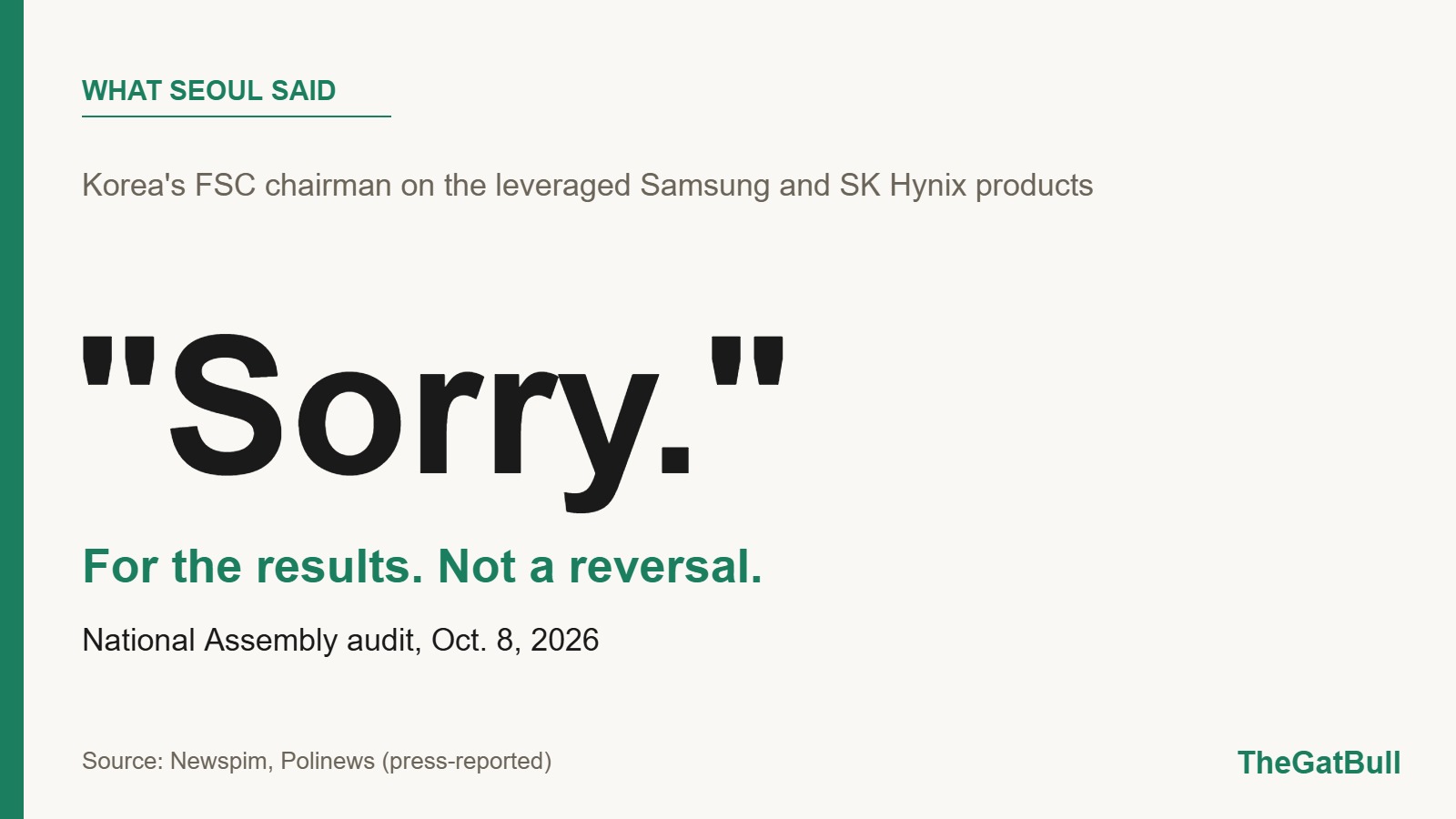
Two scenes this week matter to US investors. On Oct. 8, Lee Eok-won, chairman of the Financial Services Commission (FSC), told lawmakers he felt “sorry” for “the losses, the worry and the harm” that followed the single-stock leveraged products on Samsung Electronics and SK Hynix. He denied that the presidential office ordered them. On Oct. 6, Finance Minister Lee Hyung-il (who is also Deputy Prime Minister) responded to lawmakers’ claim that the government asked big exporters to convert their dollars by calling such a request a stabilization measure, and said he does not directly press companies to do it.
What this means if you hold EWY. The two stocks underneath those leveraged products are 46.10% of EWY — SK Hynix 23.17% plus Samsung Electronics 22.93% (iShares, as of Oct. 7). Rules Seoul writes next for products on these two stocks could affect how they trade in Seoul, and these two stocks carry nearly half of EWY’s weight.
Market context: the KOSPI closed at 6,625.93 on Thursday, Oct. 8 (down 2.62%), a KRX (Korea Exchange) regular-session close at 15:30 Seoul time. Seoul was closed on Friday, Oct. 9, for Hangul Day (a Korean national holiday); the next session is Monday, Oct. 12. Dollar amounts are converted at about ₩1,339 per dollar on Oct. 8 (press-reported, single source).
The stage: Korea’s annual parliamentary audit
Every year the National Assembly runs a public audit of the whole government. Ministers and agency heads sit in the witness seat and answer lawmakers’ questions on the record. This was the first week: the Finance and Economy Committee questioned the Ministry of Economy and Finance on Oct. 6, and the National Policy Committee questioned the FSC on Oct. 8.
Unlike a usual week of prepared statements, audit-week remarks are answers to direct questions, and they go on the record.
The FSC chairman: an apology for the leveraged products (Oct. 8)
What the products are. On May 27, Korea listed its first single-stock leveraged and inverse products — funds that move a set multiple of one stock’s daily change — built on Samsung Electronics and SK Hynix (16 ETFs and 2 ETNs, or exchange-traded notes, per press reports). After the sharp market fall in July, the authorities paused new listings on July 16 (press-reported).
The FSC’s case, in its own words. Asked whether the presidential office ordered the launch moved up from the second half of the year to the second quarter (Rep. Song Eon-seok, People Power Party), Lee answered: “That is not so.” He said the question of why such products were allowed abroad but blocked at home had been raised for a long time, and that the products came through a decree amendment, a 40-day public notice period and consultation among ministries.
What he said about the results (confirmed on the record, reported by several outlets):
- “Regardless of the need for the policy, I am sorry for the losses, the worry and the harm that resulted.” (Polinews)
- “I sincerely apologize for the worry I caused the public.” (Newspim)
- On high-frequency trading (raised by Rep. Kim Hyun-jung, Democratic Party): “If we find illegal activity, we will respond immediately.”
What was not confirmed.
- The size of the losses. During questioning, a figure of about ₩54 trillion (about $40 billion at the Oct. 8 rate) was cited as a foreign investment bank’s estimate. Lee pushed back, saying in effect that it was informal commentary and not accurate. This number is disputed and is not an official figure.
- Presidential office involvement. A lawmaker’s claim (including a closed-door meeting on Jan. 13) stands against the chairman’s denial. Neither side has been confirmed from a primary document.
What the apology did not do. The remarks did not include scrapping the products or adding new rules. As far as we could confirm, the apology was for the results, not a reversal of the policy.
The finance minister: “a stabilization measure,” he says, not pressure (Oct. 6)
The mechanism. When a currency weakens fast, a government can add dollar supply in more than one way — for example, sell dollars itself, or ask the companies that earn dollars — exporters — to convert them into won sooner and bring money held abroad back home. Lawmakers’ questions were about the second route.
The question (a lawmakers’ claim, not a confirmed fact). Reps. Kim Sang-hoon and Park Soo-young (People Power Party) said that while the won was weaker than ₩1,500 per dollar, the government asked large exporters to convert their dollars and bring overseas funds home. The scene they pointed to: a June 11 meeting between vice ministers of finance and industry and Samsung Electronics, SK Hynix, Hyundai Motor, Kia and three shipbuilders. They also said seven companies were asked for 11 years of foreign-currency records.
What the minister said (confirmed on the record; reported by a single outlet, Newspim):
- The one-way move in the exchange rate “was very severe at the time and was a burden on the economy,” and the request was “part of foreign-exchange market stabilization measures.”
- “We do not directly press companies to convert currency or intervene in their business.”
- He declined to hand over the requested records, saying in effect that they included individual companies’ confidential business and currency strategy.
How to read it. The minister did not deny the request. He called it policy (a stabilization measure) and denied only the compulsion (pressing companies). It is the same line this column draws every week between “coordinating” and “intervening”: the request is confirmed; the pressure is denied.
Context in numbers (Bank of Korea and trade ministry data cited by lawmakers’ offices; press-reported, not checked against the original data): non-financial private companies were net sellers of $186.9 billion of dollars in the first half of 2026, about 3.2 times the same period a year earlier. Of $814.5 billion in exports from January to September, chips were $340.3 billion (41.8%). As of Oct. 8, the rate was about ₩1,339 per dollar, well below the ₩1,500 level the lawmakers referred to.
The finance minister: government bonds, a follow-up (Oct. 6)
Last week’s column covered the ₩5 trillion cut in October government bond sales. This week the minister said the ministry plans to “watch market conditions and, if needed, consider further cuts” (News1). That is not a new decision; it leaves the door open to further cuts.
The Bank of Korea: not on the stage yet
As far as we could find, Governor Shin Hyun-song made no new on-the-record remarks this week (Oct. 4–10). Two dates are set:
- Monday, Oct. 12: the Bank of Korea’s audit before the Finance and Economy Committee — Shin’s first since taking office (press-reported).
- Thursday, Oct. 22: the next rate decision. The bank raised rates in July and again in August (press-reported).
This gap does not mean the central bank went silent; its audit turn is Monday.
What we checked this week, and what we didn’t
- Checked: reports on the finance ministry audit (Oct. 6) and the FSC audit (Oct. 8), and reports on the Bank of Korea’s audit date.
- Not covered this round: the Financial Supervisory Service, or FSS (audit date not confirmed), the presidential office, the Korea Exchange, the US Treasury and Fed, and Japan’s Ministry of Finance. We do not say they said nothing.
- We have not yet checked the quotes against primary records (Assembly transcripts, ministry releases). All quotes are as reported by the press, and the minister’s remarks rest on a single outlet.
| Who | When | What | How sure are we? |
|---|---|---|---|
| Lee Eok-won, FSC chairman | Oct. 8 | “Sorry” for the results of the leveraged products; presidential order “not so” | ✅ Confirmed on the record (several outlets) |
| Lee Hyung-il, finance minister | Oct. 6 | Exporter dollar request = “part of foreign-exchange market stabilization measures”; does not “directly press” | ✅ Confirmed on the record (single outlet) |
| Lee Hyung-il, finance minister | Oct. 6 | Bonds: “if needed, consider further cuts” | ✅ Confirmed on the record (single outlet, News1) |
| A foreign investment bank | — | Losses of about ₩54 trillion on the leveraged products | ⚠️ Press-reported, disputed by the FSC chairman |
| Presidential office | Jan. 13 (claimed) | Effectively decided the launch | ⛔ Not confirmed (lawmaker’s claim; chairman denies) |
What this shows about Korea’s market
In the US, a 2x single-stock ETF is something a fund manager builds and registers with the SEC. In Korea, it exists only once a government decree opens the door — so when it loses money, a minister-level official answers for it in the Assembly. Dollars work the same way: when exporters convert their earnings can be the agenda of a government meeting.
Under the Gat. An apology does not reverse a policy. It does raise the bar for the next product. In Seoul, “what can be sold” and “when the dollars get sold” are policy variables, not just market ones — and the one week a year when the story behind them comes out in public is audit week. Nearly half of EWY sits on the stocks underneath those products.

A US comparison, and how to get exposure
- US comparison: think of the SEC chair or the Fed chair testifying before Congress. Not a perfect parallel: Korea’s audit is held every year, covers every ministry, and is packed into the same few weeks.
- On currency: the US Treasury publishes a semiannual currency report that tracks government intervention in currency markets. Lawmakers’ account of this episode describes a request to companies rather than dollar sales by the government; we have not checked the Treasury’s latest report on Korea.
- Access: the single-stock leveraged products are listed in Seoul (KRX) and are hard to buy from a US retail account. A US investor’s exposure is indirect — through EWY (46.10% in the two underlying stocks) or SK Hynix’s US ADR (SKHY).
The bottom line
This week’s statements in Seoul come back to one question: did the government put its hand on the market? The FSC chairman apologized for the results. The finance minister called the method a stabilization measure. The Bank of Korea gets the same question on Monday. For EWY holders, the dates to watch are Oct. 12 (the central bank’s audit) and Oct. 22 (the rate decision).
FAQ
Did Korea’s financial regulator apologize for leveraged ETFs?
Yes. At the National Assembly audit on Oct. 8, FSC Chairman Lee Eok-won said he was sorry for the losses and worry tied to the single-stock leveraged products on Samsung Electronics and SK Hynix. He denied that the presidential office ordered the products.
Did Korea ask exporters to sell dollars?
Lawmakers said the government asked big exporters to convert their dollars and bring overseas funds home. Finance Minister Lee Hyung-il described the request as “part of foreign-exchange market stabilization measures” and said he does not directly press companies or intervene in their business.
Is the ₩54 trillion loss figure confirmed?
No. It is a foreign investment bank’s estimate cited during questioning, and the FSC chairman disputed it. As far as we could find, no official loss figure has been confirmed.
When does the Bank of Korea speak next?
Governor Shin Hyun-song is scheduled to appear at the Bank of Korea’s audit on Monday, Oct. 12 (press-reported), and the next rate decision is Thursday, Oct. 22.
What does this mean for EWY holders?
SK Hynix and Samsung Electronics, the stocks underneath the leveraged products, are 46.10% of EWY (iShares, as of Oct. 7, 2026).
Sources
- Newspim, FSC audit wrap-up (Korean), Oct. 9, 2026, 00:25 KST — newspim.com (press-reported).
- Polinews, FSC chairman “sorry” over leveraged ETFs (Korean), Oct. 8, 2026 — polinews.co.kr (press-reported).
- Newspim, exporter dollar-conversion questions at the finance ministry audit (Korean), Oct. 6, 2026 — wrap-up and 12:08 KST report (press-reported).
- News1, finance minister on further bond cuts (Korean), Oct. 6, 2026 — news1.kr (press-reported).
- Edaily, Bank of Korea audit preview (Korean), Oct. 10, 2026 — edaily.co.kr (press-reported).
- iShares MSCI South Korea ETF (EWY), fund holdings as of Oct. 7, 2026 (iShares).
- Index close: KRX regular-session close via vendor price data. Won rate: Oct. 8 Seoul, press-reported (Businesskorea).
- Related: Did Korea’s leveraged ETF rules work? · Korea’s chip tax windfall and the bond cut · Seoul’s three meetings on the Fed.
Not financial advice. TheGatBull is an independent publication; nothing here is a recommendation to buy or sell any security.
 Written by Mr.Gat — TheGatBull
Korean market coverage from a Seoul-metro-based operator who reads the filings in the original language. Every price on this site is the KRX regular-session close (15:30 Seoul); every figure states whether it came from a primary filing, the press, or our own calculation. Drafts are AI-assisted, then verified against the original Korean documents and edited by a human before publishing.
Found an error? Tell us — corrections get priority. How we work →