TL;DR — If you hold EWY. Seoul reopened on Tuesday, Oct. 6, after a three-day break and opened higher, then Samsung Electronics and SK hynix fell and KOSPI, Korea’s main index, closed down 0.89%. The same day KOSDAQ, Korea’s growth-company market, rose 2.98%. Those two stocks are 46.49% of EWY (iShares, as of Sept. 30), so EWY’s next U.S. session (Tuesday, Oct. 6, New York time) is more likely to follow the two chipmakers’ day than the rest of Korea’s.
Not financial advice.
Did Korea’s market rise after the holiday? It opened higher, then closed lower.
On Tuesday, Oct. 6, Seoul came back from a three-day break and opened KOSPI 0.58% above Friday’s close. That opening price was also the day’s high. Foreign investors net sold about ₩1.75 trillion (roughly $1.30 billion) of KOSPI stocks; Samsung Electronics fell 1.45% and SK hynix fell 3.69%; and KOSPI closed down 0.89% at 6,941.39, back below 7,000 after closing above it on Oct. 2. The same day, KOSDAQ, the exchange’s market for smaller and growth companies, rose 2.98% to 919.92 and closed at its high of the day. That is its first close above 900 since July 1.
What this means if you hold EWY. About half of EWY (46.49%, per iShares as of Sept. 30) is the two stocks that fell today. The part of Seoul that rose today, KOSDAQ growth and chip-equipment names, is barely in EWY. In Tuesday’s U.S. session, EWY is more likely to follow “the two chipmakers’ day” than “Korea as a whole.”
Every Seoul closing price here is the KRX regular-session close (15:30 Seoul time); the open and intraday low are labeled as such. Investor-flow figures are press reports citing Korea Exchange data, for the KOSPI market. Dollar conversions are for scale only, at the Oct. 6 Seoul 15:30 rate of ₩1,343.6 per dollar (press-reported).
What happened: the open and the close said different things
Seoul was closed from Saturday, Oct. 3 (Gaecheonjeol, National Foundation Day) through Monday, Oct. 5 (the substitute holiday). New York traded twice between Seoul’s Oct. 2 close and its Oct. 6 open.
| Seoul close, Oct. 6 | Close | vs. Oct. 2 close |
|---|---|---|
| KOSPI | 6,941.39 | −0.89% |
| KOSDAQ | 919.92 | +2.98% |
| Samsung Electronics (005930) | ₩272,000 (≈$202) | −1.45% |
| SK hynix (000660) | ₩1,773,000 (≈$1,320) | −3.69% |
Here is KOSPI’s day in four points: open 7,044.67, which was also the high; an intraday low of 6,897.38 (−1.52%); and the close at 6,941.39. When the high equals the open, the index never traded above its first price all day. KOSDAQ did the opposite: its close was its high, so buyers held on until the last trade.
What New York did while Seoul was closed
After Seoul closed at 15:30 on Friday, Oct. 2, the U.S.-listed products that hold Korea traded two sessions. These are U.S. trading days, in dollars.
| U.S. listing (USD) | Oct. 1 close | Oct. 2 close | Oct. 5 close |
|---|---|---|---|
| EWY (iShares MSCI South Korea) | $186.11 | $191.88 (+3.10%) | $191.46 (−0.22%) |
| SKHY (SK hynix ADR, a U.S.-listed receipt for the Korean shares) | $193.50 | $195.13 (+0.84%) | $195.02 (−0.06%) |
EWY rose 3.10% on Oct. 2 (U.S. time) and was nearly flat on Monday. Seoul’s +0.58% gap at Tuesday’s open pointed the same way. But we don’t line the two markets up day by day: they close at different times (EWY’s Oct. 2 session opened after Seoul’s Oct. 2 session had ended), and they trade in different currencies (EWY in dollars, KOSPI in won). What we can say is the direction: New York bid Korea up during the break, Seoul’s open agreed, and Seoul’s close erased it. For what EWY reflects while Korea is shut, see What Moves EWY When Korea Is Closed?
Under the Gat (our take). “The open is a question and the close is the answer. For three days New York asked, ‘Can I buy more Korean chips?’ Seoul answered in one session: ‘Not yet.’”
Who sold: foreigners, ₩1.75 trillion, and who took the other side
KOSPI net trading by investor type (press-reported, citing Korea Exchange data; four outlets’ foreign-investor figures matched except for rounding):
| Investor group | Net trading, KOSPI, Oct. 6 |
|---|---|
| Foreigners | −₩1.75 trillion (≈ −$1.30 billion) |
| Retail (individuals) | +₩0.74 trillion (≈ +$0.55 billion) |
| Institutions | Roughly flat (about −₩2 billion) |
(“Net” is value bought minus value sold. The three rows don’t add to zero because the exchange also counts other investor types, such as “other corporations.”)
Last week, foreign net selling shrank every day, from ₩3.24 trillion to ₩0.14 trillion on Friday (last week’s scoreboard). On the first day back, that figure grew again, to ₩1.75 trillion. Retail investors (nicknamed “Donghak ants” in Korea) took about ₩0.74 trillion of it.
The press cited two backdrops: brokers tying the selling to U.S. long-term Treasury yields at their highest since 2002 (Ajupress, press-reported), and caution on chip heavyweights ahead of third-quarter earnings (Seoul Shinmun and Businesskorea, press-reported). We can’t confirm which one, if either, caused today’s selling, and this piece doesn’t claim a cause.
One more thing. Ajupress reported that last week “other corporations” net bought ₩7.4 trillion, and that local brokers attribute this largely to the two chipmakers’ share buybacks. Samsung Electronics’ ₩15 trillion (about $11.2 billion) buyback program is expected to end this month (press-reported, not confirmed from a primary source). That means one of the hands that had been absorbing foreign selling may step away this month.
Same day, a different Korea: KOSDAQ back above 900
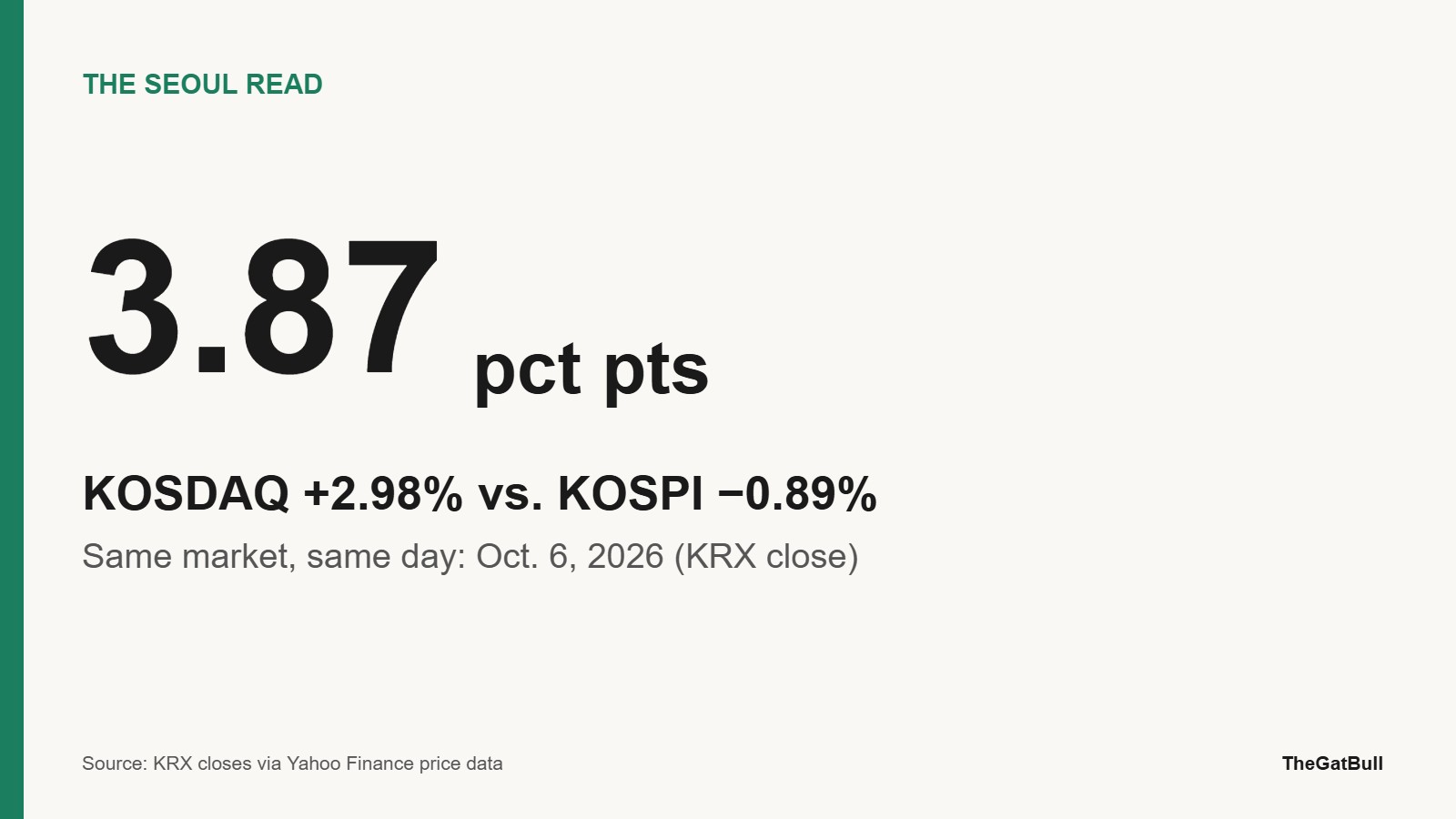
On the day KOSPI fell 0.89%, KOSDAQ rose 2.98%. That’s a gap of 3.87 percentage points between two indexes in the same market, in the same currency, on the same day.
- KOSDAQ’s close of 919.92 is its first close above 900 since July 1 (929.35), on closing prices (checked against Yahoo Finance price data and reported by Seoul Economic Daily).
- On KOSDAQ, foreigners and institutions each net bought roughly ₩0.1 trillion (outlets reported ₩109.4–118.6 billion and ₩97.9–100.1 billion; press-reported).
- Even inside KOSPI, stocks outside chips had a different day: Samsung Electro-Mechanics rose 5.95% and LG Energy Solution 5.12% (press-reported).
How can that happen? KOSPI is weighted by market value, and Samsung Electronics and SK hynix sit at the top. We don’t cite KOSPI’s own index weights here; for a sense of scale, the same two stocks are 46.49% of EWY (iShares, Sept. 30). When both fall together, the index can go down even if hundreds of stocks below them rise. KOSDAQ doesn’t hold either of them.
Not a perfect parallel: In U.S. terms, it looks like a day when the S&P 500 slips because of a couple of megacaps while the Russell 2000 rises. But KOSDAQ is not a small-cap index; it’s a separate market, weighted toward growth, biotech and chip-equipment companies. And KOSPI’s reliance on its top two stocks is much heavier than the S&P 500’s.
A three-session week: what to watch
Seoul trades only three days this week: Tuesday, Oct. 6; Wednesday, Oct. 7; and Thursday, Oct. 8. Friday, Oct. 9 is Hangul Day, and the market closes again. While Seoul is shut on Friday, New York will be open: the same structure as the last three days, repeating into the weekend.
| Date (Seoul time) | Event | How sure we are |
|---|---|---|
| Wed, Oct. 7 | Seoul regular session | — |
| Thu, Oct. 8 | Samsung Electronics’ preliminary Q3 results; Bank of Korea August balance of payments | Press-reported by two outlets; company notice not confirmed from a primary source |
| Thu, Oct. 8 | Seoul’s last session of the week | Confirmed KRX trading day |
| Fri, Oct. 9 | KRX closed (Hangul Day); U.S. markets open | Confirmed KRX holiday |
| This week | U.S. Federal Reserve minutes from the September meeting | Press-reported; date not confirmed |
Seoul Economic Daily reported the consensus for Samsung’s third quarter as revenue above ₩200 trillion (about $149 billion) and operating profit above ₩110 trillion (about $82 billion). That is an analyst consensus, not company guidance. If those numbers hold, they would be quarterly records, according to the same report. The results are due Thursday, per press reports, and Seoul is closed the next day. Much of the first price reaction could show up in EWY in New York on Friday.
Three things to watch
- Does foreign selling shrink again? Last week’s daily figure fell every day; today it jumped back to ₩1.75 trillion. Wednesday and Thursday will show whether that was a one-off reopening sale or a new trend.
- Does KOSDAQ hold 900? Today it closed at its high. Watch whether it stays above 900 for two more sessions.
- The won. It was ₩1,343.6 per dollar at today’s 15:30 close. We don’t cite the day’s change because outlets disagreed.
What today says about Korea’s market
The structural fact today shows is this: “KOSPI fell” and “Korean stocks fell” are not the same sentence. On a day when foreign information arrives all at once, as it does right after a holiday, Seoul’s open can follow New York. But today the close tracked the two chip heavyweights, and their weight drags the whole of KOSPI with it. Below them, KOSDAQ and stocks outside chips can have a completely different day, today by 3.87 percentage points.

Under the Gat. “Seoul gave two answers today. Chips said ‘not yet,’ and the rest of Korea said ‘fine.’ If you hold EWY, the first one matters more, because EWY barely holds the second. That isn’t bad. It’s just worth knowing what you own.”
How to get exposure
- One click, today: EWY (NYSE Arca), about half of which is Samsung and SK hynix (46.49%, Sept. 30). For SK hynix alone, SKHY (a Nasdaq-listed ADR, a U.S. receipt for the Korean shares).
- Direct on the KRX: a broker that supports direct overseas trading (for example, IBKR) for individual KOSPI and KOSDAQ stocks.
- Watchlist: KOSDAQ exposure is hard to get through U.S.-listed products. The side that rose today is exactly that less-crowded corner.
FAQ
Why did KOSPI fall on October 6 when KOSDAQ rose?
KOSPI is a market-value-weighted index with very large weights in Samsung Electronics and SK hynix. Those two fell 1.45% and 3.69%, foreigners net sold ₩1.75 trillion of KOSPI stocks (press-reported), and the index fell 0.89%. KOSDAQ, which holds neither, rose 2.98%.
Was the Korean stock market closed on October 5, 2026?
Yes. Monday, Oct. 5 was the substitute holiday for Gaecheonjeol (National Foundation Day, Oct. 3, a Saturday), and the KRX was closed. It also closes Friday, Oct. 9 for Hangul Day, so Seoul trades only Oct. 6–8 this week.
When does Samsung Electronics report Q3 2026 earnings?
Press reports put the preliminary third-quarter results on Thursday, Oct. 8 (press-reported; we did not confirm the company’s own notice). Seoul is closed the following day.
What does a KOSDAQ close above 900 mean?
It is KOSDAQ’s first close above 900 since July 1 (929.35). Whether it marks a change in trend will show over the week’s remaining two sessions; one day can’t settle it.
Sources
- Index and stock closes, opens, highs and lows: Yahoo Finance chart data (^KS11, ^KQ11, 005930.KS, 000660.KS), retrieved Oct. 6 (KST), KRX 15:30 regular-session prices; EWY and SKHY via the same route, U.S. trading-day closes in USD.
- Investor flows and the won: Businesskorea (Oct. 6), Seoul Shinmun (Oct. 6), Shinailbo (Oct. 6), Ajupress, “Foreigners sink KOSPI below 7,000” (Oct. 6).
- KOSDAQ above 900: Seoul Economic Daily (Oct. 6).
- This week’s schedule and consensus: Ajupress (Oct. 5), Seoul Economic Daily (Oct. 4).
- EWY weights: iShares EWY holdings, as of Sept. 30.
How sure are we?
| Item | Confidence |
|---|---|
| KRX, EWY and SKHY prices | Computed from vendor price data (Yahoo); KOSPI and KOSDAQ closes cross-checked against press reports |
| Investor flows | Press-reported, citing Korea Exchange data; not confirmed against the exchange’s own table. One outlet’s institutional figure differed from the others, and we use the majority |
| Won at ₩1,343.6 | Press-reported Seoul 15:30 level. Outlets disagreed on the day’s change, so we don’t cite one |
| Samsung Q3 date and consensus | Press-reported; an analyst consensus, not company guidance |
| Buyback attribution | Press-reported, not confirmed from a primary source |
| Oct. 5 and Oct. 9 closures | Confirmed: KRX closed both days; Seoul trades Oct. 6, 7 and 8 |
Not financial advice. TheGatBull is an independent publication; nothing here is a recommendation to buy or sell any security.
 Written by Mr.Gat — TheGatBull
Korean market coverage from a Seoul-metro-based operator who reads the filings in the original language. Every price on this site is the KRX regular-session close (15:30 Seoul); every figure states whether it came from a primary filing, the press, or our own calculation. Drafts are AI-assisted, then verified against the original Korean documents and edited by a human before publishing.
Found an error? Tell us — corrections get priority. How we work →