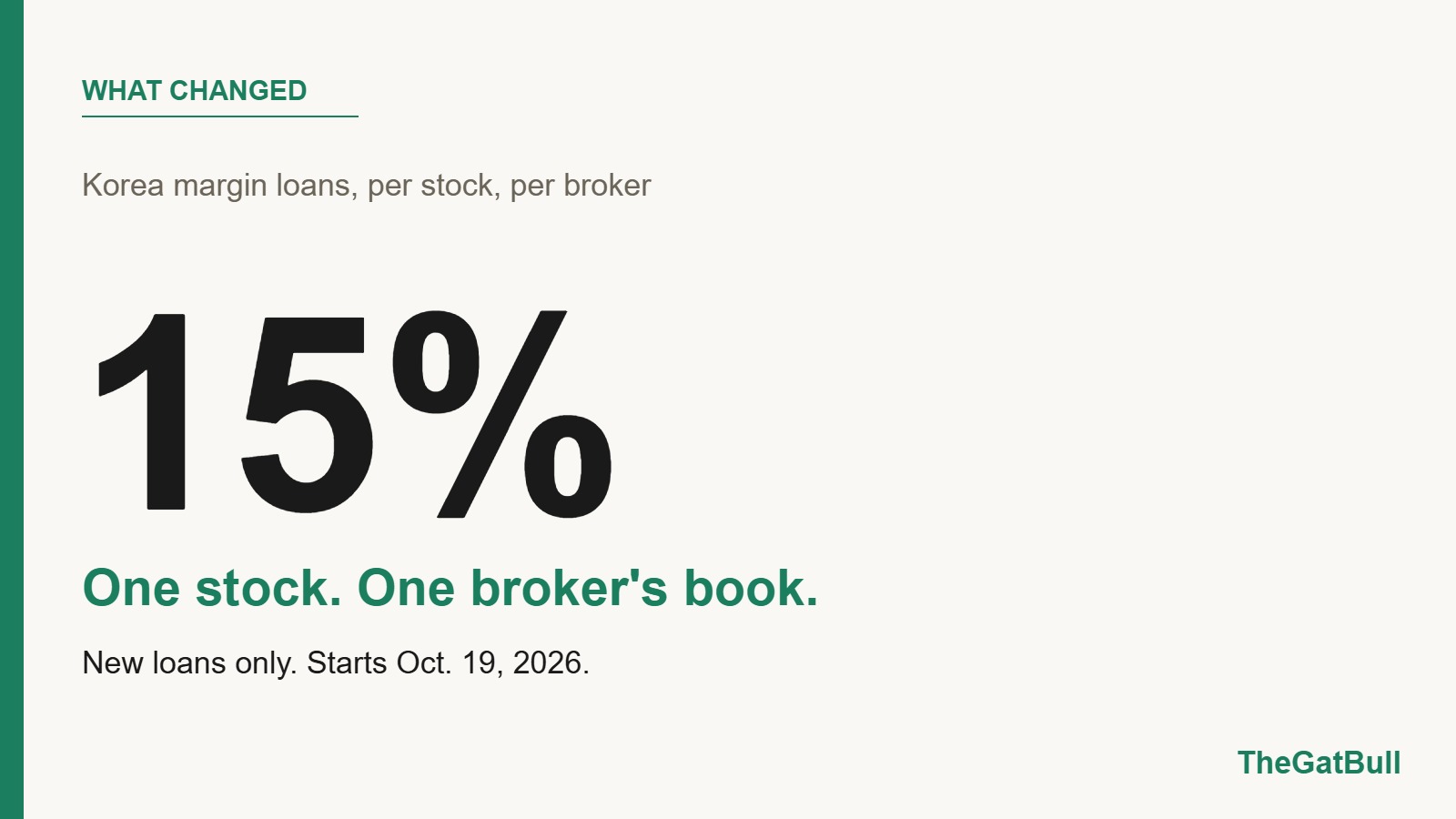
TL;DR — If you hold EWY. Starting Monday, Oct. 19, Korean brokers will put extra limits on new margin loans in any stock whose share of the broker’s total margin lending is above 15%. It is a self-imposed industry rule, not a law, and it applies only to new loans. About 40% of margin lending on Korea’s main board sits in two stocks, Samsung Electronics and SK hynix, the same two that make up 46.49% of EWY.
Not financial advice.
Is Korea limiting margin loans on individual stocks? Yes, starting Oct. 19, through its brokers.
On Sept. 23, the Korea Financial Investment Association (the brokers’ industry body) and ten of Korea’s largest brokerages announced that each firm will separately manage any stock whose margin loans exceed 15% of that firm’s total margin lending. On Sept. 29, Lee Chan-jin, governor of the Financial Supervisory Service (FSS, Korea’s market supervisor), told the heads of 23 brokerages to “strictly comply” with it (press-reported). It is not a law. It covers new loans only; existing loans are left alone. And measured across the whole market, the 15% line sits just above where Samsung Electronics and SK hynix already are.
What this means if you hold EWY. Roughly 40% of the debt Korean retail investors use to buy stocks on the main board (as of Sept. 21, press-reported) sits in the same two names that make up 46.49% of EWY 🟢 (iShares, as of Sept. 30; see how EWY’s weights stack up). After Oct. 19, new borrowed money flowing into those two stocks may slow. It is not forced selling. It is a brake on new inflows.
Dollar conversions are for scale only, at the Oct. 7 Seoul 15:30 rate of ₩1,340.4 per dollar (press-reported). Stock and index prices are KRX regular-session closes (15:30 Seoul time).
What changes: three rules, three dates
| Measure | What it does | Starts |
|---|---|---|
| Firm-wide cap | Total credit extended (margin loans included) kept within 90% of each broker’s equity, down from the 100% legal ceiling | Oct. 1 (in effect) |
| Single-stock cap | If one stock’s margin loans exceed 15% of a broker’s total margin lending, the broker manages it separately (lower per-customer limits or a higher deposit). New loans only. A cut to 10% is under review for later this year | Oct. 19 |
| Minimum deposit | Raised from 45% to 50%: you must put in half the purchase price yourself to borrow the rest | Later this year, after system changes |
(Press-reported by Newspim, MTN and Nocut News on Sept. 23; we did not check the association’s own release.)
What’s a margin loan? Money a broker lends you to buy stocks, with the stocks as collateral. In Korea it’s nicknamed bitt-u (“investing with debt”).
Why now: the balance doubled, and it bunched up
- Industry-wide margin lending rose from about ₩17 trillion (May 2025) to more than ₩33 trillion (September 2026), roughly $12.7 billion to $24.8 billion (Nocut News, press-reported).
- As of Sept. 21: about ₩4.9 trillion each in Samsung Electronics and SK hynix, about ₩10 trillion together (about $7.5 billion), roughly 40% of about ₩25 trillion in margin lending on KOSPI, Korea’s main stock market and index (Nocut News, press-reported).
- As of Sept. 28: Samsung Electronics ₩4.6 trillion (about $3.4 billion) and SK hynix ₩4.2 trillion (about $3.1 billion), each more than double the start of the year (The Daily Money, press-reported).
- Local media link the jump in these two stocks’ margin balances to the launch of single-stock leveraged ETFs (funds that magnify one stock’s daily moves) in May (press-reported; we have not confirmed the launch date from a primary source).
For how margin debt looked at an earlier low point, see Was 7,200 the KOSPI Bottom?
Two sides, fairly
The regulators and brokers. “Margin loans concentrated in specific stocks are a cause of market crowding and volatility,” Governor Lee said on Sept. 29 (as quoted by the media). The association said it was tightening “while market conditions are relatively stable.” In the authorities’ framing, stocks bought with borrowed money can trigger forced selling when prices fall: the broker sells the customer’s shares because the collateral is no longer enough, and that selling can push the price down further. The more crowded the stock, the shorter that loop.
Retail investors. The rule limits new borrowing in two stocks that many Korean retail investors hold heavily. Because existing loans are untouched, early borrowers are fine and only later ones get squeezed. And because 15% is measured against each broker’s book, the limit for the same stock on the same day can differ depending on which broker you use.
Under the Gat (our take). “This doesn’t ban borrowing to buy stocks. It changes who gets served first. After Oct. 19, someone who wants a new loan to buy Samsung or SK hynix may get a smaller amount or a higher deposit requirement, depending not on their own credit but on how full their broker’s book already is with that stock. The number worth watching isn’t the rule. It’s whether these two stocks’ margin balances start to shrink, and whether the line moves to 10%.”
Where exactly is the 15% line?
A rough calculation across the whole market (the dates of the figures differ, so treat these as approximate):
- Samsung Electronics: ₩4.6 trillion ÷ ₩33.3 trillion ≈ 13.8%
- SK hynix: ₩4.2 trillion ÷ ₩33.3 trillion ≈ 12.6%
So, on the industry average, both sit just under 15%. The rule bites not on the average but on individual brokers whose books lean more heavily into these two stocks. Which brokers are over the line has not been disclosed (none that we could find). This is our own arithmetic, not an official statistic: it divides by the whole market’s total, not by any single broker’s book.
If the line is lowered to the 10% under review for later this year, both stocks would be above it on the same market-wide math.
Has it worked? Too early to say. The single-stock rule hasn’t started, and there is no data from after Oct. 19 yet. The two stocks’ balances did fall between Sept. 21 and Sept. 28, but that was before the rule took effect, so we can’t credit the rule for it.
Meanwhile, the market: sequence only, no cause
| Seoul close, Wed., Oct. 7 | Close | Change |
|---|---|---|
| KOSPI | 6,803.90 | −1.98% (closed essentially at the day’s low of 6,803.81) |
| KOSDAQ (Korea’s growth-company market) | 898.43 | −2.34% |
| Samsung Electronics (005930 🔴) | ₩268,500 (≈$200) | −1.29% (closed at the day’s low) |
| SK hynix (000660 🔴) | ₩1,723,000 (≈$1,285) | −2.82% (closed at the day’s low) |
On KOSPI, foreigners net sold about ₩2.61 trillion and individuals net bought about ₩2.56 trillion (Maeil Ilbo, press-reported, single source). Before that, in the U.S. session of Tuesday, Oct. 6, which ended before Seoul opened, EWY closed at $186.40 (−2.64%) and SKHY, the SK hynix ADR (a U.S.-listed receipt for the Korean shares), at $182.56 (−6.39%).
We don’t explain Wednesday’s drop with the margin rules or with forced selling. We don’t have forced-selling data. Local media pointed to oil prices, U.S. long-term interest rates, and caution ahead of Samsung Electronics’ third-quarter preliminary results (an early earnings estimate the company publishes) due Oct. 8 (press-reported). Two things happened in the same week. That’s as far as we go.
What this rule shows about Korea’s market
In this case, the tool that tightens market leverage arrived as an industry self-regulation plus a public request from the supervisor, not as a change in the law. The dates (Oct. 1, Oct. 19, later this year) were public in advance. The rule names no stock, though press reports point to the two that make up nearly half of EWY. (The governor’s earlier comments on rising margin debt appear in our earlier piece on Seoul’s bond and tax moves.)

Under the Gat. “Foreign index money and Korean retail debt are stacked on the same two names. On a day those two fall, part of the selling can come from retail collateral, not from funds. Korea’s regulators are trying to shorten that loop before it’s tested.”
How the U.S. compares
In the U.S., the Federal Reserve’s Regulation T (the rule on how much you can borrow to buy stocks) sets an initial margin of 50%, and brokers add their own higher “house” requirements on accounts concentrated in one stock. Korea’s planned 50% minimum deposit would match Reg T on the headline number.
Not a perfect parallel: U.S. brokers look at how concentrated a customer’s account is. Korea’s new 15% rule looks at how concentrated the broker’s whole book is. The subject is the broker, not the customer, so the same customer could face a different limit at a different broker.
Access: EWY (NYSE Arca) and SKHY (Nasdaq 🟢) trade in U.S. accounts; Samsung Electronics and SK hynix shares trade on the KRX (Korea Exchange), which some brokers (for example, IBKR) reach directly. Korea’s domestic margin rules don’t apply directly to EWY or ADRs bought in a U.S. account; any effect comes indirectly, through the Korean share prices.
What to watch
- Oct. 19 (Mon.): the single-stock rule starts, for new loans.
- Later this year: the 50% minimum deposit, once systems are ready.
- Later this year: whether the 15% line is cut to 10%.
- The two stocks’ margin balances: about ₩4.9 trillion each on Sept. 21, then ₩4.6 trillion and ₩4.2 trillion on Sept. 28. Do they keep falling?
The bottom line
The Oct. 19 rule doesn’t stop borrowing to buy stocks. It is designed to slow new borrowing in crowded stocks, broker by broker. It starts Oct. 19, so it is too early to say whether it works. On the industry average, Samsung and SK hynix both sit just under 15%; a cut to 10% would put both above the line. For an EWY holder, the thing to watch is the direction of those two stocks’ margin balances, not the wording of the rule.
FAQ
Did Korea ban margin trading?
No. Brokers will put extra limits on new margin loans in any stock that is more than 15% of their margin book. It’s a self-imposed industry rule, not a law, and existing loans aren’t covered.
When does Korea’s single-stock margin limit start?
Oct. 19, 2026. The firm-wide 90% cap started Oct. 1, and the 50% minimum deposit is planned for later this year.
Is it only about Samsung Electronics and SK hynix?
The rule doesn’t name any stock. But by press accounts those two make up about 40% of margin lending on KOSPI, so press reports name them as the most exposed.
Does it apply if I buy EWY or SKHY on margin in the U.S.?
No. It’s a rule for Korean brokers’ domestic margin loans. U.S. accounts follow Reg T and U.S. broker rules.
Sources
- Newspim, “Securities industry strengthens self-management of margin loans” (Sept. 23); MTN (Sept. 23); Nocut News (Sept. 23).
- SBS Biz, FSS governor Lee Chan-jin’s remarks (Sept. 29); The Daily Money (Sept. 29).
- KRX closes: Yahoo Finance chart data (^KS11, ^KQ11, 005930.KS, 000660.KS, vendor data); EWY and SKHY: U.S. session of Oct. 6.
- Won rate and investor flows: Businesskorea, Maeil Ilbo (Oct. 7).
- EWY weights: iShares EWY holdings, as of Sept. 30.
How sure are we?
| Item | Confidence |
|---|---|
| The three rules and their dates | Press-reported by three outlets; not checked against the association’s own release |
| Governor Lee’s request | On the record, quoted by the media |
| Margin balances | Press-reported; the dates of the figures differ |
| 13.8% and 12.6% | Our own arithmetic on market-wide totals, not an official statistic |
| KRX, EWY and SKHY prices | Computed from vendor price data (Yahoo), KRX closes |
| Investor flows | Press-reported, single source |
Ticker key. 🟢 US-listed — buy in a US brokerage. 🔴 Seoul-listed only — no US ADR; watch, not buy directly.
Not financial advice. TheGatBull is an independent publication; nothing here is a recommendation to buy or sell any security.
 Written by Mr.Gat — TheGatBull
Korean market coverage from a Seoul-metro-based operator who reads the filings in the original language. Every price on this site is the KRX regular-session close (15:30 Seoul); every figure states whether it came from a primary filing, the press, or our own calculation. Drafts are AI-assisted, then verified against the original Korean documents and edited by a human before publishing.
Found an error? Tell us — corrections get priority. How we work →