This article is for informational purposes only and is not financial advice. TheGatBull may earn a commission from some links at no cost to you — see our disclosure and full disclaimer.
This is not financial advice — a view from Seoul, not a recommendation to buy or sell anything. (All prices are Korea Exchange regular-session closes at 3:30 p.m. KST on the date given. Dollar conversions use the August 7 Seoul close of ₩1,416.1/$. Where a figure belongs to a US-listed instrument, it is labeled by US trading day, which ends hours after Seoul’s.)
The one-paragraph answer. An American account reaches Korean chips mainly two ways: a Korea ETF, or the SK Hynix ADR. Either way, the same two names dominate — Samsung Electronics and SK Hynix — and most English-language commentary handles them in a single phrase, “Korean memory names.” On Friday, August 7, 2026, the Seoul session cut that phrase in half. Samsung Electronics closed up 0.22% at ₩231,000 (~$163.12). SK Hynix closed down 4.88% at ₩1,422,000 (~$1,004.17). Same day, same index, same industry — a 5.10-percentage-point gap, with the signs opposite, while the KOSPI itself slipped 0.60% to 6,258.77. This piece is not about why one stock moved. It is about what the split shows: that the diversification sold as “Korea” rests on two companies staying correlated, and this week they stopped.
What this means if you hold EWY or a Korea ETF. These two names were about 50% of the iShares MSCI South Korea ETF as of June 30, and roughly 41% a month later — so their correlation, not the index, is what actually sets your risk. When they move together you own one bet twice; when they split, as they did Friday, you own two bets you never chose separately.
1. The conventional wisdom: one trade, two tickers
The English-language shorthand for Korean memory runs like this. Both make DRAM and NAND — the two main kinds of memory chip — and both supply HBM, the stacked high-bandwidth memory that sits next to an AI accelerator and feeds it data. Both ride the same memory cycle. Both list on the same exchange with the same won exposure. Know one, know the other — SK Hynix is just “leveraged Samsung.”
That view has evidence behind it, so this piece does not throw it out. It tests where it holds and where it breaks, using five sessions of closing prices.
2. The data: the first five sessions of August
| Date | Samsung Electronics | SK Hynix | Gap (pp) |
|---|---|---|---|
| Aug 3 (Mon) | −8.76% | −8.79% | −0.03 |
| Aug 4 (Tue) | +0.21% | +0.64% | +0.43 |
| Aug 5 (Wed) | +2.50% | +5.77% | +3.27 |
| Aug 6 (Thu) | −6.30% | −10.37% | −4.07 |
| Aug 7 (Fri) | +0.22% | −4.88% | −5.10 — signs opposite |
Korea Exchange regular-session closes. Since 2025 Korea has had a second venue (Nextrade) trading the same stocks, so combined figures also exist; this piece uses exchange-only data so nothing in one table is measured two ways.
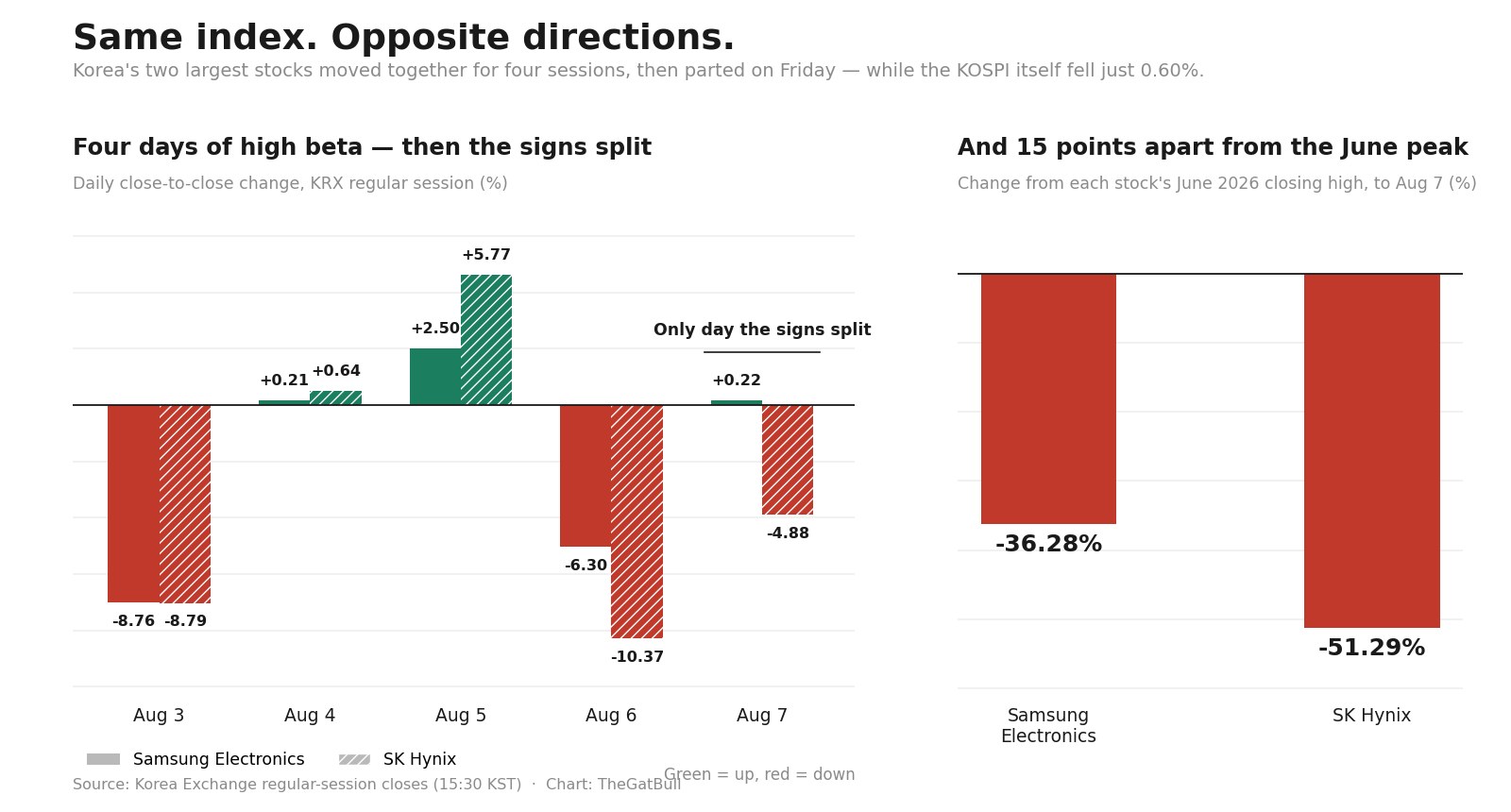
The first four days match the conventional wisdom exactly. Same direction, different size. SK Hynix moved more in both directions — 2.3× Samsung’s gain on the 5th, 1.6× its loss on the 6th. That is textbook high beta — beta being the shorthand for how much a stock amplifies the market’s move. A beta above 1 means bigger swings in the same direction.
Friday is a different animal. The signs diverged. High beta and directional divergence are not the same event: beta means “reacts harder to the same news,” divergence means “that news was different news for the two companies.”
🎩 Under the Gat — One line for the week: on Friday, Seoul split the word “memory” into two words. High beta and a directional split are not the same event, and reading Friday as more of Thursday is how you end up holding a position you never sized.
Cumulatively the gap is wider still. Over the five sessions from July 31, Samsung fell 12.00% and SK Hynix 17.23%. Measured from each stock’s June closing high — Samsung ₩362,500 (~$256) on June 18, SK Hynix ₩2,919,000 (~$2,061) on June 22 — the two sit 36.28% and 51.28% below, about 15 percentage points apart. Those are closing highs, not intraday.
One caveat on the starting line. Korea caps how far a stock may move in one session at ±30%, and on July 31 SK Hynix finished pinned at that ceiling, up 29.95% — a “limit-up” close. That price was set by the rule rather than by the last willing buyer, so August’s decline starts from an inflated base.
3. The industry backdrop: one cycle, two exposures
Both companies sit in the same memory upcycle. What differs is how much of each company that cycle touches — and the clearest measure of that is how differently the same twelve months treated them.
SK Hynix (KRX: 000660 / NASDAQ: SKHY) is the more concentrated bet: its earnings and its share price key off one product line and a small set of customers. That shows up as amplitude in both directions. Even after a 51.28% fall from its June closing high, the stock is up 118.4% year to date, measured from the December 30, 2025 close of ₩651,000 (~$460). A halving and a doubling belong to the same stock in the same year.
Samsung Electronics (KRX: 005930) carries memory alongside a contract chip-manufacturing arm (foundry), its own chip-design unit, displays and phones. The same HBM headline arrives diluted. This is why “leveraged Samsung” is the wrong metaphor: leverage is a multiple, and a multiple does not change sign.
You could see the same split in Friday’s sector tape. Electrical and electronics fell 1.29% — while chemicals rose 4.37%. The index only slipped 0.60% because the money rotated into batteries, defense and banks rather than leaving. A quiet index print can hide a loud day underneath.
4. Where policy touches the price
That ±30% ceiling is worth one more sentence, because it is where Korean policy actually touches an American’s return. It changes neither revenue nor margin — it changes the printed price, and therefore the base every percentage in this piece is measured from. A US investor reading a Korean daily move is reading a number that has already passed through a rulebook. Why that matters for leveraged positions is dissected in our piece on intervention and leverage and the margin-debt breakdown.
🎩 Under the Gat — A Korean daily move is a number that has already passed through a rulebook. Before you compare it to anything on a US tape, ask whether the price stopped because buyers stopped — or because the exchange said that was far enough for one day.
5. What actually split them on Friday
The reason circulating in Seoul was a single report: Nvidia is said to be weighing a lower HBM specification for Rubin Ultra, its next-generation AI accelerator. A lower spec means each unit needs less of the premium memory, or a cheaper grade of it — and since HBM carries the fattest margins in the memory business, that lands on the supplier’s price, not just its volume.
How strongly this is confirmed matters here. That reading came from a Daishin Securities analyst quoted by two Korean outlets. It is an analyst’s interpretation of a market report — not a confirmation from Nvidia, and not a statement from SK Hynix.
Why the same headline lands unevenly, though, is a structural question — independent of whether the report proves out. Both companies make HBM; they do not depend on it equally, and they do not depend on the same customers equally. Leadership in a product is a premium on the way up and a beta on the way down.
Flows pointed one way all session: foreigners were net sellers, while individuals and institutions were net buyers, holding the index up. The reported won amounts are available, but the exchange basis was not specified in either report — whether Korea Exchange alone or combined with the alternative venue — so only direction is used here.
6. Where the conventional wisdom holds
| Claim | Verdict | Evidence |
|---|---|---|
| Same cycle | ✅ Holds | Aug 3: −8.76% vs −8.79% |
| Same currency exposure | ✅ Holds | Both settle into the same ₩1,416.1/$ Seoul close |
| Both dominate the index | ✅ Holds | Roughly half of KOSPI market cap combined (51.22%, July 31) |
| “SK Hynix = leveraged Samsung” | ⛔ Breaks | Aug 7 signs opposite — leverage is a multiple, not a reversal |
| Same drawdown | ⛔ Breaks | −36.28% vs −51.28% from June closing highs |
| Same year | ⛔ Breaks | SK Hynix is still up 118.4% year to date, from the Dec 30, 2025 close of ₩651,000 (~$460) |
7. What this says about the Korean market
When an American buys “Korea,” the product being sold is diversification — a country, an index, a basket. But in the iShares MSCI South Korea ETF, SK Hynix and Samsung Electronics were 27.17% and 23.19% as of June 30, 2026 — about half the fund in two names, per the iShares fact sheet. A month later, on July 30, the pair sat near 41% — and Samsung, not SK Hynix, was the larger of the two.
Read those two snapshots together and something specific emerges. Concentration fell from roughly 50% to 41% in a month — but not because the fund diversified. It fell because the two largest holdings dropped. In a market this top-heavy, the concentration statistic improves when the market gets worse.
Which sets up the real dependency. If those two names are half your Korea position, then your diversification is not a function of how many stocks the fund holds — it is a function of whether those two keep moving together. For four sessions they did, and the fund behaved like one bet. On the fifth they did not, and the fund quietly became two. One limit on that reading: the evidence here is five sessions, August 3–7, 2026. This is not a claim that the split is unprecedented. Nothing in the index level told you which regime you were in: Friday’s KOSPI print was −0.60% — a quiet number sitting on top of the widest single-day gap of the week.
And this is not an artifact of one AI cycle. Two snapshots a month apart both show two companies holding somewhere between two-fifths and one-half of a fund marketed as a country. That is the standing shape of the market, not a phase of it.
It also tells you who is standing on the other side of your trade. When foreigners sold on Friday, the buyers were domestic individuals — a group large enough in Korea to have its own name, the donghak gaemi (“ant army”), and large enough that where their money goes moves these two stocks. We tracked those flows in the donghak and seohak piece.

🎩 Under the Gat — The lesson is not that one chipmaker had a bad Friday. It is that “Korea” is a label wrapped around a correlation, and a correlation is a thing that can stop. When the index is quiet and the two halves of it are pulling apart, the index is not telling you the truth — it is averaging it away. Watch the pair, not the print.
8. What to do differently, and what to watch
If you hold a Korea ETF — you hold these two companies heavily. Check the current weights on the fund provider’s own holdings page before sizing anything; they move every month, and third-party trackers lag.
When you read a headline — “Korean memory falls” needs one more question: which kind of news? HBM pricing and Nvidia supply-chain stories hit SK Hynix far harder. Broad cycle and macro stories move both.
Access differs, and it matters. SK Hynix trades on Nasdaq as an ADR (SKHY) — a US investor can hold it directly and separate it from the pair. Samsung Electronics (KRX: 005930) has no US exchange listing; an OTC line (SSNLF) exists but its practical tradability is unconfirmed, so US exposure is generally indirect — through a Korea ETF, or direct Korea Exchange access at brokers that offer it. Which means the two halves of this trade are not equally separable in an American account. Our route-by-route breakdown is in how to buy Korean stocks from the US, and the fund’s concentration is dissected in the EWY holdings piece.
The closest US parallel is AMD and Nvidia — same sector, same cycle, but one is far more levered to a specific customer and product, so the same headline lands differently. Not a perfect parallel: this is a comparison of structure, not of market position or profitability.
Three things to watch from here. Whether the Rubin Ultra specification report is confirmed by a primary source. Korea’s earnings season, which runs to a statutory deadline of August 14 — NAVER reported Friday with operating profit down 0.2% year over year and fell 7.08%. And the next EWY holdings update, which will show whether the pair’s weight kept compressing.
A note on the data
Dates and Korean market figures are on Seoul time; prices are Korea Exchange regular-session closes at 3:30 p.m. KST. Korea has run an alternative trading venue alongside the exchange since 2025, so combined figures exist for the same session; this piece uses exchange-only data throughout so that no two rows of a table are measured differently. Intraday levels are labeled as such and never mixed with closes.
Prices for the five sessions were cross-checked against two Korean outlets both citing Korea Exchange, and every figure was verified by reconciling against the prior session’s confirmed close. Fund weights come from the iShares fact sheet dated June 30, 2026 for the June figures, and from a third-party aggregator for July 30 — the latter is flagged in the text and remains unconfirmed against the fund provider’s own file.
Sources
- Korea Exchange — regular-session closes and sector indices (data.krx.co.kr)
- iShares MSCI South Korea ETF (EWY) — Fund Fact Sheet, June 30, 2026 (iShares)
- Etoday and Electronic Times, August 7, 2026 — session close reports, both citing Korea Exchange
- Money Today, August 7, 2026 — Seoul won close
- Daishin Securities analyst commentary on the Rubin Ultra HBM report, as quoted in Korean media
Disclaimer. This article is for information only. It is not financial advice, not a recommendation to buy or sell any security, and not a solicitation of any kind. Figures are drawn from exchange data, fund documents and Korean press reports as dated in the text; where sources disagree or remain unconfirmed, that is stated rather than resolved. Markets move and data gets revised — verify anything you plan to act on against the primary source. Do your own research and consider consulting a licensed professional in your jurisdiction.
Frequently Asked Questions
How did Samsung Electronics and SK Hynix close on August 7, 2026?
On Korea Exchange regular-session closes: Samsung Electronics ₩231,000 (~$163), up 0.22%; SK Hynix ₩1,422,000 (~$1,004), down 4.88%. The KOSPI closed at 6,258.77, down 0.60%, and the KOSDAQ at 798.81, down 0.36%. The won closed at ₩1,416.1 per dollar in Seoul at 3:30 p.m. This is not financial advice.
Why did SK Hynix fall while Samsung rose?
The reason circulating in the Seoul market was a report that Nvidia is considering lowering the HBM specification on its next-generation Rubin Ultra product, raising concern about memory pricing. That reading came from a Daishin Securities analyst quoted by two Korean outlets — it is not a confirmation from Nvidia and not a statement from SK Hynix. Structurally, SK Hynix carries far more direct HBM exposure.
Are Samsung Electronics and SK Hynix the same trade?
On cycle news, effectively yes — on August 3 they fell 8.76% and 8.79%, almost identically. On customer- or product-specific news, no. On August 7 the signs diverged, and measured from each stock’s June 2026 closing high the two are about 15 percentage points apart (−36.28% versus −51.28%). Not financial advice.
How much of the Korea ETF is these two stocks?
In the iShares MSCI South Korea ETF (EWY), SK Hynix was 27.17% and Samsung Electronics 23.19% as of June 30, 2026 — about 50% of the fund in two names, per the iShares fact sheet. Third-party data for July 30 shows the pair at roughly 41% with the order reversed. The fund tracks the MSCI Korea 25/50 Index, which caps how concentrated it may become.
Can US investors buy these stocks directly?
SK Hynix has traded on Nasdaq as an ADR (SKHY) since July 2026. Samsung Electronics has no US exchange listing; US exposure is generally indirect, through a Korea ETF or via direct Korea Exchange access at brokers that offer it. Verify the current routes with your broker. Not financial advice.
This article is for informational purposes only and is not financial advice. TheGatBull may earn a commission from some links at no cost to you — see our disclosure and full disclaimer.
 Written by Mr.Gat — TheGatBull
Korean market coverage from a Seoul-metro-based operator who reads the filings in the original language. Every price on this site is the KRX regular-session close (15:30 Seoul); every figure states whether it came from a primary filing, the press, or our own calculation. Drafts are AI-assisted, then verified against the original Korean documents and edited by a human before publishing.
Found an error? Tell us — corrections get priority. How we work →