Not financial advice. This page is informational and is not a recommendation to buy or sell any security.
SK Hynix has not yet announced its next earnings date. The pattern points to late October — the Q3 2025 release came on October 29 — but that is an expectation, not a confirmation (⚠️). The moment the filing lands, the table on this page changes first. That is what this page is for: the dates, ratios and numbers for SK Hynix (KRX: 000660 / NASDAQ: SKHY), fixed in one place and revised each quarter instead of rewritten from scratch every earnings day.
Under the Gat. For the past month, the English-language coverage of this company arrived on two kinds of days: earnings days and crash days. But a holder’s questions — when is the next report, is ten ADRs really one Seoul share, is there a dividend — arrive on all 365 days of the year. So instead of writing a new article every earnings day, I built the page that waits for the earnings day. Bookmarking is the intended use.
1. Where SKHY stands right now
Basis: closing prices from the KRX main session on Wednesday, September 23, 2026 (15:30 Seoul) — the last session before the Chuseok holiday. Conversions at ₩1,358.4 per dollar, the 15:30 Seoul FX close on the same day.
| Measure | Value | Basis |
|---|---|---|
| Seoul common shares, Sep 23 close | ₩1,862,000 (~$1,371) · +1.20% | ✅ Confirmed KRX close |
| Previous session, Sep 22 | ₩1,840,000 · −1.50% | ✅ Confirmed KRX close |
| Week (Sep 18 → Sep 23, three sessions) | +0.27% | ✅ Confirmed close to close |
| Year to date (from ₩651,000 on Dec 30, 2025) | +186.02% (in won) | ✅ Confirmed closes |
| ADR close, US session Sep 23 | $189.28 · −3.12% (from $195.37 on Sep 22) | ✅ Confirmed Nasdaq close — a US trading day, which does not end when Seoul does |
| ADR close, US session Sep 24 | $186.37 · −1.54% | ✅ Confirmed Nasdaq close — Seoul was closed that day; shown for reference |
| ADR premium, Sep 23 closes | about +38.1% | Calculated — formula and caveats in §3 |
Seoul was closed for Chuseok on Thursday, September 24 and Friday, September 25. With the weekend, that is four straight days without a session, and trading resumes Monday, September 28. So the latest Seoul close on this page is September 23, the last session before the holiday.
Three ways to own SK Hynix from the US. (1) The Nasdaq ADR, SKHY, where one receipt is one tenth of a Seoul share. (2) Indirectly, through a Korea ETF such as EWY, where SK Hynix is the largest holding at 24.54% (iShares, as of September 18, 2026). (3) The Seoul common shares, KRX: 000660, through a broker with Korea Exchange access. The three trade in different currencies, on different clocks and at different prices, and that gap — the premium in the table above — is wider now than it was on July 31 (see §3). The full side-by-side comparison is in How to Buy SK Hynix Stock From the US.
2. The earnings calendar
| Quarter | Date | Status |
|---|---|---|
| Q3 2026 | Not yet announced — late October expected (Q3 2025 was Oct 29) | ⚠️ Expectation, not confirmed. This row updates when the filing appears. |
| Q2 2026 | Wednesday, July 29 — results and conference call together | ✅ Done |
| Q1 2026 | April 22 | ✅ Done |
A scheduling note that matters if you are setting alarms in North America: Samsung Electronics splits its reporting into a preliminary release and then full results, but SK Hynix delivers results and the conference call in a single event. A morning call in Seoul is the previous evening on the US East Coast. How the Korean earnings season is sequenced overall is broken down in SK Hynix’s first earnings report and how Korean earnings season actually works.
Last quarter’s scorecard
| Metric | Q2 2026 | Q1 2026 | Q2 2025 (YoY) |
|---|---|---|---|
| Revenue | ₩79.32tn (~$55.5B) | ₩52.6tn | ₩22.2tn (+257%) |
| Operating profit | ₩60.54tn (~$42.3B) | ₩37.6tn | ₩9.2tn (+557%) |
| Operating margin | 76% | 72% | 41% |
✅ Company-reported figures (SK hynix Newsroom, Q2 2026 results).
Record results, and the stock fell afterwards. Operating profit came in 4.7% below the ₩63.55tn consensus, and the reason was not demand — it was timing on some HBM4 shipments. The full dissection is in record earnings, consensus miss; what the market expected going in is in the Q2 expectations checkpoint.
3. The ADR math: ten receipts make one share
One common share = 10 ADSs. A single SKHY receipt on Nasdaq represents one tenth of a Seoul share. The Nasdaq debut was July 10, 2026 — the largest ADR IPO on record, and the listing structure is taken apart in the SKHY IPO prospectus breakdown. Two-way conversion between common shares and ADRs opened on July 29, capped at 2.5% of shares outstanding.
The premium formula — the standing tool on this page:
Seoul close (KRW) / 10 / USDKRW  =  converted value of one ADR ($)
ADR market price / converted value - 1  =  premium (+) or discount (-)
Run on July 31: ₩1,718,000 / 10 / 1,424.0 (that day’s 15:30 Seoul FX close, not today’s) = $120.65. Against an ADR close of $143.73, that is a +19.1% premium. Some outlets reported 20.7% for the same day; back out their arithmetic and they used an FX print of roughly ₩1,443, from a different moment in the day. The number is only as good as the timestamp on the exchange rate.
Why July 31 flatters the premium
There is a wrinkle in that 19% that only appears if you look at the raw daily data instead of the headline, and it is the most useful thing on this page.
Seoul’s July 31 close was a limit-up. Korean shares cannot move more than 30% in a single session. SK Hynix closed +29.95% and stopped — not because the buying stopped, but because the exchange stops it there. The ADR has no such limit.
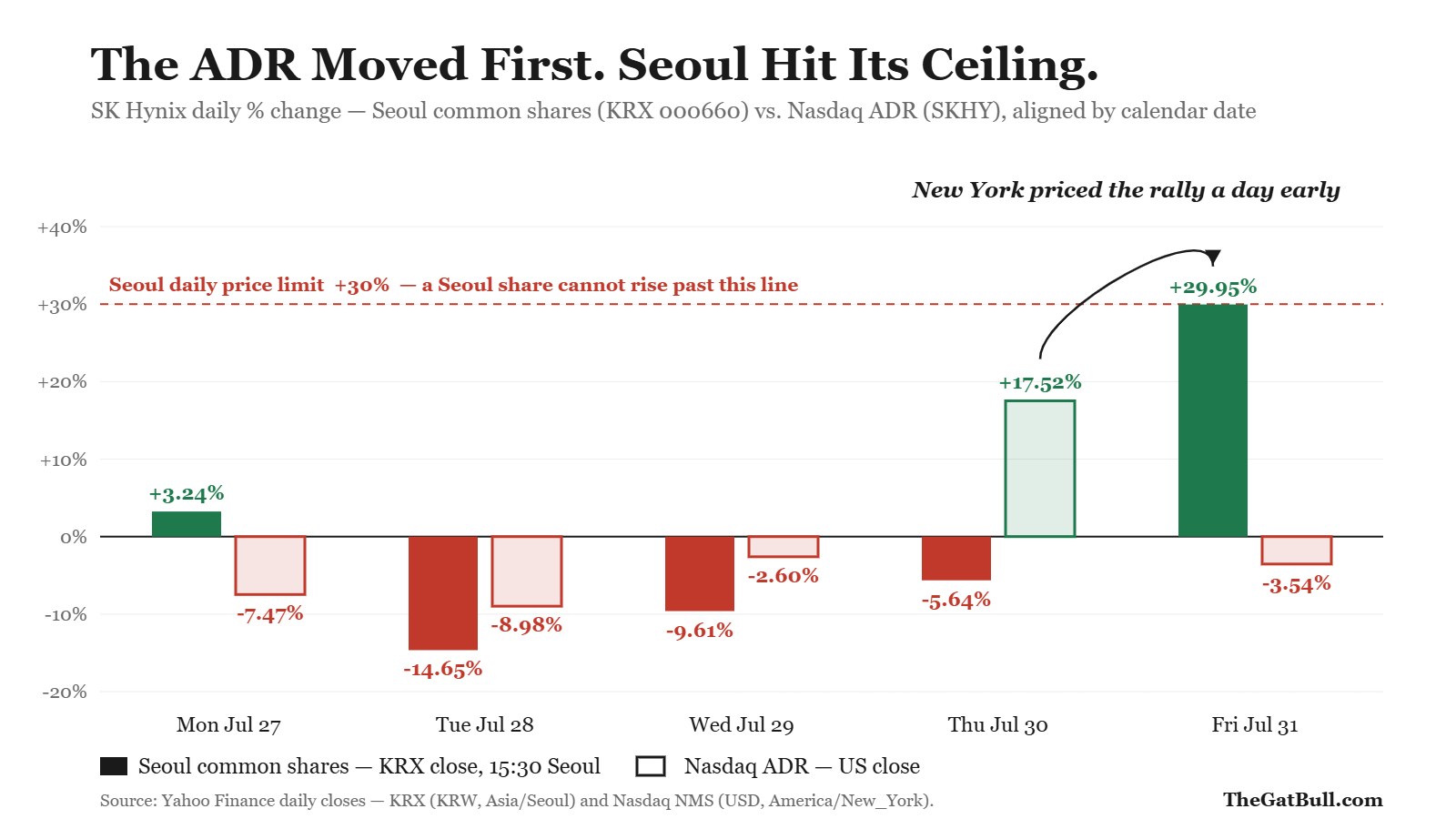
Now note when each market moved. New York’s big day was Thursday, July 30: the ADR rose +17.52% while Seoul was still falling that same calendar day (−5.64%). Seoul’s turn came on Friday, and it ran straight into the ceiling. So by Friday’s closing bell you were comparing an ADR that had already had its rally against a Seoul price that had been capped on the way up.
That is part of what the +19% is measuring. Not all of it — a structural premium was there from the start (Reuters put the initial premium at 25.6% at the debut) and it comes from genuinely scarce ADR supply. But the day you choose changes the answer, and July 31 is a day when the denominator was held down by a rule rather than by the market.
Under the Gat. A 19% premium is the price tag on the phrase “I can buy it in my US brokerage account.” With the conversion window narrow (2.5%) and American demand concentrated, that markup can persist. Whether convenience is worth it is your call — but calculate what you are paying before you pay it. The formula above is the calculator. And run it on a quiet day, not on a limit day.
July already produced a live demonstration of why this matters: the premium compressed from 38% to 22% and ADR holders took an extra 15 percentage points of loss that Seoul holders never saw. That episode is logged in the ADR premium versus Seoul shares. The premium is an independent variable in your return.
An ordinary day: September 23
The same formula on a day with no price limit in play: ₩1,862,000 / 10 / 1,358.4 (the September 23 15:30 Seoul FX close) = $137.07. Against an ADR close of $189.28 that day, the premium is +38.09%.
Compare the conditions, not just the numbers. July 31 (+19.1%) was a limit-up day — the kind of day that flatters the premium. September 23 (+38.1%) was an ordinary session with no price limit touched, and the premium was nearly twice as large. Take the limit-up out of the picture and the gap does not shrink. It is wider.
Two labels stay attached to this number. It is not a figure published by iShares or SK Hynix; it is our own calculation, combining three sources: the KRX close, the Seoul FX close and the Nasdaq close. The exchange rate is the September 23 15:30 Seoul close from a single outlet (Money Today); with Seoul closed on September 24 and 25, there is no newer Seoul FX close, so the same rate carries over. And we did not source why the premium widened. This page reports what widened, not why.
4. Shareholder returns — current status: undecided
- Dividend and buyback policy: the company has said it will disclose one during 2026 ✅ (stated at the Q2 release). Timing, size and form are all still open.
- The firepower: cash and equivalents of ₩88tn (~$61.5B), net cash of ₩69.4tn (~$48.5B) ✅ (company-reported, end of Q2).
- One analyst view: a large shareholder-return announcement from Samsung Electronics and SK Hynix is possible during Q3 (KB Securities — ⚠️ an analyst opinion, not company guidance).
This section updates when a policy is announced. Until then, any “SKHY dividend yield” figure a search engine hands you is an estimate of something that does not yet exist. Korean withholding tax on dividends for US-based holders is a separate subject and is not covered on this page.
5. SKHY inside the index: where diversification already ended
Samsung Electronics and SK Hynix together account for roughly half of the KOSPI’s market capitalisation — 51.22% at the July 31 close, per KRX. When two stocks are half the index, buying the index is not diversification; it is a two-stock position with extra steps. That is true on the way up and it was visible on August 3, when the two names (−8.76% and −8.79%) dragged the index (−5.12%) down with them.
Korea has a word for a stock with this kind of standing: gungmin-ju, the national stock. The status brings flows with it — a changing of the guard among buyers on surge days, index-wide moves on decline days. For a company like this, single-stock analysis and index analysis stop separating cleanly.
If you want a comparison anchor from a US listing, it is Micron (NASDAQ: MU) — the other half of the HBM duopoly, and reachable from a US brokerage account without any of this. In the week of July 24–31, MU fell 10.6% while SK Hynix fell 2.33% in Seoul. Not a perfect parallel: Micron is a single US-listed ticker, while SK Hynix’s Seoul common shares are the primary security and the ADR is a derived form of access carrying a premium that expands and contracts on its own.
Inside EWY. In the iShares MSCI South Korea ETF (EWY), SK Hynix is the largest holding at 24.54%, ahead of Samsung Electronics at 21.97%. Together, the two are 46.51% of the fund (iShares, as of September 18, 2026).
6. Risks this page watches
- One accounting footnote moves half the valuation. Q2 net income of ₩93.92tn (~$65.7B) includes ₩63.3tn of gains on investment assets (⚠️ per FactSet compilation). A good part of why the headline P/E looks cheap lives in that line.
- HBM4 shipment timing. The cause of the Q2 miss and the swing factor for the second half. “Orders increased” has moved this stock less than “when did it ship.”
- Long-term agreements cut both ways. Roughly ten customers on typically five-year contracts with deposits and protective clauses. Volume risk falls; upside from spot price spikes can be capped. Capex is also going up, from ₩30.2tn towards the high ₩40tn range — if large cloud customers trim spending, that build-out becomes a liability.
- Structural risk. Chinese memory competition, the trigger for July’s decline, plus the leveraged products now attached to this name. From August 3, Hong Kong funds linked to SKHY reportedly introduced variable leverage that cuts daily exposure from 2.0x to as low as 1.1x in volatile stretches (⚠️ press-reported, not confirmed from a primary source).
- The volatility itself. A stock where −35% in a month, +29.95% in a day and −8.79% the next day all coexist.
Under the Gat. A ₩94tn net income headline, with ₩63tn of investment gains sitting inside it — two people can look at the same P/E and reach opposite conclusions depending on whether they know that. If you take one thing from this hub, make it that footnote rather than the margin or the price target. Look at where the number came from, not just the number.

How to use this page
When the next earnings date is confirmed — not announced yet, late October expected — §2 updates first. Before you buy the ADR, put today’s exchange rate into the formula in §3 and see what premium you are paying. When a shareholder-return policy lands, §4 changes. The rest of the time, the five lines in §6 are the actual watchlist for this company. The news comes on earnings days. This page covers the gaps in between.
FAQ
When is SK Hynix’s next earnings date?
The Q3 2026 date has not been announced as of September 25, 2026. Late October is the pattern — Q3 2025 was reported on October 29 — but that is an expectation, not a confirmation. Section 2 of this page updates when the filing appears.
How many SKHY ADRs equal one Seoul share?
Ten. One common share equals ten ADSs. Two-way conversion has been available since July 29, 2026, capped at 2.5% of shares outstanding.
Does SK Hynix pay a dividend?
There is no confirmed shareholder-return policy. The company has said it will disclose one during 2026. Any yield figure circulating before that announcement is an estimate of a policy that does not yet exist.
Why is the SKHY ADR more expensive than the Seoul shares?
ADR supply is limited relative to US demand, because new issuance is restricted and conversion is capped at 2.5%, so access carries a markup. On July 31, 2026 closing prices the premium was about 19%. Note that Seoul closed at its 30% daily price limit that day, which holds the comparison price down and flatters the premium. On September 23 closes — an ordinary session with no price limit touched — it was about 38%. The figure changes daily.
Can I compute the ADR premium myself?
Yes. Divide the Seoul closing price in won by 10, divide again by the won-dollar rate at the Seoul 15:30 close, and compare the result with the ADR price. Use the exchange rate from the same moment as the share price, or the answer will be wrong by a percentage point or more.
Sources
September 2026 update: KRX regular-session closes for 000660 and Nasdaq closes for SKHY (Yahoo Finance chart data, Sept 18–24, 2026) · Seoul 15:30 FX close, Money Today, September 23, 2026 · iShares EWY holdings, as of September 18, 2026.
- SK hynix Newsroom — 2Q26 financial results (primary): news.skhynix.com
- SK hynix investor relations via IRGO (primary): m.irgo.co.kr/IR-COMP/000660
- Yahoo Finance — daily closes for 000660.KS (KRX, KRW, Asia/Seoul) and SKHY (Nasdaq NMS, USD, America/New_York)
- Money Today, August 3, 2026 — market close report citing KRX
- Asia Economy / Herald Economy / News1, August 3, 2026 — FX close at 15:30 Seoul (three outlets, in agreement)
- Reuters, July 28, 2026 — SK hynix Q2, consensus miss and long-term agreements
Not financial advice. TheGatBull does not recommend buying or selling any security. All figures are stated as of the basis dates given above; investment decisions and their consequences are your own.
 Written by Mr.Gat — TheGatBull
Korean market coverage from a Seoul-metro-based operator who reads the filings in the original language. Every price on this site is the KRX regular-session close (15:30 Seoul); every figure states whether it came from a primary filing, the press, or our own calculation. Drafts are AI-assisted, then verified against the original Korean documents and edited by a human before publishing.
Found an error? Tell us — corrections get priority. How we work →