
TL;DR — If you own Korean stocks, directly or through a fund such as EWY. Korea’s new “15% per stock” rule on margin lending (money brokers lend customers to buy stocks) took effect on Oct. 19, and three sessions in, it looks less like one rule than a list of broker-by-broker hurdles for buying Samsung Electronics and SK hynix with borrowed money. Margin debt was already falling before it took effect (about 6% from Oct. 12 to Oct. 16), and by Oct. 20 the market-wide total was down about 11% in six sessions.
Your Door — what to check if you hold Korean stocks or EWY. For EWY, there is no direct effect: the rule only limits new loans to Korean individuals. Watch what brokers do when margin debt in Samsung Electronics (22.49% of EWY) and SK hynix (21.51%), about 44% combined (iShares, as of Oct. 16), starts growing again. Next date: SK hynix third-quarter results, Wed., Oct. 28, 9 a.m. Seoul time (Tue., Oct. 27, 8 p.m. ET).
Not financial advice.
Dates are Seoul time (KST) unless marked ET (U.S. Eastern). Stock and index prices are KRX (Korea Exchange) regular-session closes (15:30 Seoul). Dollar conversions are for scale only, at ₩1,325.2 per dollar, the Oct. 21 Seoul 3:30 p.m. rate as reported by Korean outlets. Margin-debt figures are Korea Financial Investment Association (KOFIA) data as reported by Korean outlets; we did not check them against KOFIA’s own release.
What does the rule do?
Since Monday, Oct. 19, ten of Korea’s largest brokerages manage margin lending stock by stock. If loans for one stock go above 15% of a broker’s total margin loans, that broker takes steps on that stock, such as cutting customer limits or raising the deposit a customer must put up (press-reported, industry policy).
- It applies to new loans only. Existing loans are not pulled back.
- It is not a law. It is industry self-management, and KOFIA plans to check compliance regularly (press-reported).
- Same package: total margin lending capped at 90% of a broker’s equity (down from 100%, since Oct. 1); an industry-wide minimum deposit of 50% planned within the year; and a possible cut of the 15% line to 10% “if needed” within the year, with no date set.
What it is designed to do: slow new borrowing in crowded stocks before the debt piles up further, and do it broker by broker. The rule names no stock; in practice the crowded ones are Samsung Electronics and SK hynix. We explained the rule and why it came when it did before it took effect (Korea’s per-stock margin cap, explained). This article is about what happened after.
Same Samsung, different hurdle: what brokers actually did
| Broker | Buying Samsung Electronics or SK hynix on margin | How sure |
|---|---|---|
| Meritz Securities | New margin buying restricted from Oct. 19, “until the two stocks’ share falls to 15% or below” (company comment). Selling and extending existing loans still allowed | ✅ Company notice, several outlets |
| Hana Securities | Stopped since Oct. 1, reported as a precaution before reaching 15% | ⚠️ Press-reported |
| Samsung Securities | Samsung Electronics deposit raised from 45% to 50%; maintenance ratio from 140% to 150% (new trades from Oct. 19) | ✅ Customer notice, quoted by the press |
| Mirae Asset Securities | Deposit 45% to 50% (Oct. 19); limit for a group that includes both stocks cut from ₩300 million to ₩200 million (about $151,000) on Oct. 6, for new loans and extensions | ✅ Company terms, quoted by the press |
| Korea Investment & Securities | Limit for both stocks cut from ₩2 billion to ₩1 billion (about $755,000) | ⚠️ Press-reported, one outlet |
| KB Securities | Samsung Electronics limit cut from ₩2 billion to ₩1.5 billion (about $1.13 million) | ⚠️ Press-reported, one outlet |
| Kiwoom Securities | Opens and closes margin buying as the 15% line is crossed; Oct. 11 and Oct. 15 reports conflict, and its current status is not confirmed | ⛔ Not confirmed |
As of Oct. 21, in what we checked. “Deposit” is the share of the purchase paid in the customer’s own cash; “maintenance ratio” is the collateral level below which the broker can sell.
In plain numbers: at a broker that raised its deposit from 45% to 50% (Samsung Securities, Mirae Asset), buying ₩10 million (about $7,500) of Samsung Electronics on margin now takes ₩5 million of your own cash, up from ₩4.5 million.
The part outsiders miss: the rule looks at the broker’s book, not your account. Your account can be clean, and your new margin purchase can still be blocked because your broker’s other customers have borrowed heavily against Samsung.
Did the rule shrink margin debt?
The debt was already shrinking before the rule took effect. Market-wide margin loans fell for six straight sessions:
| Date | Margin loans outstanding | Change from the day before |
|---|---|---|
| Mon., Oct. 12 | ₩34.29 trillion (about $25.9 billion) | — |
| Tue., Oct. 13 | ₩34.25 trillion | −₩36 billion |
| Wed., Oct. 14 | ₩33.71 trillion | −₩547 billion |
| Thu., Oct. 15 | ₩32.75 trillion | −₩956 billion |
| Fri., Oct. 16 | ₩32.25 trillion | −₩497 billion |
| Mon., Oct. 19 (rule takes effect) | ₩31.11 trillion | −₩1.14 trillion (about $864 million) |
| Tue., Oct. 20 | ₩30.51 trillion (about $23.0 billion) | −₩594 billion |
KOFIA data reported by Newsway, Seoul Economic Daily and Sankyung Today (press-reported). KOSPI and KOSDAQ combined.
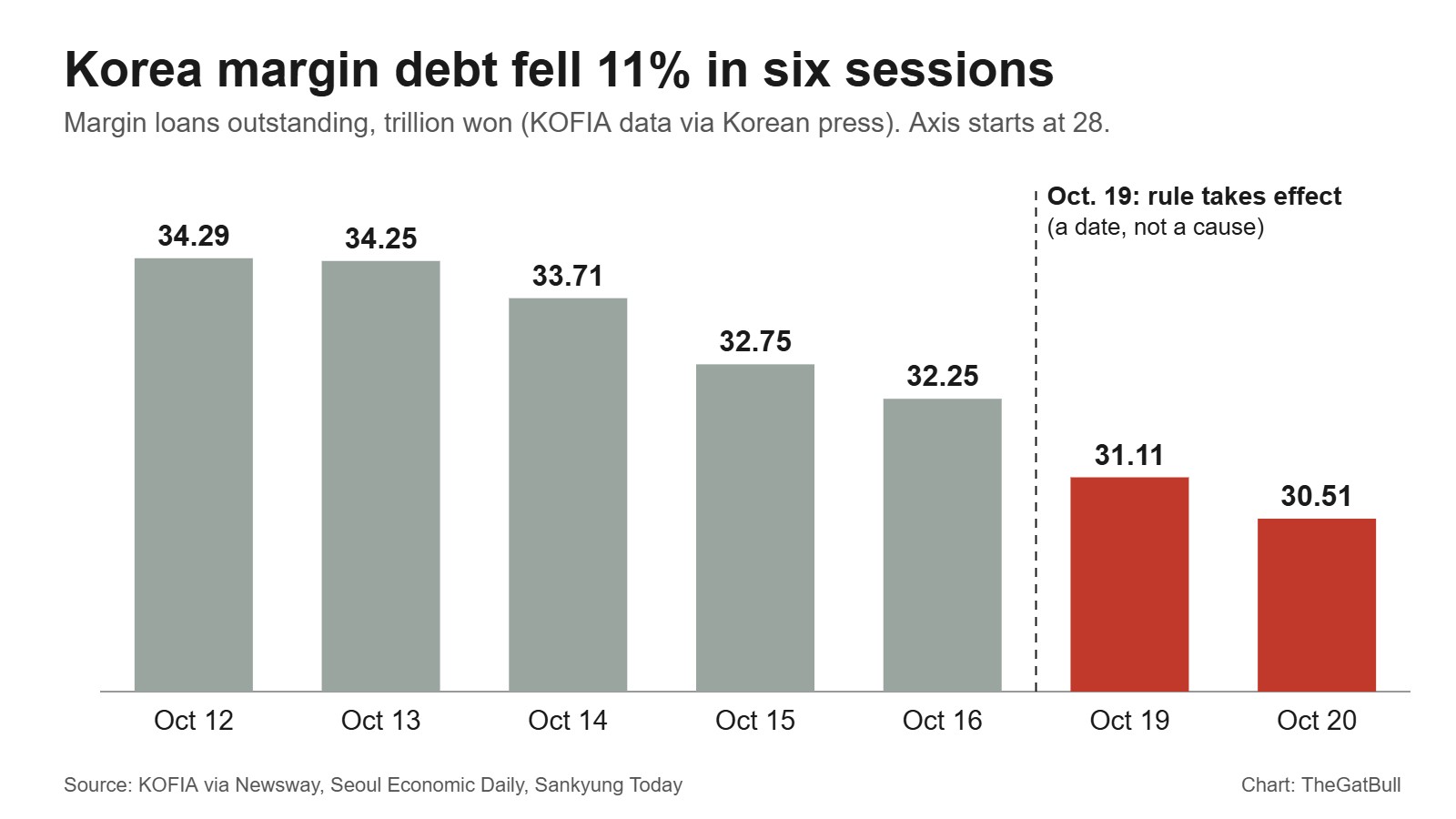
From Oct. 12 to Oct. 20, the total fell by about ₩3.77 trillion (about $2.85 billion), or 11.0% (our calculation from the reported figures).
The largest one-day drop in this series (Oct. 12–20) came on the day the rule took effect. That is a date, not a cause. The rule only covers new loans, while the daily figure is a net change that mixes repayments, maturing loans and forced sales. No breakdown has been published.
In the forced-sales data, the peak came the week before. Forced sales by brokers when customers fail to pay for stock bought on short-term credit hit ₩89.3 billion (about $67 million) on Oct. 14 and were down to ₩22.6 billion (about $17 million) on Oct. 20 (press-reported). That figure covers only unpaid purchases; forced sales on margin loans are not included, so total forced selling was likely larger. Investor deposits (cash waiting in brokerage accounts to buy stocks) also fell for six straight sessions, to ₩90.30 trillion (about $68.1 billion) on Oct. 20 (press-reported).
Has the rule worked? Too early to say. Debt has fallen, but we found no data that separates the rule’s effect from the selloff, so we cannot say the rule did it.
Under the Gat (our take). “The rule came late, and the market came first. Margin debt had already fallen about 6% before Oct. 19 as KOSPI sold off, and we can’t yet separate the rule’s share of the rest. This rule’s real test is not now. It is when borrowing starts growing again.”
What did the market do in the rule’s first three sessions?
| Close | Fri., Oct. 16 | Mon., Oct. 19 | Tue., Oct. 20 | Wed., Oct. 21 |
|---|---|---|---|---|
| KOSPI (Korea’s main index) | 5,668.05 | 5,768.01 (+1.76%) | 5,552.74 (−3.73%) | 5,735.66 (+3.29%) |
- KOSPI is up 1.19% from Oct. 16 and still 37.07% below its June 22 closing high of 9,114.55.
- Oct. 21: Samsung Electronics closed at ₩223,500 (about $169), up 5.67%; SK hynix at ₩1,294,000 (about $976), up 5.81%.
- Oct. 21 preliminary trading (press-reported): on the KOSPI, foreign investors bought a net ₩660 billion (about $500 million) and individuals sold a net ₩1.13 trillion (about $850 million). We have no evidence linking individuals’ selling to the rule; the two only happened on the same day.
- The won closed at ₩1,325.2 per dollar at 3:30 p.m., 2.9 won stronger.
EWY closed at $153.99 on Tuesday, Oct. 20, in New York (down 1.65%), before Seoul’s Wednesday session began, so it does not reflect Wednesday’s gain. Don’t compare the two day by day.
Where does this hit the numbers?
- For brokers: margin loans earn interest. Tighter limits and higher deposits give up some of that interest income in exchange for a lower risk of losses when collateral runs short.
- For investors: a 50% deposit caps leverage at two times the cash put in.
- For regulators: this is self-management plus inspection, not a law. What Seoul’s officials said about debt during the crash week is in our weekly review (Korea’s crash week: Seoul talked about debt first).
What does this rule show about Korea’s market?
Here is what you only see by watching this rule: Korea’s per-stock limit on retail leverage is enforced through each broker’s own book, not as one market-wide rule. So the terms for buying the same Samsung share with borrowed money differ by broker, and the door can close because of other customers’ debt, not yours. According to NICE Investors Service, Samsung Electronics and SK hynix accounted for ₩9.2 trillion (about $6.9 billion), or 27.5%, of ₩33.4 trillion in margin loans at the end of September (press-reported; a different basis from KOFIA’s daily data). Our Oct. 7 article cited about 40%, measured against KOSPI margin loans only; this figure is measured against all margin loans. Either way, EWY’s two largest holdings are also a large share of Korean retail debt. For the level of margin debt, see our earlier look at margin debt.
Under the Gat (our take). “The bigger news is not the number 15%. It is that it differs by broker. If borrowing builds up again, the doors would close broker by broker, not all at once, because each broker’s book is different. Which broker moves first is the thing to watch. That’s a description of how the system is built, not a forecast.”
How do you get exposure from the U.S., and is there a U.S. parallel?
How to get exposure: U.S. investors don’t use Korean margin loans. The ladder: (1) EWY, the U.S.-listed Korea ETF, about 44% in these two stocks; (2) SKHY, SK hynix’s ADR on Nasdaq (a U.S.-traded receipt for its shares); (3) buying on the Korea Exchange in cash through a brokerage account that offers overseas stocks. Any effect would come indirectly, through how much Korean individuals can borrow to buy.
U.S. parallel: Regulation T sets a 50% initial margin as a federal floor, and U.S. brokers add their own “house” requirements on concentrated positions. Not a perfect parallel: in the U.S., brokers add requirements on top of a federal floor, account by account. Korea’s 15% looks at one stock’s share of the broker’s entire margin book.

The bottom line
Three sessions after Oct. 19, “15% per stock” has turned into a list of broker-by-broker hurdles: new margin buying restricted at some, a 50% deposit at others, smaller limits at others. Market-wide margin debt fell about 11% from Oct. 12 to Oct. 20, and about 6% of that came before the rule took effect. Whether the rule works is too early to say. Next checkpoints: the Bank of Korea rate decision on Oct. 22, SK hynix results on Oct. 28 (9 a.m. Seoul time), and the first day KOFIA’s daily margin figure starts rising again.
FAQ
Does Korea’s 15% margin rule force investors to sell?
No. It applies only to new margin purchases; existing loans are not pulled back (press-reported industry policy).
Can you still buy Samsung on margin in Korea?
It depends on the broker. As of Oct. 21, in what we checked, Meritz and Hana do not take new margin purchases in Samsung Electronics or SK hynix, Samsung Securities and Mirae Asset require a 50% deposit, and Korea Investment & Securities and KB Securities have cut their limits.
Did margin debt fall because of the rule?
We can’t tell. Market-wide margin loans fell about 11% from Oct. 12 to Oct. 20, but that is a net change mixing repayments, maturing loans and forced sales, and the rule covers only new loans.
What does this mean for EWY?
No direct effect. Any effect would come indirectly, through Korean individuals’ buying power in the two stocks that make up about 44% of EWY.
Sources
- KOSPI, KOSDAQ, Samsung Electronics and SK hynix closes (KRX), EWY close: Yahoo Finance chart data (^KS11, ^KQ11, 005930.KS, 000660.KS, EWY; vendor data, not exchange-published figures).
- Margin loans outstanding, forced sales and investor deposits (KOFIA data): Newsway (Oct. 20), Seoul Economic Daily (Oct. 20), Sankyung Today (Oct. 21), Financial Today (Oct. 19) (press).
- Broker measures: Newspim (Oct. 19), Asia Today (Oct. 15), Financial Post (Oct. 16), Mediapen (Oct. 19), Greenpost Korea (Oct. 11) (press, quoting company notices where marked).
- End-September margin loans by stock: NICE Investors Service, via Newspim and Mediapen (Oct. 19) (press).
- Won-dollar rate at the Seoul 3:30 p.m. close: Asia Economy (Oct. 21), cross-checked with Financial News (press).
- Investor net trading, Oct. 21: Field News and License News (preliminary, press).
- SK hynix results date: DART 20261014800385.
- EWY weights: iShares MSCI South Korea ETF holdings, as of Oct. 16, 2026.
How sure are we?
| Item | Confidence |
|---|---|
| Index and stock closes, EWY close | Computed from vendor price data (Yahoo) |
| Margin loans outstanding, forced sales, deposits | ⚠️ Press-reported KOFIA data; not checked against KOFIA’s own release |
| Rule terms (15%, new loans only, 90%, 50% planned) | ⚠️ Press-reported industry policy, several outlets |
| Meritz, Samsung Securities, Mirae Asset measures | ✅ Company notices or terms, quoted by the press |
| Hana, Korea Investment & Securities, KB measures | ⚠️ Press-reported |
| Kiwoom’s current status | ⛔ Not confirmed (reports conflict) |
| Whether the rule caused the drop in margin debt | Not confirmed; no breakdown published |
| Seoul 3:30 p.m. exchange rate | ⚠️ Press-reported; cross-checked against the previous day’s level |
| EWY weight of Samsung and SK hynix (about 44%) | iShares holdings file, as of Oct. 16, 2026 |
Not financial advice. TheGatBull is an independent publication; nothing here is a recommendation to buy or sell any security.
 Written by Mr.Gat — TheGatBull
Korean market coverage from a Seoul-metro-based operator who reads the filings in the original language. Every price on this site is the KRX regular-session close (15:30 Seoul); every figure states whether it came from a primary filing, the press, or our own calculation. Drafts are AI-assisted, then verified against the original Korean documents and edited by a human before publishing.
Found an error? Tell us — corrections get priority. How we work →