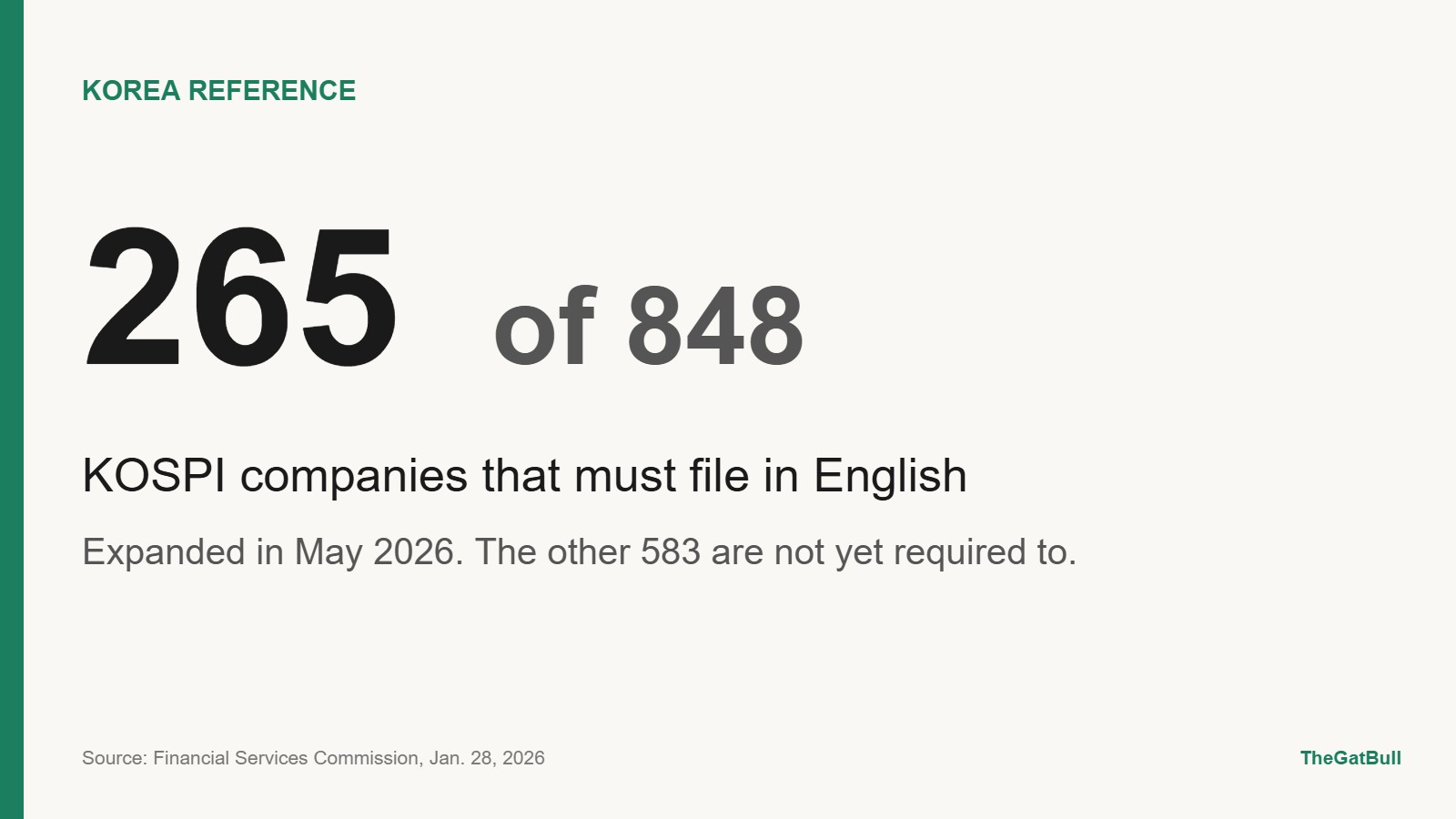
TL;DR — For U.S. investors who want to check what a Korean company actually filed. Every Korean listed company’s filings sit on DART, the regulator’s free public filing system, but the English requirement covers only 265 of 848 KOSPI companies (Financial Services Commission count, expanded in May 2026). With the English DART screen, five document names and a 14-digit receipt number, you can open the Korean original yourself.
I’m Mr. Gat, and this is TheGatBull.
Not financial advice.
Where do Korean company filings live?
Korean company filings live on DART (dart.fss.or.kr), run by Korea’s Financial Supervisory Service. It is the country’s statutory filing repository, the closest thing Korea has to the SEC’s EDGAR. Reading it costs nothing and needs no account. What you get in English depends on the company: the English-filing rule reaches about a third of KOSPI companies, and the rest file in Korean only.
Your Door — who reads what, and where.
- If you buy through a U.S. account: start on English DART, find the filing by its English title, and when the document body is in Korean, open the original by its receipt number and check the numbers in its tables.
- If you invest from a Korean account: Korean DART is the original. The English version is a translation of the same facts and can arrive later.
- If you hold EWY: its two largest holdings, Samsung Electronics (22.12%) and SK hynix (21.04%, iShares, as of Nov. 23, 2026), both have assets above KRW10 trillion, the group whose English filings are due on the same day as the Korean ones “in principle,” in the FSC’s wording; the release does not list the exceptions.
Three terms. KOSPI: Korea’s main stock market (KOSDAQ is the smaller, growth-company market). Financial Services Commission (FSC): the financial policy regulator that writes the English-filing rule. Financial Supervisory Service (FSS): the supervisor that runs DART.
Dates and times are Seoul time (KST). Prices are KRX regular-session closes (3:30 p.m. Seoul). Dollar conversions are for scale only, at ₩1,343.2 per dollar, the Seoul 3:30 p.m. rate on Nov. 25, 2026.
Seoul today (Wednesday, Nov. 25, 2026): the KOSPI closed at 4,697.51, down 6.16%, and the KOSDAQ at 650.64, down 2.29%. Samsung Electronics fell 9.87% to ₩170,700 (about $127) and SK hynix 11.05% to ₩1,030,000 (about $767). Korean outlets attributed the drop to a U.S. tech pullback and foreign selling; this piece does not judge the cause. On days like this, whether a company itself filed anything is a question DART answers. Tomorrow (Nov. 26) the Bank of Korea holds its rate meeting, while U.S. markets close for Thanksgiving.
Four places to look
| Site | Run by | What it is for |
|---|---|---|
| DART — dart.fss.or.kr | Financial Supervisory Service | Statutory filings, in the Korean original |
| English DART — englishdart.fss.or.kr | Financial Supervisory Service | The same repository with English menus, search and filing titles |
| KIND — kind.krx.co.kr (English: engkind.krx.co.kr) | Korea Exchange | Filings required by exchange rules, such as preliminary earnings and answers to exchange inquiries |
| OpenDART — opendart.fss.or.kr | Financial Supervisory Service | A free API: with a key, filing lists and financial statements come as data |
On English DART the filings are sorted into ten tabs, from “Periodic Disclosure” and “Report on Major Issues” to “Exchange Disclosure,” and a “Today’s Disclosure” list refreshes every 30 seconds. When we checked at 7:14 p.m. on Nov. 25, it showed 604 filings for the day, 195 of them from KOSPI companies. Filings made under exchange rules also appear on DART, under the Exchange Disclosure tab.
Who has to file in English
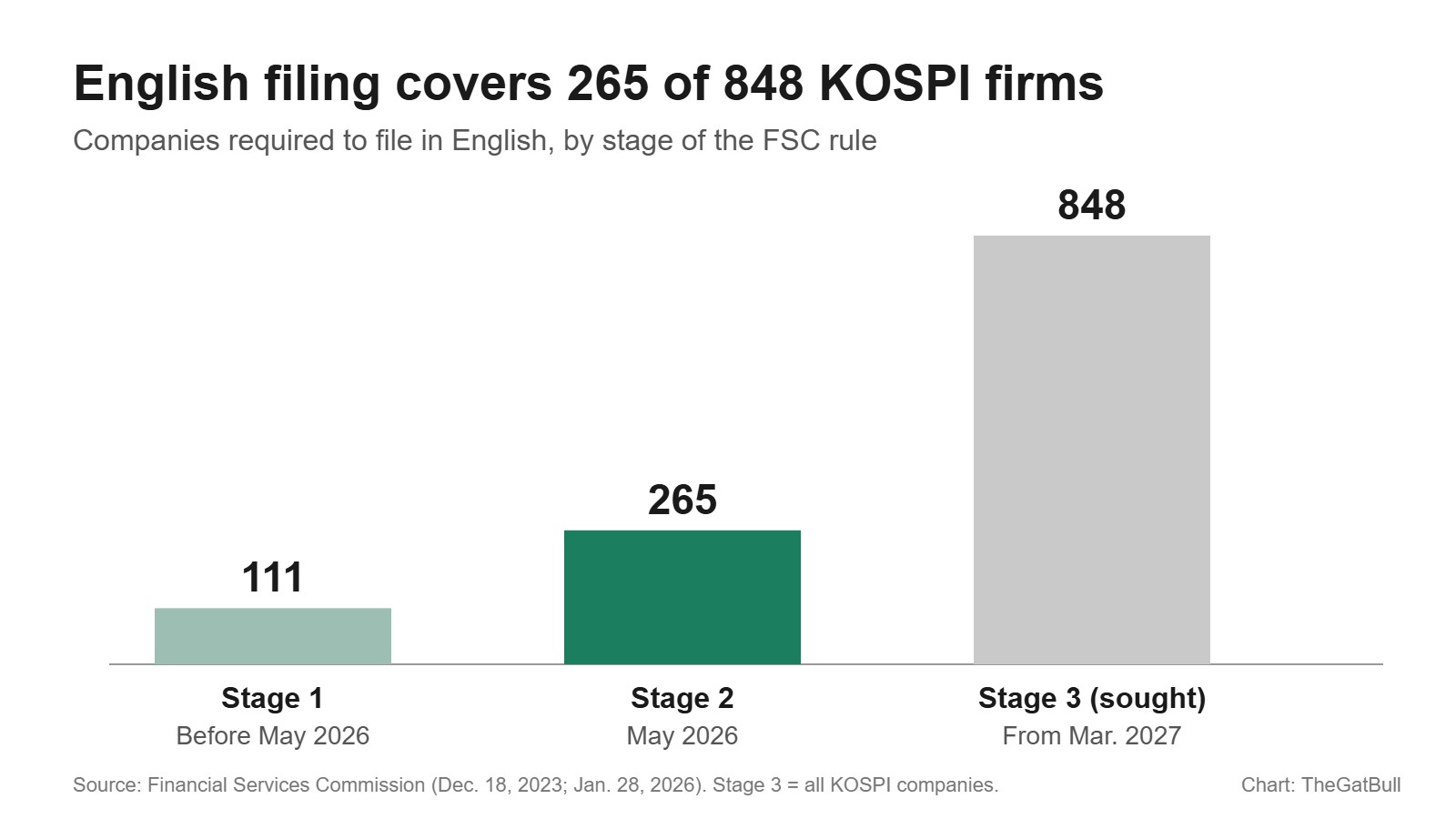
The Financial Services Commission made English filing mandatory for large KOSPI companies from Jan. 1, 2024, and in its January 2026 release extended the rule to every KOSPI company with assets of KRW2 trillion or more from May 2026. That moves coverage from 111 companies to 265 (based on assets at the end of 2024). Covering all 848 KOSPI companies was planned for May 2028; the FSC said it would seek to start earlier, from March 2027.
| Stage | Start | Who is covered | English deadline |
|---|---|---|---|
| 1 | Jan. 1, 2024 | Assets KRW10 trillion+ with foreign ownership 5%+, or assets KRW2 trillion+ with foreign ownership 30%+ | Now: same day, in principle, for KRW10 trillion+ companies (2026 revision). The original 2023 rule allowed three days. |
| 2 | May 2026 | All KOSPI companies with assets KRW2 trillion+ — 265 companies | Within three days for newly covered companies |
| 3 | From March 2027, sought (originally May 2028) | All KOSPI companies — 848 companies | Not yet set |
The scope widened too. From stage 2, the English requirement covers every filing the exchange rules require: all 55 items of material management information, fair disclosures and answers to exchange inquiries. The KOSDAQ market is not mentioned in the January 2026 release. Source: FSC press releases of Dec. 18, 2023 and Jan. 28, 2026.
Four steps from a headline to the Korean original
- Find the company. In English DART’s “Search by Company,” type the English name or the six-digit stock code (Samsung Electronics 005930, SK hynix 000660).
- Pick the document type. Decide which of the five documents below you are looking for.
- Note the receipt number. Every filing carries a 14-digit receipt number, called the rcpNo. The first eight digits are the filing date (YYYYMMDD). Example: SK Square’s third-quarter report is 20261116001068, filed Nov. 16, 2026.
- Open the original. Add the number after
dart.fss.or.kr/dsaf001/main.do?rcpNo=and the Korean original opens. If a news story or an analyst cites the receipt number, you can compare the story with the filing line by line.
A worked number: by company count, 265 ÷ 848 is about 31% (our calculation). The other 583 KOSPI companies, about two-thirds, can keep filing only in Korean until stage 3 without breaking the rule.
Five documents worth knowing by name
| Korean document (English DART tab) | What is in it | Closest U.S. filing |
|---|---|---|
| Annual, half-year and quarterly reports (Periodic Disclosure) | Annual and quarterly financial statements, equity-method notes, business description | 10-K, 10-Q |
| Report on major issues (Report on Major Issues) | Decisions on rights offerings, share buybacks and cancellations, mergers and spin-offs | Part of 8-K |
| Large-holding and insider ownership reports (Equity Disclosure, “5%·Executive”) | Changes in stakes of 5% or more; trading by executives and major shareholders | Schedule 13D/13G, Form 4 |
| Exchange filings (Exchange Disclosure) | Preliminary earnings, fair disclosures, answers to exchange inquiries about rumors or press reports | Part of 8-K and press releases |
| Securities registration statements (Issuance Disclosure) | Terms of share and bond issues | S-1, S-3 |
Not a perfect parallel: Korean preliminary earnings are unaudited numbers, and the inquiry disclosure is a system in which the exchange requires a company to answer, which has no exact U.S. match. Deadlines and forms for ownership reports also differ.
How the route differs by account
| U.S. account (EWY, ADRs) | Foreign resident with a Korean brokerage account | Korean investor | |
|---|---|---|---|
| Where to look first | English DART, English KIND | Korean DART, the broker app’s filings tab | Same |
| Language | 265 companies must file in English; for the rest, the Korean original plus a translation tool | The Korean original | — |
| Time lag | KRW10 trillion+ companies same day in principle; newly covered KRW2 trillion+ companies within three days | None (Korean is the original) | None |
Two-thirds of the KOSPI is not yet required to file in English
In Korea, “not yet in English” does not mean “not yet disclosed.” The original comes out first in Korean, and it is open to everyone at the same moment. The rule’s expansion from 111 to 265 to 848 companies is narrowing the language gap, but until stage 3, the Korean original is the only guaranteed primary record for about two-thirds of KOSPI companies. For an English-speaking investor, the gap is language and timing; the documents themselves are open to anyone.
Under the Gat. On Nov. 25, the day the KOSPI fell 6.16% and SK hynix 11.05%, English DART had logged 604 filings by 7:14 p.m. Seoul time. When an English headline explains a move like that, I look for the receipt number first, open the Korean original and compare the numbers. If the two differ, I go with the filing.
What to watch
- Stage 3 timing — whether the move to all 848 KOSPI companies from March 2027 is formally set.
- Stage 2 in practice — whether the 265 companies file in English within the deadlines. This piece did not measure compliance.
- Risk, in one line: numbers read through a translation tool often go wrong on units (millions of won vs. hundreds of millions of won) and on consolidated vs. parent-only figures; check numbers in the original tables.
Checking a filing from a U.S. account
- U.S. anchor: where you would pull a 10-K from SEC EDGAR, on DART you pull the annual report. The difference is that EDGAR’s original is in English, while DART is a Korean-language original with an English screen on top. Not a perfect parallel.
- Worked examples on this site: reading SK Square’s third-quarter filing and how Korea’s inquiry disclosures answered three SK hynix rumors. For the ADR side, see our list of Korean ADRs on the NYSE.

The bottom line
Reading DART costs nothing. The harder part is the language. Find the filing by its English title on English DART, pick the document type by name, and open the Korean original by its receipt number. Then you can judge for yourself whether an English story matches what the company filed — and on a day like Nov. 25, when the KOSPI fell 6.16%, that check is worth the most.
The Seoul Seven · how this piece was checked: Korean original (n/a — rules from the FSC’s English releases) · ✓ Dated sources · Seoul & New York time (n/a — Seoul only) · ✓ Beyond EWY · ✓ U.S. anchor · ✓ What to watch · ✓ Corrections kept · what these mean
— Mr. Gat. Stay bullish. (Not a call to buy or sell.)
Related reading: SK Square’s Q3 filing · Three SK hynix rumors and the public record
FAQ
Is DART free to use?
Yes. Reading filings needs no account. The OpenDART API requires a free key.
Do all Korean companies file in English?
No. From May 2026 the requirement covers the 265 KOSPI companies with assets of KRW2 trillion or more (FSC count). The KOSDAQ market is not mentioned in the FSC’s January 2026 release.
What is a rcpNo on DART?
The 14-digit receipt number attached to every filing. The first eight digits are the filing date. Add it after dart.fss.or.kr/dsaf001/main.do?rcpNo= to open the original.
Does the English filing rule apply to U.S. investors?
The rule is an obligation on companies. Investors of any nationality see the same documents at the same time.
Sources
- Financial Services Commission, “Provision of Corporate Disclosures in English from 2024 to Enhance Information Access for Foreign Investors” (Dec. 18, 2023) — fsc.go.kr
- Financial Services Commission, “Revised Rules to Expand English Disclosure Requirement and Enhance Transparency in Corporate Disclosures” (Jan. 28, 2026) — fsc.go.kr
- Financial Supervisory Service, English DART home page (checked Nov. 25, 2026, 7:14 p.m. KST) — englishdart.fss.or.kr
- DART, SK Square third-quarter report — 20261116001068
- iShares MSCI South Korea ETF (EWY) holdings, as of Nov. 23, 2026.
- Prices: Yahoo Finance chart data (KRX regular-session closes, Nov. 24–25, 2026; vendor data, not exchange-published figures).
- Won-dollar rate: ₩1,343.2, Seoul 3:30 p.m. close, Nov. 25, 2026 (BetaNews; press).
How sure are we?
| Item | Confidence |
|---|---|
| English-filing stages, thresholds, deadlines, company counts (111, 265, 848) | ✅ FSC press releases (primary) |
| English DART tabs and the Nov. 25 filing count (604; 195 KOSPI) | ✅ Our check of the live site, 7:14 p.m. KST |
| EWY weights of Samsung Electronics and SK hynix | ✅ iShares holdings file, as of Nov. 23, 2026 |
| Closing prices and daily changes | Vendor data (Yahoo), KRX close; percentages and conversions are our calculation |
| Nov. 25 won-dollar rate; cause of the Nov. 25 drop | ⚠️ Press-reported |
| Whether stage 2 companies are meeting the English deadlines | Not confirmed |
Not financial advice. TheGatBull is an independent publication; nothing here is a recommendation to buy or sell any security.
 Written by Mr.Gat — TheGatBull
Korean market coverage from a Seoul-metro-based operator with 15 years of personal investing experience, who reads the filings in the original language. Every price on this site is the KRX regular-session close (15:30 Seoul); every figure states whether it came from a primary filing, the press, or our own calculation. Drafts are AI-assisted, then verified against the original Korean documents and edited by a human before publishing.
Found an error? Tell us — corrections get priority. How we work →