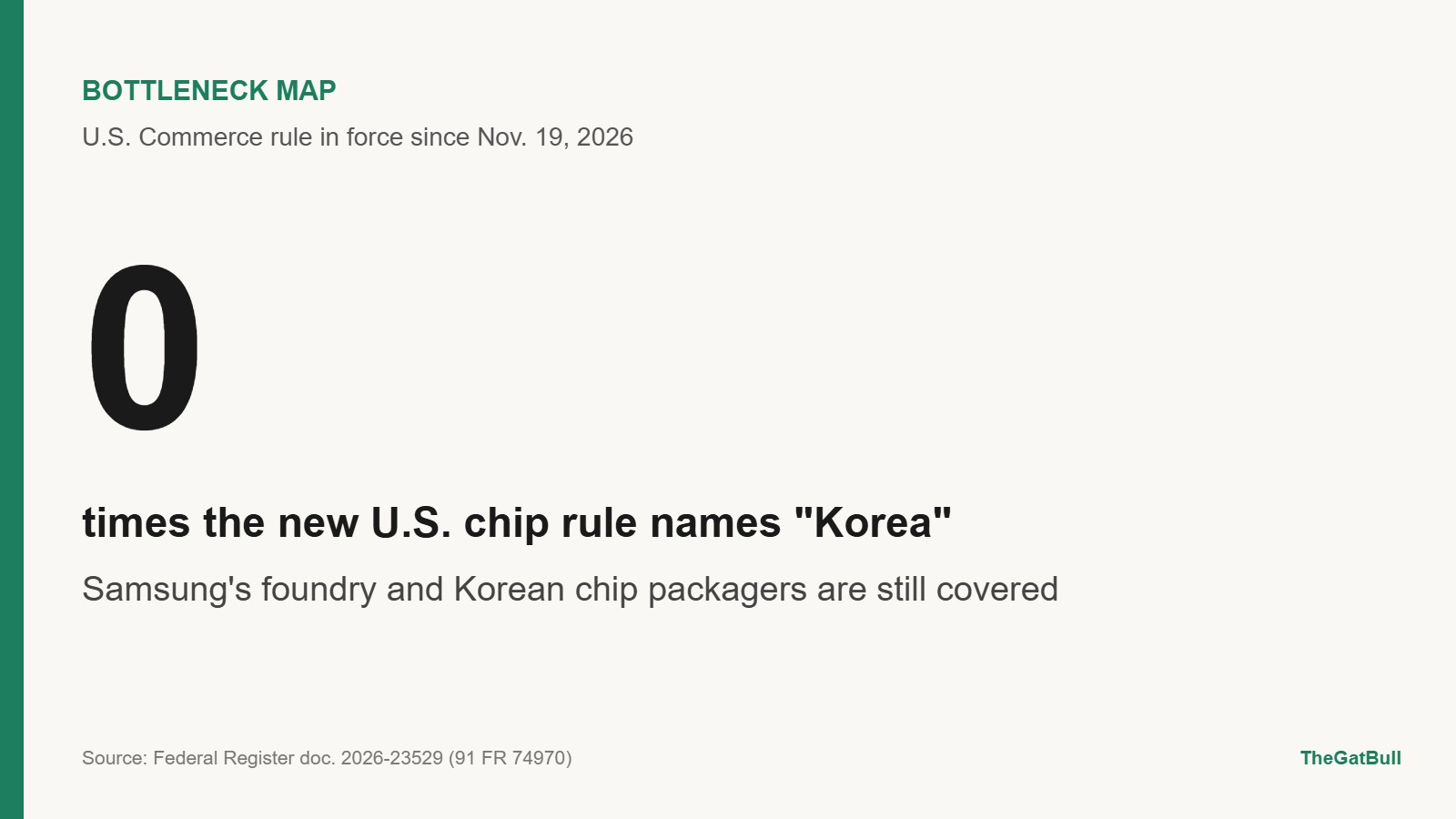
TL;DR — For holders of EWY or Samsung Electronics shares. A U.S. Commerce Department rule in force since Nov. 19 sorts advanced logic chips by where the chip’s designer is headquartered, and it makes the factories that manufacture and package those chips check that address. The rule text never names Korea, yet Samsung Electronics’ foundry and Korea’s chip packagers are covered by its definitions.
I’m Mr. Gat, and this is TheGatBull.
Not financial advice.
On Nov. 19, the Commerce Department’s Bureau of Industry and Security (BIS) published an interim final rule in the Federal Register and put it into effect the same day. An interim final rule takes effect immediately and can still be revised. One of its four parts changes who may clear advanced chips. If an advanced logic chip was designed by a company located in, or ultimately owned from, China or the other listed country groups, and that designer is not on the U.S. approved list, the factory making or packaging the chip can no longer certify, by its own transistor-count check, that the chip falls outside U.S. controls. That chip then goes into U.S. license review. The word “Korea” appears zero times in the rule. Korea still sits inside it. Under the rule’s own terms, a “front-end fabricator” is a plant that makes chips on wafers, as Samsung’s foundry does, and an “OSAT” (outsourced semiconductor assembly and test company) packages and tests them, as several Korean companies do.
Your Door — for EWY holders.
- What you own: Samsung Electronics is 22.12% of EWY and SK Hynix 21.04% (iShares, as of Nov. 23, 2026). The part of the rule that reaches Korean factories reaches Samsung’s foundry business, which makes chips for other companies.
- What to check: Samsung does not disclose foundry revenue separately, so no public number measures this exposure today; watch Dec. 21, 2026 and Jan. 19, 2027.
Dates and times are Seoul time (KST) unless marked ET; in November, ET is 14 hours behind Seoul. Korean stock and index prices are KRX (Korea Exchange) regular-session closes (3:30 p.m. Seoul). U.S. stock moves are U.S. trading days, in dollars. Dollar conversions use the Seoul 3:30 p.m. won-dollar close on Nov. 24, 2026: 1,342.4 won per dollar.
Four changes in the Nov. 19 rule
The rule is titled “Addressing Remote Access to Advanced Semiconductors” (Federal Register document 2026-23529, 91 FR 74970–74999). It does four things.
| Part | What the rule text says | Where Korea touches it |
|---|---|---|
| 1. Remote access | Exports of advanced chips to overseas data centers that supply significant computing power to companies headquartered in Country Group D:5 (which includes China) or Macau need a license. Data centers already doing so must get a license within 90 days. | The text covers such data centers “wherever located,” so a data center in Korea is not carved out. |
| 2. Five new countries | A new license requirement for advanced chips going to Indonesia, Malaysia, Singapore, Thailand and Brazil, with an exclusion for U.S.-headquartered customers that file reports. | Korea is not one of the five. |
| 3. Foundries and packagers | Designers located in, or with an ultimate parent headquartered in, Country Groups D:1, D:4 or D:5 or the five countries lose the routes that let a factory show their advanced logic chip falls outside U.S. controls, unless the designer is approved. | Samsung’s foundry and Korean packaging houses are the factories this clause applies to. |
| 4. Repeal | Formally rescinds the Biden-era AI Diffusion Rule. | — |
The rule took effect on publication, Nov. 19, 2026. Shipments already en route that day may finish under the old terms if completed by Dec. 21, 2026. Comments are due by Jan. 19, 2027, and an interim final rule can still be revised.
Under the Gat — The 30-page rule (91 FR 74970–74999) mentions “Korea” zero times. The words that matter for Seoul are “front-end fabricator” and “OSAT,” and in Korea those words belong to Samsung’s foundry lines and to packagers on KOSDAQ, Korea’s growth-stock market, such as Hana Micron (067310).
Which line of the income statement this reaches
| Company | Role under the rule | Income line it reaches | Visible in filings? |
|---|---|---|---|
| Samsung Electronics | Front-end fabricator (foundry) | Foundry sales inside the chip division, specifically the share from designers in the listed groups | No; foundry revenue is not reported separately |
| Korean packagers (e.g., Hana Micron) | OSAT | Packaging and test orders, only where the customer designs advanced logic chips | No; sales by customer country are not disclosed |
| SK Hynix | Memory maker; this clause does not name it as a party | The rule’s existing transistor-count test uses “contains high-bandwidth memory” as one variable | — |
The rule’s existing transistor-count test is carried over, and whether a chip contains high-bandwidth memory is one variable in it. For unapproved designers in the listed groups, the factory’s own test no longer clears the chip.
The headline versus the rule text
English-language headlines said TSMC and Samsung halted chip shipments to China. Sorted by how firmly each piece is established:
- Confirmed in the primary source: the rule’s content, its Nov. 19 effective date and the Dec. 21 cutoff for shipments en route, all in the Federal Register text.
- Press-reported, not confirmed from a primary source: the Financial Times, citing people familiar with the matter, reported that both foundries told some Chinese customers they would pause shipments of certain processors while applying for licenses. TSMC did not respond and Samsung declined to comment, according to a Nov. 21 summary by VLSI Korea.
- A rumor reported as denied: a market rumor that Samsung had launched a sweeping check of its foundry customers was found inaccurate by Shanghai Securities News, as relayed by the same summary.
The rule text creates a license queue and contains no order to stop supplying any customer.
Under the Gat — The FT story is about chips paused while licenses are pending. Samsung declined to comment on the FT report, and the Federal Register text gives shipments already in transit until Dec. 21, 2026 to finish.
Seoul prices from Nov. 13 to Nov. 24
BIS announced the rule on Nov. 16, according to press reports, and the Federal Register published it on Nov. 19, during the New York morning, after Seoul had closed. With two dates in play, daily price reactions cannot be matched to the rule. The table compares the last Friday close before the announcement (Nov. 13) with today’s close (Nov. 24).
| KRX close | Nov. 13 | Nov. 24 | Change |
|---|---|---|---|
| KOSPI | 5,290.53 | 5,006.03 | −5.38% |
| Samsung Electronics | 206,000 won | 189,400 won | −8.06% |
| SK Hynix | 1,216,000 won | 1,158,000 won | −4.77% |
| Hanmi Semiconductor (equipment) | 181,700 won | 163,600 won | −9.96% |
| Hana Micron (packaging) | 28,950 won | 23,000 won | −20.55% |
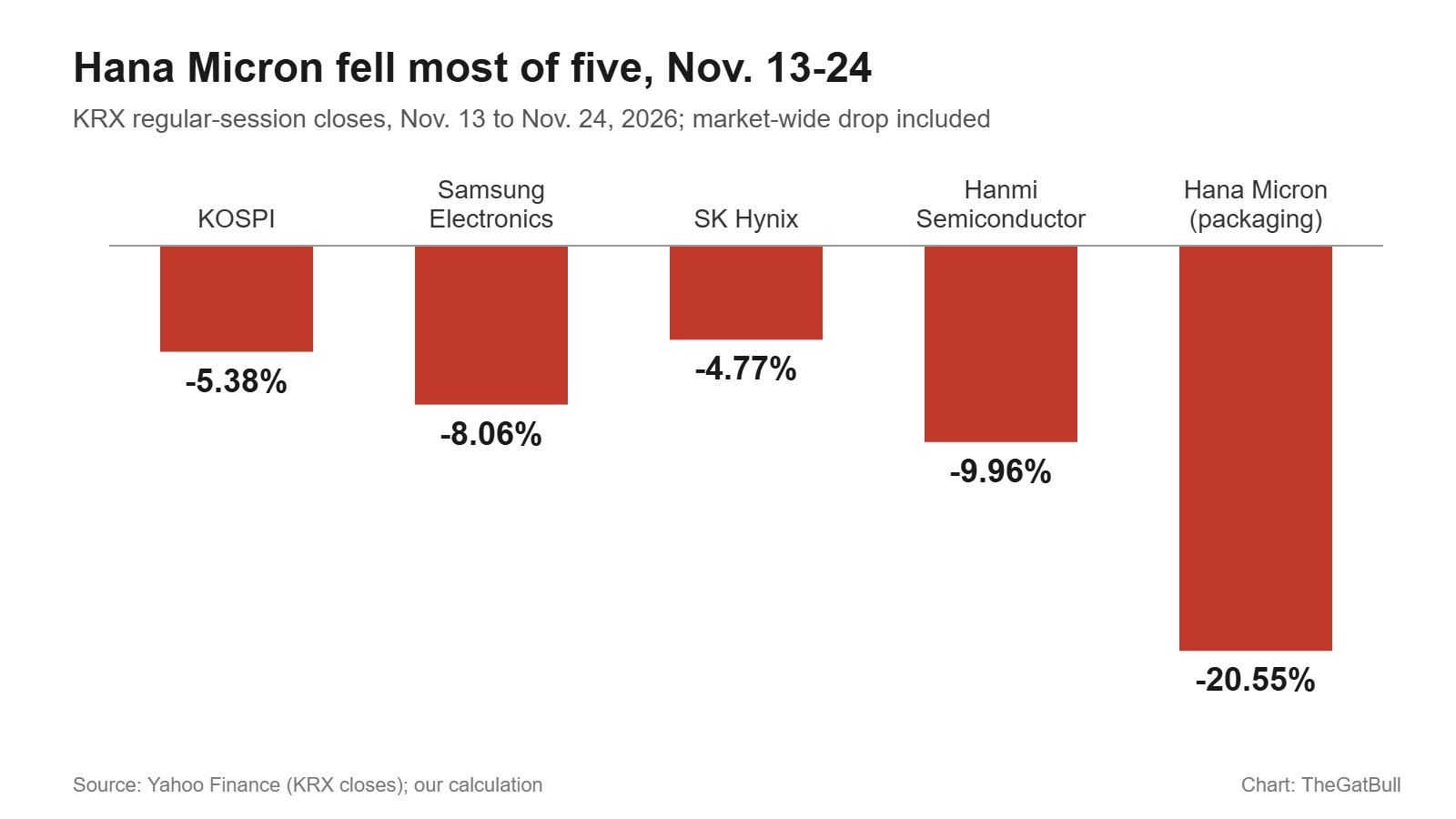
The whole market fell over the same span, including the Nov. 20 session in which the KOSPI dropped 5.21% and a sidecar, a five-minute pause in program trading, was triggered. This table cannot separate the rule’s effect from the market’s. Hana Micron fell the most, and its filings do not show how much of its revenue comes from customers covered by the rule. Today, Nov. 24, the KOSPI rose 6.32% to 5,006.03, Samsung Electronics 6.70% to 189,400 won (about $141) and SK Hynix 6.73% to 1,158,000 won (about $863). We could not confirm a cause for today’s rebound and do not link it to the rule.
Three dates to watch:
- Dec. 21, 2026: the cutoff for shipments that were en route on Nov. 19. Watch whether shipment-pause reports continue after it.
- Jan. 19, 2027: the comment deadline. The interim final rule can be revised.
- Samsung Electronics’ fourth-quarter results in January: whether the foundry commentary mentions licenses or Chinese customers.
Risk in one line: no company has disclosed how much revenue sits behind this license queue.
Korea’s chip exposure now has a customer-address line
Read as a memory country, Korea looks untouched by this rule. The rule instead puts the checking duty on the places that make chips (foundries) and the places that package them (OSATs), and it keys that duty to the customer’s headquarters address. Korea has both kinds of factory. The size of the risk is therefore set by the nationality mix of the customer list, and that list is not disclosed. For a U.S. investor sizing Korean chip exposure, this rule adds a second axis beside the memory cycle: where the customers are headquartered.
Under the Gat — Samsung is 22.12% of EWY, and Samsung does not report its foundry sales separately. Until a filing shows the share from designers in the listed groups, a headline that puts a won figure on this exposure has no disclosed number behind it.
How to reach these companies from the U.S.
- EWY: Samsung Electronics 22.12%, SK Hynix 21.04%, Hanmi Semiconductor 0.50%. Hana Micron and ISC are not held (iShares, as of Nov. 23, 2026).
- A U.S.-listed cousin: Amkor Technology (AMKR), a packaging-and-test company headquartered in Tempe, Arizona, which says in its annual report that it has significant facilities in Korea. AMKR closed at $30.24 on Nov. 20 and $34.81 on Nov. 23, up 15.11% (U.S. trading days). We did not check a cause for that move.
- KRX directly: Hana Micron (067310, KOSDAQ) is not held by EWY. Owning it directly means buying on the Korea Exchange through a brokerage with Korean market access, such as Interactive Brokers.
Not a perfect parallel: Amkor is a U.S. company, so its own headquarters puts it outside the rule’s target list. As an OSAT, though, it carries the same duty to check where its customers’ designers are located, including at its plants in Korea.
For the previous maps, see who ordered Korea’s chip-inspection tools and Korean AI stocks: power versus memory; for what EWY actually holds, see EWY’s concentration in two stocks.

The bottom line
The Nov. 19 rule never names Korea. It asks two kinds of Korean factory, the foundry and the packager, where their customers’ designers are headquartered. Until the total behind that answer shows up in a filing, treat any headline that prices it with confidence as unverified.
The Seoul Seven · how this piece was checked: n/a Korean original · ✓ Dated sources · ✓ Seoul & New York time · ✓ Beyond EWY · ✓ U.S. anchor · ✓ What to watch · ✓ Corrections kept · what these mean
— Mr. Gat. Stay bullish. (Not a call to buy or sell.)
Related reading: Korea’s chip-inspection tools · Korean AI stocks: power vs memory · EWY’s concentration
FAQ
Does the Nov. 19 U.S. chip rule sanction Korea?
No. The rule text mentions Korea zero times, and Korea is not among the five countries given a new license requirement. Korean companies are covered as the factories that must apply the checks, as foundries and as packaging-and-test companies.
Did Samsung stop shipping chips to China?
That was reported by the Financial Times, citing people familiar with the matter, and has not been confirmed by the company. Samsung declined to comment.
Does the rule restrict SK Hynix’s high-bandwidth memory?
The clause discussed here applies to foundries and packagers making advanced logic chips. High-bandwidth memory appears in the rule’s transistor-count test as one variable, and we did not find a new restriction on high-bandwidth memory exports in this rule.
What dates should EWY holders watch?
Dec. 21, 2026, when the grace period for shipments en route on Nov. 19 ends, and Jan. 19, 2027, the comment deadline. The interim final rule can be revised.
Can U.S. investors buy Korean chip-packaging stocks?
Hana Micron is not in EWY, so owning it means buying on the Korea Exchange. A U.S.-listed packaging company with significant facilities in Korea is Amkor Technology (AMKR).
Sources
- Bureau of Industry and Security, “Addressing Remote Access to Advanced Semiconductors,” interim final rule, Federal Register, Nov. 19, 2026: document 2026-23529, 91 FR 74970.
- iShares MSCI South Korea ETF (EWY) holdings, as of Nov. 23, 2026.
- Amkor Technology, Form 10-K for fiscal 2025, filed Feb. 20, 2026: SEC EDGAR.
- Prices: Yahoo Finance chart data (^KS11, 005930.KS, 000660.KS, 042700.KS, 067310.KQ, AMKR; vendor data, not exchange-published figures).
- Won-dollar rate at the Seoul 3:30 p.m. close, Nov. 24: Financial News, Asia Economy and Seoul Finance (press), checked against the previous day’s close.
- Press: VLSI Korea, Nov. 21, 2026, summarizing the Financial Times report and the Shanghai Securities News check.
How sure are we?
| Item | Confidence |
|---|---|
| Rule content, effective date, Dec. 21 cutoff, Jan. 19 comment deadline, zero mentions of Korea | ✅ Federal Register text |
| EWY weights | ✅ iShares holdings file, as of Nov. 23, 2026 |
| Amkor headquarters and Korean facilities | ✅ Company filing with the SEC |
| Closing prices and percentage changes | Vendor data (Yahoo), KRX regular-session close; percentages are our calculation |
| Shipment pauses by TSMC and Samsung, Nov. 16 announcement date, denial of the customer-check rumor, Nov. 24 won-dollar rate | ⚠️ Press-reported |
| Share of Samsung foundry or Korean packaging revenue from designers covered by the rule; cause of the Nov. 24 rebound | Not confirmed |
Not financial advice. TheGatBull is an independent publication; nothing here is a recommendation to buy or sell any security.
 Written by Mr.Gat — TheGatBull
Korean market coverage from a Seoul-metro-based operator with 15 years of personal investing experience, who reads the filings in the original language. Every price on this site is the KRX regular-session close (15:30 Seoul); every figure states whether it came from a primary filing, the press, or our own calculation. Drafts are AI-assisted, then verified against the original Korean documents and edited by a human before publishing.
Found an error? Tell us — corrections get priority. How we work →