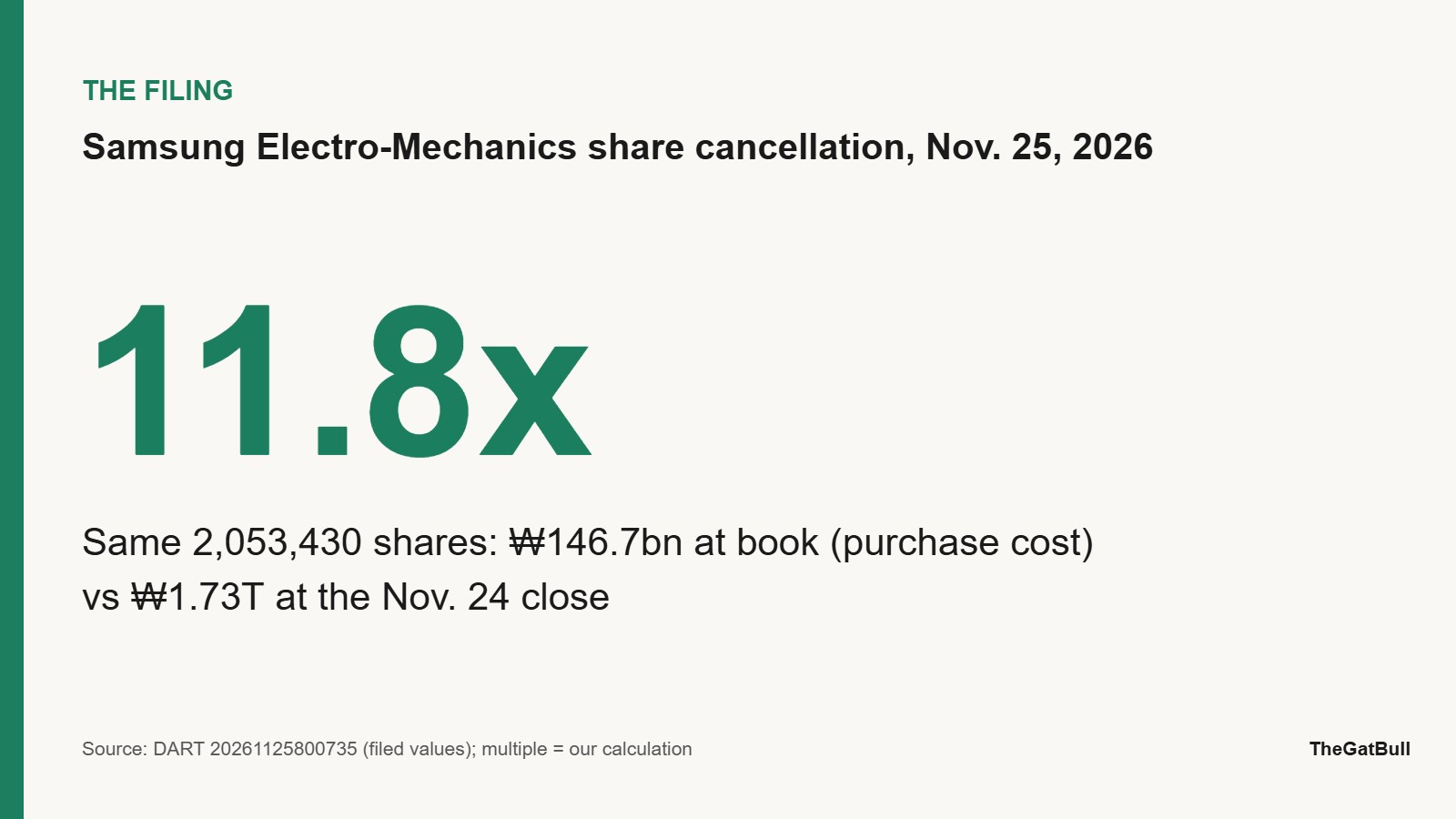
TL;DR — For holders of Samsung Electro-Mechanics shares in Seoul (KRX: 009150) or of EWY. The company’s Nov. 25 cancellation filing lists two amounts for the same 2,053,430 shares: ₩146.7 billion (about $109 million), what it paid for them, and ₩1.73 trillion (about $1.29 billion), the same shares at the Nov. 24 close. The common shares were bought on the market in 2015, so this decision buys no new shares.
I’m Mr. Gat, and this is TheGatBull.
Not financial advice.
Dates are Seoul time (KST). Stock and index prices are KRX (Korea Exchange) regular-session closes (3:30 p.m. Seoul). Dollar conversions are for scale only, at the Nov. 26 Seoul 3:30 p.m. rate of ₩1,342.7 per dollar.
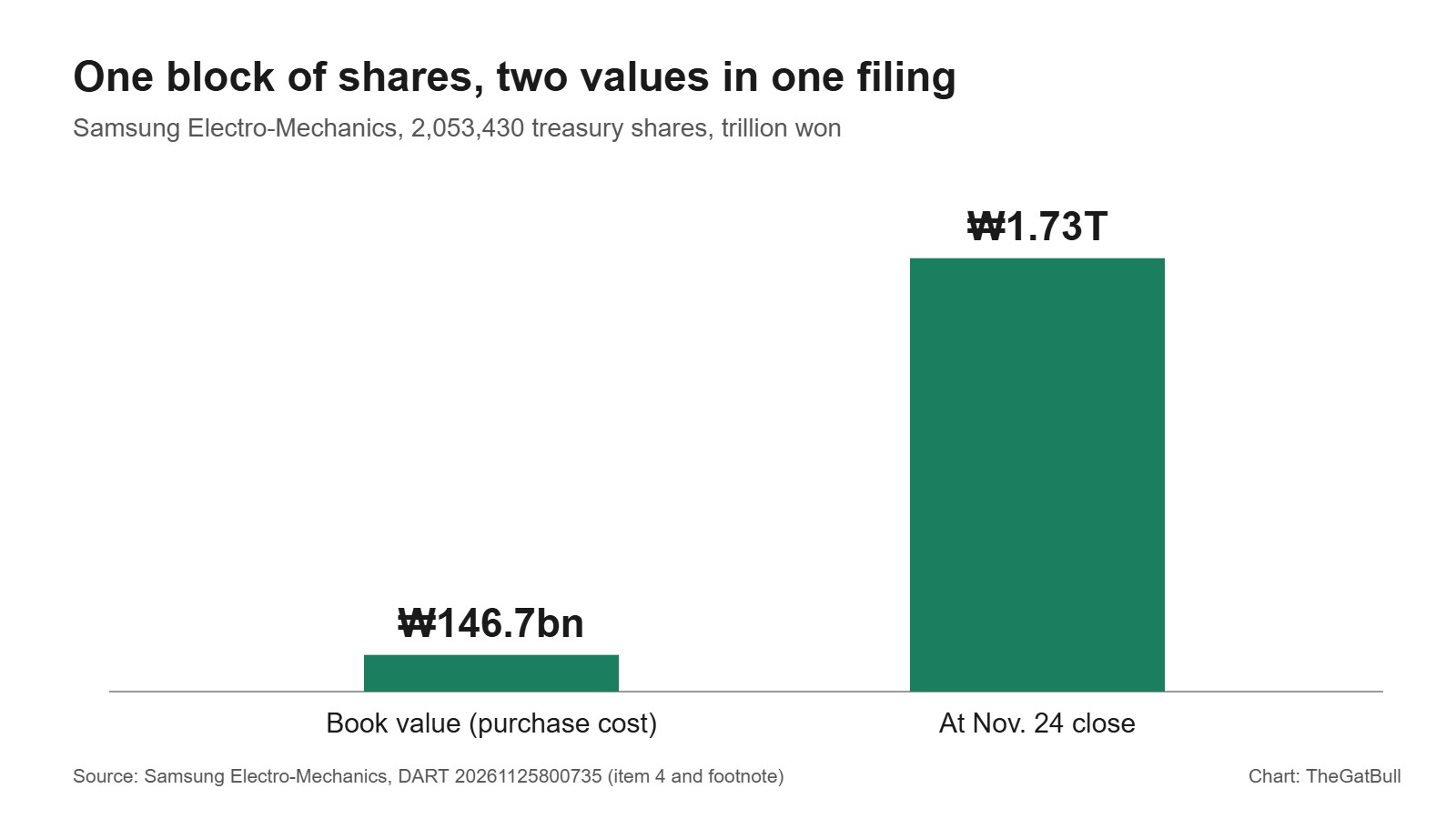
On Nov. 25, Samsung Electro-Mechanics, the Korean electronic-components maker, filed a “decision to cancel shares” on DART, Korea’s electronic disclosure system. Korean headlines that evening called it a ₩1.7 trillion cancellation. The filing itself prints two numbers. Item 4, the amount to be canceled, is ₩146,701,455,500 (about $109.3 million). A note at the bottom gives ₩1,731,868,710,000 (about $1.29 billion). Both are correct. The first is the book value, meaning the purchase cost recorded on the company’s books. The second prices the same shares at the closing price the day before the board met. These are treasury shares — shares the company bought back from the market and has held itself — so the decision itself buys zero new shares.
Your Door:
- EWY: Samsung Electro-Mechanics was about 2.07% of the fund as of Nov. 13, 2026 (iShares). The company is canceling shares it holds itself, so the number of Samsung Electro-Mechanics shares the fund owns does not change.
- KRX shares (009150): issued common stock goes from 74,693,696 to 72,693,696 shares (our calculation) on the planned date, Dec. 2. The shares that disappear are the ones in the company’s own treasury; your share count stays the same.
- Next checkpoint: the cancellation on Dec. 2 (the filing says the date can change) and the company’s next quarterly report, which lists its treasury-share holdings.
What did Samsung Electro-Mechanics file on Nov. 25?
| Item | Filing says | Label |
|---|---|---|
| Shares to cancel | 2,000,000 common (2.68% of issued common) · 53,430 preferred, a second share class that trades separately in Seoul (1.84% of issued preferred) | Filed; percentages are our calculation |
| How the shares were acquired | “Previously acquired treasury shares”; purchase period “–” (none) | Filed |
| Amount to cancel (item 4: average purchase price × shares, book value) | ₩146,701,455,500 (about $109.3 million) | Filed |
| Same shares at the Nov. 24 close (footnote: common ₩858,000, about $639; preferred ₩297,000) | ₩1,731,868,710,000 (about $1.29 billion) | Filed |
| Market value ÷ book value | about 11.8 times | Our calculation |
| Planned cancellation date | Dec. 2, 2026 (may change after consultation with the relevant agencies) | Filed |
| Share capital | No reduction — shares bought within distributable profit, canceled by board resolution (Commercial Act Article 343(1), proviso) | Filed |
Check: 2,000,000 × ₩858,000 + 53,430 × ₩297,000 = ₩1,731,868,710,000, the figure in the filing’s note.
Under the Gat. Samsung Electro-Mechanics paid an average ₩72,793 a share for its 2,000,000 common treasury shares between Feb. 2 and Apr. 1, 2015. On Dec. 2 it plans to cancel them. The ₩1.73 trillion in the headline is the Nov. 24 close of ₩858,000 times those shares, plus the preferred. What goes away is the company’s option to sell the shares again (our reading).
Where the shares came from: two filings from 2015
The cancellation filing lists two related filings at the bottom. Both are on DART.
- Jan. 29, 2015 — buyback decision. The board approved buying 2,000,000 common shares on the market, an estimated ₩127.8 billion at the prior close of ₩63,900. The stated purpose: “to stabilize the share price and enhance shareholder value.” Before the purchase the company held no common treasury shares (as of Sept. 30, 2014) and already held the 53,430 preferred shares.
- Apr. 3, 2015 — buyback result report. All 2,000,000 shares were bought between Feb. 2 and Apr. 1, 2015, at an average of ₩72,793 each, ₩145.59 billion in total before fees. After the purchase the company held 2,000,000 common and 53,430 preferred shares, ₩146.70 billion at book value.
Those are exactly the share counts and book value in the Nov. 25 filing. Korean press reported the cancellation as covering all of the company’s treasury shares. We did not check that against the treasury-share table in its latest quarterly report. Either way, the cash for the 2,000,000 common shares was spent in February–April 2015, and we could not confirm when the 53,430 preferred shares were bought. The common shares have been in the company’s treasury since then.
What the headline said, and what the filing says
- Headline (Korean press, Nov. 25): “Samsung Electro-Mechanics to cancel all its treasury shares, worth ₩1.7 trillion” (Etoday, our translation). Some reports also noted that the figure is about 12 times book value.
- Filing: the cash cost of this decision is zero. The purchase was paid for in 2015.
- Closing prices (KRX): Nov. 24 ₩858,000 → Nov. 25 ₩755,000 (−12.00%; the KOSPI, Korea’s main index, fell 6.16% that day) → Nov. 26 ₩784,000 (+3.84%; KOSPI +0.29%), about $584 at ₩1,342.7.
We do not read the Nov. 25 drop as a reaction to the filing. We did not confirm the filing’s DART submission time, and the first Korean report we found was posted at 6:29 p.m., after the close. We also do not say why the stock rose on Nov. 26; we did not collect trading data by investor type.
Where does a cancellation show up in the financials?
- Income statement: the cancellation does not pass through it (our reading). Share capital stays the same, the filing says.
- Share count: issued common stock falls 2.68%. Under the accounting rule for earnings per share (IAS 33, the international standard), treasury shares are already left out of the share count used for earnings per share, so the change to the earnings-per-share denominator is small. This is the general rule; we did not recalculate Samsung Electro-Mechanics’ EPS.
- What does change: the company loses the option to sell these shares again or use them for something else (our reading).
- Context (press-reported; we did not check the statute): Korean media have reported that a 2026 amendment to the Commercial Act makes cancellation the default for treasury shares, with a grace period for shares already held. Samsung Electro-Mechanics’ filing does not cite the amendment. The legal basis it gives is Article 343(1) of the Commercial Act.
This piece does not cover who bought or sold the stock this week. We did not collect that data, so we make no claim linking the cancellation to the share price.
What the Korean cancellation headline measured
The “₩1.7 trillion cancellation” headline is a market-value figure. The disclosure form itself carries both numbers, book value in the body and market value in a note, and in this case the headlines used the larger one. Canceling shares a company already holds and buying shares in order to cancel them are different events. The first adds no new buying in the market. The difference shows up in one line each: item 6 of the form (how the shares were acquired) and item 5 (the purchase period). In Samsung Electro-Mechanics’ case, the stock rose to about 11.8 times its 2015 average purchase price, and the same 2,053,430 shares went from ₩146.7 billion at book value to a ₩1.7 trillion headline.
Hyundai did the same thing: it canceled treasury shares it already held. To find these lines in any Korean filing yourself, see how to read Korean company filings on DART.
What to watch, and one risk
- Dec. 2, 2026: planned cancellation date, followed by filings on the change in listed shares and the new issued share count.
- Next quarterly report: the treasury-share table, where the “all of its treasury shares” reporting can be checked against the original.
- Risk: this cancellation is not a promise to buy back more shares. The filing contains no new buyback plan.
Reaching Samsung Electro-Mechanics from a U.S. account
- Access. Through EWY (about 2.07% as of Nov. 13, 2026) or by buying the Seoul shares directly (common 009150, preferred 009155). We found no U.S.-listed ADR for the company; see our list of Korean ADRs on the NYSE. For the business itself, see Samsung Electro-Mechanics’ order ledger.
- U.S. comparison. Large U.S. companies report the amount they spent on buybacks each quarter in their 10-Q quarterly reports, and investors date the return to shareholders to that quarter. For Samsung Electro-Mechanics, that quarter was the first quarter of 2015, running into early April.
- Not a perfect parallel. U.S. companies can also hold repurchased shares in treasury for years, and Korea had no cancellation requirement in 2015.

The bottom line
The same Samsung Electro-Mechanics filing gives ₩146.7 billion and ₩1.73 trillion for one block of shares, and both numbers are right. The first is what the company paid, almost all of it in 2015 for the common shares; the second is their value at the Nov. 24, 2026 close. On the planned date, Dec. 2, the shares leave the share count, and the company buys none in the market to do it.
The Seoul Seven · how this piece was checked: ✓ Korean original · ✓ Dated sources · n/a Seoul & New York time · ✓ Beyond EWY · ✓ U.S. anchor · ✓ What to watch · ✓ Corrections kept · what these mean
— Mr. Gat. Stay bullish. (Meaning: before you count a cancellation, check when the shares were bought. Not a call to buy or sell.)
FAQ
Is Samsung Electro-Mechanics spending ₩1.7 trillion on buybacks?
No. The filing’s own cost figure is ₩146.7 billion, nearly all of it paid in 2015 for the common shares. The ₩1.7 trillion is the same shares at the Nov. 24, 2026 closing price.
When will the shares be canceled?
The filing sets Dec. 2, 2026, and says the date can change after consultation with the relevant agencies.
Is Samsung Electro-Mechanics in EWY?
Yes. It was about 2.07% of the iShares MSCI South Korea ETF as of Nov. 13, 2026.
Sources
- Samsung Electro-Mechanics, “Decision to Cancel Shares,” DART, Nov. 25, 2026 (Korean): 20261125800735.
- Samsung Electro-Mechanics, “Decision to Acquire Treasury Shares,” DART, Jan. 29, 2015 (Korean): 20150129000145.
- Samsung Electro-Mechanics, “Report on Results of Treasury Share Acquisition,” DART, Apr. 3, 2015 (Korean): 20150403001762.
- Etoday, Nov. 25, 2026, 6:29 p.m. KST (Korean) — headline quoted.
- iShares MSCI South Korea ETF (EWY) holdings, as of Nov. 13, 2026.
- Prices: Yahoo Finance chart data (009150.KS, 009155.KS, ^KS11; vendor data rather than exchange-published figures), Nov. 24–26, 2026. Won-dollar rate ₩1,342.7 at the Seoul 3:30 p.m. close, Nov. 26 (Korean press).
- U.S. repurchase disclosure: SEC Form 10-Q (quarterly report).
How sure are we?
| Item | Confidence |
|---|---|
| Shares to cancel, book value, Nov. 24 market value, cancellation date, no capital reduction; 2015 purchase dates, average price and holdings | ✅ Company filings on DART |
| EWY weight | ✅ iShares holdings file |
| Closing prices and KOSPI | ✅ Vendor data (Yahoo), KRX regular-session close |
| Percentages, market-to-book multiple, dollar conversions, post-cancellation share count | Our calculation |
| “All of its treasury shares”; the 2026 Commercial Act amendment and its grace period | ⚠️ Press-reported, not confirmed from a primary source |
| DART submission time; when the 53,430 preferred shares were acquired; cause of the Nov. 25–26 price moves | Not confirmed |
Not financial advice. TheGatBull is an independent publication; nothing here is a recommendation to buy or sell any security.
 Written by Mr.Gat — TheGatBull
Korean market coverage from a Seoul-metro-based operator with 15 years of personal investing experience, who reads the filings in the original language. Every price on this site is the KRX regular-session close (15:30 Seoul); every figure states whether it came from a primary filing, the press, or our own calculation. Drafts are AI-assisted, then verified against the original Korean documents and edited by a human before publishing.
Found an error? Tell us — corrections get priority. How we work →