TL;DR — If you own Samsung Electronics or SK hynix (in Seoul, or SK hynix through SKHY). KOSPI, Korea’s main stock index, fell 5.46% on Tuesday, Oct. 13, its fifth straight decline. In the same stretch, one group of buyers is leaving: the two companies themselves. Samsung’s ₩15 trillion (about $11.2 billion) buyback ended on Oct. 6. SK hynix’s ₩40 trillion (about $29.7 billion) buyback was 84% done as of Oct. 6, the latest figure available, and Korean media expect it to finish within about a week (an estimate, not a company date). Dates to watch: Oct. 19 (a per-stock cap on new margin loans starts) and Oct. 22 (Bank of Korea rate decision).
Not financial advice.
Why did KOSPI fall 5.5% today? Korean media point to several reasons, and we don’t pick one. What we can show is a change on the buy side: the companies that were buying their own shares are stopping.
Your door: Samsung or SK hynix shares. The period when both companies were buying their own stock is ending. Samsung is done; SK hynix is done once it spends roughly ₩6.3 trillion (about $4.7 billion) more. Prices from here on will increasingly be set without that buying. Don’t read a direction into it; just mark Oct. 19 and Oct. 22 on the calendar.
Seoul index and stock levels here are KRX (Korea Exchange) regular-session closes (15:30 Seoul time; trades on Nextrade, a separate Korean exchange, are not included), except the Oct. 13 opening level and intraday low in section 1 (repeated in the FAQ) and the companies’ own average buyback prices. Dollar conversions are for scale only, at about ₩1,345 per dollar, the Oct. 13 Seoul 15:30 rate (press-reported).
1. What happened today, in numbers
KOSPI opened at 6,186.08, 3.10% below Monday’s close of 6,384.24. At 9:47 a.m. a sell-side “sidecar” was triggered, a Korea Exchange circuit that pauses program sell orders for five minutes, according to Korean media. Around midday the index hit 5,911.11 (down 7.41%, intraday), then closed at 6,035.35. Media reports said it was the first time KOSPI had traded below 6,000 since July 31, about ten weeks.
| KRX close | Mon, Oct. 12 | Tue, Oct. 13 | Change |
|---|---|---|---|
| KOSPI | 6,384.24 | 6,035.35 | −5.46% |
| KOSDAQ (smaller growth market) | 849.19 | 837.03 | −1.43% |
| Samsung Electronics | ₩250,500 | ₩232,000 (about $172) | −7.39% |
| SK hynix | ₩1,605,000 | ₩1,443,000 (about $1,073) | −10.09% |
The daily drops grew every session: −0.89% on Oct. 6, −1.98% on Oct. 7, −2.62% on Oct. 8, then (after the Oct. 9 Hangul Day holiday) −3.65% on Oct. 12 and −5.46% today. From 7,003.74 on Oct. 2, that is −13.83% in five sessions, and the index is 33.78% below its June 22 closing high of 9,114.55. It is the lowest close since July 30, according to Yahoo Finance daily data.
2. Who was buying: the companies themselves
In August, Korea’s two largest companies by market value started buying back large amounts of their own stock at almost the same time.
| Samsung Electronics | SK hynix | |
|---|---|---|
| Size | ₩15 trillion (about $11.2 billion) | ₩40 trillion (about $29.7 billion) |
| Purpose | Employee compensation (not canceled) | All shares to be canceled |
| Filed period | Aug. 24 – Nov. 21 | Aug. 20 – Nov. 19 |
| Status | Finished Oct. 6, 46 days early | 84.2% done by Oct. 6 (₩33.7 trillion); about ₩6.3 trillion left |
| Shares bought | 56,856,305 | 19.25 million (through Oct. 6) |
| Average price paid | ₩263,823 (about $196) | ₩1,750,103 (about $1,301) |
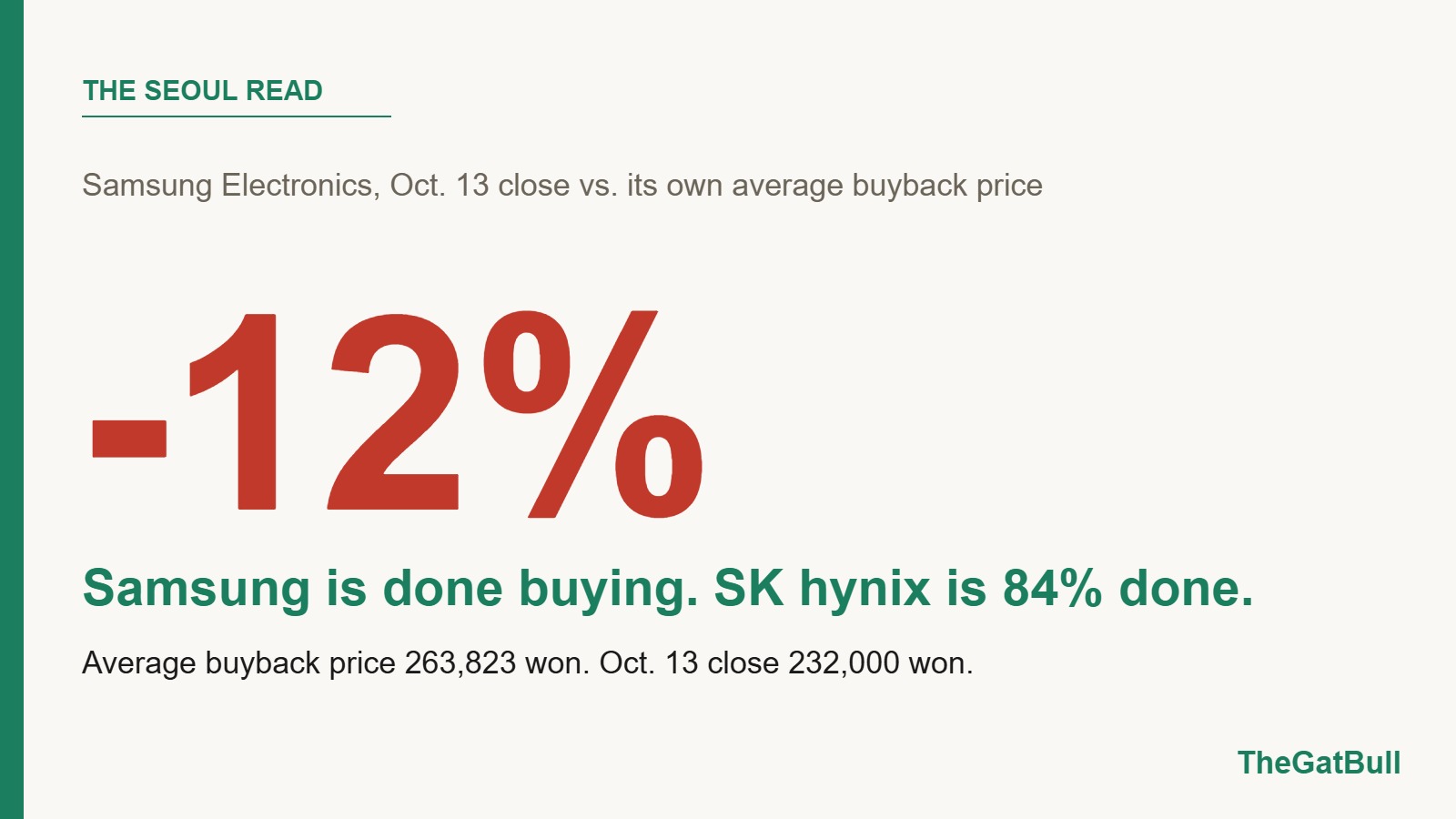
| Oct. 13 close vs. that average | −12.1% | −17.5% |
(Samsung: shares bought, period, average price and total are from the company’s Oct. 12 filing on DART, Korea’s official corporate-disclosure system; the purpose, filed period and “46 days early” are as reported by Korean media. SK hynix: Korean media citing Korea Exchange disclosure data as of Oct. 7, press-reported. The last row is our own arithmetic.)
Two things stand out.
First, Samsung is already done. Its last purchase was on Oct. 6, the first day of this five-session slide. We do not read that date as the cause. Other things happened in the same days (section 4).
Second, SK hynix is slowing down. According to Korean media, its daily purchases fell from 600,000–650,000 shares in September to 500,000 and then 400,000 shares in October. One outlet estimated that at the current pace and price it would finish around Oct. 20; another, in early October, expected Oct. 15–17. Neither is a date the company has announced. When the share price falls, the same money buys more shares, so the finish date moves too.
One more line: at today’s close, both companies are below the average price they paid, Samsung by 12% and SK hynix by 17.5% (our arithmetic). On paper, the companies are down on their own purchases.
3. Who is left on the other side: foreigners vs. individuals
Korea publishes net buying and selling by investor group each trading day. For the five sessions from Oct. 6 to Oct. 13 on the main market, one outlet (Financial News) reported:
| Investor group | Five sessions, net |
|---|---|
| Foreign investors | about −₩13.0 trillion (about $9.7 billion) |
| Individual investors | about +₩10.1 trillion |
| Institutions | about −₩0.8 trillion |
Today alone, foreigners were net sellers of about ₩4.5 trillion (about $3.3 billion), while individuals bought about ₩2.2 trillion and institutions about ₩1.7 trillion, according to three Korean outlets (the figures differ slightly, and they don’t say whether Nextrade trades are included).
The three groups don’t add up to zero. The remaining roughly ₩3.8 trillion (our arithmetic) falls into other categories such as “other corporations,” and a company buying its own shares usually shows up there. When we covered the days in September when all three investor groups sold and the index still rose, that category was the buyer. We can’t tell how much of that ₩3.8 trillion is SK hynix’s buying, so we don’t claim it is.
Under the Gat. “While a company is buying its own stock, the price has the company’s orders in it. Take those out, and the price on the screen is set mostly between foreigners and individuals. I don’t read that as a bottom signal or as a signal of more selling. I just don’t measure October with September’s numbers: in September there was one more buyer.”
4. The reasons Korean media gave today (we don’t confirm any of them)
Korean outlets explained the drop in several ways. Each is attributed to its source.
- Chinese memory competition. Infostock Daily cited reports that China’s CXMT plans to release a server memory module (DDR5) built on a new “4F²” DRAM design by year-end. Samsung and SK hynix are reported to be preparing the same design, so the worry is that CXMT could get there first.
- Doubts about AI spending paying off (cited by Korean media). U.S. chip stocks fell the night before: in the Oct. 12 U.S. session, SKHY, SK hynix’s U.S.-listed shares, fell 4.02% (Yahoo Finance), and Micron fell 3.88% (press-reported). That U.S. session ended before Seoul opened on Oct. 13, so we can only describe the order of events.
- Foreign selling, now six straight sessions (Infostock Daily).
- The end of Samsung’s buyback weakening support (Seoul Shinmun’s interpretation).
We have no primary evidence to split how much each one mattered. What the data does show: the electrical and electronics sector fell 7.61% today while LG Energy Solution rose 3.02% (press-reported). The selling was concentrated in chips.
5. What to watch this week (Seoul time)
| Date | What | Why it matters |
|---|---|---|
| From Wed, Oct. 14 | SK hynix’s daily buyback filings | SK hynix has to post each day’s buy order in advance. When a day’s order shows zero shares, the program is over (how those daily filings work) |
| Around Oct. 20 (media estimate) | SK hynix buyback ends | A results filing follows; the cancellation comes after that |
| Mon, Oct. 19 | 15% per-stock cap on new margin loans starts | A voluntary brokerage-industry rule that limits new margin lending on any single stock to 15% of each broker’s limit (our explainer). Margin borrowing is one source of individual investors’ buying power |
| Thu, Oct. 22 | Bank of Korea rate decision | The Bank of Korea’s first rate decision since the September FOMC meeting (Bank of Korea 2026 schedule) |
| Wed, Oct. 28 | SK hynix third-quarter results | 9:00 a.m. Seoul (Tue, Oct. 27, 8:00 p.m. ET), confirmed in the company’s DART filing of Oct. 14. Updated Oct. 14: this row first showed Oct. 27, the date in Korean media reports. |
(The Korea Exchange has no holidays this week; Oct. 13–16 are regular trading days.)
6. What these two companies show about the Korean market
A U.S. reader who sees only “foreigners are selling Korea” can’t see who was on the other side. One part of the picture may be the companies whose shares were being sold: they were buying their own stock, though we cannot match that buying to the foreign selling. This fall, Korea’s two largest companies by market value spent a combined roughly ₩48.7 trillion (through Oct. 6, about $36.2 billion; the sum of the figures above) on their own shares. Samsung’s part ended on Oct. 6. SK hynix’s part ends once the remaining roughly ₩6.3 trillion is spent.
So this week the thing to watch is not the index level but who is still buying. Where the companies step back, individuals remain, and from Oct. 19 their margin buying faces a per-stock cap. Three things (the end of the buybacks, the margin cap and a rate decision) fall within the same ten days. That is the structure of the Korean market this week.
7. How to reach these stocks from the U.S., and a U.S. comparison
- Access. Samsung Electronics has no ADR listed on a U.S. exchange; the usual route is buying the Seoul shares through a U.S. broker that offers Korean stocks. SK hynix trades on Nasdaq as SKHY. One common way to hold both is EWY, the iShares MSCI South Korea ETF, where the two made up 47.58% of the fund as of Oct. 9 (iShares). EWY isn’t this article’s focus, but both stocks’ moves flow straight into it.
- U.S. comparison. U.S. buybacks also have periods when the buying stops: the blackout windows around earnings, when a steady buyer, the company, steps out of the market.
- Not a perfect parallel. Large U.S. buybacks are usually ongoing programs that restart after the blackout. These two Korean programs are one-off programs with a fixed amount and period. Once they end, they don’t restart unless the company decides on a new one.

Bottom line
On a day KOSPI lost 5.5%, the one line to keep is this: the two months in which the companies were buying their own stock are ending. Samsung is done; SK hynix nearly is. We don’t say that is why the market fell today, but once SK hynix finishes, prices will be set without that buying. Watch Oct. 19 and Oct. 22.
FAQ
How much did KOSPI fall on October 13, 2026?
KOSPI closed at 6,035.35, down 5.46% (KRX regular-session close, 15:30 Seoul time). It touched 5,911.11 during the day (down 7.41%), and a sell-side “sidecar” (a five-minute pause in program selling) was triggered, according to Korean media. It was the fifth straight daily decline and left the index 13.83% below its Oct. 2 close.
Is Samsung Electronics’ share buyback finished?
Yes. According to Samsung’s Oct. 12 DART filing, it bought 56,856,305 shares between Aug. 24 and Oct. 6 for about ₩15 trillion, at an average of ₩263,823 per share. According to Korean media, the shares are for employee compensation, not cancellation.
When does SK hynix’s share buyback end?
SK hynix has not announced an end date. By Oct. 6 it had used 84.2% of its ₩40 trillion program, and Korean media estimated it could finish between about Oct. 15 and Oct. 20. The filed period runs to Nov. 19, and the shares are to be canceled.
What should I watch in Seoul this week?
SK hynix’s daily buyback filings (the day the requested quantity drops to zero), the start of the 15% per-stock cap on new margin loans on Monday, Oct. 19, and the Bank of Korea’s rate decision on Thursday, Oct. 22.
Sources
- Index and stock closes: Yahoo Finance chart data (^KS11, ^KQ11, 005930.KS, 000660.KS), retrieved Oct. 13 (KST), KRX 15:30 regular-session closes; SKHY via the same route, U.S. trading-day close in USD.
- Samsung Electronics buyback results: DART filing 20261012000421 (Oct. 12, 2026).
- SK hynix buyback progress: Womentimes (citing Korea Exchange disclosure data); Herald Economy (program terms).
- Today’s market, sidecar, investor flows, the won and media explanations: Infostock Daily, Financial News, Seoul Shinmun.
- EWY weights: iShares EWY holdings, as of Oct. 9, 2026.
- Bank of Korea 2026 Monetary Policy Board schedule (Bank of Korea press release, Oct. 30, 2025).
How sure are we?
| Item | Confidence |
|---|---|
| Index and stock prices | Computed from vendor price data (Yahoo Finance); KRX regular-session closes, matched by three Korean outlets |
| “Lowest close since July 30” and the June 22 closing high | According to Yahoo Finance daily data; not checked against KRX index files |
| Samsung buyback (period, shares, average price, total) | Confirmed from the primary filing (DART) |
| SK hynix buyback progress and end-date estimates | Press-reported, citing exchange data; the end date is a media estimate, not confirmed by the company |
| Investor flows | Press-reported; the five-session totals come from a single outlet; not checked against the exchange’s table |
| Sidecar and reasons for the fall | Press-reported; the reasons are interpretations, not confirmed |
| The won | Press-reported Seoul 15:30 rate, about ₩1,345 |
| SK hynix results date (Oct. 28, Seoul) | Confirmed from the company’s DART filing of Oct. 14; updated from the press-reported Oct. 27 shown at publication |
Not financial advice. TheGatBull is an independent publication; nothing here is a recommendation to buy or sell any security.
 Written by Mr.Gat — TheGatBull
Korean market coverage from a Seoul-metro-based operator who reads the filings in the original language. Every price on this site is the KRX regular-session close (15:30 Seoul); every figure states whether it came from a primary filing, the press, or our own calculation. Drafts are AI-assisted, then verified against the original Korean documents and edited by a human before publishing.
Found an error? Tell us — corrections get priority. How we work →