TL;DR — If you own Korean stocks directly or through a fund. In the seven sessions when KOSPI lost 20.7%, the clearest request from Seoul’s officials was about debt, meaning how much stock Korean investors hold with borrowed money, not about where prices should be. The next hard date is Monday, Oct. 19, when an industry cap on margin loans per stock, announced in September, takes effect; whether this week’s words worked is too early to say.
Not financial advice.
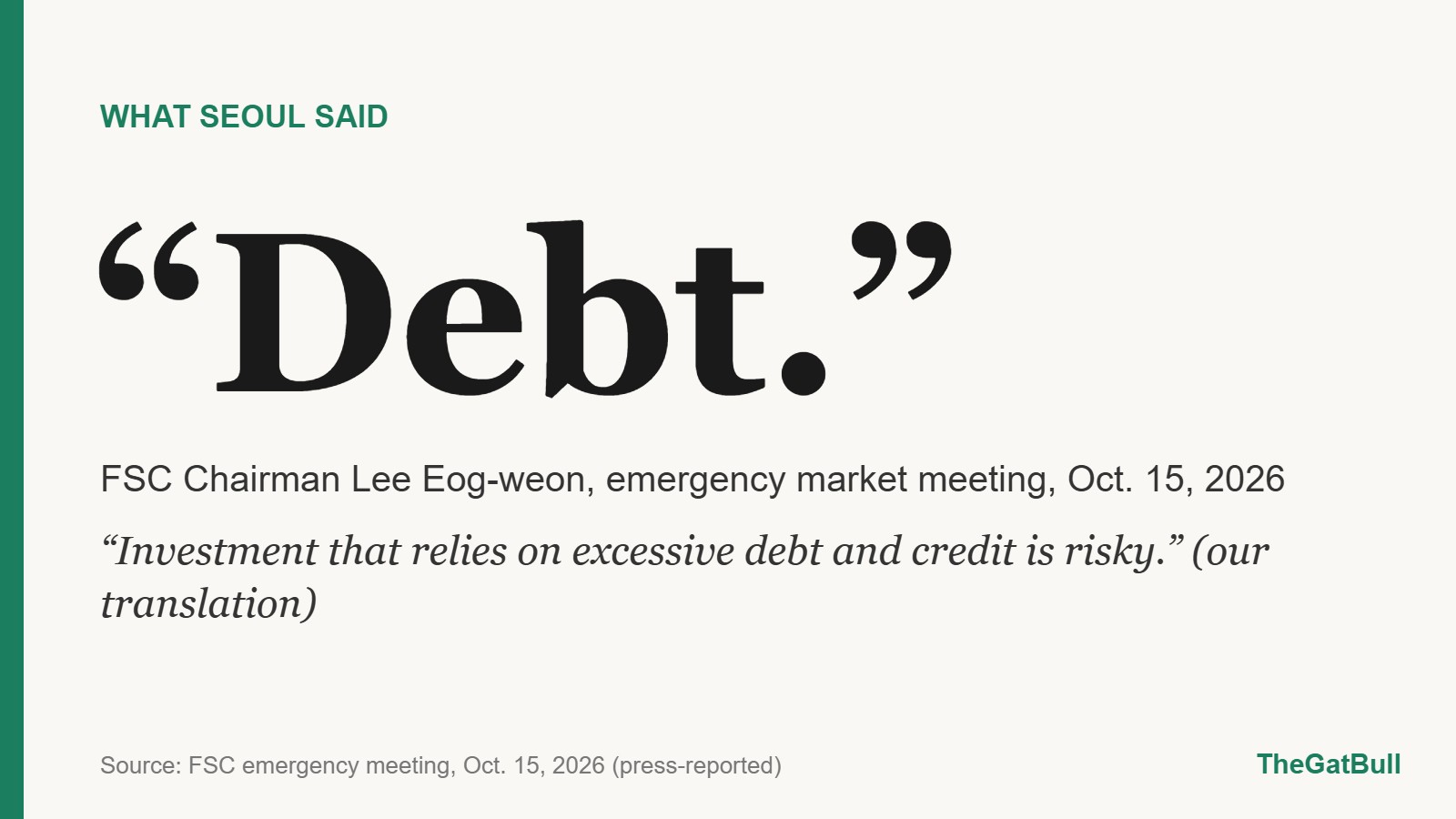
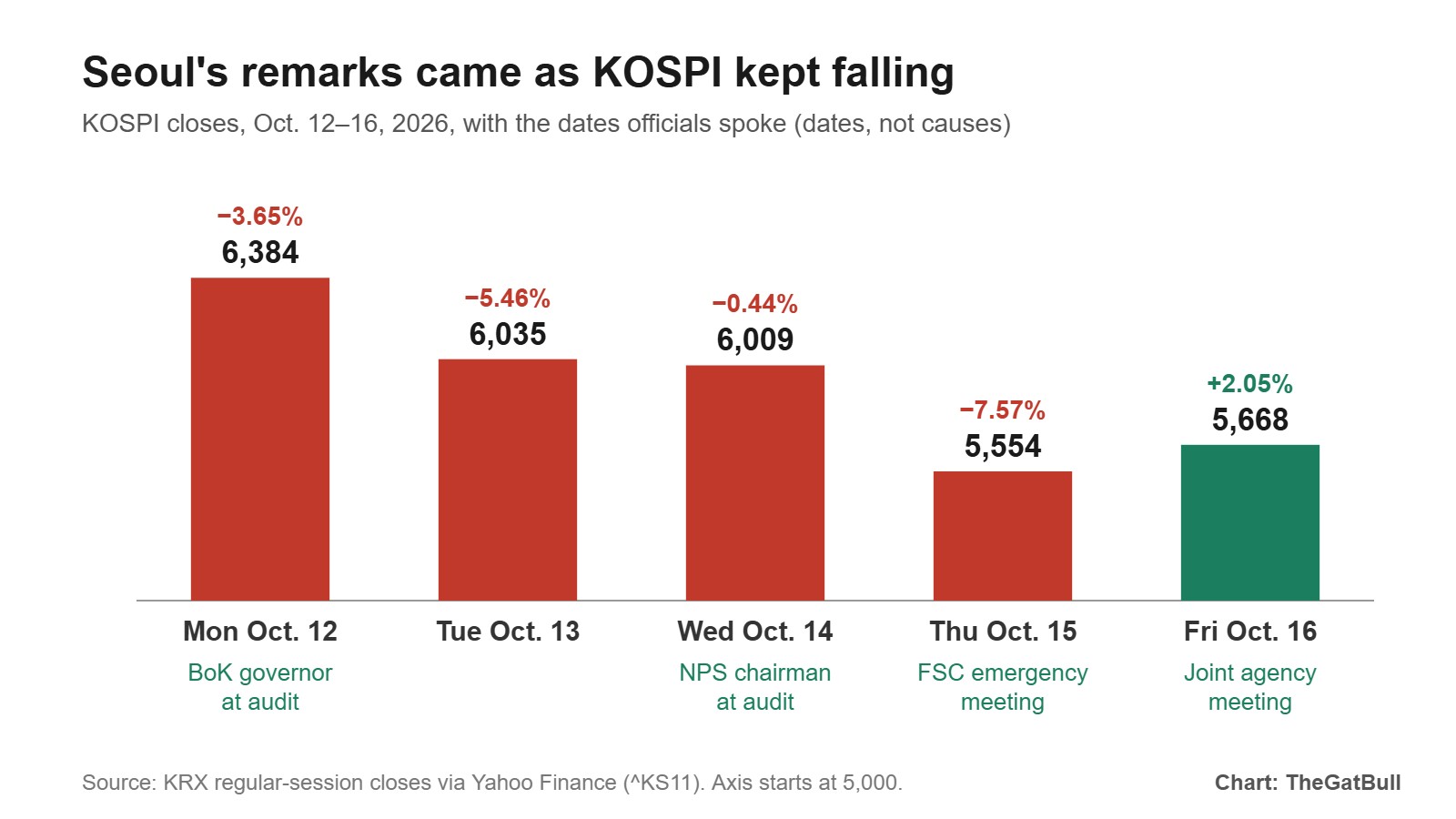
KOSPI (Korea’s main index) fell 20.70% over seven sessions from Oct. 2 to Oct. 15 on closing prices, including 7.57% on Thursday alone, a day that triggered a level-one circuit breaker (a market-wide trading halt). On Friday, Oct. 16, it bounced 2.05% to 5,668.05; from the Oct. 8 close to Oct. 16, it was down 14.46%. The clearest request officials made in public this week was about borrowed money. On Thursday, Financial Services Commission (FSC) Chairman Lee Eog-weon told an emergency meeting that “investment that relies on excessive debt and credit is risky” and asked brokerages to hold back on lending for stock purchases. In what we checked, no official said this week that the government would buy stocks through a market-stabilization fund or ban short selling. The next hard date is Monday, Oct. 19.
What this means if you own Korean stocks directly or through a fund. Two checkpoints: Oct. 19, when the brokerages’ cap on margin loans per stock takes effect, and Thursday, Oct. 22, the Bank of Korea’s rate meeting, where its language on financial stability and debt is worth watching alongside the rate decision.
Dates and times are Seoul time (KST). Index levels are KRX (Korea Exchange) regular-session closes (15:30 Seoul). Quotes from Korean officials are our translations. Dollar conversions are for scale only, at ₩1,331.4 per dollar, the Oct. 16 Seoul 15:30 rate.
Where do these words land? On the borrowing line, not the price line
Start with the mechanism. Korean individual investors can borrow from their brokerage to buy stocks; this is a margin loan (in Korean, sinyong yungja). If prices fall and the collateral drops below a set level, the brokerage can sell the shares without asking the customer. That is forced liquidation (bandae maemae). Falling prices can trigger selling, and that selling can push prices down further.
This week’s numbers (Korea Financial Investment Association data, as reported by Seoul Economic TV on Oct. 16):
| Measure | Value | Note |
|---|---|---|
| Margin loans outstanding | ₩33.71 trillion (about $25.3 billion) | Before Thursday’s Oct. 15 plunge |
| Forced liquidation, Oct. 14 alone | ₩89.3 billion (about $67 million) | The press described it as the largest daily figure since July 31; about 14 times Oct. 8’s ₩6.4 billion (about $4.8 million) |
| Forced liquidation, four trading days | About ₩182.1 billion (about $137 million) | Period as defined in the report |
| Unpaid trade balances, Oct. 14 | ₩1.36 trillion (about $1.02 billion) | Up ₩115.9 billion (about $87 million) in one day |
Press-reported figures. Unpaid trade balances are buys a customer has not yet paid for in full; they are a separate measure from forced liquidation.
The clearest request from the authorities this week was aimed at the first row of that table: the amount of debt. That is a different line from words aimed at the price level, such as a promise to defend a certain index level.
Who said what, day by day?
| Date (KST) | Who | What they said or did | How sure |
|---|---|---|---|
| Mon., Oct. 12 | Bank of Korea Governor Shin Hyun-song, at the central bank’s annual parliamentary audit | Agreed that the bank “could not fully grasp” the volatility in Korean stocks and memory chips and so “could not warn sufficiently”; said he was “sorry to the public” over single-stock leveraged ETFs; said inflation will run “above the target level for a considerable period” | ✅ On the record (quoted by two outlets) |
| Wed., Oct. 14 | National Pension Service (NPS) Chairman Kim Sung-joo, at his own parliamentary audit | Defended the fund’s January decision to delay rebalancing its Korean stocks: without the delay, it “would have had to dump at least ₩800 billion every day,” at least 10% of KOSPI’s daily trading value | ✅ On the record; the ₩800 billion (about $601 million) is a hypothetical, not actual selling |
| Thu., Oct. 15 | FSC Chairman Lee Eog-weon, emergency market meeting | “Investment that relies on excessive debt and credit is risky, and at times like this risk management matters more”; asked brokerages to hold back on “indiscriminate” lending for stock purchases; promised a strict response to unfair trading (false rumors, price manipulation, illegal short selling); said it is preparing to put a “contingency plan” into action quickly if conditions worsen | ✅ On the record (several outlets) |
| Fri., Oct. 16, 9 a.m. | Joint meeting chaired by First Vice Minister of Economy and Finance Kwon Dae-young, with the Bank of Korea, the Financial Supervisory Service and the FSC | Named the causes of the fall as U.S. Treasury yields, uncertainty over the AI and chip outlook, the Middle East and oil prices; judged “fundamentals, such as growth and corporate earnings, are solid”; set up real-time joint monitoring, including checks on spillover into bond, currency and short-term funding markets | ✅ Meeting and measures confirmed; ⚠️ the quote comes from news headlines, speaker not identified |
| Takes effect Mon., Oct. 19 | Ten large brokerages (per-stock cap announced Sept. 23 with the Korea Financial Investment Association) | New margin loans for any single stock, such as Samsung Electronics or SK hynix, capped at 15% of each firm’s total margin lending; Mirae Asset Securities raises its margin deposit rate to 50% from 45% | ⚠️ Press-reported; a voluntary industry measure announced Sept. 23, which the head of the Financial Supervisory Service urged brokerages to follow on Sept. 29 (see our Oct. 7 guide) |
We explained how the per-stock cap works in our guide to Korea’s margin-loan cap per stock, and the price side of this week in How Korea’s KOSPI Lost 20.7% in Seven Sessions.
Under the Gat (our take). “We’re not claiming Seoul ruled out buying stocks. We just found no official who said it would. The lever the authorities talked about this week was the amount of debt.”
How do the authorities see it, in their own words?
The FSC’s position on Oct. 15 was that the authorities should stay alert to the wider swings, but must also “guard against the spread of excessive anxiety and sharp herding,” and that investors “need to make rational investment decisions, considering companies’ intrinsic value and medium- to long-term growth potential.” Participants in that meeting reportedly judged that, going by the speed of the decline and trading flows alone, the market had overreacted. The next day, the government meeting pointed to outside factors, U.S. Treasury yields, the AI and chip outlook, the Middle East and oil, and called growth and corporate earnings solid. Our reading of this reasoning: the authorities’ job is not to hold prices up, but to shrink the loop through which a fall is amplified by debt, meaning forced liquidation, and to stop market abuse while that happens. The NPS chairman’s explanation points the same way: in his hypothetical, had the fund rebalanced by its rules in January, it would have had to sell at least ₩800 billion a day, and he argued that selling would itself have been a shock.
Did it work? Some evidence on each side, and it is too early to tell
What could be read as working: On Friday, Oct. 16, KOSPI ended its seven-session losing streak, up 2.05% at 5,668.05, and KOSDAQ (Korea’s smaller-company index) closed up 4.46% at 794.78. On a preliminary count just after the close, foreign investors were net buyers of KOSPI shares for the first time in eight trading days, about ₩342.8 billion (about $257 million) (Korea Economic Daily, 3:35 p.m. preliminary count, not the final tally).
What we could not confirm: By the time of the FSC chairman’s warning this week, on Thursday afternoon, forced selling had already piled up (₩89.3 billion on Oct. 14 alone), and the ₩33.71 trillion margin balance is a figure from before Thursday’s plunge. How much actual deleveraging, meaning paying down debt, has happened is not visible in this week’s data. This is a limit of the data, not evidence that the measures failed.
Why we can’t call it yet: For Friday’s rebound, the press pointed to a rebound in U.S. stocks, lower Treasury yields and remarks by Nvidia’s Jensen Huang (Korea Economic Daily). We found no evidence linking the officials’ words to the rebound. And the Oct. 19 rule has not taken effect yet. Our verdict: too early.
What did we not find this week?
Not finding something is not proof it was ruled out.
- A market-stabilization fund (a pool of government and financial-sector money that buys stocks) or a short-selling ban: we found no mention in the three or four reports we checked on the Oct. 15 and Oct. 16 meetings. The FSC said only that it is preparing a contingency plan, and it has not disclosed what is in it. Not announced in what we checked; that does not mean the authorities ruled it out.
- Direct remarks on the market this week by the president or the head of the Financial Supervisory Service: none in what we checked.
What does this week say about Korea’s market?
Here is the structural fact a U.S. reader can take from this week. In this crash week, the authorities’ clearest lever was the amount of borrowed money, not the price, and the tool for it had already been set in September: an industry-run cap that takes effect Oct. 19, not a change in the law and not government buying. The FSC chairman’s Thursday request pointed at the same line. The question U.S. investors know well, “when will the government step in to buy?”, has no answer in Korea as of this week. The question you can actually watch is how fast the debt shrinks.
Separately, the Bank of Korea governor agreed at his audit that the bank had not warned enough. That makes Oct. 22 a day to watch not only for the rate decision but for how the central bank talks about financial stability and debt. Governor Shin also said inflation will stay above target for a considerable period, after the bank’s rate increases in July and August. In his Oct. 12 remarks, we saw no signal toward a rate cut.
Is there a U.S. parallel?
- Regulation T (Federal Reserve): when you buy stock on margin in the U.S., the initial margin is 50% of the purchase price, the same number as the 50% margin deposit rate Mirae Asset Securities moves to on Oct. 19. Not a perfect parallel: Reg T is a federal rule; Korea’s 50% and 15% are voluntary industry measures.
What dates matter next week?
| Date | Event | What to look for |
|---|---|---|
| Mon., Oct. 19 | Ten large brokerages’ 15% per-stock margin-loan cap; Mirae Asset’s 50% deposit rate | Whether it takes effect, and the margin-loan balance (daily data from the Korea Financial Investment Association) |
| Thu., Oct. 22 | Bank of Korea rate decision and the governor’s press conference | The rate decision, plus any language on financial stability and debt |
| Wed., Oct. 28, 9 a.m. | SK hynix third-quarter 2026 results (DART notice) | Results from one of the stocks the cap names as an example |
Dates only, not predictions.
How to get exposure from the U.S.: for the whole Korean market, EWY, a U.S.-listed ETF ($156.22 at the close of the Oct. 15 U.S. session); for single stocks, direct buying on the Korea Exchange through a broker such as Interactive Brokers. This week’s credit rules apply only to margin loans at Korean brokerages; they do not apply directly to U.S. brokerage accounts.

The bottom line
In the seven sessions when KOSPI lost 20.70%, Seoul did not promise a price. It cautioned against debt-fueled investing and asked brokerages to hold back on lending. Oct. 19 is when the industry’s per-stock margin cap takes effect, and Oct. 22 is the day to hear how the Bank of Korea talks about financial stability. Whether this week’s words worked is too early to say; we will check the margin-loan numbers in our next What Seoul Said.
FAQ
Did the Korean government buy stocks during this crash?
Not in what we checked. Reports on the Oct. 15 and Oct. 16 meetings mentioned no market-stabilization fund or government buying. The FSC said only that it is preparing a “contingency plan” for use if conditions worsen.
What changes on Oct. 19?
Ten large brokerages limit new margin loans for any single stock, such as Samsung Electronics or SK hynix, to 15% of each firm’s total margin lending (press-reported). Mirae Asset Securities raises its margin deposit rate to 50% from 45%.
What did the Bank of Korea governor admit?
At the Oct. 12 parliamentary audit, he agreed with the criticism that the bank had not fully grasped the volatility in Korean stocks and memory chips and so had not warned sufficiently.
How much did forced liquidation rise?
According to press reports citing Korea Financial Investment Association data, it was ₩89.3 billion (about $67 million) on Oct. 14 alone, about 14 times the Oct. 8 level.
Do these margin rules apply if I buy Korean stocks through a U.S. account?
No. These rules apply to margin loans at Korean brokerages. Margin loans at U.S. brokerages follow U.S. rules, such as Regulation T.
Sources
- FSC emergency market meeting (Oct. 15, 2026): Herald Economy, Money Today Broadcasting (MTN) and Alpha Economy, Oct. 15 (press).
- Joint market meeting of government agencies (Oct. 16, 2026, 9 a.m.): Newspim, Asia Economy and Financial News (News1), Oct. 16 (press).
- Bank of Korea parliamentary audit (Oct. 12, 2026): Financial News (News1) and MTN, Oct. 12 (press).
- National Pension Service parliamentary audit (Oct. 14, 2026): SBS Biz and MTN, Oct. 14 (press).
- Margin loans, forced liquidation, unpaid balances and the Oct. 19 measures: Seoul Economic TV, Oct. 16, citing Korea Financial Investment Association data (press).
- KOSPI and KOSDAQ closes: KRX regular-session closes, via Yahoo Finance chart data (^KS11, ^KQ11; vendor data).
- USD/KRW at the Oct. 16 Seoul 15:30 close: Asia Economy, Seoul Finance and Steel & Metal News, cross-checked (press).
- SK hynix third-quarter results date: DART filing 20261014800385.
How sure are we?
| Item | Confidence |
|---|---|
| KOSPI and KOSDAQ closes and period changes | Computed from vendor price data (Yahoo), KRX closes |
| Officials’ remarks marked on the record | ✅ On the record, quoted by at least two outlets; our translations |
| “The market overreacted” and “fundamentals are solid” | ⚠️ Press paraphrase or headline; speaker not identified |
| Margin, forced-liquidation and unpaid-balance figures | ⚠️ Press-reported, citing industry-association data |
| Oct. 19 brokerage measures | ⚠️ Press-reported, single outlet |
| Foreign net buying on Oct. 16 | ⚠️ Preliminary count, not the final tally |
| No stabilization fund or short-selling ban | ⚠️ Not found in what we checked; absence is not proof |
Not financial advice. TheGatBull is an independent publication; nothing here is a recommendation to buy or sell any security.
 Written by Mr.Gat — TheGatBull
Korean market coverage from a Seoul-metro-based operator who reads the filings in the original language. Every price on this site is the KRX regular-session close (15:30 Seoul); every figure states whether it came from a primary filing, the press, or our own calculation. Drafts are AI-assisted, then verified against the original Korean documents and edited by a human before publishing.
Found an error? Tell us — corrections get priority. How we work →