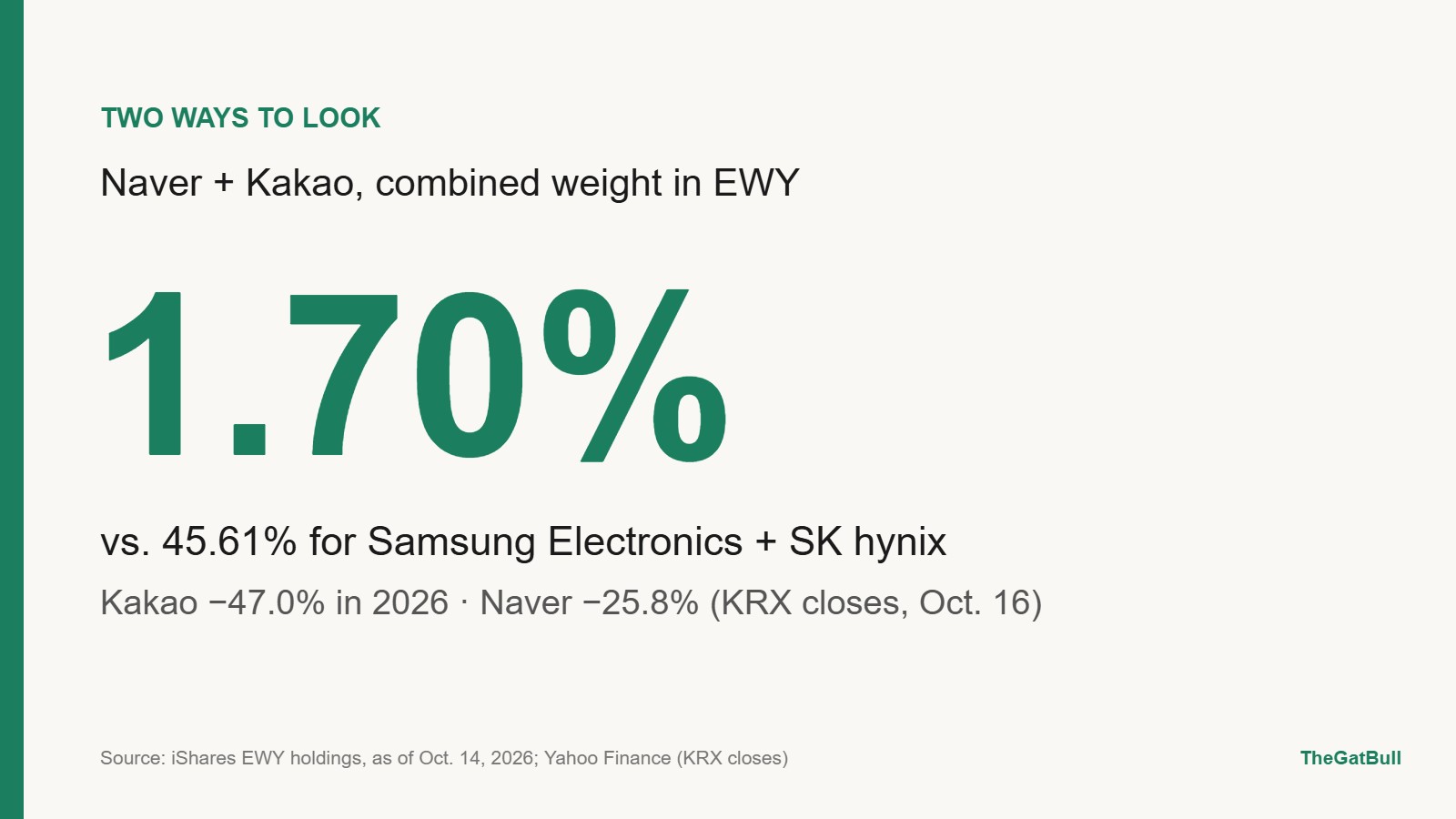
TL;DR — If you own or watch Naver or Kakao. Kakao fell more: in 2026, Kakao’s stock is down 47.0% and Naver’s 25.8%, even though Kakao’s second-quarter operating profit grew 36% and Naver’s slipped 0.2%. Both stocks are waiting on corporate restructurings scheduled for early 2027, and together they are just 1.70% of EWY.
Not financial advice.
Naver (search, ads and e-commerce) and Kakao (the KakaoTalk messenger), two of Korea’s large internet platforms, hit their lowest closing prices of the past year on the same day, Thursday, Oct. 15: Naver at ₩173,600 and Kakao at ₩31,000. On Friday, as KOSPI (Korea’s main index) bounced 2.05%, Naver closed at ₩180,000 (about $135) and Kakao at ₩31,850 (about $24). The company whose profit grew faster has fallen further this year. Our reading is that the gap owes less to the earnings line than to two restructuring dates: Kakao is splitting itself in two, with the new company, Kakao AI, targeting its first trading day on Jan. 27, 2027, and Naver’s financial arm is waiting on a share swap with Dunamu, operator of the crypto exchange Upbit, now pushed to March 31, 2027.
What this means if you hold EWY or either stock. In EWY (the iShares MSCI South Korea ETF), Naver is 1.12% and Kakao 0.58%, a combined 1.70% versus 45.61% for Samsung Electronics and SK hynix (iShares, as of Oct. 14), so this week’s crash and this year’s rally were not their doing; if you hold only EWY, these two are too small to move your fund much. If you own either stock directly, the dates to watch are Kakao’s third-quarter results on Nov. 5 (press-reported), its shareholder vote on the split on Dec. 17, and Jan. 27, 2027.
Prices are KRX (Korea Exchange) regular-session closes (15:30 Seoul time). “Start of 2026” means the 2025 closing price on Dec. 30, 2025. Percentages are in Korean won. Dollar conversions are for scale only, at ₩1,331.4 per dollar, the Oct. 16 Seoul 15:30 rate.
Did Naver and Kakao miss the rally, or dodge the crash?
Both. It depends on which stretch of 2026 you look at.
| Period (KRX closes) | KOSPI | Naver | Kakao |
|---|---|---|---|
| Start of 2026 to June 22 (KOSPI’s closing high) | +116.3% | −8.5% | −38.8% |
| June 22 to Oct. 16 | −37.8% | −18.9% | −13.5% |
| Oct. 2 to Oct. 15 (the seven-session slide, for reference) | −20.7% | −9.7% | −7.3% |
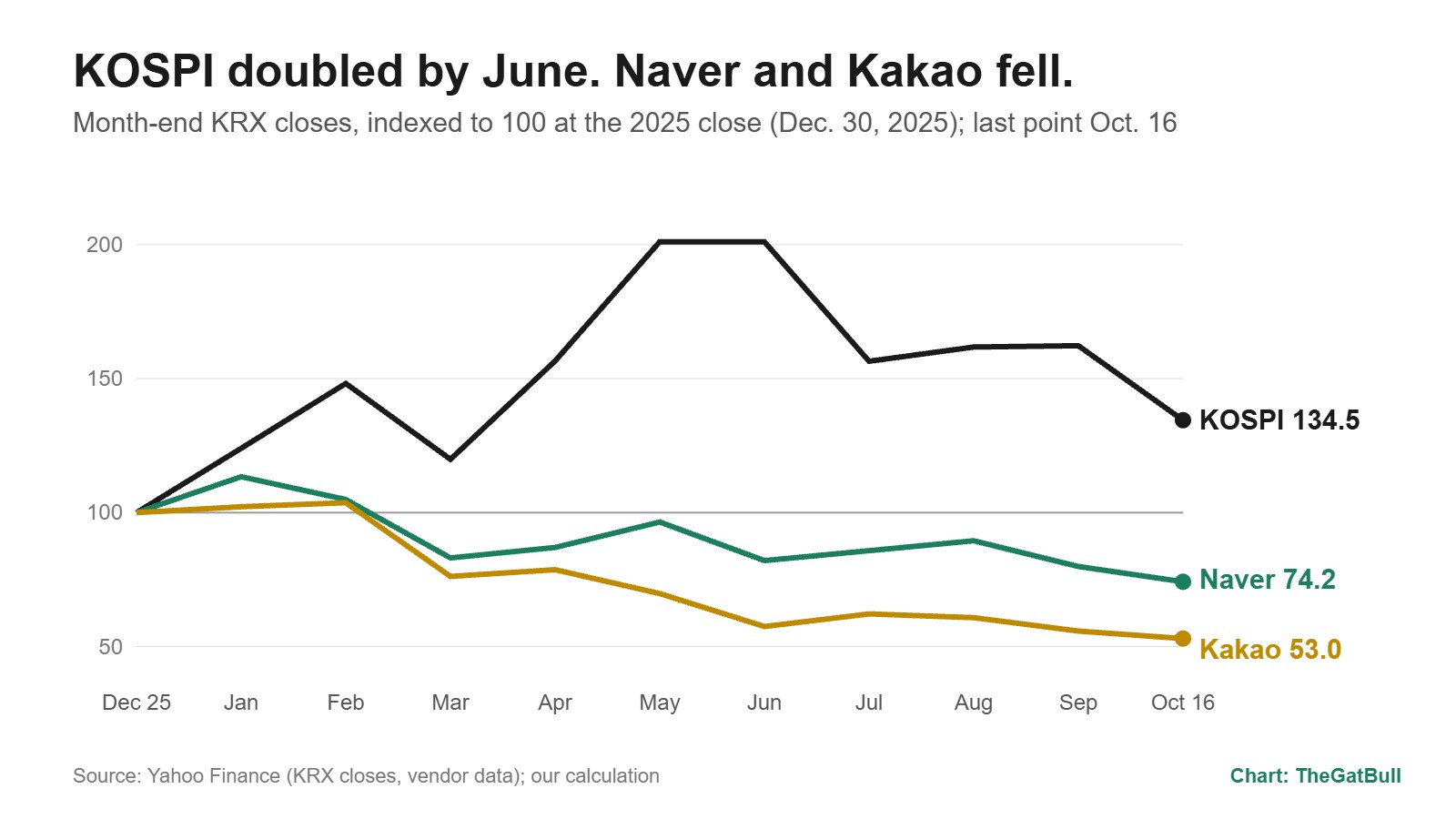
| Start of 2026 to Oct. 16 | +34.5% | −25.8% | −47.0% |
KRX closes; percentages are our calculations from vendor price data (Yahoo Finance).
One reading: they missed the chip rally. KOSPI more than doubled in the first half of 2026 while both stocks fell. The other reading: they took less of the chip crash. Since June 22, KOSPI is down 38%; Naver is down 19% and Kakao 14%. On daily returns this year, Naver’s correlation with KOSPI is 0.48 and Kakao’s 0.56 (1.0 would be a perfect match in daily moves; 0 would be no link). The two stocks track each other (0.66) more closely than they track the index (our calculation from vendor closing prices).
Under the Gat (our take). “Don’t read ‘fell less’ as ‘safe.’ Both stocks hit a one-year low this week. Moving apart from the chips also means they don’t climb with them.”
Whose profit is growing faster?
| Second quarter of 2026 (consolidated) | Naver | Kakao |
|---|---|---|
| Revenue | ₩3.39 trillion (about $2.55 billion), +16.2% | ₩2.10 trillion (about $1.58 billion), +9% |
| Operating profit | ₩520.3 billion (about $391 million), −0.2% | ₩277.0 billion (about $208 million), +36% |
| Source | Company-reported (Naver earnings release, Aug. 7) | Company-reported (Kakao earnings release, Aug. 6) |
Changes are from a year earlier.
- Naver: revenue was a quarterly record (that description is from press reports), but operating profit was flat. The company said buying computing assets, content and data raised its costs. The stock fell 7.08% on results day (Aug. 7).
- Kakao: revenue and operating profit were both the highest for any quarter, the company said. One broker expects a slowdown next: DB Securities estimates third-quarter operating profit of ₩249.5 billion, up 19.9% from a year earlier but down 9.9% from the second quarter and 4.9% below the market consensus of ₩262.3 billion (Newspim, Oct. 16). That is an analyst estimate, not company guidance. The broker cut its price target to ₩47,000 from ₩57,000 and kept a buy rating.
By profit growth alone, the stock moves should run the other way. So look at the next line.
What are the two restructurings?
Kakao is splitting itself in two. Its board approved the split on Aug. 21 (company-reported, press release). Kakao says existing shareholders will receive shares in both companies (company-reported in a press release; we have not checked the filing text). The 0.36 / 0.64 ratio is how Kakao’s book value (assets minus debts, on paper) is divided between them. It divides book value, not shares; the number of shares of each you will receive is not covered here, so check your broker’s corporate-action notice:
- Kakao AI (the new company, which will list as a separate stock): KakaoTalk, the messenger so widely used in Korea it is called the “national messenger,” plus AI, advertising and commerce.
- Kakao X (the surviving company): what Kakao calls a “future-value investment company.” It holds stakes in KakaoBank, KakaoPay, KakaoPay Securities, Kakao Entertainment, SM Entertainment, Kakao Piccoma and Kakao Mobility.
- Timeline: shareholder vote Dec. 17, split effective Jan. 1, 2027, listing targeted for Jan. 27, 2027 (Kakao says the dates may change).
Kakao’s stock fell 7.49% on announcement day, a day KOSPI rose 0.88%. On Oct. 13, Kakao showed Kanana Space, an AI assistant inside KakaoTalk, with a closed beta planned for December and a full launch in early 2027 (press-reported). The stock kept falling.
Naver is trying to merge, and the date keeps moving. The share swap between Naver Financial, Naver’s financial arm, and Dunamu has been delayed three times: from June 30 to Sept. 30, to Dec. 31, and now to March 31, 2027, with a Dunamu shareholder meeting on Feb. 26, 2027 (Dunamu’s Oct. 7 correction filing, as reported by Korea Economic Daily and Financial News). The press pointed to two holdups: Korea’s Fair Trade Commission has not finished its merger review, and parliament has not finished debating a digital-asset bill that would cap how much of a crypto exchange a major shareholder can own. Dunamu said it is “cooperating with the relevant authorities’ review and procedures.”
Both outcomes land in the first quarter of 2027. Until then, our reading is that the market is pricing these stocks less on profits than on what each share will turn into after the split or the merger. That is our view, not a confirmed fact.
Under the Gat (our take). “In Korea, holding companies often trade for less than the stakes they own (see SK Square). Once Kakao X is a bundle of stakes in listed companies, the question is whether that discount sticks to it. That is also why Korean retail investors dislike jungbok sangjang (double listing: a parent and its subsidiaries both trading on the market).”
Who was buying on Friday?
On Friday, foreign investors were net buyers of KOSPI shares for the first time in eight trading days, about ₩342.8 billion (about $257 million), on a preliminary 3:35 p.m. count (Korea Economic Daily). We don’t have reliable stock-level figures for Naver or Kakao, so we don’t quote any.
What dates should holders watch?
| Date | Event | How sure |
|---|---|---|
| Nov. 5, 9 a.m. Seoul | Kakao third-quarter results and call | Press-reported company IR notice |
| Not yet announced | Naver third-quarter results | No date in what we checked |
| Dec. 17 | Kakao shareholder vote on the split | Company-reported (press release) |
| Jan. 1, 2027 | Kakao split takes effect | Company-reported (press release) |
| Jan. 27, 2027 | Kakao AI listing target (first trading day) | Company-reported (press release), may change |
| Feb. 26 / March 31, 2027 | Dunamu shareholder meeting / share swap | Press-reported |
What do these two stocks say about Korea’s market?
KOSPI’s 2026 rise (+116% to June 22) and fall (−38% since) were, in our reading, driven mostly by Samsung Electronics and SK hynix. In EWY, those two are 45.61% of the fund and the information technology sector is 51.14%; the whole communication sector (Naver, Kakao, Krafton, SK Telecom, HYBE and LG Uplus) is 3.12% (iShares, as of Oct. 14). We covered that concentration in our look at EWY’s top two holdings, and this week’s chip-led slide in How Korea’s KOSPI Lost 20.7% in Seven Sessions. Naver and Kakao moved apart from the chip stocks, and apart from their own profit growth. In our reading, they tracked their restructuring calendars instead. Apply the U.S. rule of thumb that rising profits pull a stock up, and these two look backwards. In our reading, for these two platform stocks the discount for an unsettled corporate structure has outweighed earnings so far this year.
Under the Gat (our take). “With Korean platform stocks, a shareholder-meeting notice can matter more than an earnings date. This is one of those times.”
How can you get exposure from the U.S.?
- One click today: EWY. Naver is 1.12% and Kakao 0.58%; KakaoBank is a separate 0.43% (iShares, as of Oct. 14).
- Direct: a broker with access to the Korea Exchange, such as Interactive Brokers (Naver 035420, Kakao 035720).
- Watch list: Nov. 5, Dec. 17 and Jan. 27, 2027 (see the date table above).
Neither company has a U.S. ADR (a U.S.-listed share that represents the Korean stock). Naver has an over-the-counter quote, NHNCF, which is not an ADR; we did not confirm a Kakao OTC ticker. For Naver’s AI-infrastructure deal with Nvidia, see our read of that filing.
U.S. anchors: Naver is roughly Korea’s Alphabet: search plus advertising. Not a perfect parallel: Naver earns far more from e-commerce, and its financial arm is trying to combine with a crypto exchange. Kakao is a super-app built on a messenger (a comparable foreign example is China’s Tencent). After the split, Kakao X may look more like IAC, a holding company of stakes in other businesses. Not a perfect parallel: many of Kakao X’s companies are already listed on their own.

The bottom line
Both stocks hit one-year lows this week, and both are small in EWY. What sets them apart is the date each is waiting for: Jan. 27, 2027 for Kakao and March 31, 2027 for Naver. Kakao’s Nov. 5 results come first, but our reading is that the restructuring dates matter more than the profit line. This is our view, not advice.
FAQ
Are Naver and Kakao in EWY?
Yes. As of Oct. 14, 2026, Naver is 1.12% of EWY and Kakao 0.58%, with KakaoBank a separate 0.43% (iShares). Samsung Electronics and SK hynix together are 45.61%.
Why has Kakao stock fallen more than Naver in 2026?
From the 2025 close to Oct. 16, Kakao is down 47.0% and Naver 25.8% (KRX closes), even though Kakao’s second-quarter profit grew faster. The coming split in January 2027 and an expected third-quarter slowdown (an analyst estimate) overlap; no single cause has been confirmed.
What is the Kakao split?
Kakao’s board approved it on Aug. 21, 2026. Kakao AI (KakaoTalk, AI, ads and commerce) is the new company and gets 0.36 of the book value; Kakao X (stakes in its finance, content and mobility companies) is the surviving company and gets 0.64. The shareholder vote is Dec. 17, and Kakao AI’s listing is targeted for Jan. 27, 2027.
When does the Naver–Dunamu deal close?
The share swap is now set for March 31, 2027, after a third delay (press-reported). The press cited an unfinished Fair Trade Commission review and a delayed digital-asset bill.
Can I buy Naver or Kakao stock in the U.S.?
Neither has a U.S. ADR. You get a small slice through EWY, or you can buy the shares on the Korea Exchange through a broker that offers it.
Sources
- KRX closes: Yahoo Finance chart data (035420.KS, 035720.KS, ^KS11; vendor data).
- EWY weights: iShares EWY holdings file, as of Oct. 14, 2026.
- Naver second-quarter 2026 earnings release (Aug. 7, 2026), navercorp.com.
- Kakao second-quarter 2026 earnings release (Aug. 6, 2026) and split announcement (Aug. 21, 2026): earnings, split.
- Dunamu delay: Korea Economic Daily, Financial News (press).
- DB Securities estimate: Newspim (press). Kanana Space: Korea Economic Daily (press).
- Kakao results date: Vegan News (press).
- Exchange rate and market close: Asia Economy, Seoul Finance, Korea Economic Daily (press).
How sure are we?
| Item | Confidence |
|---|---|
| Prices and period changes | Computed from vendor price data (Yahoo), KRX closes |
| EWY weights | ✅ Confirmed on the record (iShares holdings file) |
| Second-quarter results, both companies | ✅ Company-reported |
| Kakao split terms and dates | ⚠️ Company-reported in a press release; filing text not checked |
| Dunamu delay and dates | ⚠️ Press-reported, two outlets agree |
| Third-quarter estimate | ⚠️ An analyst estimate, not company guidance |
| Why the stocks fell | ⚠️ Our reading, not a confirmed cause |
Not financial advice. TheGatBull is an independent publication; nothing here is a recommendation to buy or sell any security.
 Written by Mr.Gat — TheGatBull
Korean market coverage from a Seoul-metro-based operator with 15 years of personal investing experience, who reads the filings in the original language. Every price on this site is the KRX regular-session close (15:30 Seoul); every figure states whether it came from a primary filing, the press, or our own calculation. Drafts are AI-assisted, then verified against the original Korean documents and edited by a human before publishing.
Found an error? Tell us — corrections get priority. How we work →