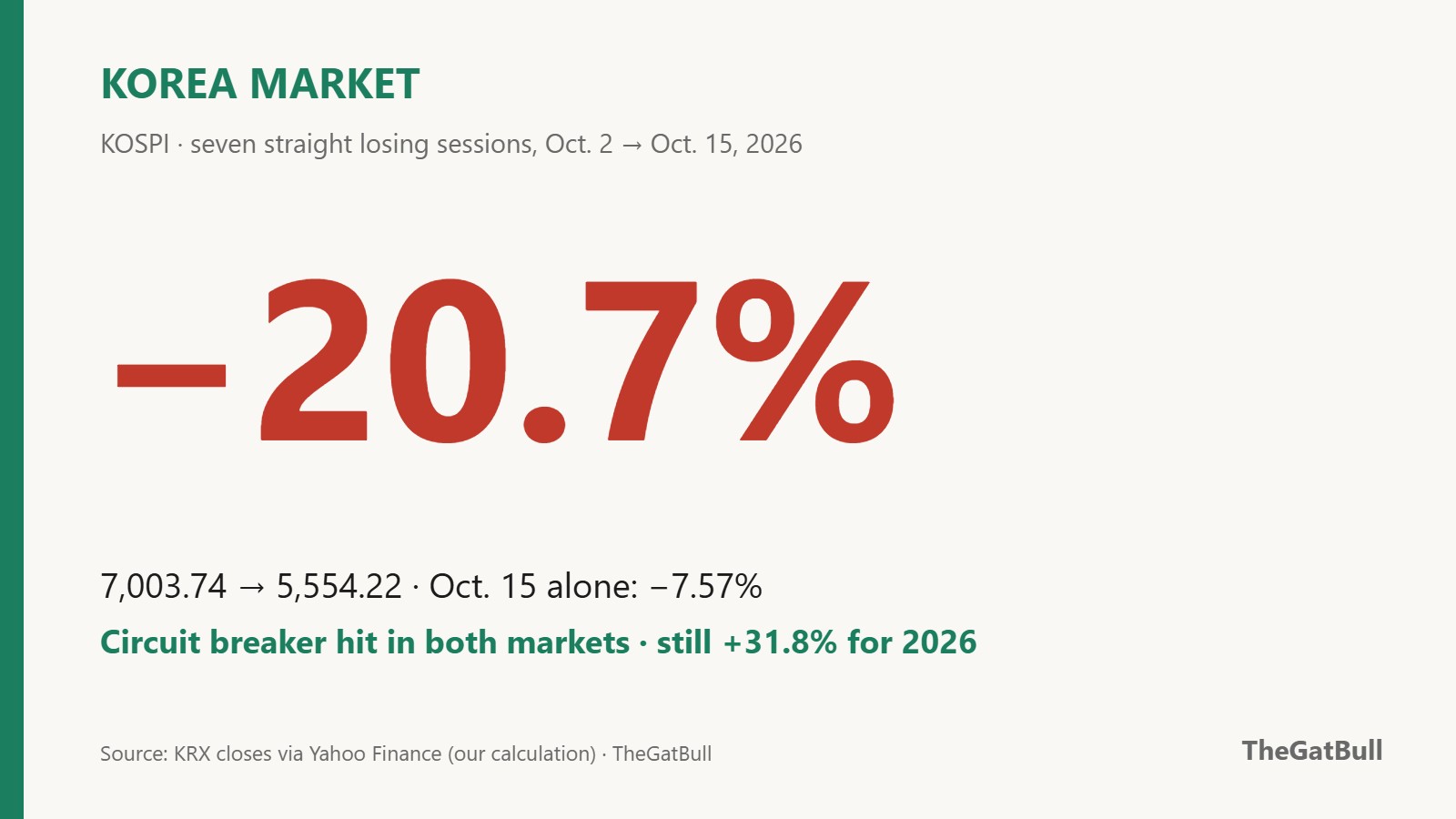
TL;DR — If you own Korean stocks. KOSPI, Korea’s main stock index, fell 7.57% to 5,554.22 on Thursday, Oct. 15, with trading halted in both Korean stock markets, and is down 20.7% over seven straight losing sessions. Samsung Electronics and SK hynix, Korea’s two memory-chip giants, have fallen further than the index since June.
Not financial advice.
On Thursday, Oct. 15, KOSPI closed down 7.57% at 5,554.22. During the day it fell more than 8%, which triggered a level-one circuit breaker (a 20-minute halt of all trading) in both of Korea’s stock markets, KOSPI and the smaller-company KOSDAQ. It was KOSPI’s seventh straight losing session: from 7,003.74 on Oct. 2, it is down 20.7%. For perspective, it is still up 31.8% from where it closed 2025 (4,214.17).
What this means if you own Korean stocks, directly or through a fund. Check how much of your holding is Samsung Electronics and SK hynix: since June, both have fallen more than the index. The next checkpoints are Friday’s Seoul open, the Bank of Korea’s rate decision on Oct. 22 and the third-quarter results of SK hynix (Oct. 28) and Samsung Electronics (Oct. 29).
Index and stock prices are KRX (Korea Exchange) regular-session closes (15:30 Seoul time); EWY prices are New York closes. Dollar conversions are for scale only, at ₩1,338.3 per dollar, the Oct. 14 Seoul 15:30 rate.
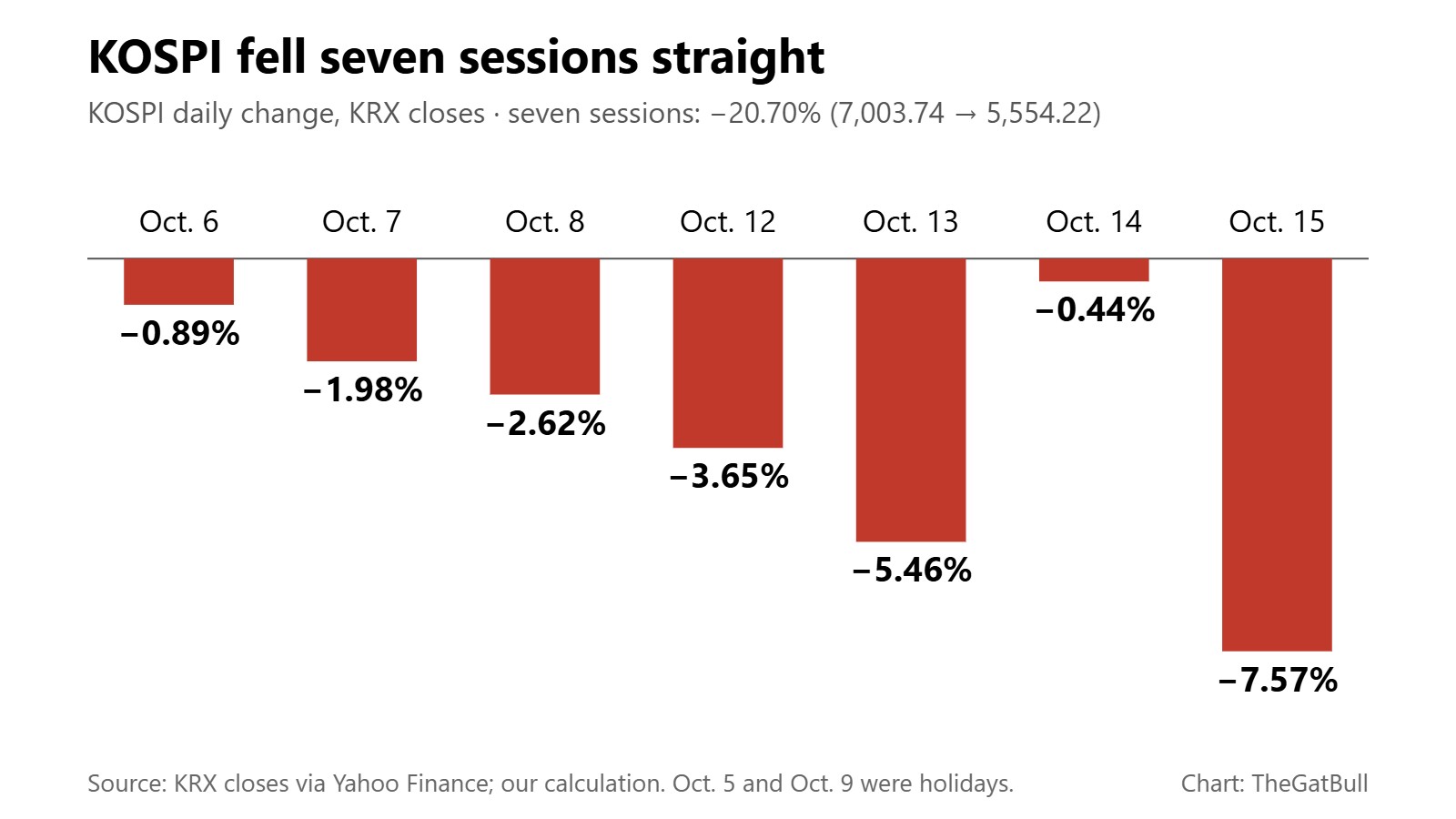
Seven sessions in numbers
| Date | KOSPI close | Daily change |
|---|---|---|
| Fri., Oct. 2 (start) | 7,003.74 | — |
| Tue., Oct. 6 | 6,941.39 | −0.89% |
| Wed., Oct. 7 | 6,803.90 | −1.98% |
| Thu., Oct. 8 | 6,625.93 | −2.62% |
| Mon., Oct. 12 | 6,384.24 | −3.65% |
| Tue., Oct. 13 | 6,035.35 | −5.46% |
| Wed., Oct. 14 | 6,008.81 | −0.44% |
| Thu., Oct. 15 | 5,554.22 | −7.57% |
| Seven sessions | −20.70% |
KRX closes, computed from vendor price data (Yahoo Finance). Korea’s market was closed on Oct. 5 (a substitute holiday for Gaecheonjeol, National Foundation Day) and Oct. 9 (Hangul Day).
KOSDAQ fell 7.65% the same day, to 760.82.
How do Korea’s sidecars and circuit breakers work?
Seoul has two automatic brakes for a falling market.
- Sidecar: when index futures swing sharply, the exchange pauses program sell orders only (automated basket trades) for 5 minutes. On Thursday it was triggered 7 minutes after the open on KOSPI and 12 minutes after the open on KOSDAQ.
- Level-one circuit breaker: when an index is down 8% or more from the prior close for one minute, all trading stops for 20 minutes, then resumes with a 10-minute single-price auction (orders are collected, then matched at one price). KOSDAQ hit it at 12:23 p.m. and KOSPI at 12:38 p.m. Seoul time, at 5,528.05 (−8.00%).
Circuit-breaker times and rules: four Korean outlets; sidecar timing: Asia Economy (press-reported). We explained the system in more detail in our guide to Korea’s sidecars and circuit breakers.
Under the Gat (our take). “A 7.57% day is a big number. The more important one is this: since June, the index is down 39%, but Samsung Electronics is down 42% and SK hynix 57%. When you buy Korea’s index, you are also buying the weather around those two stocks.”
Since June:
| June closing high | Oct. 15 close | From June high | Seven sessions (Oct. 2–15) | Oct. 15 change | |
|---|---|---|---|---|---|
| KOSPI | 9,114.55 (Jun. 22) | 5,554.22 | −39.06% | −20.70% | −7.57% |
| Samsung Electronics | ₩362,500 (Jun. 18) | ₩210,000 | −42.07% | −23.91% | −9.48% |
| SK hynix | ₩2,919,000 (Jun. 22) | ₩1,262,000 | −56.77% | −31.45% | −11.06% |
KRX closes; percentages are our calculations from vendor price data (Yahoo Finance). Korean media measured the index decline as “more than 40%” from the June 19 intraday high of 9,385.
Who sold? The outlets don’t agree
Foreign investors net sold about ₩3.6 trillion (about $2.7 billion) of KOSPI shares on Thursday, according to three Korean outlets (Joongang Economy News, Asia Economy, Kangwon Domin Ilbo). A fourth, Newspim, put it at ₩4.8 trillion (about $3.6 billion). The gap is too large to pick one, so we give the range. In dollars, that is roughly $2.7 billion to $3.6 billion. Individuals and institutions were net buyers. Foreign investors have been net sellers for eight straight trading days (press-reported; the outlets measure the running total differently, so we don’t quote one).
EWY hadn’t priced Thursday’s fall as of Seoul’s close
If you hold EWY (the iShares MSCI South Korea ETF), note the timing. Seoul’s Thursday session ran after New York’s Wednesday session had closed, so EWY’s last close ($159.83 on Wednesday, Oct. 14) does not include Seoul’s 7.57% drop. Thursday’s New York session is the first to reflect it. By that Wednesday close, EWY was already down 16.70% from Oct. 2 (in dollars). Samsung Electronics and SK hynix together are 47.58% of the fund (iShares, as of Oct. 9).
Why did Korean stocks fall? Four explanations, none confirmed
Korean media offered four explanations. All of them are the outlets’ reading, not a confirmed cause.
- U.S. inflation. The U.S. consumer price index rose 3.7% from a year earlier in September, against 3.6% expected; core prices rose 2.6%, against 2.5% expected. Outlets said that raised the chance of additional U.S. interest-rate increases (Newspim, Electronic Times).
- AI debt. Bond yields at CoreWeave, a U.S. AI cloud company, jumped, and its stock fell more than 15%, feeding worries about debt used to build AI infrastructure (Newspim, Electronic Times).
- Memory competition. Concern that CXMT, a Chinese memory-chip maker, is closing the technology gap in memory chips (Newspim).
- Selling pressure. Persistent foreign selling and worries about investors being forced to unwind borrowed positions (Joongang Economy News).
The same day, Taiwan’s TSMC reported third-quarter net profit up 69% from a year earlier; it did not turn Seoul’s market around (Joongang Economy News). In New York on Wednesday, the S&P 500 fell 1.1% and the Nasdaq 1.9% (Electronic Times). Seoul fell much harder.
What are Korea’s regulators trying to stop?
The mechanism. When investors buy stocks with borrowed money and prices fall, brokers can sell their shares for them to cover the loan (a forced sale, like a margin call). Those forced sales can push prices lower and trigger more of them. Breaking that chain appears to be the point of the request (our reading). Margin loans stood at ₩34.25 trillion (about $25.6 billion) on Oct. 13 (Korea Financial Investment Association data). A separate measure, forced sales when investors failed to pay for shares bought on short-term credit, was ₩59.35 billion (about $44 million) that day, more than double the day before (Digital Daily, press-reported).
In the regulators’ own words. Financial Services Commission Chairman Lee Eog-weon held an emergency review meeting on Thursday afternoon and asked brokers to refrain from indiscriminate lending for stock purchases. “Investing that relies on excessive debt and credit is risky, and at times like this, risk management matters more,” he said, and he asked financial firms to make every effort to protect customers and manage risk (Digital Daily, press-reported; our translation).
What they did and didn’t do. Regulators did not announce across-the-board limits on new margin lending or lower lending caps, and a contingency plan was prepared but not activated (press-reported).
Our verdict: too early to tell. Next week’s margin-loan and forced-sale numbers will be the first evidence, though price moves will affect them too.
What to watch, and a U.S. comparison
- Friday’s Seoul open (Oct. 16), and EWY in New York on Thursday.
- Margin loans and forced sales (Korea Financial Investment Association).
- The Bank of Korea’s rate decision, Thursday, Oct. 22.
- Third-quarter results from SK hynix (Oct. 28) and Samsung Electronics (Oct. 29), both dates set in company notices.
U.S. anchor — U.S. market-wide circuit breakers: in the U.S., trading halts for 15 minutes if the S&P 500 falls 7% (Level 1) or 13% (Level 2) before 3:25 p.m. Eastern, and for the rest of the day at 20% (Level 3) (Nasdaq).
Not a perfect parallel: Korea’s breakers are set separately for each index (KOSPI and KOSDAQ), and Korea’s first level is 8% and 20 minutes. A single U.S. trigger based on the S&P 500 stops all U.S. stock trading.
For how Seoul’s regulators answered the crash in July, see How Korea Answered a Crash Without Helping Shareholders. For the buyback angle earlier this week, see our Oct. 13 piece on the end of the chip giants’ buybacks. For a company-level earnings story from the same week, see LG Energy Solution’s preliminary third-quarter results.

The bottom line
Korea’s market fell 7.57% on Thursday and 20.7% over seven sessions; Thursday’s intraday drop of more than 8% stopped trading for 20 minutes. The two chip giants fell further than the index, so their results on Oct. 28 and 29 are the next big data points. Year to date, KOSPI is still up 31.8%.
FAQ
How much did KOSPI fall on Oct. 15, 2026?
It fell 7.57% to 5,554.22, its seventh straight losing session, for a 20.70% decline from 7,003.74 on Oct. 2 (KRX closes).
What is a circuit breaker in the Korean stock market?
When an index is down 8% or more for one minute, all trading stops for 20 minutes, then resumes with a 10-minute single-price auction. On Oct. 15 it was triggered on KOSDAQ at 12:23 p.m. and on KOSPI at 12:38 p.m. Seoul time.
Why did Korean stocks crash on Oct. 15?
No cause has been confirmed. Korean media pointed to hotter-than-expected U.S. inflation (the September consumer price index up 3.7%), worries about AI debt, competition in memory chips and heavy foreign selling.
Has EWY already priced in the Oct. 15 drop?
No. EWY’s Oct. 14 close came before Seoul’s Oct. 15 session. The first New York session to reflect it is Oct. 15.
Is KOSPI still up this year?
Yes. At 5,554.22 it is up 31.8% from its 2025 close of 4,214.17, though down 39% from its June 22 closing high.
Sources
- KRX and New York closes: Yahoo Finance chart data (^KS11, ^KQ11, 005930.KS, 000660.KS, EWY; vendor data).
- Market close reports, Oct. 15: Asia Economy, Kangwon Domin Ilbo, Joongang Economy News, Maeil Ilbo, Dailian, Newspim, Electronic Times (press).
- Regulators’ meeting and margin data: Digital Daily, News1 (press).
- EWY weights: iShares EWY holdings, as of Oct. 9, 2026.
- U.S. circuit breakers: Nasdaq.
How sure are we?
| Item | Confidence |
|---|---|
| Index and stock closes, daily and cumulative changes | Computed from vendor price data (Yahoo), KRX closes |
| Circuit-breaker times and rules | ⚠️ Press-reported, four outlets agree |
| Sidecar timing | ⚠️ Press-reported, single outlet |
| Foreign net selling | ⚠️ Press-reported; outlets differ (₩3.6 trillion vs. ₩4.8 trillion) |
| Causes of the decline | ⚠️ Media explanations, not confirmed |
| Regulators’ statements, margin and forced-sale data | ⚠️ Press-reported |
Not financial advice. TheGatBull is an independent publication; nothing here is a recommendation to buy or sell any security.
 Written by Mr.Gat — TheGatBull
Korean market coverage from a Seoul-metro-based operator who reads the filings in the original language. Every price on this site is the KRX regular-session close (15:30 Seoul); every figure states whether it came from a primary filing, the press, or our own calculation. Drafts are AI-assisted, then verified against the original Korean documents and edited by a human before publishing.
Found an error? Tell us — corrections get priority. How we work →