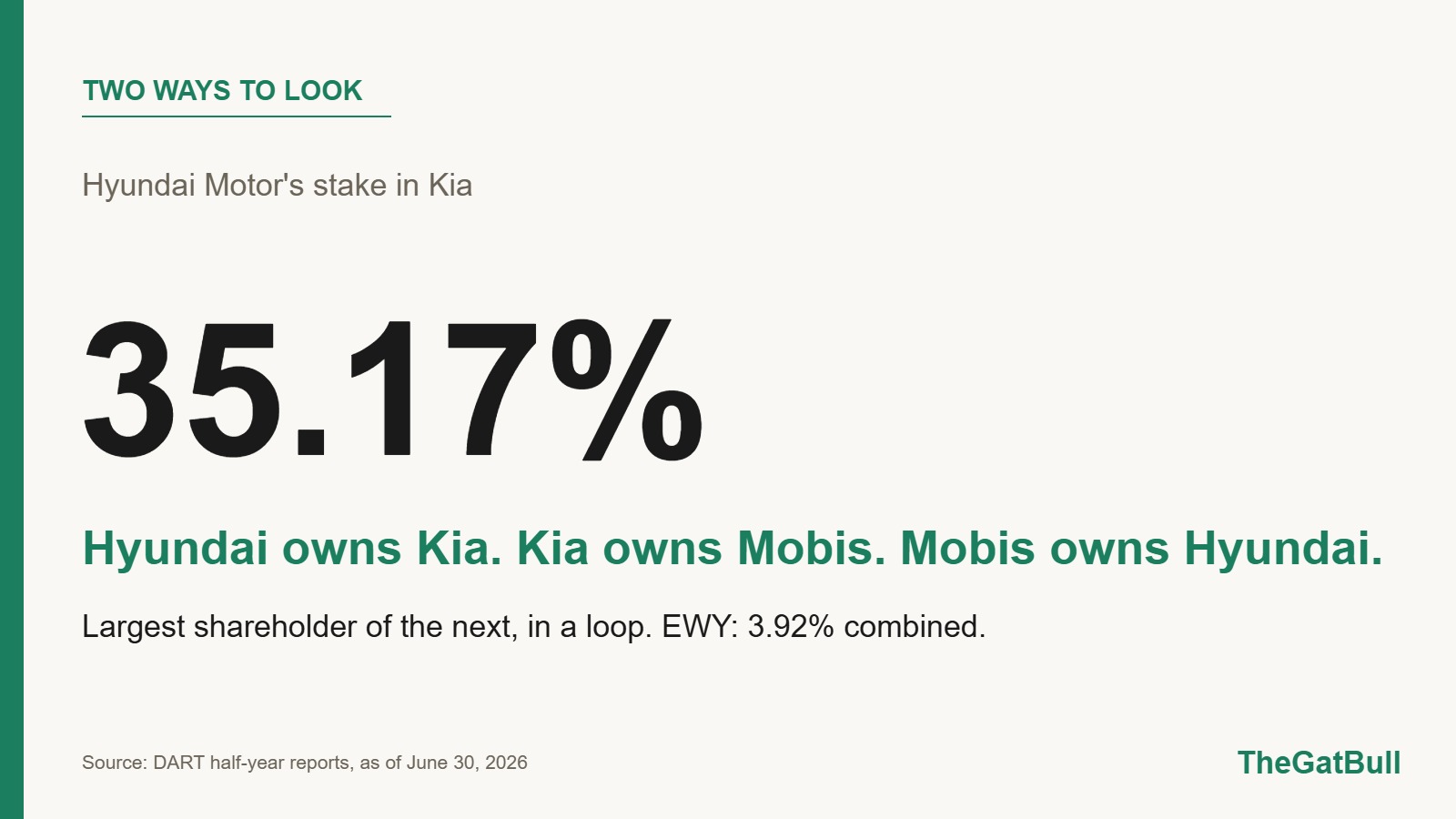
TL;DR — If you hold EWY. Hyundai Motor is Kia’s largest shareholder (35.17%). Kia is Hyundai Mobis’s largest shareholder (18.10%). Mobis is Hyundai Motor’s largest shareholder (22.36%). Follow the arrows and you come back to the start. Inside EWY, these three companies add up to 3.92% — one loop of owners, not three fully independent bets. Yet this year the market priced them apart: Hyundai Motor is up 9.44%, Kia is down 12.32%.
Not financial advice.
Does Hyundai own Kia? About a third of it — and the chain doesn’t stop there.
Hyundai Motor (KRX: 005380) and Kia (KRX: 000270) trade as two separate stocks in Seoul. By ownership, they are two links in one loop. According to the two companies’ half-year filings (as of June 30, 2026), Hyundai Motor owns 35.17% of Kia, Kia owns 18.10% of Hyundai Mobis (KRX: 012330, the group’s parts maker), and Mobis owns 22.36% of Hyundai Motor. Each one is the largest shareholder of the next.
What this means if you hold EWY. As of Oct. 7, the three companies in this loop — Hyundai Motor’s common and preferred shares, Kia and Hyundai Mobis — are 3.92% of EWY (iShares). That looks like three holdings. It is one cluster tied together by who owns whom. For scale, SK Hynix and Samsung Electronics together are 46.10% of the same fund.
Stock and index prices are KRX (Korea Exchange) regular-session closes (15:30 Seoul time) on Thursday, Oct. 8. Seoul was closed on Friday, Oct. 9, for Hangul Day (a Korean national holiday); the next session is Monday, Oct. 12. Dollar figures are for scale only, at the Oct. 8 Seoul rate of ₩1,338.5 per dollar (press-reported, single source).
The loop: three filings, three numbers
| Who | Owns | Stake | Where it’s stated |
|---|---|---|---|
| Hyundai Motor | Kia | 35.17% (137,318,251 shares) | Kia half-year report |
| Kia | Hyundai Mobis | 18.10% | Largest-shareholder sections of both reports |
| Hyundai Mobis | Hyundai Motor | 22.36% (45,782,023 shares) | Hyundai Motor half-year report |
Source: half-year reports filed on DART (Korea’s official electronic filing system, similar to the SEC’s EDGAR): Kia (amended), filed Sept. 16, 2026; Hyundai Motor, filed Aug. 14, 2026. Company filings, as of June 30, 2026.
Follow the arrows and you return to where you started. The holding-company structure most US readers know is a tree: a parent at the top, holdings below. This is a circle.
Two footnotes from the same filings. First, according to footnotes in the filings, these percentages rose through share cancellations, not purchases. Each time Mobis retired its own shares held in treasury, Kia’s stake rose (17.54% → 18.10%); each time Hyundai Motor did, Mobis’s stake rose (21.64% → 22.36%). The stakes held the same number of shares; the total share count shrank, so each stake became a bigger slice. Second, the founding family also holds stakes of its own: Chairman Chung Eui-sun holds 1.81% of Kia, 2.73% of Hyundai Motor and 0.33% of Mobis.
Way 1: two companies
The market prices them separately. The comparison below works because every line is in won and starts from the same date (the Dec. 30, 2025 close).
| Stock | Dec. 30, 2025 | Oct. 8, 2026 | Year to date |
|---|---|---|---|
| KOSPI (Korea’s main index) | 4,214.17 | 6,625.93 | +57.23% |
| Hyundai Motor | ₩296,500 | ₩324,500 (~$242) | +9.44% |
| Hyundai Mobis | ₩373,000 | ₩359,000 (~$268) | −3.75% |
| Kia | ₩121,800 | ₩106,800 (~$80) | −12.32% |
KRX closes, computed from vendor price data. Price returns in won; dividends not included.
The gap between Hyundai Motor and Kia is 21.8 percentage points. The three links in the loop did not even move in the same direction. We are not going to say why here: third-quarter results and tariff costs for the two carmakers are not out yet. Kia’s second quarter is covered in our Kia piece, and the group’s gap to the index in our Hyundai group piece.
On Oct. 8 alone, all three fell: Hyundai Motor −3.42%, Mobis −3.88%, Kia −2.55%, against KOSPI −2.62%. Hyundai Motor and Mobis closed at the day’s low.
Way 2: one loop
Put a market price on the stake and the loop becomes a number. This is simple arithmetic — Oct. 8 closing price times the June 30 share count — not a book value from the accounts.
- Hyundai Motor’s Kia stake: 137,318,251 shares × ₩106,800 ≈ ₩14.7 trillion (about $11.0 billion).
- That is roughly one-fifth of Hyundai Motor’s common-share market value (about ₩66.4 trillion, using the June 30 share count and excluding preferred shares).
So when you buy Hyundai Motor stock, part of what you are paying for is a block of Kia. When Kia moves, part of a Hyundai Motor shareholder’s assets moves with it. When Kia pays a dividend, a little over a third of it goes to Hyundai Motor. And Hyundai Motor’s largest shareholder is Mobis, whose largest shareholder is Kia.
Mr. Gat: Two tickers, one loop. Diversification is a count of owners, not a count of tickers.
Accounting and rules: where this loop sits
Under standard accounting, a 35.17% stake means Hyundai Motor books its share of Kia’s profit as its own income (the “equity method”). We did not pull that figure for this piece. In Korea, creating new circular shareholdings like this has been banned since 2014, but loops that already existed were allowed to stay — general background, not checked against the statute text here. Whether the group plans to change this structure is outside this piece; we have no primary-source confirmation either way.
Who bought and sold the three stocks on Oct. 8 is also outside this piece: we did not source investor-flow data for that day.
What to watch next
- Monday, Oct. 12: Seoul reopens. EWY fell 4.03% (in dollars) in US trading on Oct. 8, after Seoul had already closed for the day, and Seoul stayed shut on Oct. 9. Monday is the first chance for Seoul prices to respond. The two moves are not the same day’s move.
- Third-quarter results: we’ll add the reporting dates once the companies announce them.
- EWY’s line-up: Hyundai Mobis appears at 0.84% in EWY’s Oct. 7 holdings. It was not in the Sept. 18 holdings we checked. When and why it was added is not confirmed.
What this shows about Korea’s market
This loop is a clear example of how Korea’s big family-run business groups (chaebol) have tied their listed companies together. In a US index, “three stocks = three independent companies” is mostly a safe assumption. In a Korean index, you have to recount by group. That EWY’s 3.92% sits inside one loop means that 3.92% could react together to a single ownership event — a stake sale, a merger, the loop being unwound. That is not a claim that any such event is coming. At the same time, this year’s 21.8-point gap is evidence that the market still prices each company on its own results. Both views are true. The practical takeaway: if you hold EWY, size that 3.92% as one group position, and don’t read three tickers as three separate bets.

How to get exposure, and a US comparison
- 🟢 EWY — all three loop companies at once, 3.92% in total (with 46.10% in the two chip giants alongside).
- 🔴 Seoul directly — 005380, 000270, 012330 (requires a Korean brokerage account).
- Neither Hyundai Motor nor Kia has a US ADR (a US-traded certificate for a foreign stock). Hyundai Motor’s US over-the-counter line (HYMTF) is a thinly traded line for the Korean shares, not an ADR.
US comparison: think of a holding company like Berkshire Hathaway, which owns stakes in listed companies. Not a perfect parallel: the companies Berkshire owns stakes in don’t own Berkshire back. A US structure like that is a tree; this one is a circle.
The bottom line
Hyundai Motor and Kia are two tickers and one loop. The market priced them 21.8 percentage points apart this year, but the ownership structure puts them on the same circle. If you hold EWY, count that 3.92% as one group, not three stocks.
FAQ
Does Hyundai own Kia?
Hyundai Motor is Kia’s largest shareholder with 35.17% (Kia half-year report, as of June 30, 2026). Kia is not a wholly owned subsidiary; it is separately listed in Seoul.
Who owns Hyundai Motor?
Its largest shareholder is Hyundai Mobis, with 22.36%; including related parties (family members and affiliated executives), 30.67% (Hyundai Motor half-year report, as of June 30, 2026).
Who owns Hyundai Mobis?
Its largest shareholder is Kia, with 18.10%, as stated in both companies’ half-year reports.
Is Hyundai Mobis in EWY?
Yes, at 0.84% in iShares’ holdings as of Oct. 7, 2026. It was not in the Sept. 18 holdings; when it was added is not confirmed.
If I own EWY, how much of the Hyundai group loop do I own?
3.92% in total as of Oct. 7: Hyundai Motor common 1.43%, Hyundai Motor preferred 0.71%, Kia 0.94% and Hyundai Mobis 0.84%.
Sources
- Kia, amended half-year report (June 2026), DART rcpNo 20260916000427, Section VII (company filing).
- Hyundai Motor, half-year report (June 2026), DART rcpNo 20260814003521, Sections I-4 and VII (company filing).
- iShares MSCI South Korea ETF (EWY), fund holdings as of Oct. 7, 2026 (iShares).
- Stock and index closes: KRX regular-session closes via vendor price data. Won rate: Oct. 8 Seoul close, press-reported (Businesskorea).
- Related: Hyundai’s share cancellation · What’s inside EWY.
How sure are we?
| Item | Confidence |
|---|---|
| The three ownership stakes | ✅ Confirmed in company filings on DART (as of June 30, 2026) |
| EWY weights | ✅ iShares holdings file (as of Oct. 7, 2026) |
| Stock and index moves | Computed from vendor price data (Yahoo), KRX closes |
| Stake market value (₩14.7 trillion) | Our calculation; market value, not book value |
| 2014 ban on new circular shareholdings | ⚠️ General background, not checked against the statute text |
| When Mobis entered EWY | ⚠️ Not confirmed |
| Won rate | ⚠️ Press-reported, single source |
Ticker key. 🟢 US-listed — buy in a US brokerage. 🔴 Seoul-listed only — no US ADR; watch, not buy directly.
Not financial advice. TheGatBull is an independent publication; nothing here is a recommendation to buy or sell any security.
 Written by Mr.Gat — TheGatBull
Korean market coverage from a Seoul-metro-based operator who reads the filings in the original language. Every price on this site is the KRX regular-session close (15:30 Seoul); every figure states whether it came from a primary filing, the press, or our own calculation. Drafts are AI-assisted, then verified against the original Korean documents and edited by a human before publishing.
Found an error? Tell us — corrections get priority. How we work →