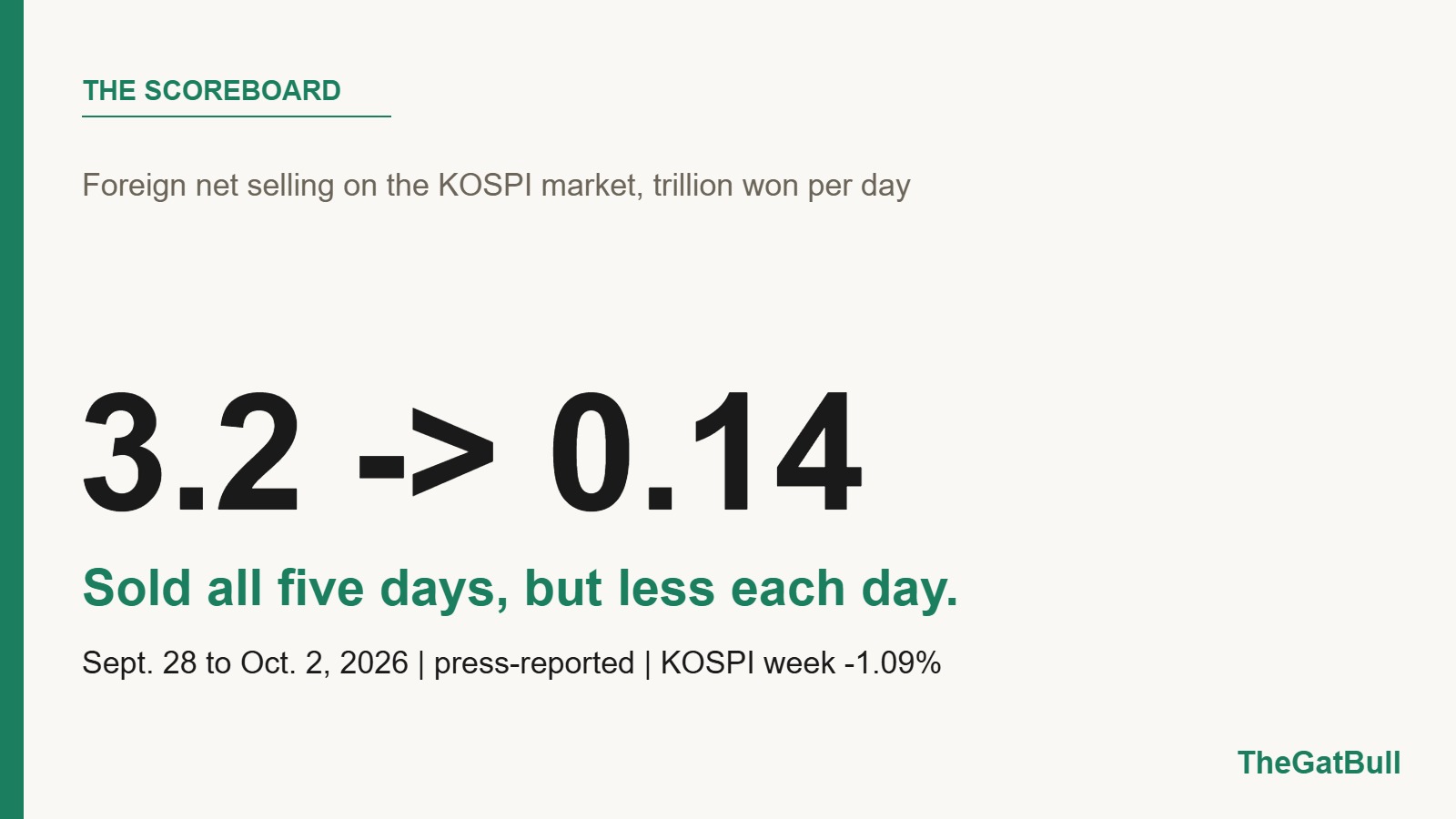
TL;DR — If you hold EWY. In Korea’s first week back from the Chuseok holiday (Korean Thanksgiving), foreign investors sold more Korean stocks than they bought on all five trading days, but the daily amount shrank from about ₩3.2 trillion on Monday to about ₩0.14 trillion on Friday (press-reported). KOSPI, Korea’s main stock index, ended the week down 1.09% from its last pre-holiday close. Your EWY rose 2.51% over its own five U.S. sessions, but that number isn’t comparable with Seoul’s, so don’t subtract one from the other.
Not financial advice.
Did foreign investors stop selling Korean stocks this week? No. But they sold less every day.
The Korea Exchange (KRX) closed on Thursday and Friday, Sept. 24–25, for the Chuseok holiday. With the weekend after it, Seoul’s last pre-holiday session was Wednesday, Sept. 23, and trading resumed on Monday, Sept. 28. In the five sessions since (Sept. 28–Oct. 2), foreign investors were net sellers in the KOSPI market every day. “Net selling” means the value they sold minus the value they bought that day. The daily figure fell from about ₩3.24 trillion (roughly $2.4 billion) on Monday to about ₩0.14 trillion (roughly $0.1 billion) on Friday.
KOSPI fell 2.70% on Monday, the first day back. Measured from its last pre-holiday close (Sept. 23, 7,080.92), it was down 3.43% by Wednesday’s close (Sept. 30), then recovered 2.42% over Thursday and Friday to finish at 7,003.74, a weekly change of −1.09%. That is the first close above 7,000 since Sept. 23. KOSDAQ, the exchange’s market for smaller and growth companies, gained 5.78% over the same stretch.
Every Seoul price here is the KRX regular-session close (15:30 Seoul time; the separate Nextrade venue is not included). Investor-flow figures are press reports citing Korea Exchange data, for the KOSPI market. Dollar conversions are for scale only, at the Oct. 2 Seoul close of ₩1,350.6 per dollar.
The week’s scoreboard
“Week” here means the five sessions after the holiday, measured from the last pre-holiday close (Sept. 23), not a calendar week. Index levels are in points.
| Date | KOSPI close (daily) | Foreigners, net (₩ trillion; negative = selling) |
|---|---|---|
| Mon, Sept. 28 | 6,889.74 (−2.70%) | −3.24 |
| Tue, Sept. 29 | 6,870.81 (−0.27%) | −2.90 |
| Wed, Sept. 30 | 6,838.04 (−0.48%) | −2.05 |
| Thu, Oct. 1 | 6,971.35 (+1.95%) | −0.55 |
| Fri, Oct. 2 | 7,003.74 (+0.46%) | −0.14 |
Foreigners’ five-day total is roughly ₩8.9 trillion. These are press-reported figures that we have not yet checked against the exchange’s own table. For Wednesday, one early report (15:58 KST) said −1.45 trillion won, but later reports said −2.05 trillion, so we use −2.05. Friday’s figure appeared in two outlets’ reports.
One way to read it: foreign selling shrank every day
Lined up by date, foreign net selling runs 3.24, then 2.90, then 2.05, then 0.55, then 0.14 trillion won. Every day’s figure is smaller than the day before.
Monday is where the curve starts. That day, foreigners net sold roughly ₩1.73 trillion of SK hynix and ₩1.38 trillion of Samsung Electronics, together ₩3.11 trillion, about 96% of that day’s total foreign net selling (our arithmetic on press-reported figures). Tuesday’s session has its own piece.
The index did not line up neatly with that curve, though. Wednesday (−0.48%) fell more than Tuesday (−0.27%) even though foreign net selling was smaller on Wednesday. Thursday (+1.95%) rose far more than Friday (+0.46%) even though foreign net selling was larger on Thursday (0.55 versus 0.14). With five data points, “less foreign selling means a higher index” can’t be a rule. It’s an observation about one week, not a law.
Under the Gat. “Korean closing reports often lead with who sold and who bought, because the exchange publishes net trading by investor type every day. This week the same word, ‘sold,’ started at more than ₩3 trillion and ended at ₩0.14 trillion. That is a one-week curve, not a forecast.”
Who took the other side
On the three days where press reports agreed on all groups, retail investors (individuals) were on the other side of the foreign selling early in the week: they net bought about ₩1.1 trillion on Sept. 29 and ₩1.2 trillion on Sept. 30. On Friday, Oct. 2, the pattern changed: retail investors net sold ₩1.72 trillion, while institutions (pension funds, insurers and asset managers) net bought ₩0.38 trillion. The three groups don’t net to zero on those days, because the exchange also counts other investor types. We couldn’t confirm the retail and institutional figures for Sept. 28 and Oct. 1, so the table above shows only the foreign series. We haven’t confirmed why retail switched sides.
KOSPI −1.09%, KOSDAQ +5.78% — and one day
| Index / stock | Sept. 23 close | Oct. 2 close | Change |
|---|---|---|---|
| KOSPI | 7,080.92 | 7,003.74 | −1.09% |
| KOSDAQ | 844.48 | 893.29 | +5.78% |
| Samsung Electronics (₩) | 285,500 | 276,000 | −3.33% |
| SK hynix (₩) | 1,862,000 | 1,841,000 | −1.13% |
(SK Square went from ₩1,190,000 to ₩1,160,000, down 2.52%.)
Most of KOSDAQ’s 5.78% came on one day, Thursday. On Oct. 1 it rose 4.48% (855.91 to 894.29), 4.72% from the open, and closed at its intraday high of 894.29 (per Yahoo price data). Press reports cited three backdrops (none confirmed as the cause): September chip exports of $60.3 billion, reported as the first month above $60 billion (up 262.8% from a year earlier); U.S. memory maker Micron’s results and its outlook that memory supply and demand would be tighter in 2027 and 2028 than this year; and a government announcement of wider research coverage for small and mid-cap stocks. KOSDAQ chip-equipment names jumped (Wonik IPS +9.13%, LEENO Industrial +10.90%).
Samsung Electronics and SK hynix together make up roughly 46% of EWY (the top two holdings per iShares, as of Sept. 30), and both ended the week below their pre-holiday closes (−3.33% and −1.13%). KOSDAQ still rose. Under one name, “Korean stocks,” the week pulled in different directions.
If you hold EWY: same week, different clocks
EWY (NYSE Arca) rose 2.51% over the five U.S. sessions of Sept. 28–Oct. 2, from $187.18 (Sept. 25) to $191.88 (Oct. 2). SKHY, a U.S.-listed depositary receipt (ADR) for SK hynix shares (Nasdaq), went from $191.56 to $195.13, up 1.86%. It’s tempting to set that beside KOSPI’s −1.09%. Don’t subtract. At least four things differ:
- Currency. KOSPI is in won, EWY in dollars. The won strengthened slightly over the week, from ₩1,357.5 per dollar (Sept. 23) to ₩1,350.6 (Oct. 2), per press-reported Seoul 15:30 closes.
- Start date. Seoul’s window starts at the last pre-holiday close (Sept. 23); EWY’s starts at the prior U.S. close (Sept. 25).
- Closing time. EWY’s last day (Oct. 2, +3.10%) happened in U.S. trading after Seoul had already closed.
- Index. EWY tracks the MSCI Korea 25/50 index, not KOSPI itself (per etfdb).
The closing-time point connects to next week. Seoul hasn’t traded since EWY’s +3.10% on Friday; its next regular session is Tuesday, Oct. 6, because Monday is a market holiday. How Seoul opens is unknown. See how EWY is priced while Korea is closed and what EWY actually holds.
What to watch next week
- Monday, Oct. 5 is a substitute holiday for National Foundation Day, so the KRX is closed. Seoul reopens Tuesday, Oct. 6, and closes again Friday, Oct. 9 for Hangul Day. That leaves three Seoul sessions: Oct. 6, 7 and 8.
- U.S. markets are open on both holidays, so EWY and SKHY will keep pricing while Seoul is shut, the same structure again.
- The thing to watch from this week’s curve is whether daily foreign net selling, now about ₩0.14 trillion, keeps shrinking or starts growing again.

Bottom line
Foreigners sold on every one of the five days, but less each day, while KOSPI ended the week down 1.09% and KOSDAQ rose 5.78%. If your EWY number looks different from Seoul’s, nothing is wrong: the clocks are different.
FAQ
Are foreign investors still selling Korean stocks?
Press reports show net foreign selling in the KOSPI market on all five sessions after Chuseok, shrinking from about ₩3.2 trillion to about ₩0.14 trillion a day. What happens next week is unknown.
How did KOSPI do in the first week after Chuseok?
It closed at 7,003.74 on Oct. 2, down 1.09% from 7,080.92 on Sept. 23, after being down 3.43% as of Sept. 30.
Did EWY beat KOSPI that week?
The two numbers aren’t comparable. EWY rose 2.51% in dollars over five U.S. sessions; KOSPI fell 1.09% in won from a different start date and closing time.
Sources
- KOSPI, KOSDAQ, Samsung Electronics, SK hynix and SK Square closes: Yahoo Finance chart API, retrieved Oct. 4 (KST), KRX 15:30 regular-session closes.
- EWY and SKHY: same route, U.S. trading-day closes in USD.
- Investor flows: press reports — Herald Business (Sept. 28), Asia Business Daily (Sept. 29), Korea Times and Korea JoongAng Daily (Sept. 30), Ajupress (Oct. 1), Digital Today (Oct. 1), Ajupress and Digital Today (Oct. 2). One early Sept. 30 report (Digital Today, 15:58 KST, −1.45 trillion won) differed from later ones (−2.05 trillion), so we use the latter. Retail and institutional figures cited above: Asia Business Daily (Sept. 29), JoongAng (Sept. 30), Ajupress (Oct. 2).
- Exchange rates: Seoul 15:30 closes as reported by the Korean press (newsis, Sept. 28) and Korea JoongAng Daily (Oct. 2).
- Oct. 1 backdrop (chip exports, Micron, research coverage): Seoul Economic Daily (English).
- Holiday dates (Oct. 5 and Oct. 9): KRX closure schedule, also reported in the Korean press (e.g. bnt News via Daum, Sept. 24).
How sure are we?
| Item | Confidence |
|---|---|
| KRX, EWY and SKHY closes | Computed from vendor price data (Yahoo); KOSPI closes cross-checked against press reports |
| Investor flows (foreign; retail and institutional for Sept. 29, Sept. 30 and Oct. 2) | Press-reported, citing Korea Exchange data; not confirmed against the exchange’s own table |
| Sept. 30 and Oct. 1 foreign flows | Sept. 30: an early report differed from later ones. Oct. 1: one outlet differed from three others. We show the majority figure |
| Oct. 2 flows | Press-reported by two outlets |
| Oct. 1 rally backdrop | Press-reported context, not confirmed as the cause |
| Oct. 5 and Oct. 9 closures | Confirmed: KRX closed Oct. 5 and Oct. 9; Seoul trades Oct. 6, 7 and 8 |
| EWY top-two weight of about 46% | iShares figure as of Sept. 30, not re-checked today |
Not financial advice. TheGatBull is an independent publication; nothing here is a recommendation to buy or sell any security.
 Written by Mr.Gat — TheGatBull
Korean market coverage from a Seoul-metro-based operator who reads the filings in the original language. Every price on this site is the KRX regular-session close (15:30 Seoul); every figure states whether it came from a primary filing, the press, or our own calculation. Drafts are AI-assisted, then verified against the original Korean documents and edited by a human before publishing.
Found an error? Tell us — corrections get priority. How we work →