TL;DR — If you hold EWY. Seoul now expects corporate tax ₩35 trillion above its March estimate, which it attributes to the chip boom, and it is using part of a ₩63.2 trillion tax windfall to sell ₩5 trillion fewer government bonds in October. The two companies at the front of that chain, Samsung Electronics and SK Hynix, are 46.49% of EWY; whether the smaller bond supply pulled Korean yields down cannot yet be separated from a drop in US yields at the same time.
Korean figures are as reported by Korean media unless marked. Dollar conversions use ₩1,356.7 per dollar (Seoul close, Sep 29, 2026). Not financial advice.
The short answer
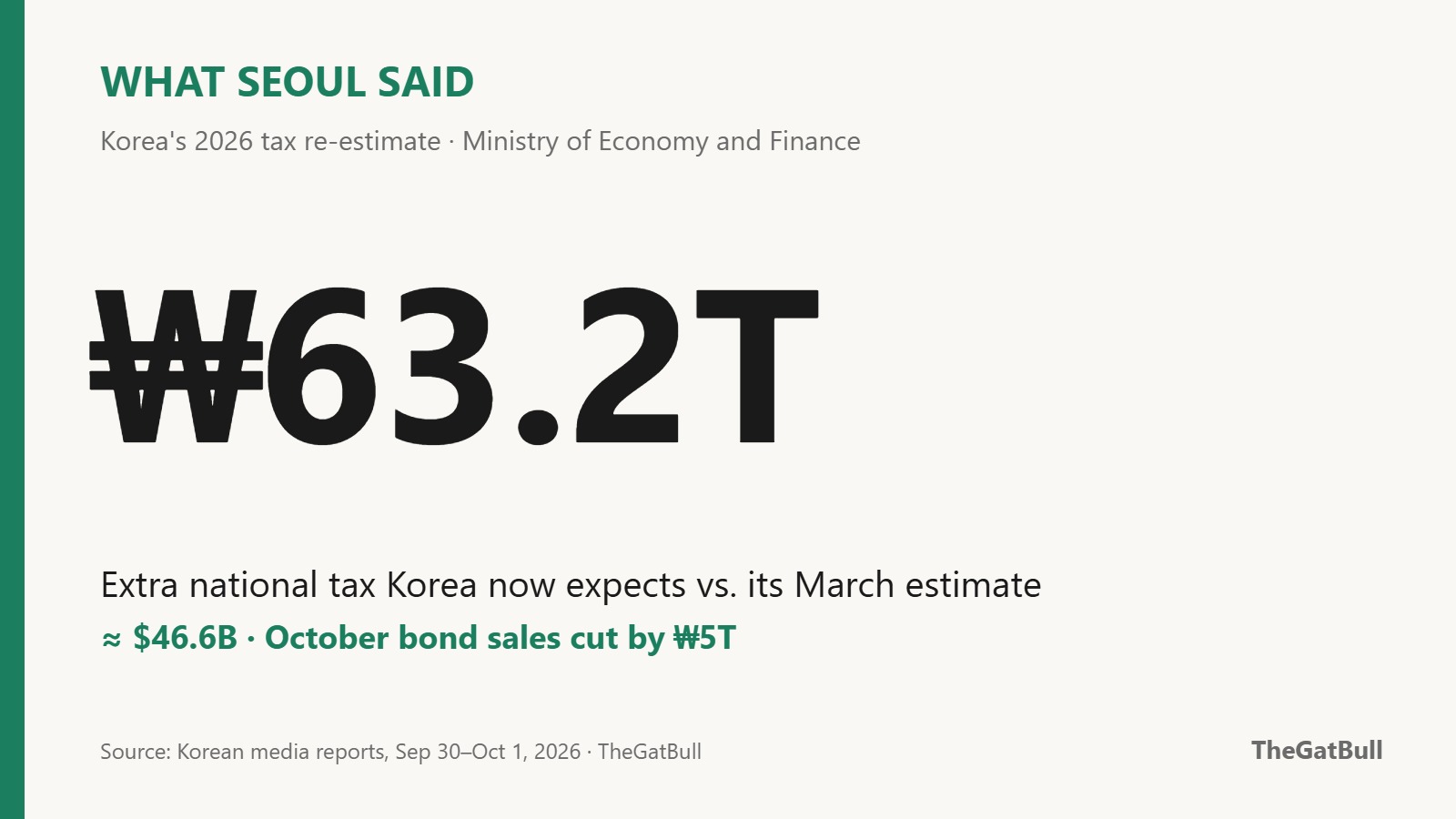
In the first week of Korea’s new Deputy Prime Minister and finance minister, Lee Hyung-il, who took office on September 22, the most concrete thing we found from Seoul was not a speech. It was a number. The government now expects 2026 national tax revenue of ₩478.6 trillion (about $352.8 billion), ₩63.2 trillion (15.2%) more than its March estimate (about $46.6 billion more), and it decided to issue ₩5 trillion (about $3.7 billion) less in October government bonds than originally planned.
The same week, the Financial Services Commission (FSC), Korea’s financial policy regulator, called the current moment a “turning point” in financial conditions, and the head of the Financial Supervisory Service (FSS), which inspects banks and brokerages, said that, looking beneath a KOSPI up more than 60% this year, “I am not at ease.”
This piece puts three things in order: a government with more money than it planned for, a bond market where yields had climbed, and a supervisor uneasy about the rally.
If you hold EWY. This week’s news from Seoul came from the bond market, not the stock market. But the source of the money, by the government’s own account, is the chip boom, and Samsung Electronics and SK Hynix are 46.49% of EWY (iShares, as of Sep 30). Seoul is closed on Monday, October 5 (National Foundation Day, observed); the next regular session is Tuesday, October 6. EWY trades in New York in between.
First, the mechanism: why more tax means fewer bonds
When Korea’s government spends more than it collects, it covers the gap by selling Korea Treasury Bonds. It publishes a monthly issuance plan in advance, and the market absorbs that supply through auctions.
If taxes come in higher than expected, the gap shrinks, and the government can fund the same spending while selling fewer bonds. For the bond market, that means less new supply to absorb. All else equal, less supply supports bond prices, and because a bond’s yield moves opposite to its price, that holds yields down. That is the channel the government is aiming at.
But yields are not set by supply alone. Expectations for the central bank’s policy rate, overseas yields and inflation move them too. So between “we sold fewer bonds” and “yields fell,” there is always one step left to check.
US readers know a version of this: the Treasury announces auction sizes at its quarterly refunding (its regular update on how much debt it will sell), and markets trade the number. Not a perfect parallel: US auction cuts usually reflect deficit paths or cash management, while Korea’s came from an unexpected tax surplus, and Seoul says a share of that surplus is aimed at housing, jobs and lower-income support, so not all of it reduces supply.
That missing step is why the verdict below is limited.
What was said, in their own words
1. The finance minister, Lee Hyung-il: bond cuts if yields overshoot
Here is the government’s case, as reported. On September 30, Lee chaired his first expanded macroeconomic, fiscal and financial meeting, with Minister of Planning and Budget Park Hong-keun, Bank of Korea Governor Shin Hyun-song and Financial Services Commission Chairman Lee Eok-won at the table. The participants agreed to focus the year’s ₩63.2 trillion in excess tax revenue on housing, jobs and financial support for lower-income households, and Lee said he wanted the windfall to help ease polarization. On bonds, he said the government would “closely monitor the government bond market and implement necessary market-stabilization measures, such as emergency buybacks and reducing bond issuance using part of the excess tax revenue.” Participants were reported to agree that fiscal and monetary policy can complement each other in supporting vulnerable groups and future growth drivers.
The next day came the number. The Ministry of Economy and Finance said October issuance would be ₩5 trillion below the original plan. The reported October plan also lists ₩12 trillion (about $8.8 billion) in competitive auctions (₩16 trillion in September), ₩0.5 trillion in exchange issuance, and ₩3.5 trillion (about $2.6 billion) in buybacks of existing 2-, 3-, 5- and 10-year bonds. A ministry official said further cuts in November and December would be considered depending on market conditions.
2. Where the money came from: the reason the government gave
The biggest piece of the revision is corporate tax: up ₩35 trillion (about $25.8 billion) from the March estimate, to ₩136.4 trillion, and the government cited the semiconductor boom as the reason. By our calculation, that is about 55% of the ₩63.2 trillion.
The next-largest piece is income tax (up ₩15.6 trillion, to ₩152.4 trillion). One smaller line is worth noting: securities transaction tax rose ₩1.9 trillion, to ₩12.4 trillion, on the strong stock market. That is the stock rally showing up directly in tax receipts.
Note: “chip boom → corporate tax” is the government’s explanation. How much any single company paid was not disclosed, and we do not estimate it.
3. Bank of Korea Governor Shin Hyun-song: stability comes first
Two days before that meeting, on September 28, Lee visited the Bank of Korea six days after taking office (his predecessor, Koo Yun-cheol, waited 17 days). Lee asked the two institutions to “seek ways to run economic and monetary policy in harmony.” Shin replied that “to build a foundation for sustainable growth, overall macroeconomic stability through price and financial stability must come first.”
The words are ceremonial. The order is not: the fiscal side spoke of harmony; the central bank spoke of a precondition. The Bank of Korea’s next rate decision was about three weeks away at that point, on October 22.
4. The FSC chairman, Lee Eok-won: a “turning point”
At a financial-market monitoring meeting on October 1, the FSC chairman said that “as this is a turning point in which the flow of the financial environment is changing, it is important to stay especially vigilant and prepare thoroughly.” The figure cited for the meeting: the 3-year government bond yield at 4.011% on September 30, up 105.8 basis points since the start of the year (a basis point is one hundredth of a percentage point, so that is about 1.06 percentage points).
Two instructions came with it. Keep up active use of the bond and money-market stabilization program (₩100 trillion-plus, at least $73.7 billion; ₩12.1 trillion bought since March, as of Oct 1) as market rates keep rising. And review in advance the fourth-quarter bond issuance and maturity schedules of banks and specialized credit-finance (card and lending) companies, so issuance does not bunch up.
5. The FSS governor, Lee Chan-jin: “I am not at ease”
Meeting the CEOs of 23 brokerages on September 29, the head of the Financial Supervisory Service said the KOSPI was up more than 60% since the start of the year, but “looking beneath it, I am not at ease,” because “most of the rise came from concentration in a handful of large caps, and market volatility has instead expanded sharply.” Margin loans (money investors borrow from brokers to buy stocks), in figures the FSS cited, rose from ₩15.8 trillion (about $11.6 billion) in 2024 to ₩33.3 trillion (about $24.5 billion) in August 2026.
He asked brokerages to manage margin lending by stock, manage liquidity risk, improve investor protection and, after what he called “record” profits, raise dividends, noting payout ratios that range from 11.1% to 51.0% across firms. “A securities industry that cannot earn investors’ trust,” he said, “cannot guarantee its future.”
What the numbers say: did it work?
The case that it is working. The 3-year yield was 4.011% on September 30 and 4.010% on October 1, the day the cut was announced. On October 2 it fell 7.3 basis points to 3.937% (its lowest in 14 trading days, per Special Times, a single outlet), and the 10-year fell 7.1 basis points to 4.365%.
The case that we cannot credit it yet. The same report (Oct 2) said US Treasury yields had fallen too: 9.8 basis points on the 2-year and 4.5 on the 10-year. With one day of movement and an overseas move in the same direction, we cannot separate what the smaller Korean supply did from what US yields did. We could not find evidence that the cut failed; we also cannot show it worked.
One fact about scale. The ₩5 trillion cut is about 8% of the ₩63.2 trillion windfall, by our calculation. The government’s stated main uses for the windfall are housing, jobs and support for lower-income households; bond cuts were presented as a tool for when yields rise too far. Reading this as “Korea is using its windfall to pay down debt” would overstate it.
We do not claim that the bond cut lowered yields. That can be judged with numbers only after October’s auctions and the October 22 rate decision.
What this means for EWY holders
This week’s announcements are not the kind that move EWY directly. What matters for an EWY holder is the shape of the chain:
- The front link: the chip boom, which the government named as the reason corporate tax rose. Samsung Electronics and SK Hynix are 46.49% of EWY (iShares, Sep 30).
- The middle link: part of that tax goes to reducing bond supply. The path of Korean interest rates matters for both the discount rate on Korean stocks (the rate investors use to value future profits) and the won. Whether this step changed that path is not confirmed.
- The side link: the supervisor read the same rally as “concentration in a handful of large caps” and “expanded volatility.” Two large caps make up nearly half of EWY. What that volatility does to a 3x daily Korea fund is in our KORU vs. EWY piece.
On September 19 we covered the three meetings Seoul held after the Fed’s hike; on September 26, what Seoul heard from Wall Street. This week the finance ministry went a step further and cut bond supply.
What we checked, and what we did not
This column normally covers the same set of institutions, so we do not carry over last week’s list. For September 28 to October 3:
- Finance ministry, Bank of Korea, FSC, FSS: the statements and steps above, all from Korean media reports; we did not check the original press releases.
- Bank of Korea or FSS reorganization: we found no announcement this week. Not finding one is not proof there was none.
- Presidential office, Korea Exchange, US Treasury and Fed, Japan’s Ministry of Finance: not checked this round. We do not say they were silent.
- Market effect of the bond cut: one trading day of data; no verdict.
Verdict
Too early. The step is real: October bond supply is ₩5 trillion smaller, and the government named the chip boom as the source of the money. Whether it held yields down is not confirmed. The dates we will check are fixed: October’s bond auctions and the Bank of Korea’s decision on October 22.
Under the Gat. By the government’s account, chip companies made money, the money became tax, and the tax is now going into the bond market. If you hold EWY, you already own the front link of that chain. The interesting part: the same week, the supervisor looked at the same rally and called it concentration. In one government, one rally is revenue on one desk and risk on another. Neither is wrong. A view, not advice.

The takeaway
- A ₩63.2 trillion tax windfall, led by corporate tax the government tied to the chip boom.
- October bond issuance cut ₩5 trillion below plan; more cuts under consideration for November and December.
- FSC: a “turning point.” FSS: “not at ease.”
- Effect on yields not yet confirmed. Next checkpoints: October’s auctions and the Oct 22 rate decision.
FAQ
Why did South Korea cut its October government bond issuance?
The government now expects 2026 national tax revenue to come in ₩63.2 trillion (about $46.6 billion) above its March estimate, and it decided to issue ₩5 trillion less in October government bonds than originally planned. It presented the cut as a market-stabilization step for when bond yields rise too far.
Where did the extra tax revenue come from?
The largest piece is corporate tax, revised up by ₩35 trillion, and the government cited the semiconductor boom as the reason. Income tax was revised up by ₩15.6 trillion and securities transaction tax by ₩1.9 trillion on the strong stock market. Payments by individual companies were not disclosed.
Did the bond cut bring Korean yields down?
Not confirmed. The 3-year yield was 4.011% on September 30 and 4.010% on October 1, then fell 7.3 basis points to 3.937% on October 2, as reported. US Treasury yields also fell around the same time, so the effect of the smaller supply cannot be separated out yet.
What does this have to do with EWY?
The government named the chip boom as the main reason corporate tax was revised up, and Samsung Electronics and SK Hynix together were 46.49% of EWY (iShares, as of September 30, 2026). Any effect of this bond decision on EWY’s price is not confirmed.
What dates should I watch next?
The Bank of Korea’s rate decision on Thursday, October 22. Seoul’s stock market is closed on Monday, October 5 (National Foundation Day, observed) and Friday, October 9 (Hangul Day).
Sources
Tax revision and bond plan: Seoul Economic Daily (Sep 30) · Korea Economic Daily (Sep 30) · Newspim (Sep 30) · Money Today (Oct 1) · Newspim (Oct 1) · BOK visit: Herald Business (Sep 28) · FSC meeting: Financial News · Newspim (Oct 1) · FSS meeting: Kuki News · Asia Economy (Sep 29) · Bond yields: EBN via Investing.com (Oct 1 close) · Special Times (Oct 2) · EWY weights: iShares, as of Sep 30, 2026 · FX: Seoul close, Sep 29, 2026, as reported
Confidence
| Item | Strength |
|---|---|
| Tax revision (₩478.6T, +₩63.2T, by tax) and October bond cut (₩5T, ₩12T auctions, ₩3.5T buybacks) | [reported] — several Korean outlets agree; original ministry release not checked |
| Statements by Lee Hyung-il, Shin Hyun-song, Lee Eok-won, Lee Chan-jin | [on the record] — named officials, via Korean reports, our translation |
| “Chip boom → corporate tax” | [reported] — the government’s explanation, not company-level data |
| 3-year yield 4.011% (Sep 30) | [reported] — FSC meeting figure |
| 3-year yield 4.010% (Oct 1) | [reported — single outlet] |
| EWY top-two weights (46.49%) | [primary] — iShares, as of Sep 30, 2026 |
| Oct 2 yields (3-year 3.937%, 10-year 4.365%) and US yield moves | [reported — single outlet]; another outlet reported 3.96% for the 3-year, likely before the close |
| Effect of the bond cut on yields · BOK/FSS reorganization this week | not confirmed |
This article is for informational purposes only and is not investment advice. Figures are as of the dates shown. Do your own research.
 Written by Mr.Gat — TheGatBull
Korean market coverage from a Seoul-metro-based operator who reads the filings in the original language. Every price on this site is the KRX regular-session close (15:30 Seoul); every figure states whether it came from a primary filing, the press, or our own calculation. Drafts are AI-assisted, then verified against the original Korean documents and edited by a human before publishing.
Found an error? Tell us — corrections get priority. How we work →