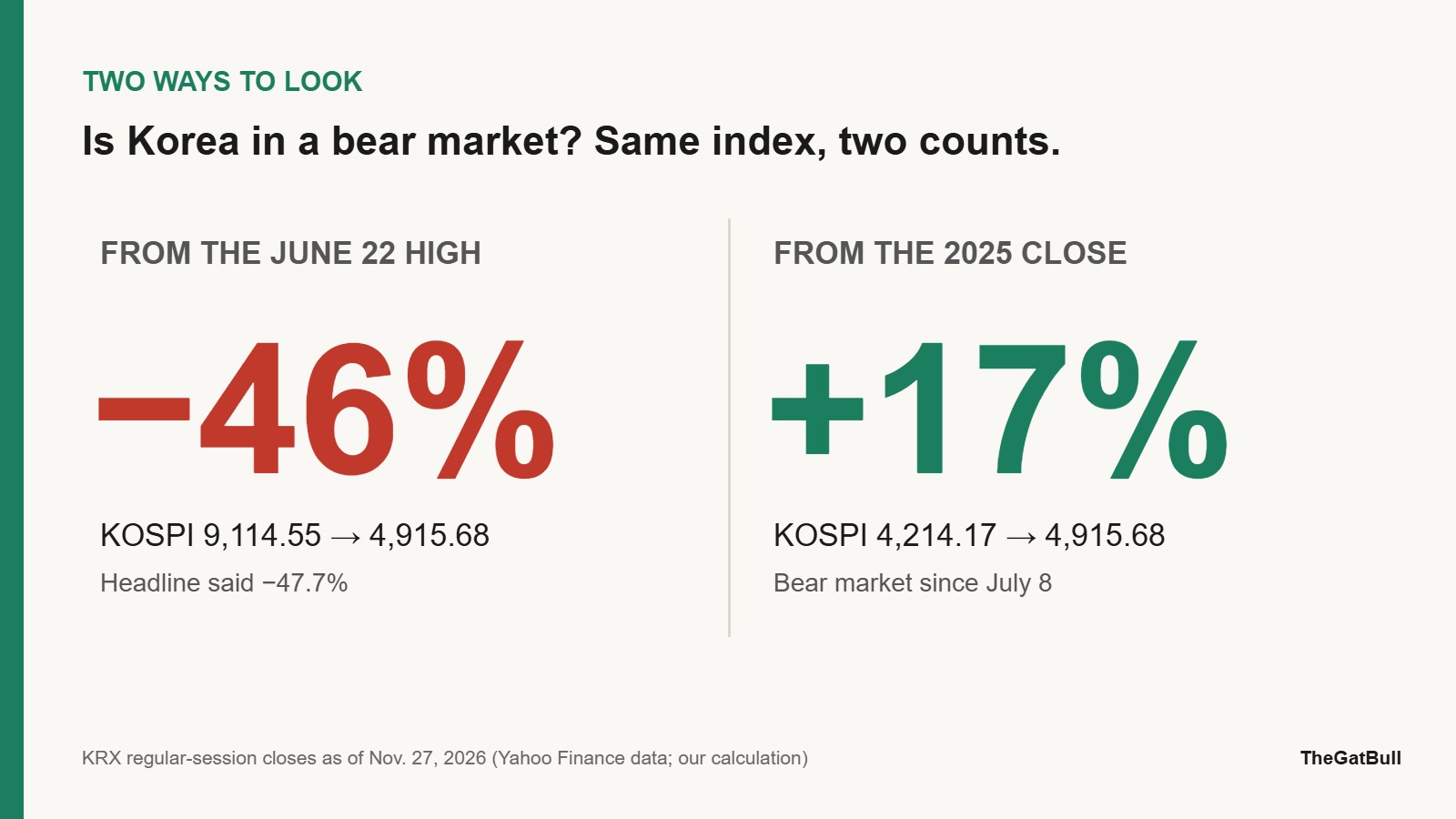
TL;DR — For EWY holders and anyone reading “Korea bear market” headlines. Yes, South Korea’s KOSPI is in a bear market: on KRX closing prices it has been more than 20% below its June 22 high since July 8, and on Nov. 27 it closed 46.07% below that high. Counted from the last close of 2025, the same index is up 16.65%.
I’m Mr. Gat, and this is TheGatBull.
Not financial advice.
Dates are Seoul time (KST) unless marked. KOSPI and stock prices are KRX (Korea Exchange) regular-session closes, 3:30 p.m. Seoul; trading on the NXT alternative venue is not included. EWY prices are U.S. trading days, in dollars; the latest full session we use is Nov. 25 (U.S. markets were closed Nov. 26 for Thanksgiving).
An English headline on Nov. 27 said the KOSPI had plunged 47.7%. KRX closing prices give two other numbers. The index finished Nov. 27 at 4,915.68, which is 46.07% below its June 22 closing high of 9,114.55 and 16.65% above its Dec. 30, 2025 close of 4,214.17. Both numbers are right. The bear market is real, and it did not start this week: the index crossed the 20% line on July 8.
Your Door — for EWY holders:
- What decides your result: when you bought. EWY closed 2025 at $97.22 and Nov. 25 at $129.19, up 32.88% in dollars for the year. Bought near its June 18 closing high of $219.20, the same fund is down 41.06%.
- What to check before reading the next headline: which starting point the percentage uses — the peak, the calendar year, or a year ago.
The headline: “KOSPI plunges 47.7%”
On Nov. 27, Hokanews ran “South Korea’s KOSPI Plunges 47.7% as Asian Stock Markets Face Deeper Losses Than Wall Street.” The article said seven of nine major indexes it tracked were in bear-market territory at the Nov. 25 close, each at least 20% below its 2026 high, and it credited the KOSPI figure to Coin Bureau. The same framing ran elsewhere. Matrix News headlined “KOSPI Edges Up After Rate Increase as Analysts Warn of Bear-Market Swings.” On Nov. 6 (ET), 24/7 Wall St put the KOSPI about 45% below its 52-week high of 9,385.59.
Way 1: the bear-market reading
This reading has solid support.
- The usual line was crossed months ago. A bear market is commonly defined as a 20% fall from a peak. The KOSPI’s closing high was 9,114.55 on June 22, and its lowest close since then was 4,697.51 on Nov. 25, a 48.46% drop.
- The two largest EWY holdings fell more than the index. As of Nov. 27, Samsung Electronics was 50.59% below its June 18 closing high and SK Hynix 61.97% below its June 22 high, against 46.07% for the KOSPI.
- Big up days fit the pattern. Analysts quoted by Matrix News said that since 2000, about 70% of the 46 days when the KOSPI rose 5% or more came during bear markets; we have not checked that count against the underlying data. On Nov. 27 the KOSPI rose 4.34% and the KOSDAQ, Seoul’s smaller-company board, 8.13%.
Way 2: the same closes, counted from other dates
| Starting point | Date | KOSPI close | Change to Nov. 27 (4,915.68) |
|---|---|---|---|
| One year earlier | Nov. 27, 2025 | 3,986.91 | +23.30% |
| Last close of 2025 | Dec. 30, 2025 | 4,214.17 | +16.65% |
| Closing high | June 22, 2026 | 9,114.55 | −46.07% |
| Intraday high (highest price traded during a session) | June 19, 2026 | 9,385.59 | −47.62% |
Yahoo Finance daily data for ^KS11 (vendor data, KRX regular-session closes); percentages are our calculation.
Two details change how the headline reads.
1. We could not reproduce 47.7%. At the Nov. 25 close, the KOSPI was 48.46% below its closing high and 49.95% below its intraday high. The article does not say whether its 2026 high is the closing or the intraday peak. The direction matches; the decimals point to a different starting point.
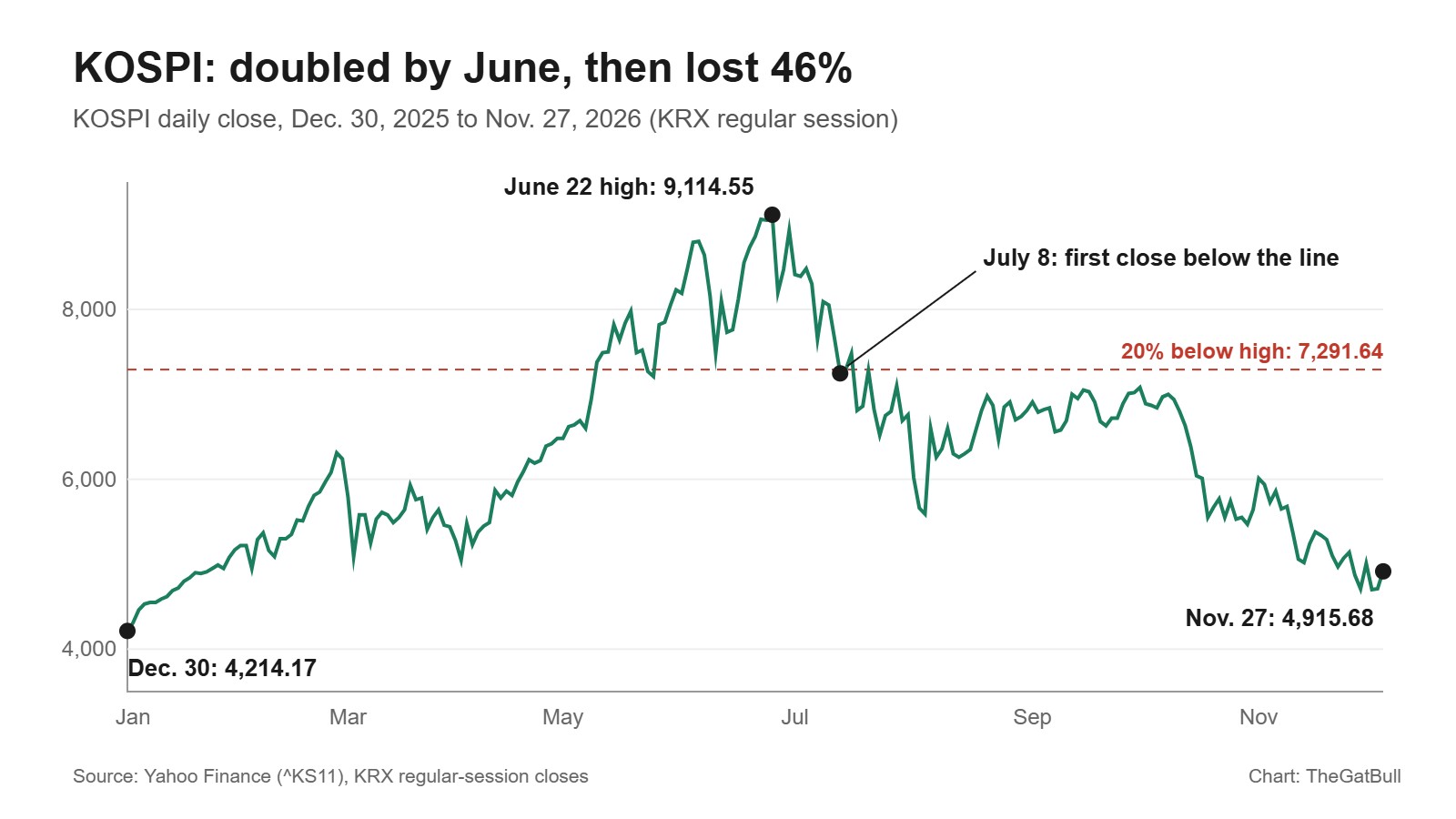
2. “Plunges” can read as a single event. The 20% line below the closing high sits at 7,291.64. The KOSPI first closed under it on July 8, 2026, at 7,246.79. November’s number is the end of a five-month slide from the June 22 peak, four and a half months of it below the 20% line, and in the week from Nov. 20 to Nov. 27 the index actually rose 0.94%.
Where the two readings agree and differ
| They agree | They differ |
|---|---|
| The KOSPI is far more than 20% below its high, so the bear-market label fits | Headline 47.7% vs. 48.46% (closing high) or 49.95% (intraday high) at the Nov. 25 close; the article does not say whether its 2026 high is a closing or intraday high |
| The two big chip stocks sit at the center of both the rise and the fall (43.16% of EWY) | “Plunges” can read as one event; the closes show a slide under way since July 8 |
| Swings are large: daily moves of 5% or more keep recurring | From the 2025 year-end and from a year ago, the index is still up (+16.65% and +23.30%) |
Under the Gat. Seoul’s benchmark more than doubled in under six months, from 4,214.17 on Dec. 30 to 9,114.55 on June 22, then gave back 46% by Nov. 27. A rise and fall that fast is why one index can be in a deep bear market and still up for the year.
What it means for your account
- U.S. account (EWY): your gain or loss depends on your purchase date, and the index peak does not set it. EWY’s numbers above are in dollars and the KOSPI’s are in won. That is one reason EWY’s +32.88% for the year differs from the KOSPI’s +16.65%: a fund priced in dollars also moves with the won, and it holds different weights and ends on a different date (Nov. 25). For that reason we do not subtract one from the other.
- Korean account: your average purchase price this year matters more than the label. Shares bought near the June peak are deep in the red; shares bought in January are still ahead.
Two stocks made Korea’s year go both ways
The KOSPI can be both “down nearly half” and “up 17%” because the rise and the fall were each short and narrow. Much of the climb from 4,214 to 9,114 came from two companies (by EWY weight; we did not compute their share of the index move). In EWY, Samsung Electronics is 22.12% of the fund and SK Hynix 21.04%, together 43.16% (iShares, as of Nov. 23). As of Nov. 27, Samsung Electronics is up 49.37% from its 2025 close and down 50.59% from its June high; SK Hynix is up 70.51% and down 61.97%.
That is why English coverage of Korea is likely to keep splitting in two. Stories that count from the peak will say “crash”; stories that count from January will say the market is still ahead this year. Both use real closing prices. Each of them should state its starting date.
Dates to watch
- Nov. 30 (Mon.): MSCI’s November review takes effect; EWY weight changes follow in our Dec. 2 piece (background: MSCI’s November Korea review).
- Nov. 28 (tomorrow): our What Seoul Said reads the Bank of Korea’s Nov. 26 decision; Matrix News reported a rate increase, which we have not yet checked against the bank’s own statement.
- Dec. 9 and Dec. 10: the Fed’s rate decision and the U.S. CPI report.
- Risk: one 4% up day does not end a bear market. To get back above the 20% line (7,291.64), the KOSPI would have to rise about 48% from its Nov. 27 close (our calculation).

Buying Korea from the U.S., and the Nasdaq in 2022
- Access: EWY (NYSE Arca, in dollars) holds Korea’s large caps. Single stocks trade on the KRX through a brokerage with Korean market access; SK Hynix also trades in the U.S. as the ADR SKHY (see how to buy SK Hynix stock from the U.S.).
- U.S. anchor: the Nasdaq Composite closed at its high of 16,057.44 on Nov. 19, 2021 and spent most of 2022 in a bear market. Its lowest close of 2022, 10,213.29 on Dec. 28, was still above its 2019 year-end close of 8,972.60. Not a perfect parallel: the Nasdaq’s run-up took years, while the KOSPI’s rise and fall each took about half a year.
The bottom line
Korea is in a bear market on closing prices, and has been since July 8. A reader who sees only “47.7% plunge” would miss that someone who held through the 2025 year-end is still ahead (the KOSPI in won, EWY in dollars). Before you take in the percentage in a Korea headline, find the date it counts from.
Mr. Gat: On Nov. 27 the same KOSPI close of 4,915.68 was minus 46% from June 22 and plus 17% from Dec. 30.
The Seoul Seven · how this piece was checked: ✓ Korean original · ✓ Dated sources · ✓ Seoul & New York time · ✓ Beyond EWY · ✓ U.S. anchor · ✓ What to watch · ✓ Corrections kept · what these mean
— Mr. Gat. Stay bullish. (Not a call to buy or sell.)
Related reading: Was 7,200 the KOSPI bottom? (our July 14 look at whether 7,200 was the bottom) · EWY’s Nov. 16–20 week · What moves the EWY stock price
FAQ
Is South Korea’s stock market in a bear market?
Yes, by the usual rule of a 20% fall from a peak. The KOSPI first closed more than 20% below its June 22, 2026 closing high on July 8, 2026. On Nov. 27 it closed 46.07% below that high.
Is the KOSPI down for 2026?
No. The KOSPI closed at 4,915.68 on Nov. 27, up 16.65% from the last close of 2025 (4,214.17 on Dec. 30).
Did the KOSPI really fall 47.7%?
It depends on the starting point. On KRX closing data, the Nov. 25 close was 48.46% below the closing high and 49.95% below the intraday high. The article that used 47.7% did not say which one it measured from.
What does Korea’s bear market mean for EWY holders?
It depends on when you bought. EWY was up 32.88% in dollars for 2026 through Nov. 25, and down 41.06% from its June 18 closing high.
Sources
- Prices: Yahoo Finance chart data (^KS11, ^KQ11, 005930.KS, 000660.KS, EWY, ^IXIC; vendor data, not exchange-published figures), retrieved Nov. 27, 2026.
- iShares MSCI South Korea ETF (EWY) holdings, as of Nov. 23, 2026.
- Hokanews, “South Korea’s KOSPI Plunges 47.7% as Asian Stock Markets Face Deeper Losses Than Wall Street,” Nov. 27, 2026: hokanews.com.
- Matrix News, “KOSPI Edges Up After Rate Increase as Analysts Warn of Bear-Market Swings,” Nov. 27, 2026: matrixnews.in.
- 24/7 Wall St, “Wall Street’s AI Crash Just Hit Asia: Korea Halted, Japan in a Bear Market,” Nov. 6, 2026, 8:12 a.m. ET: 247wallst.com.
How sure are we?
| Item | Confidence |
|---|---|
| KOSPI, KOSDAQ, stock and EWY closes; Nasdaq closes | Vendor data (Yahoo), KRX regular-session close for Korea; percentages are our calculation |
| EWY weights | ✅ iShares holdings file, as of Nov. 23, 2026 |
| July 8 bear-market crossing, the 7,291.64 line | Our calculation from closing data |
| The 47.7% figure, the “70% of 46 days” count, the Bank of Korea rate increase | ⚠️ Press-reported, not confirmed from a primary source |
| Which starting point the 47.7% uses | Not confirmed |
Not financial advice. TheGatBull is an independent publication; nothing here is a recommendation to buy or sell any security.
 Written by Mr.Gat — TheGatBull
Korean market coverage from a Seoul-metro-based operator with 15 years of personal investing experience, who reads the filings in the original language. Every price on this site is the KRX regular-session close (15:30 Seoul); every figure states whether it came from a primary filing, the press, or our own calculation. Drafts are AI-assisted, then verified against the original Korean documents and edited by a human before publishing.
Found an error? Tell us — corrections get priority. How we work →