1. The short answer
On September 22, Stanley Druckenmiller was in Seoul. It was his first visit to Korea.
The same day, the Bank of Korea’s financial stability report stated that risk is amplified if semiconductor conditions deteriorate.
Two days later the market shut for Chuseok, Korea’s autumn harvest holiday. The exchange has been closed since Thursday and reopens Monday, September 28.
This piece puts those three in order: who spoke, what the central bank wrote, and then the closure.
For EWY holders — two lines. One stock, SK Hynix, was 24.54% of the fund on September 22, and it sits underneath everything below. What moved that day was speech, not price: the KOSPI closed +0.15%, Seoul ran one more session on Wednesday, and no new close arrives until Monday.
2. First, the mechanism — what a financial stability report actually is
The Bank of Korea’s financial stability report is not a forecast. It is a stress-test document. It asks: if this shock arrives, which line in the system snaps first? Then it runs the assumption and publishes the result.
So the decline figures in that document are assumed values, not projections. Miss that distinction and you read it as a central bank predicting a crash. It is not that kind of document.
3. What was said that day
Stanley Druckenmiller — “many good companies”
On September 22, Druckenmiller’s first stop was not a corporate headquarters in central Seoul. It was a semiconductor equipment company in Seongnam, Gyeonggi Province. He then met with Samsung Electronics executives, and meetings with Doosan and Doosan Enerbility were reported as being arranged.
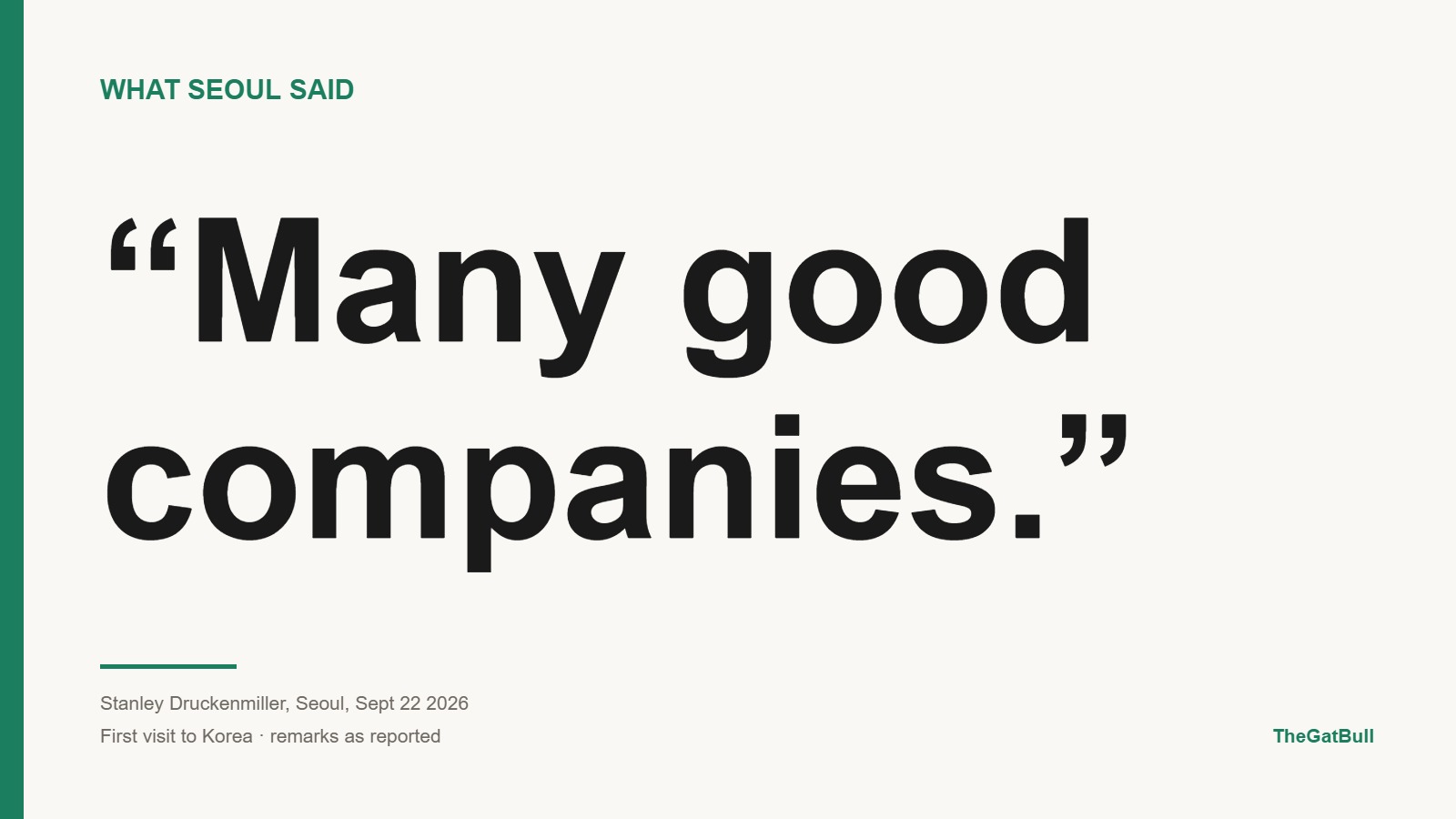
He told reporters that Korea has many good companies, and that he had come to find more Korean companies to invest in. He did not name specific companies.
Two things worth pinning down:
- He has reportedly been investing in Korean companies since 2025. This is his first visit, not his first position.
- At an investor event in New York on September 10, he said he had cut his AI exposure to about one-fifth of what it was six months earlier.
Someone who was trimming AI flew to the country that supplies it. Those two facts are not a contradiction — but he has never explained the connection, and we are not going to invent one for him.
The Bank of Korea — “risk is amplified”
The authority’s own framing, as reported: the Bank of Korea’s financial stability report stated that risk is amplified if semiconductor conditions deteriorate, and its stress scenario ran a 40% equity decline as an assumed value.
The purpose of that document is inspection, not warning. When an index becomes concentrated in one industry, checking in advance how that concentration could transmit into systemic risk is precisely why the report exists. Running that scenario in a year when the index’s semiconductor weight has risen is the document doing its job.
And then Seoul closed
September 24 (Thursday) and 25 (Friday) were Chuseok holidays. With the weekend, the session stays shut through September 27. The first trading day after the holiday is Monday, September 28.
4. What the numbers said — both sides
Evidence on the optimistic side. EWY is up 91.81% year to date (98.62 → 189.16, USD price return). And an investor known for a three-decade run without a losing year got on a plane rather than taking a video call.
Evidence on the cautious side. The KOSPI — the index, not the fund — fell 34.01% in the first month of the third quarter alone (June-end close 8,476.48 → July 30 close 5,593.56). Its September 22 close of 7,017.91 sits 23.00% below the closing high of 9,114.55 set on June 22, even though the same index is up 66.53% year to date.
| Measure | Value | Label |
|---|---|---|
| BOK stress scenario | −40% | assumption |
| KOSPI drawdown (Jun 30 → Jul 30) | −34.01% | actual |
The table puts them side by side, but the point is the labels, not the arithmetic between them. One is an assumption and one is a realized number, and the coverage we saw did not state the baseline the central bank measured its 40% from — so we cannot say the two start from the same point. Erasing that distinction is how a stress test becomes a headline about a predicted crash.
One more boundary: EWY’s +91.81% is a USD price return and the KOSPI’s +66.53% year to date is in KRW. Different currencies. We do not subtract them in the same sentence.
5. What this means for EWY holders
Samsung Electronics — one of the names on his Seoul schedule — sits at the center of EWY, and so does SK Hynix, which was 24.54% of the fund on its own as of September 22.
So the meaning of this visit for an EWY holder is not “what did he buy.” That is unknowable, and for a specific reason: Korean-listed shares are not Section 13(f) securities, so they do not appear in a US manager’s 13F regardless of where they were bought. Even if he says he holds significant positions in Korea and Japan, US paperwork will not tell you which ones.
The meaning is elsewhere: what he came to verify. Semiconductor supply chain and power. Those are the two places EWY’s top weights already sit — see our SK Hynix investor hub for how concentrated that is.
6. Where we looked, and what we did not check
This is the part we are going to be strict about. This piece covers what was said through Tuesday, September 22. Anything said on or after September 23 is outside what we checked.
- What he bought — cannot be confirmed. Korean-listed shares fall outside 13F reporting entirely. This is a structural gap, not an oversight.
- Whether the Financial Services Commission or the Financial Supervisory Service commented on the visit — we did not check. We are not claiming they were silent. We are saying we did not look, and absence of a check is not evidence of absence.
- Whether officials spoke during the holiday — not checked. A closed exchange is a fact about the calendar, not a finding about what anyone said.
What the calendar does guarantee is narrower: with no regular session since Thursday, neither statement gets a new closing price behind it until Monday.
7. So, the verdict
Too early to say.
The visit is a fact. The remarks are a fact. The buying is unconfirmed, and there is no route to confirm it. And on the same day, the central bank ran a scenario pointing the other way.
One person showing up does not change the arithmetic of a market. But that the most optimistic remark we recorded that day came from a visitor, and the most cautious we recorded came from Korea’s own central bank — that is worth writing down.
Under the Gat. A man known for thirty years without a losing year flew in. The same day, the central bank put a chip-downturn scenario in writing. Neither is wrong — they are looking at different clocks.

The conclusion
- September 22: Druckenmiller’s first Korea visit. His first stop was not a corporate headquarters.
- The same day, the Bank of Korea wrote about semiconductor-driven risk amplification and ran a 40% decline as an assumption.
- September 24–27: four consecutive closed days. Trading resumes Monday, September 28.
- What he bought does not show up in 13F filings. Anyone telling you otherwise is guessing.
Last Saturday we wrote about three meetings Seoul held on the Fed. On September 22 the notable voice came from outside.
FAQ
Did Druckenmiller buy Korean stocks?
Not confirmed. Korean-listed shares are not Section 13(f) securities, so they do not appear in a US manager’s 13F at all — there is no public US record to check. What press reports confirm is the visit and the remarks, nothing further.
If I buy EWY, do I own the companies in the news around his visit?
Partly. Samsung Electronics, which was on his Seoul schedule, and SK Hynix are both among EWY’s largest holdings — SK Hynix alone was 24.54% as of September 22, 2026. The KOSDAQ-listed equipment maker he visited first is not in EWY.
Does EWY trade during Korea’s Chuseok holiday?
Yes. EWY trades in New York on its own schedule; Korea’s regular session was closed September 24 and 25.
Did the Bank of Korea forecast a 40% drop?
No. That figure is a stress-test assumption, not a forecast. A financial stability report runs shock scenarios to see where the system strains first; it does not predict prices.
Sources
Hankyung (Sept 22, 2026) · Money Today (Sept 20, 2026) · Aju Business Daily (Sept 21, 2026) · press coverage of the Bank of Korea financial stability report · KRX regular-session closes (Yahoo v8 direct, Sept 22, 2026, 15:32 KST)
Confidence
| Item | Strength |
|---|---|
| Seongnam visit and remarks | [reported] — multiple outlets, not a primary filing |
| Quoted remarks | [reported, translated] — English rendering of Korean-language reporting |
| Doosan meetings | [reported, planned] |
| KRX closes | [measured] — Yahoo v8 regularMarketTime self-verifying |
| BOK report figures | [reported] — primary document not cross-checked |
| Sept 23 close and statements | not obtained — outside this piece’s scope |
| What he bought | unconfirmable — no US filing route |
This article is for informational purposes only and is not investment advice. Figures are as of September 22, 2026. Do your own research.
Written by Mr.Gat — TheGatBull
Korean market coverage from a Seoul-metro-based operator who reads the filings in the original language. Every price on this site is the KRX regular-session close (15:30 Seoul); every figure states whether it came from a primary filing, the press, or our own calculation. Drafts are AI-assisted, then verified against the original Korean documents and edited by a human before publishing.
Found an error? Tell us — corrections get priority. How we work →