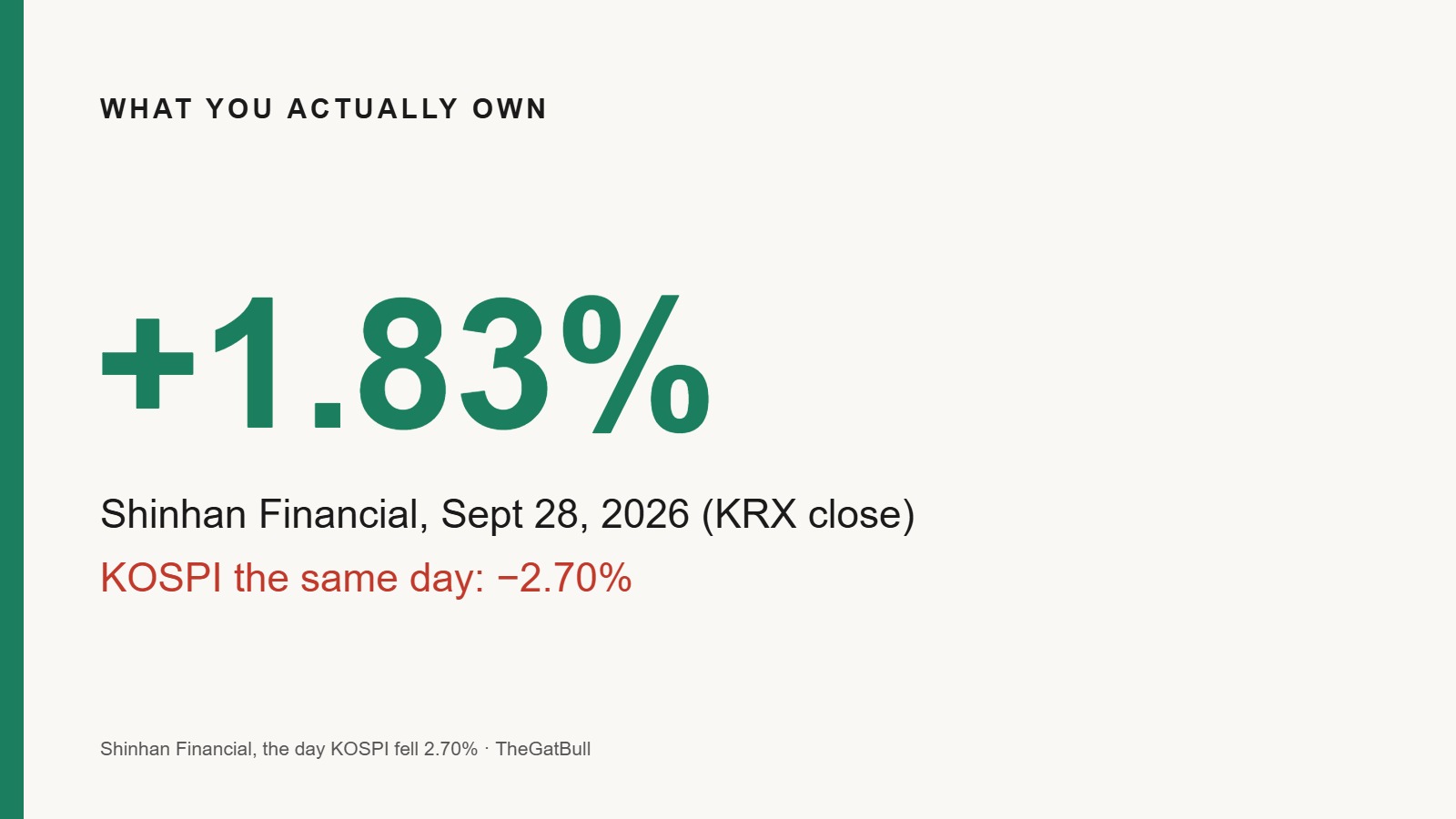
TL;DR — If you hold EWY. On Korea’s first trading day after Chuseok, KOSPI fell 2.70%. Most of that came from two stocks, Samsung Electronics (−5.43%) and SK Hynix (−5.05%). The same day, bank holding company Shinhan Financial, 1.56% of EWY, closed up 1.83%.
Basis: every Korean price here is the KRX regular-session close at 15:30 Seoul time on Monday, September 28, 2026 (Nextrade after-hours volume is not included). EWY holdings are from iShares, as of September 25, 2026.
1. The short answer
On September 28, the first trading day after the Chuseok holiday, KOSPI closed at 6,889.74, down 2.70% (−191.18 points). The headline writes itself: Korea sold off.
But on the same day, bank holding company Shinhan Financial (055550) closed at ₩111,300, up 1.83%. Same market, same day, opposite direction.
The reason lies in what the index is made of. KOSPI’s two largest stocks by market value, Samsung Electronics (−5.43%) and SK Hynix (−5.05%), fell hard and account for most of the index’s decline. Banks, meanwhile, saw buying. KB Financial also closed higher, up 0.58%.
What this means if you hold EWY. First, KOSPI’s −2.70% does not tell you how much your EWY position lost today. Samsung Electronics (23.50%) and SK Hynix (22.66%) together were 46.16% of EWY as of September 25, while Shinhan was 1.56%. On a day both chip names fall about 5%, EWY is likely to fall more than KOSPI. EWY’s own September 28 close was not available when this was written, because the US market had not yet opened. Second, even on a day KOSPI drops, some of what is inside it goes up. “Korea fell” is one line that hides the spread underneath.
2. The numbers: KOSPI fell, Shinhan rose
| Measure | Sept 23 close (last before holiday) | Sept 28 close (reopening) | Change |
|---|---|---|---|
| KOSPI | 7,080.92 | 6,889.74 | −2.70% |
| KOSDAQ | 844.48 | 846.58 | +0.25% |
| Samsung Electronics (005930) | ₩285,500 | ₩270,000 | −5.43% |
| SK Hynix (000660) | ₩1,862,000 | ₩1,768,000 | −5.05% |
| Shinhan Financial (055550) | ₩109,300 | ₩111,300 | +1.83% |
| KB Financial (105560) | ₩173,200 | ₩174,200 | +0.58% |
On the same reopening day, under the same selling pressure, the two large-cap chip stocks and the banks moved in opposite directions. KRX trading value that day was ₩21.8 trillion on 216 million shares, as reported by Seoul Shinmun and other outlets. For scale, the won closed at ₩1,365.1 per $1 at 15:30 Seoul time, weaker by ₩7.6 from the prior session.
3. Gap vs. session: Shinhan opened lower too
Everything in this comparison opened lower. The difference came after the open. Splitting the day in two helps: the gap is where prices opened after four days shut, and the session is what happened once trading was under way.
| Open | Gap (open vs. prior close) | Close | Session (close vs. open) | |
|---|---|---|---|---|
| KOSPI | 7,057.86 | −0.33% | 6,889.74 | −2.38% |
| Shinhan Financial | ₩108,800 | −0.46% | ₩111,300 | +2.30% |
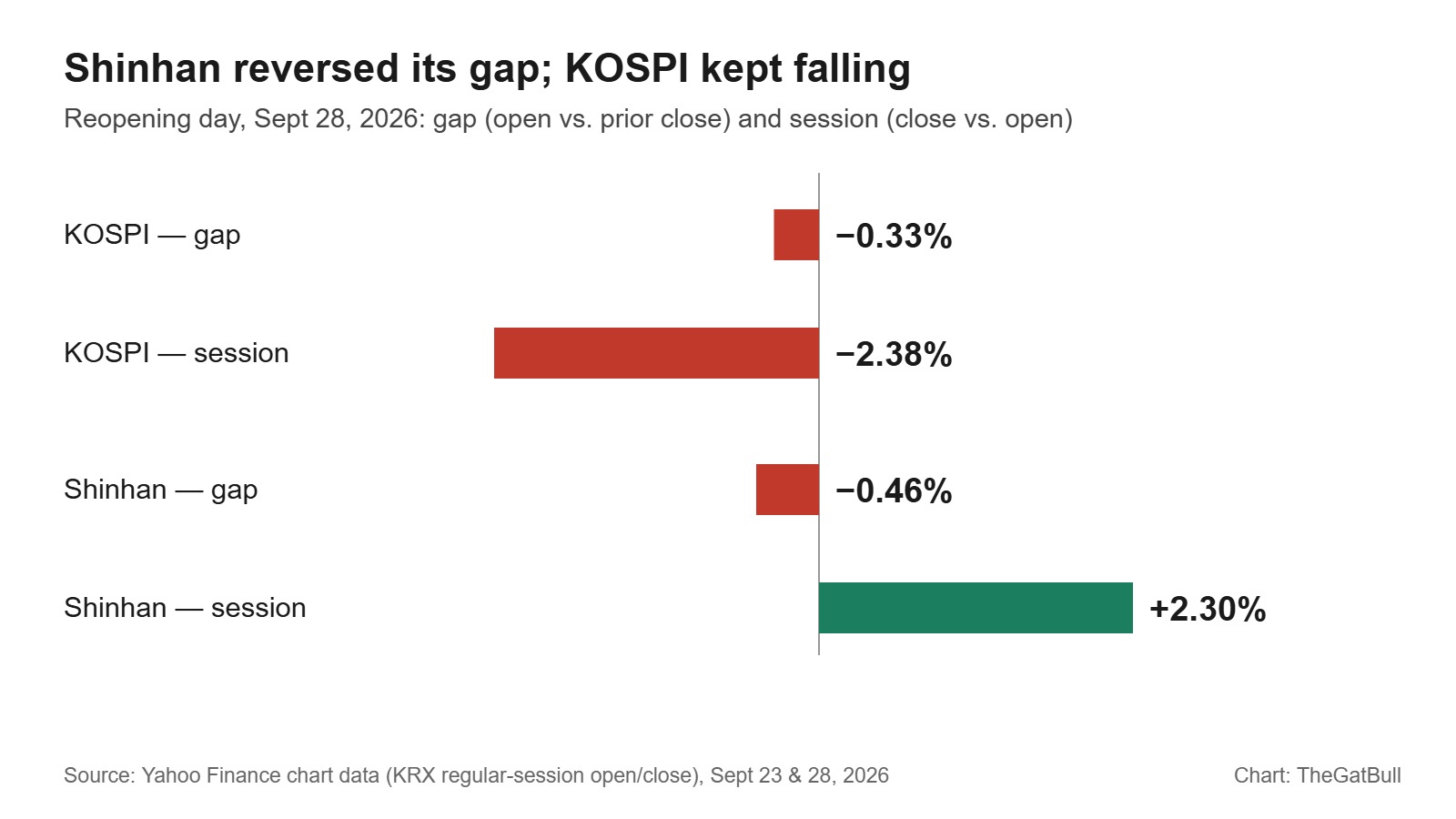
Shinhan gapped down at the open just like KOSPI. What happened next is the story. KOSPI fell further during the session (−2.38%), while Shinhan more than erased its gap and closed higher (+2.30% from the open). We did not obtain stock-level flow data showing who bought Shinhan, so we are not going to guess.
4. What is Shinhan Financial, and how is business?
Shinhan Financial is one of Korea’s largest financial holding companies, built around Shinhan Bank. Its recent results, as reported by the company and carried in the Korean press (we did not check them against the primary IR materials):
- Q2 2026 net income: ₩1.8201 trillion, up 12.2% from the prior quarter
- First-half 2026 net income: ₩3.4427 trillion, up 13.3% year over year, a record for the company
- First-half non-interest income up 19.7% and interest income up 7.7% year over year
- CET1 ratio 13.43%, BIS ratio 15.74% (as of end-June; both are regulatory measures of a bank’s capital cushion)
Looking at those numbers, it is tempting to call Monday’s gain an earnings story. It was not. These results were published in July. They were not new on September 28 (see section 6).
5. The policy backdrop: “Value-up 2.0” and shareholder returns
Shinhan has guided to more than ₩2.8 trillion in shareholder returns this year: roughly ₩1.4 trillion in dividends and roughly ₩1.4 trillion in buybacks and cancellations, including ₩700 billion slated for the third quarter. Its Q2 dividend per share was ₩740. The company calls this its “Value-up 2.0” strategy, aimed at raising both capital efficiency and profitability, according to Newspim.
Buyback cancellations and higher payouts are not unique to Shinhan. They run along the same axis we covered in KB Financial’s value-up execution. Korea’s financial holding companies as a group are moving in this direction.
6. Flows: no specific news on the day
Across KOSPI on September 28, foreigners were net sellers of ₩3.23 trillion and institutions net sellers of ₩1.02 trillion, while individuals were net buyers of ₩2.61 trillion (Seoul Shinmun, citing KRX). Foreigners and institutions together sold more than ₩4 trillion, and that selling reads as concentrated in the index’s heaviest names such as Samsung Electronics and SK Hynix. To be precise: we only have the index-level totals, not stock-level flows.
Shinhan’s rise has a thinner explanation. One Korean outlet, Jaekyung Ilbo, wrote that buying came in “without any specific positive disclosure” and lifted the stock. Apart from a notice of an upcoming IR briefing, there was no new earnings, contract or policy news. So Monday’s +1.83% is best described as buying pressure, not a specific headline. We do not claim any cause beyond that.
7. Context: the first day after four days shut
This was not just any Monday. It was the first session after the market had been closed for four straight days, September 24 to 27, for Chuseok. The US market kept trading through that stretch, so four days of information, including US chip-stock moves and currency swings, could land in Seoul all at once. That may have something to do with why the chip decline was so large on this particular day. We did not verify that link. What to watch next: EWY’s own September 28 close, once the US session opens, will show how much of the chip slide reached the fund.
8. What this tells you about the Korean market
This is the fact about the Korean market you only see by looking at this company: KOSPI looks like it stands for the whole Korean market, but in practice a handful of very large stocks set the day’s direction. On Monday it was just two, Samsung Electronics and SK Hynix. When those two fall, the index gets a “sell-off” headline, while sectors with small weights inside the same index, such as banks, can have a completely different day.
Under the Gat. The headline says “Korean stocks fall 2.7%.” Most of that fall came from exactly two stocks. If you read only the headline without knowing what is inside KOSPI, you might worry even if you held a bank stock that went up that day. Before the index, look at what is in it, and how much.
Shinhan’s weight in EWY
Shinhan Financial is an EWY holding at 1.56% of the fund (iShares, as of September 25, 2026). EWY’s two largest holdings, Samsung Electronics and SK Hynix, were 46.16% combined on the same date. On a day like Monday, when both slide, their effect on EWY’s return is far larger than Shinhan’s.
9. How can a US investor own Shinhan?
Shinhan Financial is listed on the New York Stock Exchange as an American depositary receipt (NYSE: SHG), so it can be bought in an ordinary US brokerage account. SHG closed at $80.95 on Friday, September 25 (US trading day), while Seoul was closed. The September 28 US session had not opened when this was written. We did not confirm the ADS-to-common-share ratio (how many Seoul shares one SHG share represents) in this session, so we do not calculate a price parity between SHG and the Seoul shares.
Not a perfect parallel. US investors know the feeling of a down day for the index when one sector goes up anyway; financials rising on a day the S&P 500 falls is common. Two things differ. First, the top two stocks in the S&P 500 do not carry weight on the scale of KOSPI’s top two. On Monday, two stocks explain most of KOSPI’s decline. Second, this was a reopening gap after four straight holiday closures, a situation US indexes do not face in that form.
For US investors who want this exposure, there are three routes: (1) EWY (ETF, Shinhan at 1.56%), (2) SHG (ADR, Shinhan alone), and (3) the KRX directly through an international brokerage account such as IBKR (ticker 055550).

The conclusion
- On the first trading day after Chuseok, KOSPI fell 2.70%.
- Most of that came from two stocks: Samsung Electronics (−5.43%) and SK Hynix (−5.05%).
- The same day, Shinhan Financial rose 1.83%, with no specific positive news, on buying alone.
- Before concluding “Korea fell” from one index headline, look at what is inside the index, and how much.
More on what is actually inside EWY: EWY’s concentration. For the dividend angle on Korean bank stocks: Korea’s dividend tax cut and foreign investors.
FAQ
Why did KOSPI fall on September 28, 2026?
Its two largest stocks by market value, Samsung Electronics (−5.43%) and SK Hynix (−5.05%), fell sharply and account for most of the index’s decline. Foreign and institutional investors were net sellers of more than ₩4 trillion combined.
Why did Shinhan Financial rise the same day?
No company-specific catalyst was confirmed. One Korean outlet reported that buying came in “without any specific positive disclosure.” We can only describe it as buying pressure, not a news-driven move.
Can I buy Shinhan Financial in the US?
Yes. It is listed on the New York Stock Exchange as an American depositary receipt under the ticker SHG. It is also held in EWY, at 1.56% of the fund as of September 25, 2026.
How does a day like this affect an EWY holder?
Samsung Electronics and SK Hynix together were 46.16% of EWY as of September 25, 2026, so on a day when both fall about 5%, EWY is likely to move more than KOSPI. EWY’s own September 28 close was not available when this was written, because the US market had not yet opened.
Why was September 28 a reopening day?
The Korea Exchange was closed for four straight days, September 24 to 27, for the Chuseok holiday. It reopened for regular trading on Monday, September 28.
Sources
KRX closes: Yahoo Finance chart data for ^KS11, ^KQ11, 005930.KS, 000660.KS, 055550.KS, 105560.KS (KRX regular-session closes, retrieved September 28, 2026) · KOSPI move and flows: Asia Economy · SBS Biz · Seoul Shinmun · Money Today · Seoul Finance (figures identical across all five) · Shinhan on the day: Jaekyung Ilbo · Shinhan first-half results: Newspim (company-reported) · USD/KRW: Newsis, Seoul 15:30 close · SHG: Yahoo Finance chart data · EWY weights: iShares EWY holdings, as of September 25, 2026
Confidence
| Item | Strength |
|---|---|
| KOSPI and stock closes, Sept 28 | [measured] — vendor data for KRX regular-session closes, matched by 4–5 outlets |
| Reason for Shinhan’s rise (“no specific positive disclosure”) | [reported] — single outlet, not confirmed from a primary source |
| Shinhan first-half results and return plan | [reported] — company figures via press, primary IR not cross-checked |
| USD/KRW 1,365.1 | [reported] — single outlet, prior-close difference checks out |
| EWY weights (Shinhan 1.56%, top two 46.16%) | [primary] — iShares holdings, as of Sept 25, 2026 |
| Stock-level flows · SHG ADS ratio · EWY Sept 28 close | not obtained |
This article is for informational purposes only and is not investment advice. Figures are as of September 28, 2026. Do your own research.
 Written by Mr.Gat — TheGatBull
Korean market coverage from a Seoul-metro-based operator who reads the filings in the original language. Every price on this site is the KRX regular-session close (15:30 Seoul); every figure states whether it came from a primary filing, the press, or our own calculation. Drafts are AI-assisted, then verified against the original Korean documents and edited by a human before publishing.
Found an error? Tell us — corrections get priority. How we work →