Not financial advice. TheGatBull does not provide investment advice.
The Fed raised rates. The next morning at 8 o’clock, two Korean government meetings opened at once — and a third followed a day later. Three institutions said three different things, and the number that moved most that week was nobody’s headline.
The short answer
At 3 AM Seoul time on September 17, the Federal Reserve raised its policy rate by a quarter point. Five hours later, two government meetings convened in Seoul — one called by the Ministry of Economy and Finance, one held separately by the Bank of Korea. The next day, the head of the Financial Services Commission laid out a capital-markets package at a conference.
Two days, three podiums. The week’s numbers landed like this.
| What | Sept 11 → Sept 18 | Currency & market |
|---|---|---|
| KOSPI (Korea’s main index) | −0.23% | won · KRX closes |
| EWY (the US-listed Korea ETF) | −3.93% | dollars · NYSE Arca |
| Won per dollar | +2.78% (won weaker) | Seoul 3:30 PM |
In won, the index went essentially nowhere. In dollars, a holder of Korea lost 3.9% on the week. None of the three official appearances made that gap its headline.
⚠️ Do not subtract these three numbers from one another. EWY is unhedged, its holdings are not the index, and it trades on a different clock — its September 18 session opened after Seoul’s September 18 close. What we can say is that the three facts point the same direction. We do not compute a residual and hand it to the currency.
1. First, the machinery — what happens in Seoul the morning after a Fed hike
Before any of the quotes, the thing to understand is the procedure. For a US investor, the morning after an FOMC decision is just a Thursday: the Fed announces, the market digests, done. Nothing convenes the Treasury, the Fed and the securities regulators for breakfast.
In Seoul that morning, two meetings opened at the same hour.
- The expanded macroeconomic and financial meeting — the finance ministry’s, with the central bank and both financial regulators attending. The government reading an external shock in one voice.
- The market-situation review — the central bank’s own, held separately. Its read does not get folded into the government’s.
That both convened at 8 AM is itself the information: Korea treated this Fed decision not as foreign news but as a domestic event demanding an immediate cross-agency response.
The price side of these same two days is in the six and a half hours Seoul traded before New York reopened. This piece is the words side.
2. What was said, in their own words
No commentary in this section. These are the statements as delivered.
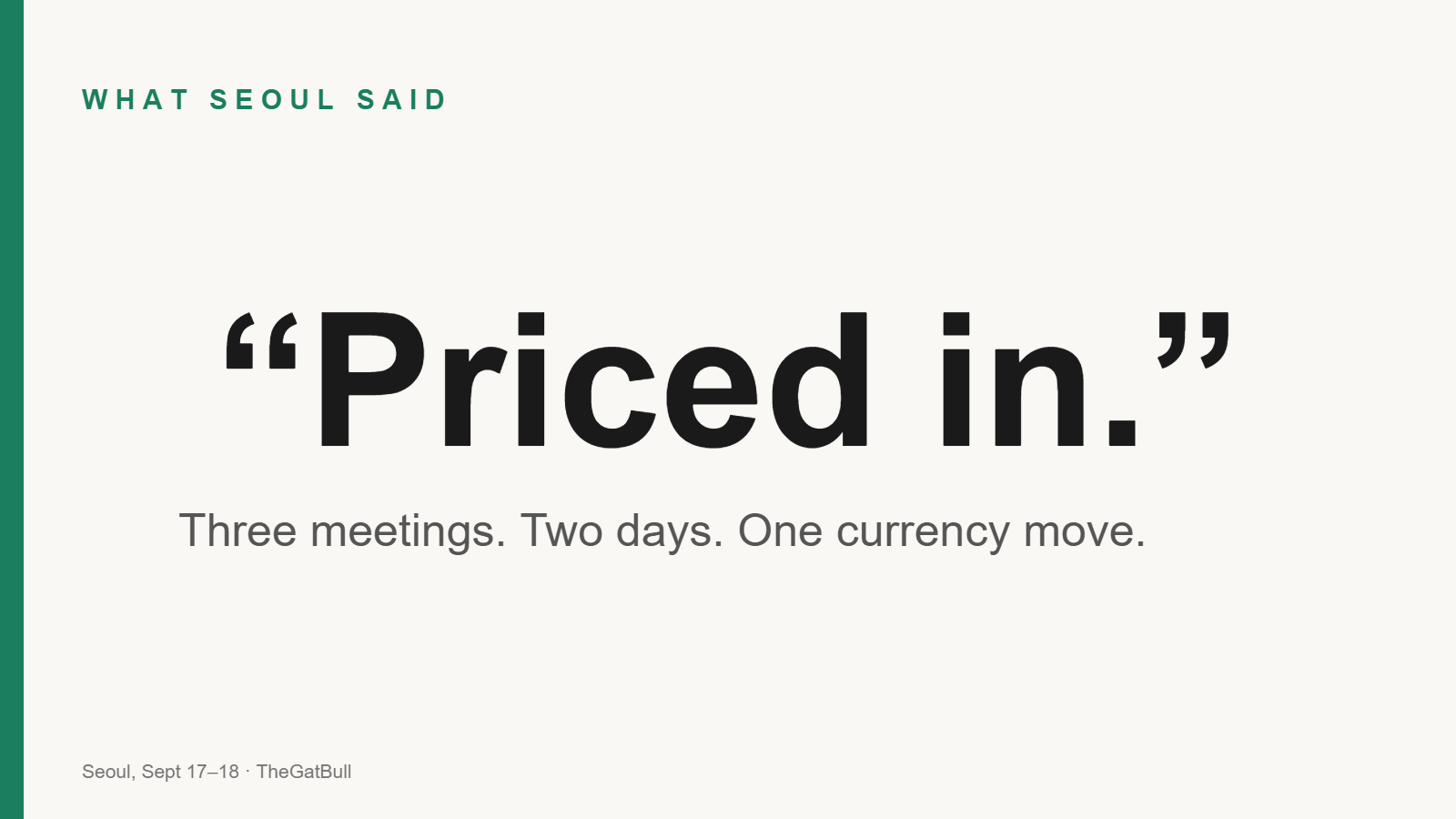
The finance ministry: “already priced in”
September 17, 8 AM, chaired by the deputy prime minister and finance minister, Koo Yun-cheol, with the central bank and both financial regulators in the room.
The meeting read the Fed’s move as grounded in “solid economic and employment conditions and inflation staying at a high level,” and judged the hike “already priced into the market, with financial market conditions broadly stable.” On what comes next: monitor oil and global capital flows; deploy stabilization measures if bond-market volatility widens; support vulnerable borrowers; watch the liquidity effects of the current-account surplus.
The central bank: “we expect a tighter stance ahead”
The same hour, at the central bank, chaired by its senior deputy governor, Kwon Min-soo, who took the job in August.
“With the Fed having raised rates overnight for the first time in about three years since July 2023, and taking into account Chair Kevin Warsh’s emphasis on the commitment to price stability and his signalling of the possibility of further hikes, we expect the Fed’s monetary policy stance to be tight going forward.”
On the risks: “the course of the war in the Middle East and the path of international oil prices, concerns about fiscal soundness in major economies, and uncertainty around the artificial-intelligence industry.” The bank said it would monitor domestic financial and foreign-exchange conditions “around the clock, with heightened vigilance.”
This is the week’s genuinely new fact, and it is narrower than it looks. Seoul’s message for weeks has been that Korea does not follow the Fed mechanically — from the governor’s late-August remarks into the bank’s own September policy report. That did not change. What changed is Seoul’s read of where the Fed is going: the subject moved from its own rate stance to a forecast of somebody else’s, and that forecast hardened.
The financial regulator: a capital-markets package
September 18, Seoul. The chairman of the Financial Services Commission, Lee Eok-won, speaking at a capital-markets conference.
His diagnosis: “In June and July, concentration in particular sectors, expanded investing on borrowed money, and FOMO combined, and volatility rose.” Four directions followed.
A long-term buyer base (new investment funds and tax-advantaged savings accounts, plus tax treatment moving “in the direction where holding a stock longer brings a bigger reward,” under review with other ministries); governance measures, including publishing a list of low price-to-book companies; a KOSDAQ overhaul — KOSDAQ is Korea’s secondary board for smaller, growth-stage companies — with a state growth fund’s KOSDAQ vehicle due to start investing around October; and volatility tools — zero tolerance for manipulation, tighter margin-lending management, and “the introduction of an emergency powers mechanism for the FSC to stabilize markets in a crisis.”
One thing to keep separate: the low price-to-book list is not new this week — it was announced in March, and this was a progress mention. On the emergency powers, the chairman named the idea; the limits of what we know are in the section below.
Still, the appearance itself is the event for this column: stock-market remarks from Korea’s financial regulators had come up empty in our weekly log three weeks running. That ended this week — with a structural package, not a single measure.
3. What the numbers said — both sides
Evidence exists in both directions here. We are not going to pick one.
Consistent with the authorities’ read: the KOSPI finished the week at −0.23% — a flat tape, not a broken one. It rose 2.66% the day after the hike, and 4.03% from the week’s low close (6,627.26 on September 15) to Friday.
Pointing the other way: the won closed at 1,383.3 per dollar in Seoul on September 18, against 1,345.9 a week earlier — 2.78% weaker, or 37.4 won in absolute terms. Korean outlets reported it as the seventh straight session of dollar gains; that is their count, not one we reproduced from a daily series. And a dollar-based holder of Korea — an EWY holder — finished the week at −3.93%.
So Korea in won and Korea in dollars told different stories that week. The three appearances covered bonds, oil, capital flows, borrowers and market structure; the currency appeared as something to monitor “around the clock.” The distance between that word and the size of the move is the distance between Seoul’s statements and an American brokerage account.
4. What this means if you hold EWY
Your Korea exposure carries two prices: what the shares cost in won, and what those won cost in dollars. EWY does not hedge the second one. The authorities’ “broadly stable” is defensible about the first price; the second was not in the sentence. Which is why this column also tracks what officials did not say — and in the three appearances we read, we found no directional comment on the level of the won.
How officials have handled the currency before is in the week Seoul called the won “immune”; whether a Korean market rule reaches a US-listed ETF is the question we worked through in the ETF premium rule piece. The new FSC package will face that same question, and we cannot answer it yet.
5. Who did not speak
A rule this column keeps: never declare a silence we have not established. Plainly, then: this week’s search covered the three appearances above. We did not sweep every other Korean, US or Japanese authority that might have spoken about markets or the won, and we are not claiming we did. Absence from this column is not evidence of absence.
And here, in one place, is what we could not confirm. We did not match a single one of the three appearances to its institution’s own document — the releases were not on the ministry’s, the central bank’s or the commission’s sites (the Bank of Korea’s list was showing a “content being prepared” notice). Everything quoted above is on-record remarks by named officials, cross-checked across multiple outlets, which is not the same as reading the institution’s paper. We could not establish the scope, legislative route or timing of the emergency powers, nor whether every Fed decision triggers those same two morning meetings. And the exchange rate above is a press figure, not one we pulled from a primary source.
That is a long list, and we would rather print it than write around it. None of it touches the two numbers this piece turns on — the index close and the ETF close — which we pulled directly.
6. The verdict
Too early to call — and we mean that as a verdict, not a dodge. Two days of statements and two sessions cannot establish that Seoul’s response worked. The index holding is consistent with the authorities’ read; the size of the currency move over the same days sat outside the frame of that read.
What would change our answer:
- The October 22 monetary policy decision. The bank has held the line that it does not follow the Fed mechanically; now that its forecast of the Fed has hardened, whether that line holds is the first real test. (The Bank of Korea’s published 2026 calendar sets the rate meeting for Thursday, October 22, with the next one on November 26.)
- The direction of the won — and whether “monitoring” ever becomes a different verb.
- Whether the FSC package produces a dated action — the tax-treatment review with other ministries, the governance push, or the KOSDAQ vehicle’s “around October” start. A speech becomes policy when something gets a date on it.
- The substance of the emergency powers. Once the legislative route and the scope are public, “volatility tools” can be assessed as something specific.
Next week is Chuseok. The KRX regular session is closed September 24 and 25, with September 28 a substitute holiday; US markets run normally throughout.
7. The American anchor
Not a perfect parallel: the US makes the decision, so a “response meeting” is a different kind of need, and Washington has crisis-convening machinery when it wants it. The difference is not whether anyone gathers — it is that Seoul gathered within five hours of the decision.
One structural point behind the language: Article 1(2) of the Bank of Korea Act directs the central bank to pay attention to financial stability in conducting monetary policy. The Fed’s dual mandate — prices and employment — has no such clause. That statutory difference is consistent with a Korean central banker pairing currency-watching with the policy stance in one breath — though we cannot say the statute is the reason for this week’s particular wording.
The takeaway
The morning after the Fed moved, Seoul held two meetings, and a third followed. The finance ministry said “priced in.” The central bank said “heightened vigilance.” The financial regulator broke three weeks of quiet to talk about market structure. None of the three made the currency move its headline.
That week the KOSPI went almost nowhere in won. And anyone holding Korea in dollars was down 3.9%. Reading what Seoul says is useful not because the answer is inside it, but because you can see what is not.
Update — the October date
When this went up we wrote that we could not establish the date of the Bank of Korea’s October rate meeting. We have since read it off the bank’s own published 2026 meeting calendar: Thursday, October 22, with the following rate decision on November 26. A financial-stability meeting sits on September 22, two days before the Chuseok closures.
FAQ
Does Korea’s government really meet the morning after a Fed decision?
Yes. The finance ministry convenes an expanded macroeconomic and financial meeting, and the Bank of Korea holds its own market-situation review; both met at 8 AM on September 17, five hours after the decision. Whether every Fed decision triggers the same two meetings is something we did not verify. The US has no equivalent cross-agency meeting after an FOMC decision.
Will the Bank of Korea raise rates because the Fed did?
This article does not answer that. The bank has repeatedly said it does not follow the Fed mechanically, and that position did not change this week — what changed is its forecast of where the Fed is heading. The Bank of Korea’s published 2026 calendar puts the next rate decision on Thursday, October 22.
Why did EWY fall 3.9% when the KOSPI barely moved?
Three things are in play at once: EWY is priced in dollars and does not hedge the currency, its holdings are not the index, and it trades on a different clock. Over the same week the won weakened 2.78% against the dollar. The direction is consistent — but we do not subtract these numbers to claim the currency “took” a specific number of percentage points, because we have not verified what that calculation would require.
What are the FSC’s “emergency powers”?
What is confirmed is that the chairman named the introduction of an emergency powers mechanism as one of the volatility tools being prepared. The scope of the power, the legislative route and the timing are things we could not establish.
What was actually new in Korean officials’ remarks this week?
Two things. The central bank’s forecast of the Fed hardened — a statement about someone else’s policy, not its own rate plan. And the Financial Services Commission resumed speaking about the stock market after three weeks in which we found no new remarks, doing so with a structural package rather than a single measure.
When is the Korean market closed for Chuseok?
The KRX regular session is closed on September 24 and 25, with September 28 a substitute holiday. US markets are open throughout.
Sources
- Expanded macroeconomic and financial meeting (September 17, 8 AM; chaired by Koo Yun-cheol, Deputy Prime Minister and Minister of Economy and Finance) — on-record remarks cross-checked across multiple Korean outlets. We did not reach the ministry’s own release.
- Bank of Korea market-situation review (September 17, 8 AM; chaired by Kwon Min-soo; “senior deputy governor” renders a Korean rank distinct from “deputy governor” — the English title is not confirmed on the bank’s own site) — on-record remarks cross-checked across multiple Korean outlets. We did not reach the bank’s own release; its monetary-policy release list was displaying a “content being prepared” notice. Quotations are our translations.
- FSC chairman’s remarks (September 18, Korea Capital Market Institute 29th-anniversary conference, Yeouido, Seoul) — on-record remarks cross-checked across multiple Korean outlets. The commission’s press-release list does not carry this item. Quotations are our translations.
- KOSPI closes, September 10–18: market data queried directly — KRW · KRX regular session (3:30 PM KST) · Asia/Seoul vendor tags. Weekly, daily and low-to-close changes each re-verified against the underlying closes.
- EWY closes, September 10–18: market data queried directly — USD, US trading days.
- Won per dollar: 1,383.3 at the Seoul 3:30 PM close on September 18 — press-reported, not confirmed from a primary source; 1,345.9 on September 11 is our previously confirmed figure. The “seven straight sessions” framing is press wording; we did not recount it from a daily series.
- Bank of Korea 2026 meeting calendar: the central bank’s published schedule of regular Monetary Policy Board meetings — rate decisions on October 22 and November 26, 2026; a financial-stability meeting on September 22. Read from the release itself after this article first went up.
- Chuseok closures (regular session closed September 24–25; September 28 a substitute holiday) — previously verified.
- Not claimed: any cause of the currency move; the scope, legislative route or timing of the FSC’s emergency powers; that the low-PBR list is new this week (it was announced in March).
Not financial advice. This article is for information only. TheGatBull and its author hold no position in the securities mentioned unless disclosed. Confidence labels are as of publication.