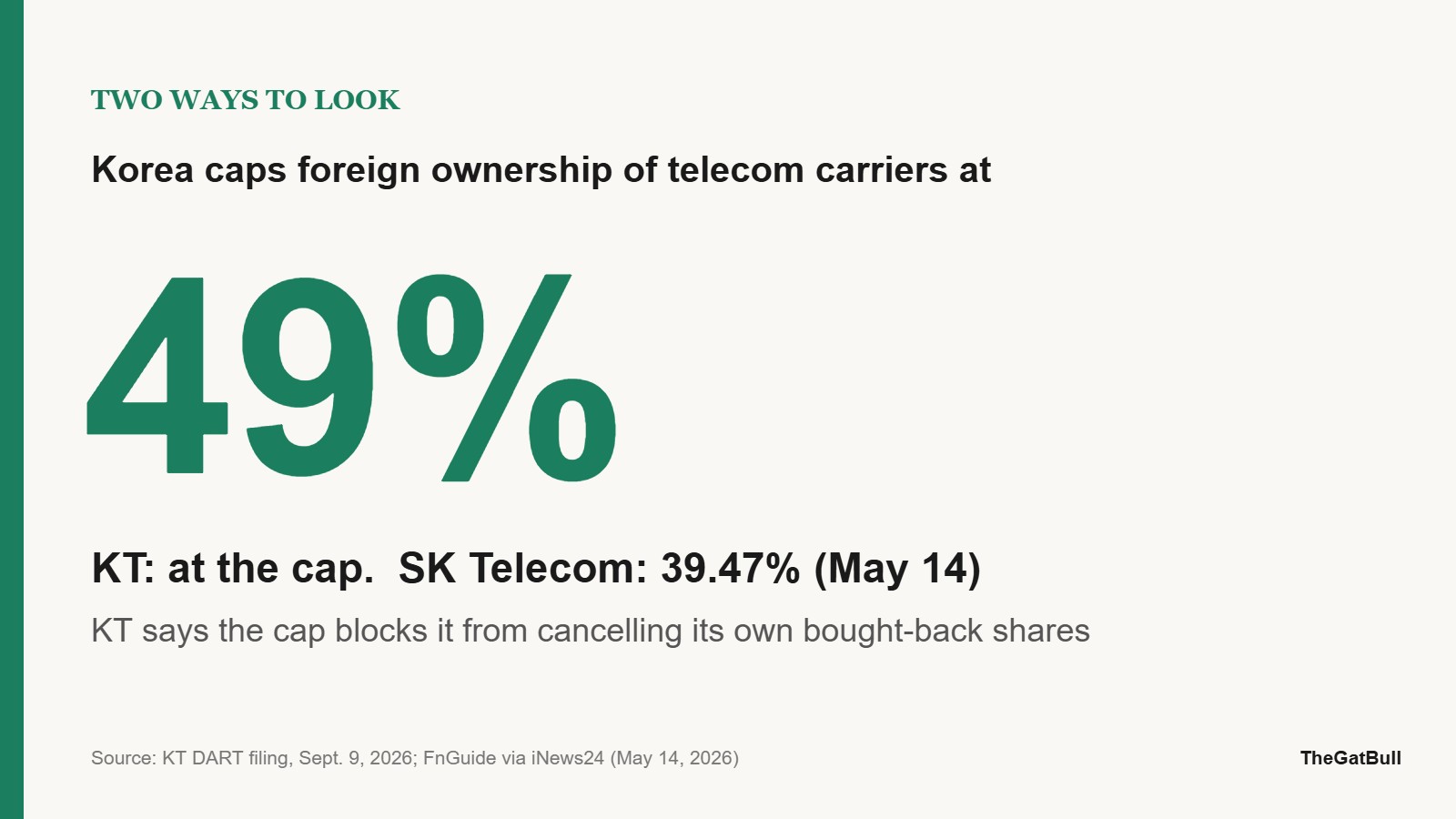
TL;DR — If you own SK Telecom (SKM) or KT (KT) ADRs. Both Korean carriers pay quarterly dividends: KT has set a minimum annual dividend of ₩2,400 (about $1.81), about a 5.1% yield at Friday’s close, and SK Telecom has paid ₩830 (about $0.63) in each of the last two quarters, about 4.5% if you simply multiply by four (that is our math, not company guidance). In our view, the bigger difference for a foreign investor is that Korean law caps foreign ownership of telecom carriers at 49%, and KT has reached that cap while SK Telecom still has room.
Your Door — what to check if you hold SKM or KT. SKM holders: the 49% cap does not bind SK Telecom today; on the latest count we have (May 14) there were about 9.5 points of room. Since one SK Telecom share equals 1.8 SKM ADRs, ₩830 per share works out to about ₩461 per ADR (about $0.35) before taxes and fees (our calculation). KT holders: the Seoul record date (the date you must be on the shareholder list to get paid) for the ₩600 third-quarter dividend is Wed., Oct. 28; your ADR record date is set separately by the depositary bank (the U.S. bank that issues the ADRs), so check your broker’s notice. For SKM, the next checkpoint is whether SK Telecom declares ₩830 again for the third quarter; the date has not been announced.
Not financial advice.
Dates are Seoul time (KST) unless marked otherwise. Stock and index prices are KRX (Korea Exchange) regular-session closes (15:30 Seoul) on Fri., Oct. 23, 2026. Dollar conversions are for scale only, at ₩1,324.2 per dollar, the Oct. 22 Seoul 3:30 p.m. rate as reported by Korean outlets.
SK Telecom vs KT: two dividend records
KT (KRX: 030200; NYSE ADR: KT) declared a third-quarter dividend of ₩600 per share (about $0.45) at its Oct. 13 board meeting. The record date is Oct. 28, payment is scheduled for Nov. 12, and the total is about ₩142.0 billion (DART 20261013800366). In May, KT raised its minimum annual dividend from ₩1,960 (about $1.48) to ₩2,400 and said it would return 50% of adjusted standalone net profit to shareholders through 2028 (Newsis, May 12).
SK Telecom (KRX: 017670; NYSE ADR: SKM) stopped paying dividends for the second half of 2025 after a hacking incident in April 2025 exposed SIM card data (ZDNet Korea, Feb. 13). A search of Korea’s disclosure system, DART, for Oct. 20, 2025, to Feb. 15, 2026, turned up no SK Telecom dividend decisions, which fits that account. Payments resumed in 2026 at ₩830 a quarter; the second-quarter dividend, declared July 23, was ₩830 with an Aug. 31 record date and a Sept. 17 payment (DART 20260723800522). A third-quarter dividend had not been filed as of Oct. 23.
| SK Telecom (SKM) | KT (KT) | |
|---|---|---|
| Oct. 23 close | ₩74,500 (about $56.26) | ₩46,800 (about $35.34) |
| Latest quarterly dividend | ₩830 (Q2) | ₩600 (Q3) |
| Yearly basis | ₩3,320 (about $2.51) if Q2 repeats four times; about 4.5% | ₩2,400 minimum under KT’s policy; about 5.1% |
| Foreign ownership vs. 49% cap | 39.47% (May 14) | At the cap (KT filing, Sept. 9) |
Sources: DART filings; Yahoo Finance chart data (KRX closes); FnGuide data via iNews24 (SK Telecom foreign ownership). Yields are our calculation at the Oct. 23 close.
Why can’t KT cancel the shares it bought?
SK Telecom is not at the limit, but the same law covers it, and KT shows what happens once a company reaches the line. Article 8 of Korea’s Telecommunications Business Act limits foreign ownership of facilities-based carriers (companies that own their own networks, such as SK Telecom and KT) to 49% of shares outstanding. KT’s foreign ownership reached 49% in November 2024 (Hankyung, March 19, 2025), and KT’s Sept. 9, 2026 filing says the limit is still exhausted.
KT’s own Sept. 9 filing spells out the result (DART 20260909000349). Through a trust that ran from March 10 to Sept. 9, KT spent ₩250 billion (about $189 million) on 4,480,551 of its own shares. Shares a company buys back and holds are called treasury shares; cancelling them retires them for good, so each remaining share owns a larger slice of the company. KT bought these to cancel them, but wrote that at the time of termination the 49% foreign ownership limit under the Telecommunications Business Act “has been exhausted, so cancellation is not possible” (our translation).
Cancelling shares shrinks the number of shares outstanding, while the number of shares foreigners hold stays the same, so the foreign percentage rises and crosses 49%. By our count from KT’s filings, it holds about 15.3 million treasury shares, roughly 6.1% of its stock. If foreigners own exactly 49% and KT cancelled all of them, the foreign share would rise to about 52%, above the legal limit.
So KT is sitting on about ₩500 billion (about $378 million) of bought-back stock from its 2025 and 2026 programs, uncancelled (Newstomato, Sept. 10). The company says it will cancel the shares once there is room under the foreign limit. For a Korean company that did cancel its shares, see Hyundai’s treasury share cancellation.
Under the Gat (our take). “KT spent ₩250 billion between March 10 and Sept. 9 on its own shares and, by its own filing, cannot cancel them. Cancellation is a step Seoul’s value-up push (a government campaign urging listed companies to raise shareholder returns) encourages, and at KT it is blocked by how much foreigners already own.”
Foreign ownership: one company full, one with room
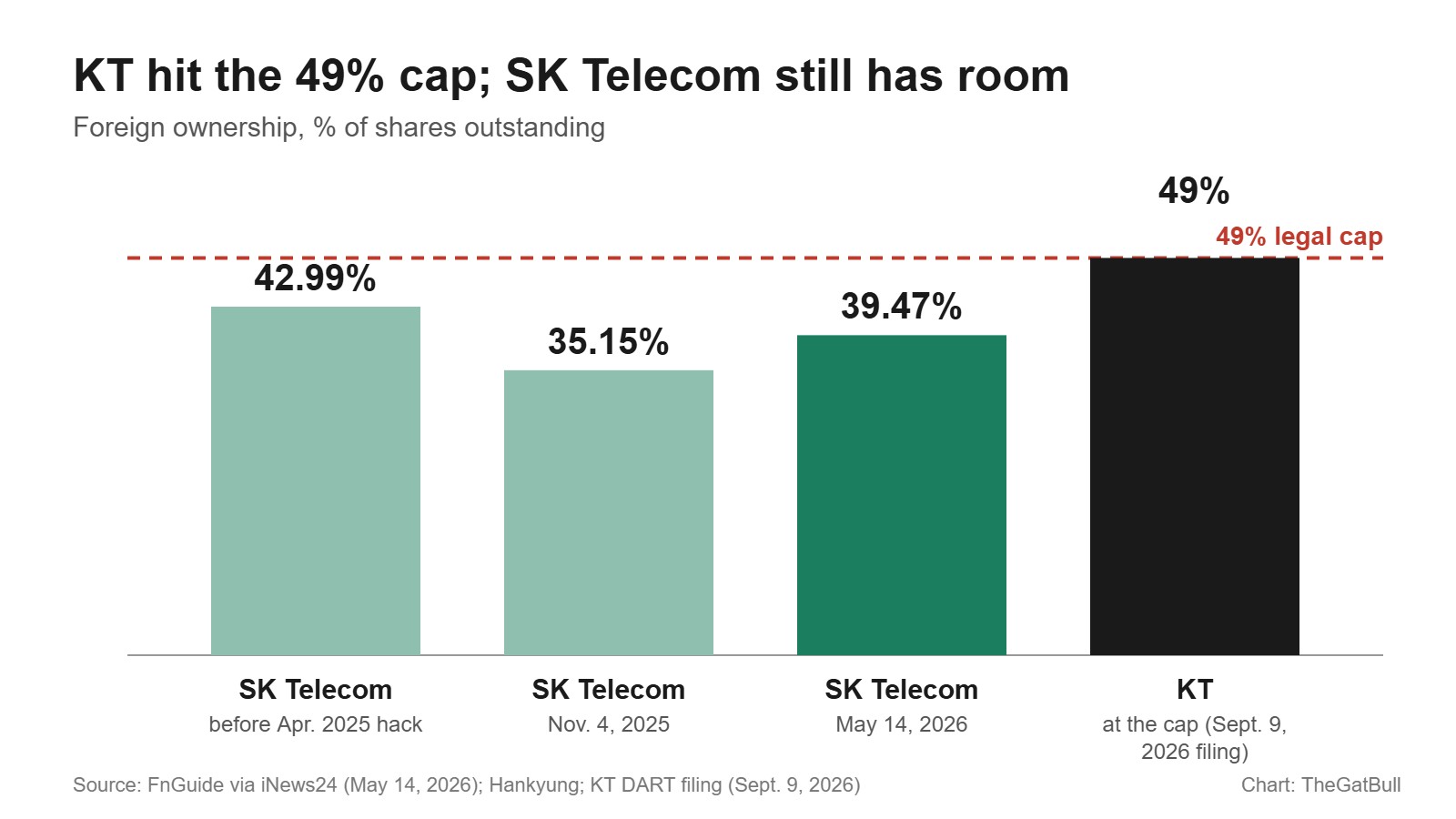
SK Telecom’s foreign ownership fell from 42.99% just before the hack to 35.15% on Nov. 4, 2025, then climbed back to 39.47% by May 14, 2026, according to FnGuide data reported by iNews24. We could not confirm the current figure. On the May number, there were about 9.5 percentage points left before the 49% line.
At KT, with no room left, foreigners can in practice buy KT shares in Seoul only from other foreigners. In March 2025, that pushed KT’s New York ADR about 5.3% above the value of the Seoul shares; a KT official said at the time that, with the limit full, only existing holders could convert between ADRs and Korean shares (Hankyung, March 19, 2025). We did not calculate today’s ADR premium: Seoul and New York close at different times, so matching one day’s prices gives a wrong number. For how a large ADR premium looked in another Korean stock, see the SK hynix ADR premium.
Under the Gat (our take). “On the May 14 count, SK Telecom had roughly 9.5 points of foreign room left. KT used up its room in November 2024. For an American buyer, that gap matters more than the difference between a 5.1% and a 4.5% yield.”
Price moves and recent filings
- From the Sept. 23 close to Oct. 23, KOSPI fell 21.6%, SK Telecom 14.5% and KT 11.2% (KRX closes). Telecoms, usually seen as defensive, fell too, though less than the index.
- On Oct. 23, KOSPI rose 0.30% to 5,550.30, while SK Telecom fell 2.23% and KT 1.58%.
- KT filed two notices on Oct. 23. It said it is reviewing various options but that nothing specific has been decided about a reported merger with its subsidiary KT Cloud; it will update by April 22, 2027 (DART 20261023800988). And the government of Rwanda and related parties filed a counterclaim against KT in international arbitration for about ₩512.4 billion (about $386 million in the filing, 2.63% of KT’s equity), after KT had sought about $152 million in put-option payments (DART 20261023800986). Neither matter is resolved.
- SK Telecom said on Aug. 27 that it would split an AI data center company, SK Horizon, out of its subsidiary SK Broadband and sell 49% of it to a KKR and IMM consortium (DART 20260827800684). Analysts also point to the value of SK Telecom’s 2023 investment in Anthropic, but the stake and its value are analyst estimates the company has not confirmed.
What KT shows about Korea’s 49% cap
In the U.S., foreign ownership rules mostly work as a check on takeovers. Korea’s 49% cap applies to total foreign ownership, so it also bites in ordinary trading, and at KT three things follow from it:
- The company cannot cancel shares it has bought back. About ₩500 billion of KT stock stays uncancelled because cancelling it would push foreigners over 49%.
- The ADR can trade at a premium. Foreigners who can’t buy in Seoul can buy the New York ADR instead; in March 2025, KT’s ADR was about 5.3% above the Seoul shares.
- Index funds that care about foreign room can drop the stock. KT is not in the Oct. 21 holdings file of EWY (the iShares MSCI South Korea ETF, the main U.S. fund for Korean stocks), while SK Telecom is, at 0.40% (iShares). MSCI penalizes stocks with little room left for foreign buyers, and KT was removed from the MSCI Korea index for that reason in May 2019 (Korea Economic TV, April 11, 2024). KT’s absence from EWY is consistent with this, but we could not confirm the reason or when KT most recently left the index.
Buying SKM or KT from the U.S.
- ADRs: SK Telecom trades on the NYSE as SKM (one common share equals 1.8 ADRs) and KT as KT (two ADRs equal one common share), per Hankyung. Both trade in an ordinary U.S. brokerage account. ADR prices can drift from the value of the underlying shares, especially at KT, where the foreign limit is full.
- KRX directly: possible through a brokerage account that offers overseas stocks, such as Interactive Brokers, but new foreign purchases of KT’s Korean shares may be restricted while the limit is full.
- EWY: holds SK Telecom at 0.40% and no KT (iShares, Oct. 21), so it gives almost no telecom dividend exposure. For what EWY does hold, see our EWY holdings guide.
U.S. comparison: Verizon and AT&T are two of the best-known U.S. telecom dividend stocks. Section 310(b) of the U.S. Communications Act also sets foreign ownership thresholds for companies holding certain radio licenses, including wireless carriers. Not a perfect parallel: the FCC can approve foreign stakes above those benchmarks, and the rule does not stop everyday trading in Verizon or AT&T shares. Korea’s 49% cap limits foreign buying at the point of trading.
Dates to watch
- Mon., Oct. 26: last day to buy KT in Seoul and receive the ₩600 dividend, since Korean trades settle two business days later (our calculation from the Oct. 28 record date). The ADR record date is set by the depositary.
- Wed., Oct. 28: KT third-quarter dividend record date.
- Thu., Nov. 12: KT dividend payment date.
- SK Telecom third-quarter results and dividend: date not yet announced. Whether ₩830 repeats is the first check.
- Whenever KT’s foreign ownership drops below 49%: that is the first day KT could cancel some of the treasury shares it holds.

The bottom line
SK Telecom and KT share a dividend habit but differ in how open they are to foreign buyers. KT has the higher minimum dividend, and its Seoul shares are largely closed to new foreign buyers. SK Telecom has just restored its dividend and still has room under the cap. This piece doesn’t rank them. The room left under 49% is the first number we would look at, ahead of the yield.
FAQ
Which pays the higher dividend, SK Telecom or KT?
At the Oct. 23 close, KT. Its promised minimum of ₩2,400 a year is about a 5.1% yield; SK Telecom’s latest ₩830 quarterly dividend, multiplied by four, is about 4.5%. The SK Telecom figure is not company guidance.
Why doesn’t KT cancel the shares it bought back?
Cancelling them would reduce shares outstanding and push foreign ownership above the 49% legal limit. KT said so in its Sept. 9 filing.
Is KT in EWY?
No. EWY’s Oct. 21 holdings file from iShares lists SK Telecom at 0.40% and does not include KT.
Can you buy KT stock in the U.S.?
Yes, through its NYSE ADR, ticker KT. Because the foreign limit is full, the ADR price can drift away from the value of the Korean shares.
Sources
- KT quarterly cash dividend decision, Oct. 13, 2026: DART 20261013800366.
- KT treasury share trust termination, Sept. 9, 2026: DART 20260909000349.
- KT inquiry response (KT Cloud) and arbitration counterclaim, Oct. 23, 2026: DART 20261023800988, DART 20261023800986.
- SK Telecom quarterly cash dividend decision, July 23, 2026: DART 20260723800522.
- SK Telecom subsidiary split and share disposal, Aug. 27, 2026: DART 20260827800679, DART 20260827800684.
- iShares MSCI South Korea ETF (EWY) holdings file, as of Oct. 21, 2026.
- SK Telecom, KT and KOSPI closes (KRX): Yahoo Finance chart data (017670.KS, 030200.KS, ^KS11; vendor data, not exchange-published figures).
- Won-dollar rate at the Seoul 3:30 p.m. close, Oct. 22: Asia Economy, Businesskorea (press).
- Newsis (May 12, 2026, KT minimum dividend); Newstomato (Sept. 10, 2026, KT cancellation on hold); Hankyung (March 19, 2025, KT ADR premium and ADR ratios); iNews24 (May 14, 2026, SK Telecom foreign ownership); ZDNet Korea (Feb. 13, 2026, SK Telecom dividend pause); Korea Economic TV (April 11, 2024, MSCI foreign room rule and KT’s 2019 removal) (press).
How sure are we?
| Item | Confidence |
|---|---|
| KT ₩600 and SK Telecom ₩830 dividends, dates | ✅ Company filings on DART |
| KT can’t cancel treasury shares because of the 49% limit | ✅ KT’s own Sept. 9 filing |
| KT treasury shares about 15.3 million (6.1%); about 52% foreign share if cancelled | Our calculation from KT filings, assuming exactly 49% foreign ownership |
| KT ₩2,400 minimum dividend; about ₩500 billion uncancelled | ⚠️ Press-reported (Newsis, Newstomato) |
| SK Telecom paused its second-half 2025 dividend | ⚠️ Press-reported; consistent with no DART dividend filing in that window |
| Foreign ownership levels (KT at cap since Nov. 2024; SK Telecom 39.47% on May 14) | ⚠️ Press-reported; current SK Telecom figure not confirmed |
| KT ADR premium (March 2025) and ADR ratios | ⚠️ Press-reported (Hankyung) |
| EWY holds SK Telecom 0.40%, no KT | ✅ iShares holdings file, Oct. 21 |
| When KT last left the MSCI Korea index | Not confirmed |
| Stock and index closes | Computed from vendor price data (Yahoo) |
Not financial advice. TheGatBull is an independent publication; nothing here is a recommendation to buy or sell any security.
 Written by Mr.Gat — TheGatBull
Korean market coverage from a Seoul-metro-based operator who reads the filings in the original language. Every price on this site is the KRX regular-session close (15:30 Seoul); every figure states whether it came from a primary filing, the press, or our own calculation. Drafts are AI-assisted, then verified against the original Korean documents and edited by a human before publishing.
Found an error? Tell us — corrections get priority. How we work →