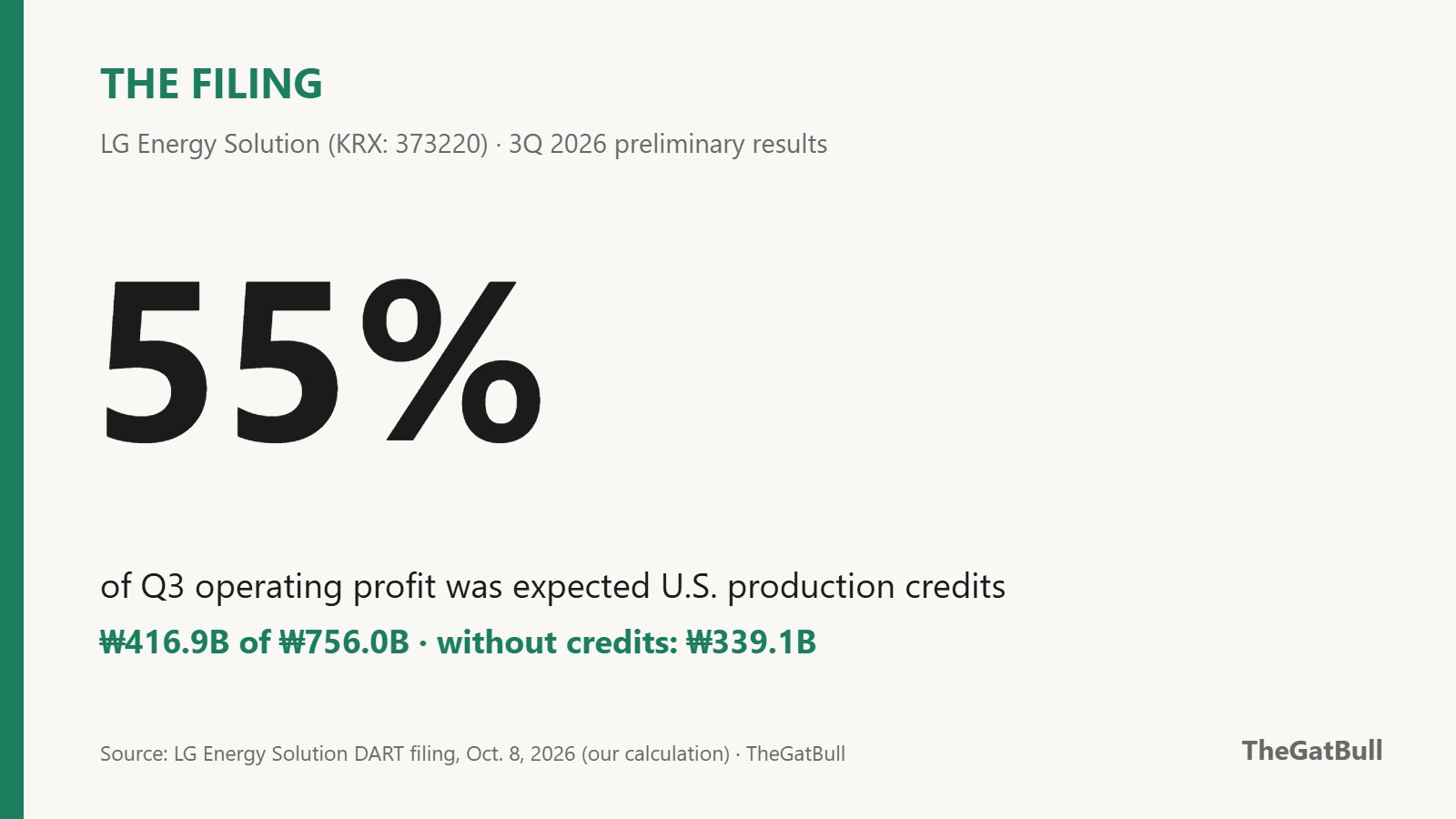
TL;DR — If you own or watch LG Energy Solution (KRX: 373220). LG Energy Solution reported third-quarter operating profit of ₩756 billion (about $565 million), and the company says ₩417 billion of it was an expected U.S. production tax credit: 55% of the total, by our calculation. Without the credit, operating profit was still ₩339 billion (about $253 million at ₩1,338.3 per dollar), up from a ₩128 billion loss on the same basis in the second quarter.
Not financial advice.
Did LG Energy Solution make an operating profit without U.S. production credits? In the third quarter of 2026, by the company’s own estimate, yes. Its Oct. 8 filing puts operating profit at ₩756 billion (about $565 million). The company says ₩416.9 billion of that is the expected effect of U.S. production credits, mainly Section 45X (a U.S. tax credit paid for each battery part made and sold in America) and similar provisions it does not list. Take the credits out and operating profit is ₩339.1 billion (about $253 million). On the same basis, the second quarter was a loss of ₩127.7 billion. Both facts are true at once.
What this means if you own or follow LG Energy Solution (KRX: 373220). Read its results as two lines: what the factories earned, and what U.S. tax law added. Both improved in the third quarter; the next check is whether both hold in the final results (no date announced).
Dollar conversions are for scale only, at ₩1,338.3 per dollar, the Oct. 14 Seoul 15:30 rate (the Oct. 15 rate was not available to us). Stock and index prices are KRX (Korea Exchange) regular-session closes (15:30 Seoul time).
What did the Oct. 8 filing actually say?
At 8:34 a.m. Seoul time on Oct. 8, LG Energy Solution filed its preliminary consolidated operating results under Korea’s fair disclosure rules. The table itself is simple.
| Item | 3Q 2026 | 2Q 2026 | 3Q 2025 (restated) |
|---|---|---|---|
| Revenue | ₩9.64 trillion (≈$7.21B) | ₩7.56 trillion | ₩6.07 trillion |
| Operating profit | ₩756.0 billion (≈$565M) | ₩113.3 billion | ₩601.3 billion |
| Change | Revenue +27.6% from 2Q, +59.0% from a year earlier · Operating profit +567.3% from 2Q, +25.7% from a year earlier | ||
Source: LG Energy Solution, preliminary consolidated operating results, DART (Korea’s official electronic filing system, similar to the SEC’s EDGAR), Oct. 8, 2026 (company filing). Consolidated, unaudited.
The filing gives no net profit or pre-tax profit; those lines are blank. These are preliminary figures, before the outside audit.
The real news sits below the table, in item 4(b), “other matters relevant to investment decisions.” In summary, it says third-quarter revenue and operating profit include the expected third-quarter 2026 effect of North American production credits under Section 45X of the U.S. Inflation Reduction Act and similar provisions. Without them, revenue would be ₩9.23 trillion, operating profit ₩339.1 billion and the margin 3.7%. Since the first quarter, the company has shown these credits under “revenue and other income,” and it restated the year-earlier figures the same way.
Two words matter here. “Similar provisions” means it isn’t only 45X. “Expected” means it is the company’s estimate, not cash already received.
Three quarters in numbers
| Item | 1Q 2026 | 2Q 2026 | 3Q 2026 |
|---|---|---|---|
| Reported operating profit | −₩207.8 billion | ₩113.3 billion | ₩756.0 billion |
| North American production credits | n/a | ₩241.0 billion | ₩416.9 billion |
| Operating profit without the credits | n/a | −₩127.7 billion | +₩339.1 billion |
Sources: company filings and the company’s quarterly results releases (Jul. 7 and Oct. 8, 2026). The first-quarter figure is the nine-month total in the Oct. 8 filing (₩661.6 billion) minus the second and third quarters (our calculation, −₩207.7 billion), which matches SBS Biz’s −₩207.8 billion within rounding.
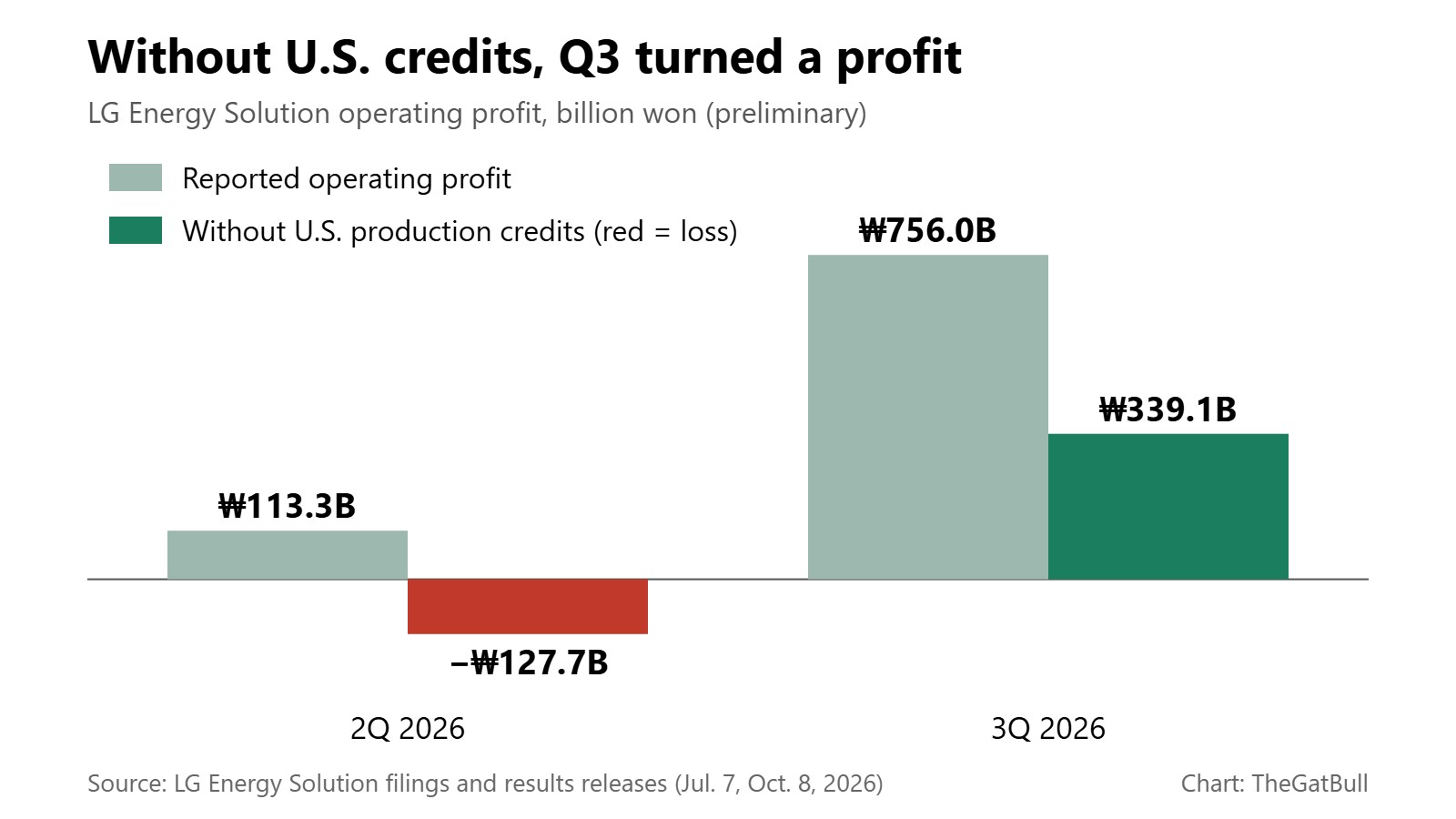
There are two ways to read this.
- The optimistic read: without credits, operating profit improved by about ₩467 billion in one quarter. Credits as a share of operating profit fell from 213% in the second quarter to 55% in the third (our calculations). The factories are carrying more of the load.
- The skeptical read: more than half of the profit still comes from U.S. policy. And the credit itself grew 73% (our calculation), from ₩241.0 billion to ₩416.9 billion. The more the company builds in the U.S., the bigger that line can get.
SBS Biz (Oct. 8) pointed to higher shipments of energy storage systems (ESS, large batteries for power grids) in North America, which spread fixed costs; shipments to Europe; the restart of a joint-venture plant with GM and the start of one with Hyundai; and “compensation received from some electric-vehicle customers” (press-reported). The compensation amount was not disclosed, so the ₩339.1 billion without credits may also include money that won’t repeat. That is something to check in the final figures. SBS Biz called the revenue a quarterly record (press-reported); the figure uses the accounting presentation the company adopted in the first quarter.
Where does the U.S. credit sit in the income statement?
Section 45X pays a tax credit for battery cells, modules and other parts that are made and sold in the U.S., in proportion to output. The company gets it because it built factories in America; the Korean government has nothing to do with it. The company books the credit inside operating profit, under “revenue and other income,” so one policy can swing the headline profit a lot.
The size of that line is set in Washington, not Seoul. In 2025, Congress (Public Law 119-21) applied three “foreign entity” restrictions to 45X, meant to limit the involvement of companies and individuals from China, Russia, Iran and North Korea, according to the Congressional Research Service. In short, more than half of this company’s third-quarter operating profit depended on decisions made in Washington.
How has the stock traded since the filing?
| Date (Seoul close) | LG Energy Solution | KOSPI (Korea’s main index) |
|---|---|---|
| Oct. 7 (day before filing) | ₩391,000 | 6,803.90 |
| Oct. 8 (filing day) | ₩401,000 (volume 2.6 times the prior day) | 6,625.93 |
| Oct. 14 | ₩422,000 | 6,008.81 |
| Oct. 15 | ₩402,500 (−4.62%) | 5,554.22 (−7.57%) |
| Oct. 7 → Oct. 15 | +2.94% | −18.37% |
KRX regular-session closes. Vendor price data (Yahoo Finance).
Same day, two clocks
On Thursday, Oct. 15, KOSPI closed down 7.57% at 5,554.22. At 12:38 p.m. the index was down 8%, which triggered a level-one circuit breaker (a 20-minute trading halt); the KOSDAQ, Korea’s smaller-company market, hit its own circuit breaker 15 minutes earlier (four Korean outlets, press-reported). It was KOSPI’s seventh straight decline, and foreign investors net sold about ₩3.6 trillion (about $2.7 billion) of KOSPI shares (press-reported). Korean media blamed worries about the returns on AI spending and tougher competition in memory chips; that is the outlets’ reading, not a confirmed cause. Samsung Electronics fell 9.48% and SK hynix 11.06%.
LG Energy Solution fell 4.62% that day. But from Oct. 7, the day before its filing, to Oct. 15, the stock rose 2.94% while the index fell 18.37%. We don’t know why. The earnings filing, money rotating out of chips, or plain chance are all possible. What the filing does show: this company’s profit depends on U.S. policy and energy-storage demand, while Korean media tie the index’s fall to chip and AI worries (press-reported).
What to watch:
- Whether profit without credits stays near ₩339 billion in the final results.
- Whether one-off items such as the customer compensation are shown separately.
- News on changes to the U.S. 45X rules.
What this shows about Korea’s market
Under the Gat (our take). “If you see Korea’s stock market as a chip index, you miss this company. By the company’s own estimate, 55% of LG Energy Solution’s third-quarter operating profit was U.S. tax credits, not anything made in Seoul. So for this stock, open Congress’s calendar before the KOSPI chart. And when you read its results, read both lines. The company printed both in the same filing.”
Here is the structural fact: at LG Energy Solution, a large share of this quarter’s profit was U.S. credits tied to production in America. We have not checked other Korean battery makers here. But it means two kinds of “Korean stock,” a big chipmaker and a big battery maker such as LG Energy Solution, can react to different forces. Inside an index product such as EWY (the iShares MSCI South Korea ETF) the difference is hard to see: LG Energy Solution is 0.87% of the fund (iShares, as of Oct. 9), in the shadow of the two chip stocks at 47.58%.

How to get exposure, and a U.S. comparison
Access: LG Energy Solution (373220 🔴) has no U.S.-listed ADR (a U.S.-traded certificate that represents foreign shares), as far as we know as of Oct. 15. You can buy it directly on the KRX through a broker that offers Korean shares, or get a small slice through EWY 🟢 (0.87%, along with 47.58% in two chip stocks). We don’t list an over-the-counter symbol because we have not verified one.
U.S. anchor — First Solar (FSLR 🟢): the U.S. solar panel maker earns the same Section 45X credit. Its 2026 guidance assumes $2.10 billion to $2.19 billion of 45X credits; its 2025 operating income was $1.60 billion (company release filed with the SEC). Different years, so this is not a ratio.
Not a perfect parallel: First Solar is an American company making solar panels. LG Energy Solution is a Korean company earning the same U.S. credit from factories it built in America, some of them joint ventures. What they share is one thing: a big line of profit comes from the same U.S. tax provision.
For how LG Energy Solution and Samsung SDI’s shares split last month, see our two-way look at the battery makers. For how to read a Korean preliminary filing, see our read of Samsung’s two-number filing, and for this week’s market setup, our Oct. 13 market preview.
The bottom line
LG Energy Solution’s third quarter tells two true stories. Without U.S. credits, it swung from a loss in the second quarter to a profit. With them, more than half of its profit still depends on a law written in Washington. The final results will show whether both lines hold.
FAQ
What was LG Energy Solution’s third-quarter 2026 operating profit?
Preliminary operating profit of ₩756 billion (about $565 million at ₩1,338.3 per dollar) on revenue of ₩9.64 trillion, filed on DART on Oct. 8, 2026.
How much of LG Energy Solution’s profit came from U.S. subsidies?
The company put the expected effect of North American production credits (Section 45X and similar provisions) at ₩416.9 billion, which is 55% of operating profit by our calculation. Without it, operating profit was ₩339.1 billion.
Is LG Energy Solution profitable without U.S. production credits?
At the operating level in the third quarter, by the company’s estimate, yes: ₩339.1 billion of operating profit and a 3.7% margin without credits. In the second quarter, the same measure was a loss of ₩127.7 billion (company figures).
Can I buy LG Energy Solution stock in the U.S.?
It has no U.S.-listed ADR, as far as we know. You can buy it on the Korea Exchange (373220) through a broker with Korean market access, or hold a small slice through EWY (0.87%). We have not verified an over-the-counter symbol.
What is the Section 45X tax credit?
A U.S. federal tax credit, the Advanced Manufacturing Production Credit, paid in proportion to how many clean-energy components, such as battery cells, a company makes and sells in the U.S.
Was LG Energy Solution hit by the Oct. 15 KOSPI sell-off?
It fell 4.62% that day, less than KOSPI’s 7.57%. From Oct. 7, the day before its filing, to Oct. 15, the stock rose 2.94% while the index fell 18.37%. The cause has not been established.
Sources
- LG Energy Solution, preliminary consolidated operating results (fair disclosure), DART, Oct. 8, 2026 (primary).
- LG Energy Solution quarterly results releases, Jul. 7 and Oct. 8, 2026, via LG (Jul. 7, 2026; Oct. 8, 2026) (company).
- Congressional Research Service, “The Section 45X Advanced Manufacturing Production Credit” (U.S. government research).
- First Solar, fourth-quarter and full-year 2025 results and 2026 guidance, SEC filing (company).
- SBS Biz, reports on second- and third-quarter preliminary results (Jul. 7 and Oct. 8, 2026) (press).
- Kangwon Domin Ilbo, Joongang Economy News, Asia Economy, Maeil Ilbo, Oct. 15 market close reports (circuit breaker, investor flows) (press).
- EWY weights: iShares EWY holdings, as of Oct. 9, 2026.
- KRX closes: Yahoo Finance chart data (373220.KS, ^KS11; vendor data).
How sure are we?
| Item | Confidence |
|---|---|
| 3Q revenue, operating profit, credit effect, figures without credits | ✅ Company filing on DART (preliminary, unaudited; credit is the company’s estimate) |
| 2Q credit (₩241.0 billion) and loss without credits | ✅ Company results release |
| 1Q operating profit | Our calculation from the filing, matches press reports |
| 55% share, 213%, +73%, ₩467 billion improvement | Our calculations from company figures |
| Stock and index moves | Computed from vendor price data (Yahoo), KRX closes |
| Circuit breaker, foreign selling, reasons for improvement | ⚠️ Press-reported |
| First Solar 45X figures | ✅ Company guidance and results (SEC filing) |
Ticker key. 🟢 US-listed — buy in a US brokerage. 🔴 Seoul-listed only — no U.S. ADR; reachable through a broker with Korean market access.
Not financial advice. TheGatBull is an independent publication; nothing here is a recommendation to buy or sell any security.
 Written by Mr.Gat — TheGatBull
Korean market coverage from a Seoul-metro-based operator who reads the filings in the original language. Every price on this site is the KRX regular-session close (15:30 Seoul); every figure states whether it came from a primary filing, the press, or our own calculation. Drafts are AI-assisted, then verified against the original Korean documents and edited by a human before publishing.
Found an error? Tell us — corrections get priority. How we work →