Not financial advice. This article describes structure, not a recommendation to buy or sell any security.
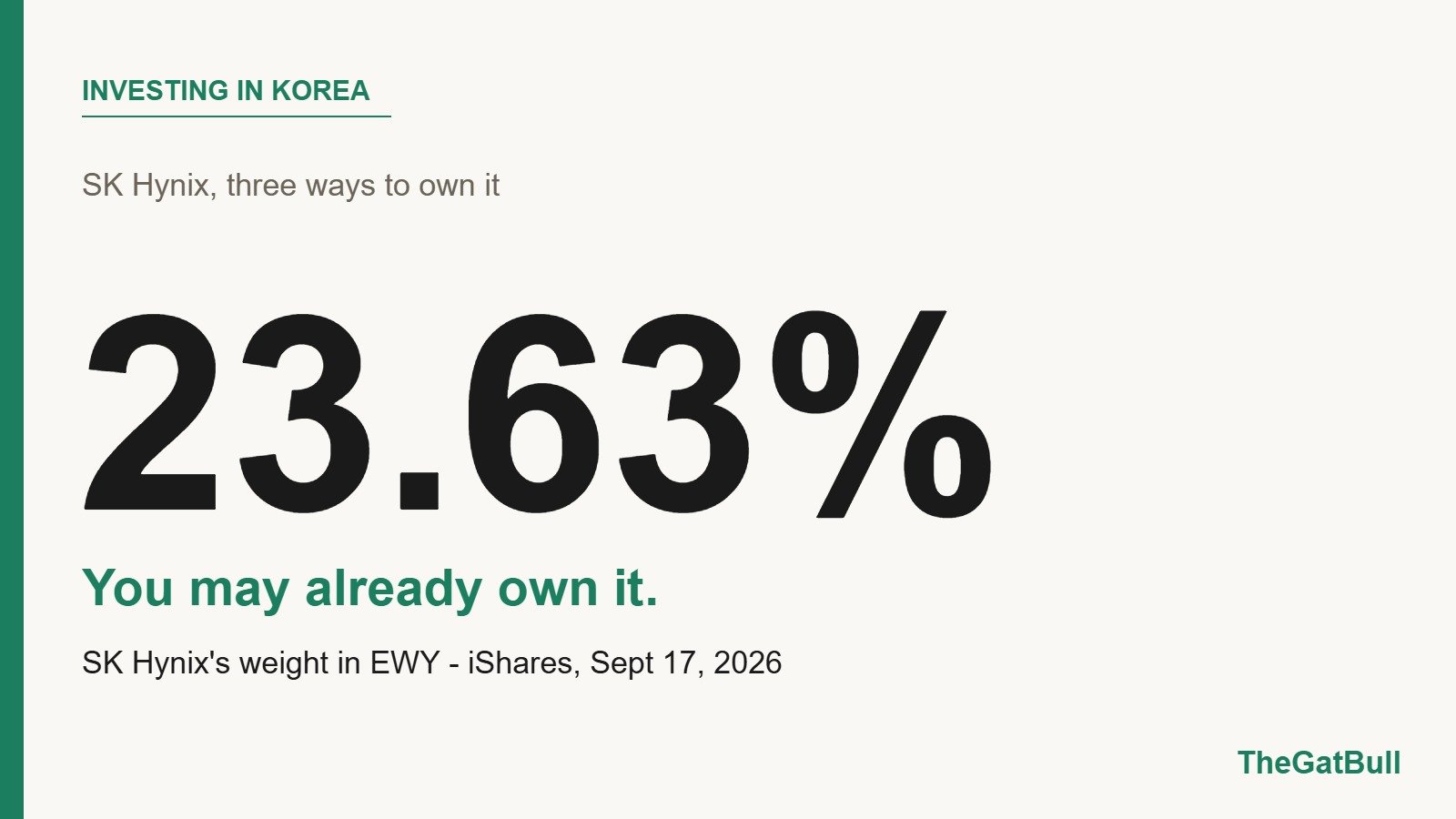
TL;DR — if you hold EWY. SK Hynix trades on Nasdaq as SKHY, so you can buy it directly. But if you already own EWY, you already own SK Hynix — at 23.63%, it is the fund’s single largest holding (iShares, as of September 17, 2026).
Can you buy SK Hynix stock in the US?
Yes. Since the Nasdaq debut on July 10, 2026, all three routes are open at once — and they are not the same purchase.
| Route | What you actually own | Ticker | The thing that differs |
|---|---|---|---|
| 1. Nasdaq ADR | A depositary receipt — a bank holds the Korean share and issues you a US-traded claim on it. One common share = ten ADSs (American Depositary Shares) | SKHY | Dollar-denominated, US hours, depositary fees apply |
| 2. ETF, indirectly | A slice of a basket | EWY and others | SK Hynix is 23.63% of EWY; 0.59% expense ratio |
| 3. Seoul common shares | The ordinary share itself | 000660 | Won-denominated, Seoul hours, needs a broker with KRX access |
For scale: the listing raised $26.5bn (177.9m ADSs priced at $149), which was reported as the largest foreign-company listing in US history, passing Alibaba’s 2014 debut at roughly $21.8bn. Those listing figures are as reported by financial media at the time, not read by us from a filing.
What is the difference between SKHY and the Seoul shares?
Both are claims on the same company. Three things separate them.
One: the ratio, and what it does to dividends. One common share equals ten ADSs, so a dividend declared per share arrives at the ADS level cut into ten pieces. That is a change of unit, not of amount — ten ADSs and one common share are the same claim, so the per-ADS figure is smaller while the total is not. What does not divide with it is a fee charged per ADS. SK Hynix’s SEC-filed prospectus caps the cash-distribution fee at US$5.00 per 100 ADSs on page 145 — and a cap is what the contract permits, not what gets charged. The gap between the two is where the real cost sits, and we took it apart against an actual declared dividend in the SK Hynix ADR dividend breakdown. The cap is read from the primary filing.
Two: currency and clock. SKHY prices in dollars during US hours. 000660 prices in won during the Seoul session. Your currency exposure runs in opposite directions depending on which one you hold.
Three: the two prices drift apart. An ADR does not track its home-market share one-for-one. The gap — premium or discount — is a live variable, and we measured a wide one in the ADR premium piece.
Isn’t EWY enough?
It depends on what you are trying to own.
If you want SK Hynix specifically, SKHY is the direct instrument. If you want Korea broadly, EWY is the standard vehicle — and inside it SK Hynix is the largest single holding at 23.63% (iShares, as of September 17, 2026). If what you actually want is memory exposure rather than Korea, that is a third question again, and a memory-sector ETF is a different instrument from either.
The EWY route avoids the ADR depositary fee entirely. It carries a 0.59% expense ratio instead — an annual charge on the money you have in the fund, rather than a charge per event. If you already hold EWY, that exposure is already yours; whether you want more of it concentrated in one name is a separate question, and yours.
When does SK Hynix report earnings?
Quarterly dates move, so we keep them on a standing page rather than inside an article that would go stale. The current schedule and status live on the SK Hynix investor hub.
What about taxes?
Korean dividend withholding comes out before anything reaches you, and the reduced treaty rate is not automatic. We keep the rates and the conditions in one place rather than copying them here, so there is a single page to keep current: Korea’s dividend tax and what it means for foreign investors. This is not tax advice.

Under the Gat. Before July 2026, the honest answer to this question was “it’s complicated” — the over-the-counter line was thin and the Seoul shares sat behind a broker wall. The Nasdaq listing removed that. So the question changed: it is no longer can you buy SK Hynix, but which of three different things you mean to buy. Almost nothing written in English draws that distinction cleanly, which is the reason this page exists. A view, not advice.
Sources
- iShares MSCI South Korea ETF (EWY) — fund holdings and expense ratio, as of September 17, 2026 (primary)
- SK hynix SEC-filed prospectus, p.145, “Fees and Charges” (primary, via our earlier analysis)
- Listing size and pricing — financial media reporting, July 2026 (press)
 Written by Mr.Gat — TheGatBull
Korean market coverage from a Seoul-metro-based operator who reads the filings in the original language. Every price on this site is the KRX regular-session close (15:30 Seoul); every figure states whether it came from a primary filing, the press, or our own calculation. Drafts are AI-assisted, then verified against the original Korean documents and edited by a human before publishing.
Found an error? Tell us — corrections get priority. How we work →