Not financial advice. TheGatBull does not provide investment advice.
The Fed raised rates at 3 AM Seoul time on Thursday. New York traded two more hours on the news and closed. Seoul traded the next six and a half — and spent them taking back the number the night had added.
The short answer
The Federal Open Market Committee raised the target range for the federal funds rate by a quarter point to 3¾–4 percent on September 16 at 2 PM Eastern. The vote was 12–0. Both facts are printed in the Fed’s own statement — confirmed on the record.
Two in the afternoon in Washington is 3 AM Thursday in Seoul. New York traded two more hours on the decision and closed at 4. Seoul opened four hours after that, at 9 AM Korean time — and what Seoul’s benchmark index, the KOSPI, did is invisible if you only look at the closing number.
| KOSPI | Level | vs. prior close |
|---|---|---|
| September 16 close | 6,717.97 | — |
| September 17 open | 6,779.02 | +0.91% |
| September 17 close | 6,715.41 | −0.04% |
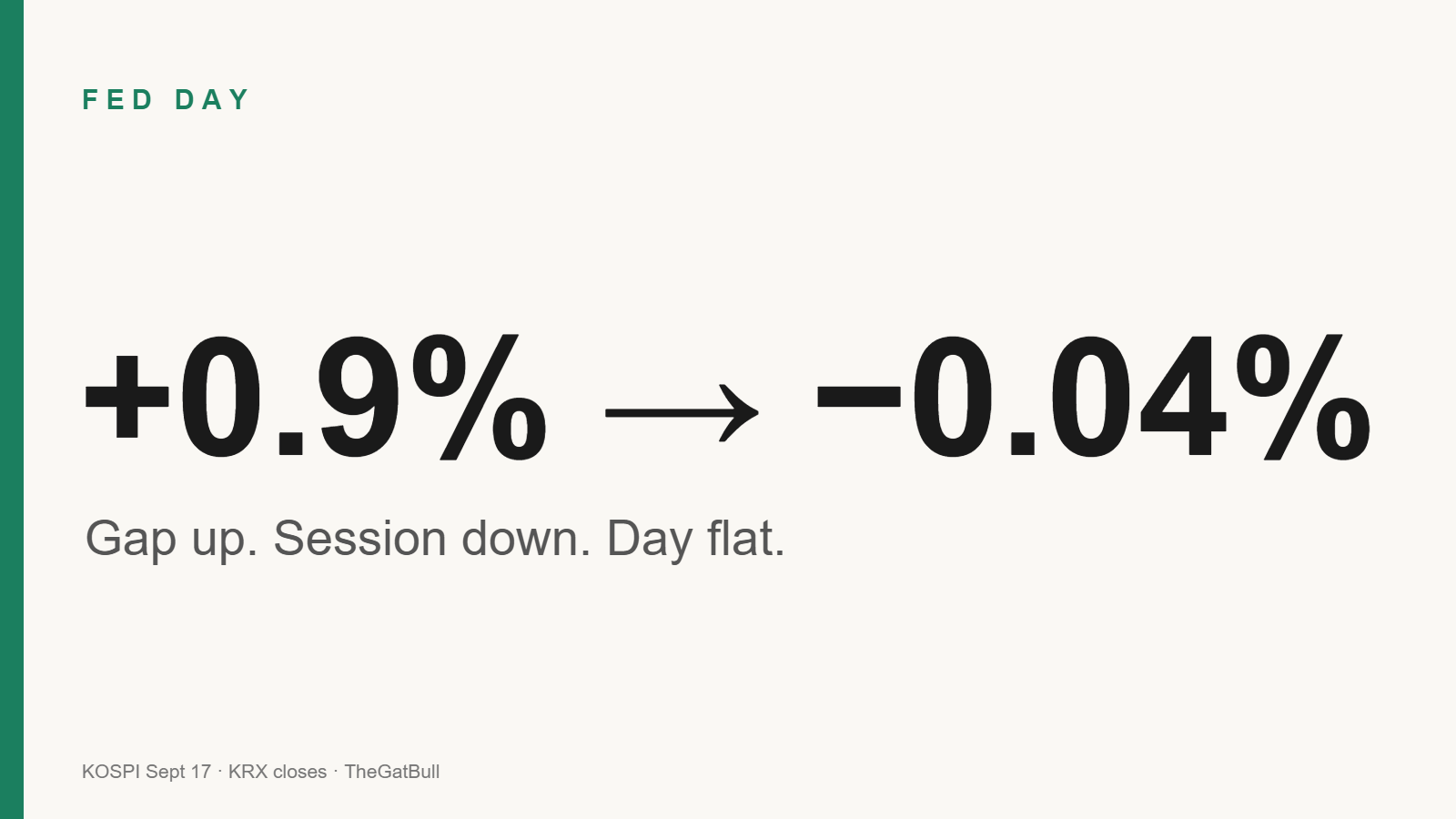
As a full day: nothing happened — down 2.56 points, 0.04%. But inside that nothing, the index moved twice. While Seoul slept, +0.91% attached itself to the open. While Seoul was awake and trading — six and a half hours, no lunch break — −0.94% came off. Multiply the two legs and you get the day exactly (1.0091 × 0.9906 = 0.9996).
This article is about those six and a half hours.
What this means for EWY holders
The Korean “day” you see on your screen is mostly a day that already ended. If you held EWY — the iShares MSCI South Korea ETF — through Fed day, your Wednesday session contained only the first two post-decision hours. Seoul’s six-and-a-half-hour answer came after your market closed, and it will already be finished when New York reopens. And today, the number to check is not the close — it is the distance between the open and the close. “Korea shrugged off the hike” is wrong. Korea reacted, then took it back.
1. What the Fed actually said
The statement is short. Three sentences stand out, quoted exactly:
- The Committee raised the range by a quarter point “in support of the Federal Reserve’s dual mandate.”
- “Inflation remains elevated.” Today’s action “will support a timelier return to the Committee’s 2 percent goal.”
- “The Committee will deliver price stability.”
The economic read is not gloomy: the statement says activity is “expanding at a solid pace,” spending is resilient, productivity growth strong, capital investment robust, and unemployment little changed — with uncertainty elevated owing in part to “geopolitical developments.” In one line: the economy is fine, inflation is not, so they hiked.
We also read the projections. In the dot plot released with the statement, 16 of 18 participants put the appropriate end-2026 rate above where it now stands — twelve at a 4.125% midpoint, four at 4.375%, two at the current 3.875% (Fed SEP, Figure 2 — read from the original). Dots are a record of judgment on the day, not a promise.
One thing we are deliberately not writing: whether this was the first hike in however many years. That is a superlative, and we have not finished checking it against the Fed’s own release archive. If a headline told you a number, it did not come from us.
The 2:30 press conference and its chair are press-reported; we did not confirm them from a primary document.
2. The bridge — how far the decision sits from each market’s close
For a US investor, Fed day is “announced at 2, closed by 4” — two hours between the decision and the official close. In Seoul, that same distance is twelve and a half hours.
Same decision, different clock. Three steps:
Step one — New York trades two hours and closes. 2 PM announcement, 4 PM bell. What Korea-linked tickers did in that window is in section 4.
Step two — the next markets to open include Seoul. 9 AM Thursday in Korea is 8 PM Wednesday in New York, four hours after the close. Tokyo opens the same hour — the two cities share a time zone — but Seoul’s regular session runs six and a half hours without a lunch break.
Step three — Seoul closes before New York reopens. The 3:30 PM Seoul close is 2:30 AM in New York, seven hours before the next opening bell. Korea’s whole Fed-day session sits inside the gap between two American trading days. Seoul’s answer is complete before New York gets to reply.
3. Seoul’s six and a half hours
All Korean prices are 3:30 PM Korea Standard Time regular-session figures on the KRX (the Korea Exchange), in won. Gap = open vs. prior close (what attached while Seoul slept). Own session = close vs. open (what Seoul did between 9:00 and 3:30). The two multiply into the daily move.
Seoul opened up across the board — of the eight names we track (two indexes — KOSPI, the main board, and KOSDAQ, the growth board — plus six stocks), not one gapped down. And then seven of the eight closed their own session in the red.
| Name | Prior close | Open | Close | Gap | Own session | Day |
|---|---|---|---|---|---|---|
| KOSPI | 6,717.97 | 6,779.02 | 6,715.41 | +0.91% | −0.94% | −0.04% |
| KOSDAQ | 815.98 | 820.16 | 822.18 | +0.51% | +0.25% | +0.76% |
| Samsung Electronics | 253,500 | 257,000 | 252,500 | +1.38% | −1.75% | −0.39% |
| SK Hynix | 1,759,000 | 1,770,000 | 1,745,000 | +0.63% | −1.41% | −0.80% |
| SK Square | 1,020,000 | 1,021,000 | 1,008,000 | +0.10% | −1.27% | −1.18% |
| Hyundai Motor | 362,000 | 364,500 | 363,000 | +0.69% | −0.41% | +0.28% |
| Kia | 120,700 | 121,600 | 120,900 | +0.75% | −0.58% | +0.17% |
| KEPCO | 30,850 | 31,050 | 31,000 | +0.65% | −0.16% | +0.49% |
How to read the table: the gap column is all pluses. In the session column, the only plus is KOSDAQ. The six individual stocks went six for six — every one gapped up, every one sold off in its own session. One thing the table does not say is that the Fed caused any of this — the decision came first and the session came after, and that order is the only causal-sounding fact we can prove.
Three footnotes to keep this honest.
The index went below flat during the day. The intraday high was 6,795.53 and the intraday low 6,697.85 — both intraday prints, not closes — and the low sits under Wednesday’s close. Seoul did not just hand back the gap; it briefly went through it, then recovered a little into the close. Samsung’s intraday low (₩251,500) was also below its prior close.
KOSDAQ was the exception. It kept its gap and added to it — the two Korean indexes finished in opposite directions, which by itself weakens any “Korea moved one way” headline.
Who sold, and why, we do not know. Investor-flow data was not available when this was written, so we do not name the seller. And we do not write “the Fed caused the reversal” — the decision came first, the session came after, and that order is the only causal-sounding thing we can prove.
📎 If this gap-versus-session split is new to you: we walked through it the day KOSPI fell 1.8% while its own session rose 1.6%. That day was this day’s mirror image — the gap dragged the index down and the session pulled it back. Today the gap pushed it up and the session took it away. And today’s gap, unlike that one, has a name and a timestamp.
4. What New York’s two hours looked like
One market traded the decision first: New York’s Wednesday session, which held four and a half pre-decision hours and two post-decision hours.
| US-listed (USD) | Sept 15 close | Sept 16 open | Sept 16 close | Gap | Session |
|---|---|---|---|---|---|
| EWY | $176.49 | $179.63 | $175.54 | +1.78% | −2.28% |
| SKHY (SK Hynix, Nasdaq) | $174.83 | $180.34 | $174.87 | +3.15% | −3.03% |
US dollars, US trading days — a separate ledger from the won table above, in both currency and calendar.
Same shape. Both opened up, both sold off through the session, both closed near where they started. SKHY opened 3.15% up and gave back 3.03% — a day trip to nowhere.
Two guardrails before anyone runs with that. Do not pair the dates. EWY’s September 16 and KOSPI’s September 17 are not “the same day” — they are legs of a relay: New York closed, then Seoul opened, then Seoul closed, and New York reopens after that. And do not subtract the returns. One ledger is in dollars, the other in won; a “percentage-point difference” between them silently smuggles in the currency. We compare signs and shapes, nothing more.
Within those limits, the observation stands: the market that traded the first two hours and the market that traded the next six and a half drew the same picture. Seoul didn’t take New York’s answer and set a new direction. It did New York’s trade over again, longer.
5. What this says about the Korean market
The fact you cannot see without this one day: after a Fed decision, New York trades two hours and stops — Seoul then trades six and a half straight, and its answer is complete before New York can respond.
US readers almost always meet the Korean market after it has closed, compressed into one net number. “KOSPI flat.” Today, that sentence is true and nearly meaningless: inside the 0.04% live a +0.91% and a −0.94%, made in different hours by different participants holding different information.
This is not a weakness of the Korean market; it is an artifact of its address. Between a Fed decision and the next New York open, Seoul runs six and a half straight hours with no lunch break, and finishes before New York can reply — hours it spends trading while US bonds and futures keep moving overnight. More time is not more information. Sometimes it is just more time to be pushed around.
Whether the Bank of Korea follows this hike is a different question and not this article’s — we covered what Korean policymakers said in the week before this meeting — including why the Bank of Korea does not move automatically with the Fed — in that week’s policy wrap. What Seoul’s stock market did today and what Korea’s central bank does next month are separate stories. So is the after-market question — Korea’s new evening session, which is for Korean accounts and still ends before the US bell.
6. The other side of the read
“Down 0.04% — so Korea ignored the Fed?” Only if you skip the open. A +0.91% gap and an intraday dip below the prior close are not a market ignoring anything; they are a market reacting in both directions. Which reading is right, one day cannot settle.
“But KOSDAQ rose.” It did — gap and session both positive. A split tape is a real counterpoint to any single-direction story, including ours.
“How do you know the reversal was about the Fed?” We don’t, and we didn’t write it. The only thing proven is the order: decision first, session second.
7. Access, in one line
Of the eight names above, the only one a US account buys directly is SK Hynix (SKHY, Nasdaq, dollars); the rest need a brokerage account with KRX access (availability varies by broker) or arrive indirectly through ETFs like EWY. For a US investor, Fed-day trading fits in a two-hour window; Korea stamps its official answer twelve and a half hours after the decision. Not a perfect parallel: the longer window is not more insight — Seoul prices the decision while US bonds and futures are still moving against it in real time.

The takeaway
While you slept, Seoul traded the Fed. What it did with six and a half uninterrupted hours was not set a direction — it peeled off the number the night had attached. The day reads −0.04%, which looks like nothing. It was two moves: the +0.91% that arrived while Seoul slept, and the −0.94% Seoul subtracted while awake. And New York has not answered this day yet — when it does, you will be reading it after Seoul already has.
FAQ
What exactly did the Fed decide on September 16?
A quarter-point increase in the federal funds target range, to 3¾–4 percent, by a 12–0 vote — both stated in the FOMC statement itself.
When did the decision land in Korean time?
2 PM Wednesday Eastern is 3 AM Thursday in Seoul. The Korean market opened six hours later, at 9 AM.
Is Seoul the first market in the world to trade a Fed decision?
No. New York itself trades two post-decision hours, and Tokyo opens at the same hour as Seoul — they share a time zone. What is distinctive is the shape: Seoul runs six and a half hours with no lunch break, and finishes before New York reopens.
Did KOSPI rise or fall on Fed day?
Down 0.04% close-to-close — but it opened 0.91% above the prior close and printed an intraday low beneath it. The flat day contains two opposite moves.
What did the dot plot show?
Sixteen of eighteen participants put the appropriate end-2026 rate midpoint above the new 3.875% midpoint — twelve at 4.125%, four at 4.375%, two at the current level (Fed SEP Figure 2, read from the original). A judgment snapshot, not a commitment.
When do EWY holders see Seoul’s reaction?
After it is over. Seoul’s Thursday session ends at 2:30 AM New York time; when the US opens at 9:30, Seoul’s answer is already final. As this was written, New York had not yet responded to it.
Will the Bank of Korea raise rates too?
Out of scope here. The BOK has recently explained why it does not automatically follow the Fed; its next scheduled decision is a separate event from anything Seoul’s stock market did today.
Sources
- Federal Reserve, FOMC statement, September 16, 2026 (for release at 2:00 p.m. EDT) — read in full from federalreserve.gov; rate decision, 12–0 vote, and all quoted sentences taken verbatim from the statement.
- Federal Reserve, Summary of Economic Projections, September 16, 2026 — dot plot (Figure 2) read from the accessible original: end-2026 midpoints of 4.375% (4 participants), 4.125% (12), 3.875% (2).
- Korean opens/closes/highs/lows (^KS11, ^KQ11, 005930.KS, 000660.KS, 402340.KS, 005380.KS, 000270.KS, 015760.KS): market data queried directly — KRW · KRX regular session · Asia/Seoul vendor tags; every gap × session product re-verified against the daily change. Intraday highs/lows labeled as intraday and never used as closes.
- EWY and SKHY: market data queried directly, US trading days, USD.
- Press conference details (2:30 PM, chair): press-reported; not confirmed from a primary document.
- Won–dollar conversion: none used in the final text. All Korean figures are quoted in won; US-listed figures in dollars. (Basis on file if needed: ₩1,345.9, Seoul close, September 11, 2026.)
- Not claimed: whether this is the first hike since any particular date (unverified superlative); investor-flow attribution for the session reversal (data not obtained).
Not financial advice. This article is for information only. TheGatBull and its author hold no position in the securities mentioned unless disclosed. Confidence labels are as of publication.