Not financial advice. TheGatBull does not provide investment advice.
The short answer
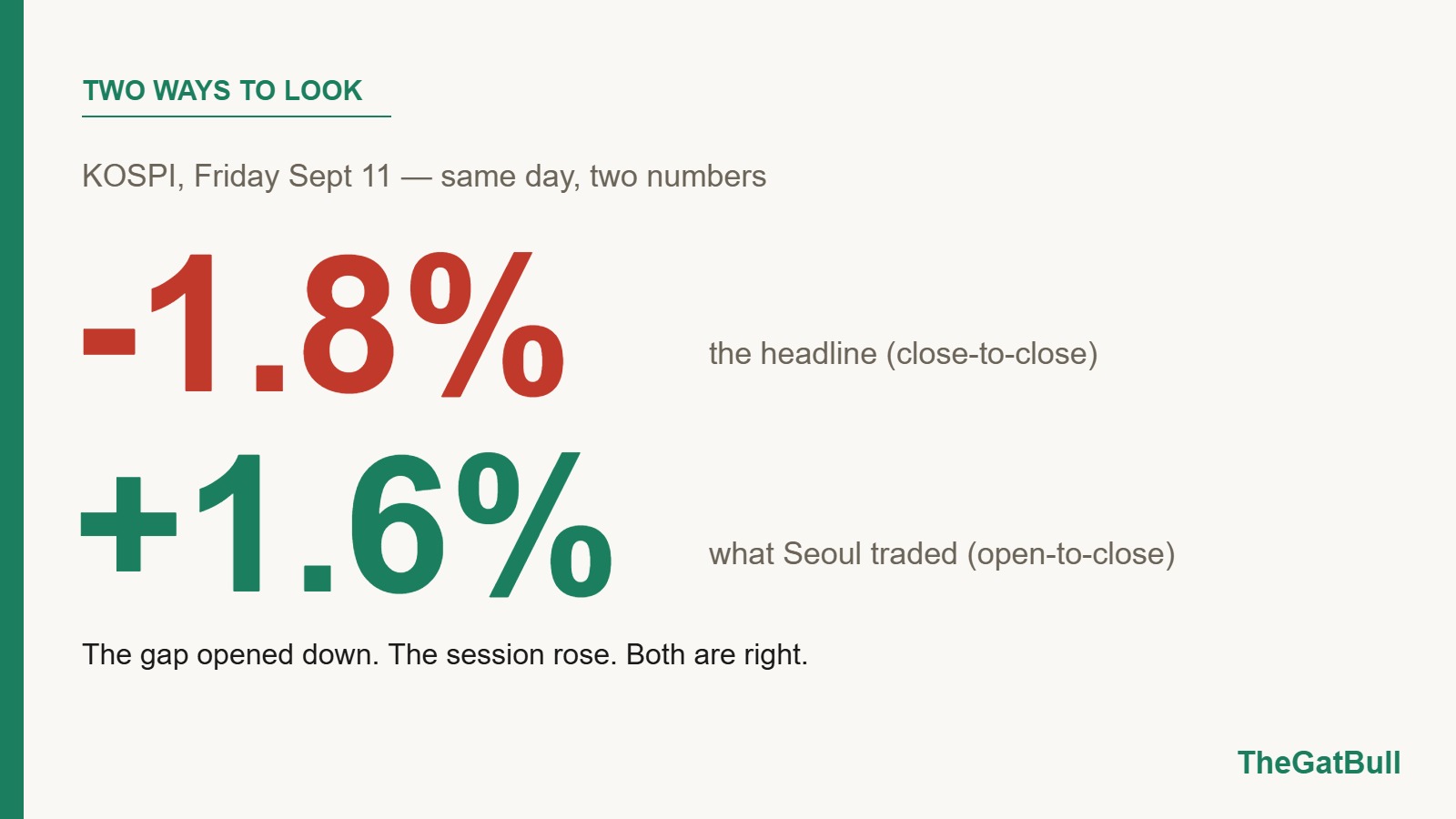
On Friday, September 11, 2026, the KOSPI closed at 6,909.91 — down 124.01 points, or −1.76% from Thursday’s close of 7,033.92.
And yet, on the same day, the KOSPI rose. It opened at 6,802.50 and closed at 6,909.91, so between 9:00 AM and 3:30 PM — the hours Seoul’s regular session was actually open — the index gained +1.58%.
Both numbers are correct. They just answer different questions.
- −1.76% = from yesterday’s close to today’s close. A 24-hour question.
- +1.58% = from today’s open to today’s close. A six-and-a-half-hour question.
The difference is the opening gap. The KOSPI opened −3.29% below the prior close — and that −3.29% was set while Seoul was shut (local media tied the gap-down to rising US Treasury yields, firmer oil, and a sharp drop in New York tech).
What this means for EWY holders
While you hold EWY on New York time, Korea is closed. So the hours when Korea’s “opening gap” is formed are exactly the hours you are trading. A KOSPI headline move blends a part you have already lived through with a part you have not. (The flip side — what your EWY does while Korea itself is shut — was our Labor Day gap piece; this is its sibling from Korea’s open side.)
1. Friday’s numbers
| Instrument (KRX close, Sept 11) | Close | Change |
|---|---|---|
| KOSPI | 6,909.91 | −124.01 / −1.76% |
| KOSDAQ | 820.64 | −16.28 / −1.95% |
| Samsung Electronics | ₩259,500 (≈$193) | −9,500 / −3.53% |
| SK Hynix | ₩1,812,000 (≈$1,346) | −41,000 / −2.21% |
Won-to-dollar conversions use the Seoul 3:30 PM close of ₩1,345.9 (+6.7) on Sept 11, a single basis. One detail worth noting: the KOSPI’s open and low were identical — both 6,802.50. The index never traded below its opening print; the intraday high was 6,948.83.
2. A day is two trades multiplied
Define the terms first — this is arithmetic, not theory.
- Gap = today’s open ÷ yesterday’s close − 1. The part set while Seoul was shut.
- Session = today’s close ÷ today’s open − 1. The part set inside 9:00–3:30.
Multiply the two and you get the headline daily move. For Friday:
0.96710 (gap −3.29%) × 1.01579 (session +1.58%) = 0.98237 → −1.76% ✓
Because the two pieces had opposite signs, looking at one alone means seeing half the day.
🎩 Under the Gat — Ask “how much did the KOSPI drop Friday?” and the honest answer is “which part?” The headline says −1.8%. What someone actually placing orders in Seoul lived was +1.6%. Neither is wrong — Korea’s day always contains a stretch Seoul did not take part in.
3. The same week, decomposed
| Day | Prev close | Open | Close | Gap | Session | Day |
|---|---|---|---|---|---|---|
| Mon 9/7 | 6,687.21 | 6,910.78 | 6,995.39 | +3.34% | +1.22% | +4.61% |
| Tue 9/8 | 6,995.39 | 7,045.79 | 6,954.52 | +0.72% | −1.30% | −0.58% |
| Wed 9/9 | 6,954.52 | 6,972.87 | 7,051.64 | +0.26% | +1.13% | +1.40% |
| Thu 9/10 | 7,051.64 | 7,038.85 | 7,033.92 | −0.18% | −0.07% | −0.25% |
| Fri 9/11 | 7,033.92 | 6,802.50 | 6,909.91 | −3.29% | +1.58% | −1.76% |
Here a common belief breaks. “Korea’s market is decided overnight in the US” is the saying. This week was the opposite. From Sept 4’s close (6,687.21) to Sept 11’s (6,909.91), the KOSPI rose +3.33%, and decomposed:
- Five gaps, cumulative contribution: +0.75%
- Five sessions, cumulative contribution: +2.57%
- Check: 1.0074583 × 1.0256525 = 1.0333008 ✓
More than two-thirds of the week’s gain was made inside Seoul’s regular session. Tuesday and Thursday had positive gaps but negative sessions; Friday was the reverse. Each piece carries its own sign, day by day.
🎩 Under the Gat — “It’s all decided overnight” was true for Friday only. Over the week, the session did more than three times the work of the gap. One day’s impression is not a structure — that is why this table exists.
4. Why Korea’s overnight stretch is structurally large
US stocks gap too. But for a US reader, “value set while my market sleeps” is closer to an exception — an earnings day, an event day — because a pre-market (from 4:00 AM ET) and after-hours (to 8:00 PM ET) keep price and information nearly continuous. Korea’s clock is different:
- The regular session is 9:00 AM–3:30 PM KST — roughly the prior day 8:00 PM to 2:30 AM ET.
- While the US regular session (9:30 AM–4:00 PM ET) is open, Seoul is entirely shut. New York’s 4:00 PM close is 5:00 AM in Seoul.
- So everything that happens in the New York session arrives in Seoul not as continuous trading but as a single point at the 9:00 AM open. That point is the gap.
From September 14, the KRX opens a 4:00–8:00 PM after-market. It does not change this structure — the official close and next-day reference stay pinned to the 3:30 PM regular close, and 8:00 PM KST is 7:00 AM ET, still two and a half hours before New York opens (we covered this in the KRX after-market piece).
5. One calculation not to do
There is a tempting but wrong calculation here — the kind you will see done on social media the morning after a Korea gap-down. On the US trading day of September 10, EWY closed at $182.78 (−4.19% from $190.78) and the SK Hynix ADR (SKHY, its US-listed shares) at $188.30 (−5.20% from $198.63) — both US-trading-day closes, in dollars. Then Seoul opened the next morning with a −3.29% gap.
The numbers are close, so it is tempting to subtract them. We do not. Two reasons: the timing differs — the US Sept 10 session ended before Seoul’s Sept 11 open, so pairing them one-to-one narrows a mix of drivers into a single cause; and the currency differs — EWY and SKHY are dollar returns, the KOSPI and SK Hynix’s Seoul shares are won returns, and the difference hides the exchange rate. We show each figure under its own label only.
At the time of writing (Seoul’s Sept 11 close), the US Sept 11 session had not yet opened; the US figures above are Sept 10, the latest available.
6. What it means for the Korean market
Here is the thing you cannot see about the Korean market without looking at this one day. Seoul’s “daily move” is not one trade but the product of two trades of entirely different character, and a New Yorker holding EWY lives only one of them on their own clock. The gap is where information banked while Seoul was closed clears in a single point; the session is where Korean retail, institutions, and foreigners actually placed orders on Seoul time. That Friday’s two pieces split signs means that, inside the Korean market, someone bought the bad news that arrived that morning — though which investor group did the buying we do not assert, because we did not have the by-investor flow data at the time of writing. What is confirmed is the direction, not the actor.
🎩 Under the Gat — A mistake Americans make watching Korea is reading a single KOSPI change as “Korean sentiment.” Half of that number is often set while Koreans are asleep. Want the sentiment? Look at open-to-close. That is what Seoul did while awake.
7. Access and the US anchor
EWY concentration. The KOSPI itself cannot be bought from the US. The closest US-listed route is the iShares MSCI South Korea ETF (NYSE Arca: EWY), whose top two names — Samsung Electronics and SK Hynix — make up a large share (together in the 40%s on recent data; confirm the exact weight and date against the iShares holdings).
Access, one line: KOSPI index = KRX only (no direct US buy) · EWY = NYSE Arca · SK Hynix = Nasdaq ADR (SKHY) · Samsung Electronics = no liquid US ADR.
US anchor: the nearest feel for a US investor is the morning after an earnings report — results released after the close, priced into the next day’s opening print all at once. Korea lives that every trading morning. Not a perfect parallel — in the US, pre-market and after-hours partly resolve the gap in advance; in Korea the official reference is pinned at 3:30, so the gap remains whole on the record. And this frame — Seoul reacting first, on its own clock — is the same one behind Korea trading Nvidia’s earnings before the US.

The takeaway
Friday the KOSPI was −1.76% and it was +1.58%. The headline uses the first; Seoul’s actual trading was the second. Get into the habit of reading them side by side and “why did Korea do this today?” becomes “in which stretch did it?” — a much easier question to answer. For the week, the gap added +0.75% and the session +2.57% for a +3.33% gain; one Friday is a thin basis for “it’s all decided overnight” when the other four days say the opposite.
And if you hold EWY, the one figure worth pulling out is the session (open-to-close) — that is what Seoul itself did while awake, stripped of the overnight point you already lived through on New York time. Just remember your EWY return is in dollars, so the won’s move that day is folded into it too.
FAQ
When exactly is the KOSPI’s “close”?
It is the 3:30 PM KST regular-session close. This site uses that basis without exception. The 4:00–8:00 PM after-market starting September 14 does not change the official close or the next-day reference.
Are “gap” and “intraday” the same thing?
No. Here the gap is the difference between the prior close and today’s open, and the session is open-to-close. Intraday is reserved for values printed inside the session, like the day’s high and low.
Why did EWY fall harder than the KOSPI?
They are different clocks and currencies. EWY’s Sept 10 move is a US-trading-day, dollar figure; the KOSPI’s Sept 11 move is a Seoul, won figure. We do not subtract one from the other — the gap between them contains the exchange rate and a timing mismatch.
Who bought Friday’s session rally?
We do not assert it. The by-investor-group flow data was not available at the time of writing. What is confirmed is the direction — the index rose from its open — not which group did the buying.
Sources
- Yahoo Finance v8 chart (^KS11, ^KQ11, 005930.KS, 000660.KS), sourced Sept 11 — OHLC for the gap/session decomposition; five-day multiplicative checks all pass
- MoneyToday / Businesskorea / Asia Economy, 2026-09-11 — KOSPI close 6,909.91 (−1.76%), open 6,802.50 (−3.29%), KOSDAQ 820.64 (−1.95%); USD/KRW 3:30 close 1,345.9 (+6.7); gap-down tied to US yields, oil, NY tech
- Yahoo Finance — EWY $190.78→$182.78 and SKHY $198.63→$188.30 on the US Sept 10 trading day
- TheGatBull: WP696 (Labor Day gap, 2-part lead-in), WP371 (EWY concentration pillar), WP700 (KRX after-market), WP545 (Korea trades Nvidia before the US)
Not financial advice. This article is for information only. TheGatBull and its author hold no position in the securities mentioned unless disclosed. Confidence labels are as of publication.