This article is for informational purposes only and is not financial advice. TheGatBull may earn a commission from some links at no cost to you — see our disclosure and full disclaimer.
This is not financial advice — a view from Seoul, not a recommendation to buy or sell anything. (All index and stock levels are Korea Exchange regular-session closes at 3:30 p.m. KST on the date given; the Next Trade alternative venue is excluded. Currency levels are Seoul spot-market closes at 3:30 p.m. US market figures are labeled by US trading day, which ends hours after Seoul’s.)
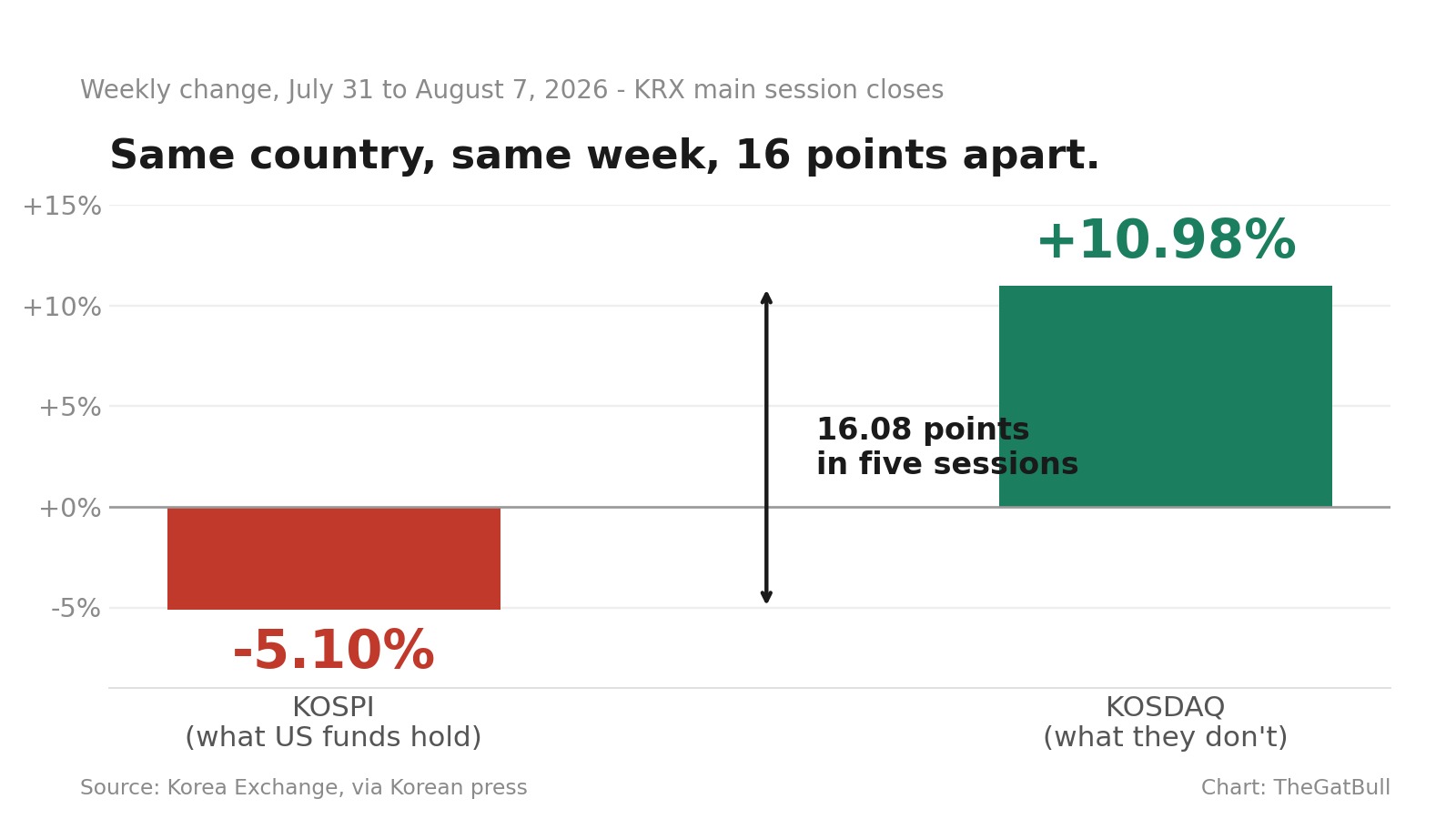
The short answer. Between August 3 and 7, 2026, the KOSPI closed the week down 5.10% and the KOSDAQ closed up 10.98%. Same country, same week, a gap of 16.08 percentage points. That makes seven consecutive weekly losses for the KOSPI — the longest such run since December 2022. And nearly everything a US investor buys under the label “Korea” holds the half that fell.
1. The week’s numbers
Indices
| July 31 | August 7 | Week | |
|---|---|---|---|
| KOSPI | 6,595.45 | 6,258.77 | −336.68 pts / −5.10% |
| KOSDAQ | 719.76 | 798.81 | +79.05 pts / +10.98% |
KOSPI by day — do not mistake this for a quiet week
| Session | Close | Change |
|---|---|---|
| Mon Aug 3 | 6,257.45 | −5.12% |
| Tue Aug 4 | 6,358.95 | +1.62% |
| Wed Aug 5 | 6,598.26 | +3.76% |
| Thu Aug 6 | 6,296.38 | −4.58% |
| Fri Aug 7 | 6,258.77 | −0.60% |
The weekly number is −5.10%. Inside it sit a −5.12% day and a +3.76% day two sessions apart. Three of the five sessions moved more than 3% in absolute terms. Read the weekly figure alone and this looks like a gentle drift lower; in fact the start and end points simply happened to land near each other.
Arithmetic note: the daily point changes — −338.00, +101.50, +239.31, −301.88, −37.61 — sum to exactly −336.68. Daily and weekly reconcile.
Currency and drawdown
- USD/KRW, Seoul 3:30 p.m. close: 1,451.3 → 1,416.1, a ₩35.20 strengthening of the won
- Intraday August 6 the won reached the ₩1,415 area, a ten-month high (intraday — not a close)
- Against the record close of 9,114.55 on June 22, the August 7 close is −31.33%
Friday flows (Korea Exchange basis)
Foreign investors sold a net ₩859.0bn. Institutions bought a net ₩579.1bn and individuals a net ₩267.7bn. Program trading: arbitrage +₩87.7bn, non-arbitrage −₩739.1bn, for a net −₩651.4bn.
One number we are not printing. Several August 6 reports referred to foreign investors having made “record net purchases of over ₩7 trillion” in the previous session. The August 5 closing report puts foreign net buying at ₩1.4463trn — a gap of roughly five times. None of the reports specify whether the larger figure combines KOSPI and KOSDAQ, includes the Next Trade venue, or includes futures. Until it can be checked against exchange source data, this article does not use the ₩7trn figure.
2. The real event: two markets moved in opposite directions
KOSPI −5.10%. KOSDAQ +10.98%. A gap of 16.08 percentage points.
The habit of treating Korean equities as one block broke this week. The KOSPI fell for a seventh consecutive week while the KOSDAQ turned higher for the first time in five, gaining nearly 11% in a single week.
The market’s explanation is straightforward — large-cap profit-taking, rotation into small- and mid-cap growth. Friday alone shows the structure. The KOSPI index fell 0.60%, and yet 554 stocks rose against 322 that fell. Advancing issues outnumbered decliners comfortably, and the index still printed a minus. A handful of the largest names dragged it there by themselves.
The sector moves that day tell the same story: semiconductors and semiconductor equipment −2.05%, while electrical products rose 4.91%, banks 2.25% and pharmaceuticals 1.88%.
Why this matters to a US reader. In the United States, “buying Korea” effectively means buying KOSPI large caps. The iShares MSCI South Korea ETF is not a vehicle for KOSDAQ small caps. The best-performing part of the Korean market this week was, for practical purposes, unreachable from a US brokerage account.
This is not a loss problem. It is a measurement problem. Asked how the Korean market did this week, answer −5.10% and you are half right; answer +10.98% and you are also half right. Which half you hold decides the answer.
Under the Gat. An index is not a market. An index is a selection from a market, weighted by size. If 554 stocks rose on a day the index fell, what went down was not “the market” — it was the weight. View, not advice.
3. The weight that dragged it — and the weight that split
Over the three sessions from August 5 to August 7 (three sessions, not the full five-session week — July 31 single-stock closes were not available for this scoreboard):
| Aug 5 | Aug 7 | 3 sessions | |
|---|---|---|---|
| Samsung Electronics | ₩246,000 | ₩231,000 | −6.10% |
| SK Hynix | ₩1,668,000 | ₩1,422,000 | −14.75% |
While the index gave up 5.10% on the week, SK Hynix lost close to three times that over three sessions. And on Friday alone the two carried opposite signs: Samsung +0.22%, SK Hynix −4.88%.
That divergence is the subject this site took up separately on Friday, in why these are not the same trade. What the scoreboard adds is one line: these two names are roughly half of the main US Korea ETF, and when a pair that large moves by different magnitudes in the same week, the phrase “Korea exposure” stops describing anything precise. What is actually inside that fund is broken down in the EWY concentration piece.
Large caps also rose on the same Friday: Samsung Electro-Mechanics +3.99%, LG Energy Solution +4.35%, Samsung Biologics +2.77%, KB Financial +2.51%, Hanwha Aerospace +4.08%. The battery-production theme gained 7.54%, among the strongest theme moves of the day.
4. The same week in New York
| Asset | Aug 7 | Week |
|---|---|---|
| Nasdaq Composite | 26,690.62 | +5.19% |
| S&P 500 | 7,753.92 | +3.53% |
| Dow Jones Industrial Average | 54,036.52 | +2.96% |
| US 10-year yield | 4.642% | −10.3 bp |
| Dollar index | 99.56 | −0.35 pt |
| WTI crude | $76.18 | −10.00% |
| Gold spot | $4,344.29/oz | +7.46% |
| Bitcoin | $64,998 | +3.34% |
The Nasdaq gained 5.19% in a week the KOSPI lost 5.10%.
The near-symmetry catches the eye, but it is a coincidence and not a causal link. The two markets close at different hours; Seoul’s decline was concentrated in large-cap semiconductors while New York’s advance rested on a rate-driven growth rally. The only claim here is that they went opposite ways in the same week.
One practical implication does hold. US yields and the dollar both fell, and Seoul’s large caps got none of the warmth. Korean large caps decoupled in a week when global risk appetite returned — which says something about the character of a seven-week losing streak.
5. What a US account cannot reach
The half that rose this week — the KOSDAQ, battery-supply-chain names, small- and mid-cap growth — is difficult for a US retail investor to buy directly. Samsung Electronics has no US listing either.
- Directly tradable: SK Hynix (Nasdaq: SKHY, listed July 2026) and KB Financial (NYSE: KB). Note that these move on the US trading day, which ends hours after Seoul’s.
- Via ETF: KOSPI large caps broadly, through a Korea ETF — but with essentially no exposure to the KOSDAQ side that rose this week.
- Effectively unavailable: individual KOSDAQ small caps, absent a broker offering direct Korea Exchange access. Availability varies; check with your own broker.
So the better half of the Korean market this week was structurally out of reach from a US account. Reading −5.10% while knowing that is a different experience from reading it without.
6. Brakes and rules — background only
In July, sidecars triggered on 14 of 20 sessions. On the morning of August 5 the 45th of the year fired — 23 sell-side, 22 buy-side — and it fired inside a +3.76% rally. On August 6 at 10:18 a.m. it was a sell-side sidecar instead. The mechanics are set out in Korea’s three-layer brake system, and the leveraged-product and intervention backdrop in the three tiers of July’s intervention.
The scoreboard stops there deliberately. Sunday is for settlement; rules and statements belong to the Wednesday and Saturday columns.
7. On the calendar
- Monday, August 10 — Seoul reopens
- Friday, August 14 — statutory deadline for semiannual reports; last session before a three-day break
- Saturday, August 15 — Liberation Day; Monday, August 17 — substitute holiday, market closed
- Wednesday, August 19 — tightened disparity management for single-stock leveraged products takes effect
- Thursday, August 27 — Bank of Korea rate decision
- End of August — Japan’s Ministry of Finance monthly intervention disclosure, confirming the size of the July 30–31 coordinated operation

8. The week in one sentence
The KOSPI fell for a seventh straight week, the KOSDAQ rose almost 11% in that one week, the won strengthened by ₩35, and the Nasdaq gained 5%. Buy “Korea” from a US account and only the first of those four arrives in your portfolio.
Under the Gat. Seven is the longest streak since December 2022. But the number worth remembering from this scoreboard is not 7 — it is 16.08. When two markets in one country separate by sixteen points in five sessions, the question to ask next is not “is Korea going up or down.” It is “which one do I actually own.” View, not advice.
Not financial advice — a view from Seoul, not a recommendation. Investing in the Korean market carries currency, liquidity and regulatory-change risk.
Frequently Asked Questions
How much did the KOSPI fall in the first week of August 2026?
The KOSPI closed at 6,258.77 on August 7, down 336.68 points or 5.10% from the July 31 close of 6,595.45. All levels are Korea Exchange regular-session closes at 3:30 p.m. KST.
What does a seventh straight weekly loss for the KOSPI mean?
It means the index closed lower than the previous week for seven consecutive weeks. Korean media reported this as the longest such streak since December 2022. That framing comes from media reporting and has not been checked against Korea Exchange source data.
Why did the KOSDAQ rise while the KOSPI fell?
The KOSDAQ rose from 719.76 to 798.81, up 10.98%, in the same week. The market explanation is profit-taking in large caps and rotation into small- and mid-cap growth names. On August 7 the KOSPI fell 0.60% even though 554 stocks rose and only 322 fell — the decline came from the weight of a few of the largest names, not from breadth.
How did the Korean won move this week?
Using Seoul spot-market closes at 3:30 p.m., the won strengthened by ₩35.20 over the week, ending at ₩1,416.1 per dollar. Intraday on August 6 it reached the ₩1,415 area, a ten-month high for the currency — that is an intraday level, not a close.
Can a US investor get exposure to the part of the Korean market that rose?
Only in a limited way. Korea ETFs available in the US are built mainly from KOSPI large caps and carry little KOSDAQ small-cap exposure. Individual KOSDAQ names generally require a broker offering direct Korea Exchange access. Check current routes with your own broker. Not financial advice.
This article is for informational purposes only and is not financial advice. TheGatBull may earn a commission from some links at no cost to you — see our disclosure and full disclaimer.
 Written by Mr.Gat — TheGatBull
Korean market coverage from a Seoul-metro-based operator who reads the filings in the original language. Every price on this site is the KRX regular-session close (15:30 Seoul); every figure states whether it came from a primary filing, the press, or our own calculation. Drafts are AI-assisted, then verified against the original Korean documents and edited by a human before publishing.
Found an error? Tell us — corrections get priority. How we work →