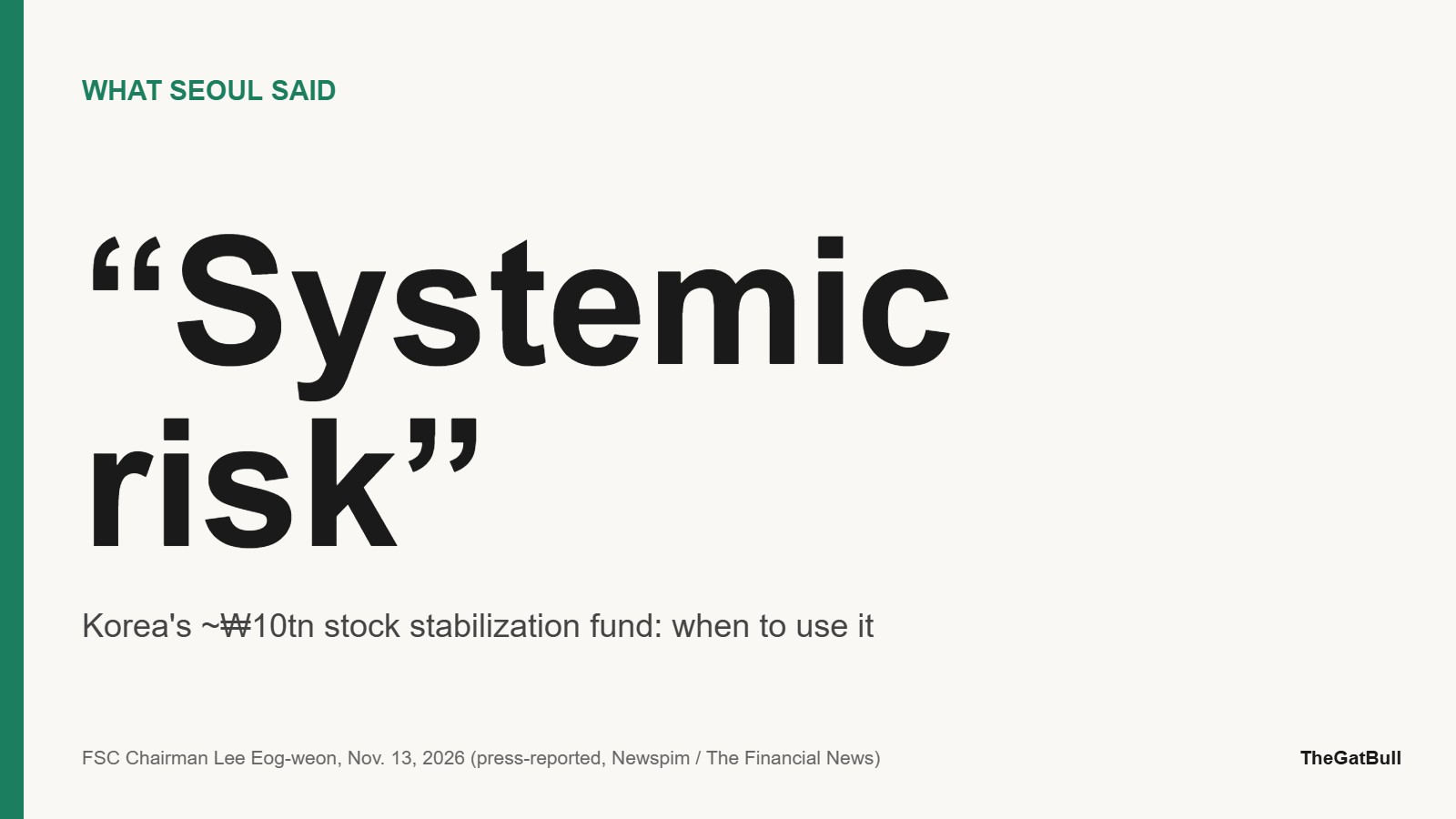
TL;DR — For anyone who holds Korean stocks directly on the Korea Exchange. Korea keeps a stock-market stabilization fund of roughly ₩10 trillion (about $7.5 billion) that financial firms have pledged but not yet paid in; if it is switched on, it buys index products such as KOSPI 200 funds. On Nov. 13, 2026, Korea’s top financial regulator told the president the fund is for “extremely urgent, temporary or exceptional” moments, and that Korea needs to discuss using it only at the level of “systemic risk.” That came one week after the KOSPI fell 6% in a day.
I’m Mr. Gat, and this is TheGatBull.
Not financial advice.
Korea has a government-organized fund that can buy stocks when the market crashes, and as of Nov. 13 it has not been switched on. At a Nov. 13 meeting chaired by President Lee Jae-myung, Financial Services Commission (FSC) Chairman Lee Eog-weon said Korea needs to discuss using it only at the level of “systemic risk” in the market. The president asked officials to check how the fund could work and how large it should be. As far as we found, this is the first time that standard has been stated in public.
Your Door — if you hold Korea Exchange stocks in a Korean or global brokerage account.
- The fund buys market-wide index products, according to Korean press reports, so if it ever runs, it reaches market-wide prices rather than picking your individual stocks.
- On Nov. 13, the fund (about ₩10 trillion) was still uncalled, and the test under discussion is systemic risk. No date has been set for the next official decision on it.
Times are Seoul time (KST) unless marked ET; in November, ET is 14 hours behind Seoul. Seoul prices are KRX (Korea Exchange) regular-session closes (3:30 p.m. Seoul) through Friday, Nov. 13, 2026; there is no new close on the weekend. Dollar conversions are for scale only, at ₩1,336.7 per dollar, the Nov. 13 Seoul 3:30 p.m. rate.
Korea’s stock stabilization fund, and where its money would go
The fund’s Korean name is jeung-an peondeu, short for Securities Market Stabilization Fund. When stocks fall hard and buyers disappear, banks, brokerages and market-related institutions pledge money the fund can call on to buy broad index products such as KOSPI 200 funds (funds tracking Korea’s 200 largest listed companies). It aims at the market’s overall base of buyers through those index products.
The key feature is the capital call. The contributing firms do not hand over cash up front. They sign commitments, and the fund asks for only what it needs when it actually buys; that request is the “call.” So the “₩10 trillion fund” is a credit line of promises it can draw on.
| Item | What we found |
|---|---|
| Current setup | The structure set up in 2000 has been extended and kept; because it runs on capital calls, the system is in place to activate it if needed, the FSC chairman said |
| Size | About ₩10 trillion (about $7.5 billion), a figure the president used at the meeting |
| 2020 (pandemic) | ₩10.7 trillion (about $8.0 billion) pledged by 23 financial firms plus market institutions; a first capital call of about ₩3 trillion was planned; never deployed because stocks rebounded |
| 2022 | Prepared for reactivation; never deployed |
| Last actual purchases | The 2008 global financial crisis |
Under the Gat (our take). “Look at the 2020 and 2022 rows before the ₩10 trillion figure. Both times the fund was readied and never bought a share, and its last purchases were in 2008. On Nov. 13, the FSC chairman said Korea needs to discuss using it only at “systemic risk.””
The Nov. 13 meeting at the Korea Exchange
On the morning of Friday, Nov. 13, President Lee chaired a capital-market policy meeting at the Korea Exchange in Yeouido, Seoul, under the theme “A trusted capital market: asking and answering on the ground.” In New York, it was the evening of Thursday, Nov. 12.
The discussion of the fund went in this order, as reported by Newspim and The Financial News:
- Kim Jin-wook, chief economist at Citibank Korea, proposed switching it on. He called it “the most practical policy” to ease volatility and said that even a signal that it would be used could calm the market.
- FSC Chairman Lee said the fund set up in 2000 has been kept and extended, and because it works on capital calls, it can be activated.
- The president asked whether the government was holding back because using it might look like market intervention and deepen investor distrust. The chairman answered: “Yes.”
- The chairman said Korea needs to discuss “whether we must go in whenever there is volatility, or whether we go in when it reaches the level of systemic risk in the market,” calling the fund a tool for times that are “extremely urgent, temporary or exceptional.”
- The president: “We need to check whether there is a way for it to work effectively, what size would be appropriate, and whether there is a new approach.”
Other points from the same meeting:
- The president’s goal: “My goal is to normalize the asset market, and then the financial market.” He called it “a highly irrational abnormality” that the same kind of stock is valued lower because it is a Korean company listed in Korea. The government’s own policy-news site carried these remarks.
- A task force: he ordered a task force on normalizing and advancing the capital market, with government, lawmakers and the private sector, and a named head who can report to him directly. He also said he had separately told the serious-crimes investigation agency to crack down on unfair trading.
- Mandatory tender offers: Korea is debating how much of a company a buyer must offer to purchase from minority shareholders after taking control (50% plus one share, 100%, or a pro-rata version). The president said he leans toward “growing the pie” by encouraging mergers, “even if we take criticism.” No decision has been announced.
- Disclosure: the Korea Exchange is considering an annual investor-briefing requirement for listed companies (Chairman Jeong Eun-bo), and a Financial Supervisory Service assistant governor proposed earnings calls.
All quotes are on the record and by name; the fund discussion and the president’s remarks were matched across two outlets (Newspim, Nov. 13, 1:58 p.m. and 4:49 p.m. KST; The Financial News, 3:40 p.m. KST). The government’s policy-news site, Korea.kr, confirms the meeting and the president’s opening remarks; its article does not cover the fund exchange.
The regulator’s case for waiting
Chairman Lee’s argument runs like this. The fund is a tool for urgent, temporary and exceptional moments. If it goes in every time the market swings, investors may read it as the government stepping in to steer prices, and that can erode trust in the market. So the decision should judge why the market is moving separately from how dangerous the move is, and ask whether the financial system as a whole has reached systemic risk. The system exists, and it can be used when that point comes.
Evidence on each side, and what has not been measured
For waiting (reported facts). In the 2020 pandemic crash, the fund was formed but the market rebounded quickly and it never bought. In 2022 it was only prepared. Newspim wrote that the fund has been seen as working more as a signal of the government’s resolve than as a buyer; that is a judgment, and we did not find a measurement behind it.
For switching it on (a reported argument). The Citibank economist said foreign investors are put off less by Korea’s low valuations than by its high volatility. The numbers from early November: on Nov. 6, the KOSPI fell 6.02% in one day to 5,059.69, and a first-stage circuit breaker (an automatic market-wide trading halt) stopped trading at 9:03 a.m., according to press reports citing the Korea Exchange. The week of Nov. 2–6 ended down 11.71%.
What we could not confirm. Even for 2008, when the fund did buy, Newspim notes the rebound cannot be credited to it alone, since U.S. rescue measures were also in play. We found no Korean data measuring whether a signal alone lowers volatility or whether using the fund deepens distrust.
This week’s market. The KOSPI closed at 5,290.53 on Nov. 13, up 4.56% for the week and still 41.95% below its June 22 closing high of 9,114.55; the KOSDAQ rose 8.60% to 699.66. The meeting took place during trading, and the KOSPI ended that day down 0.98%. We do not link the remarks to the index moves.
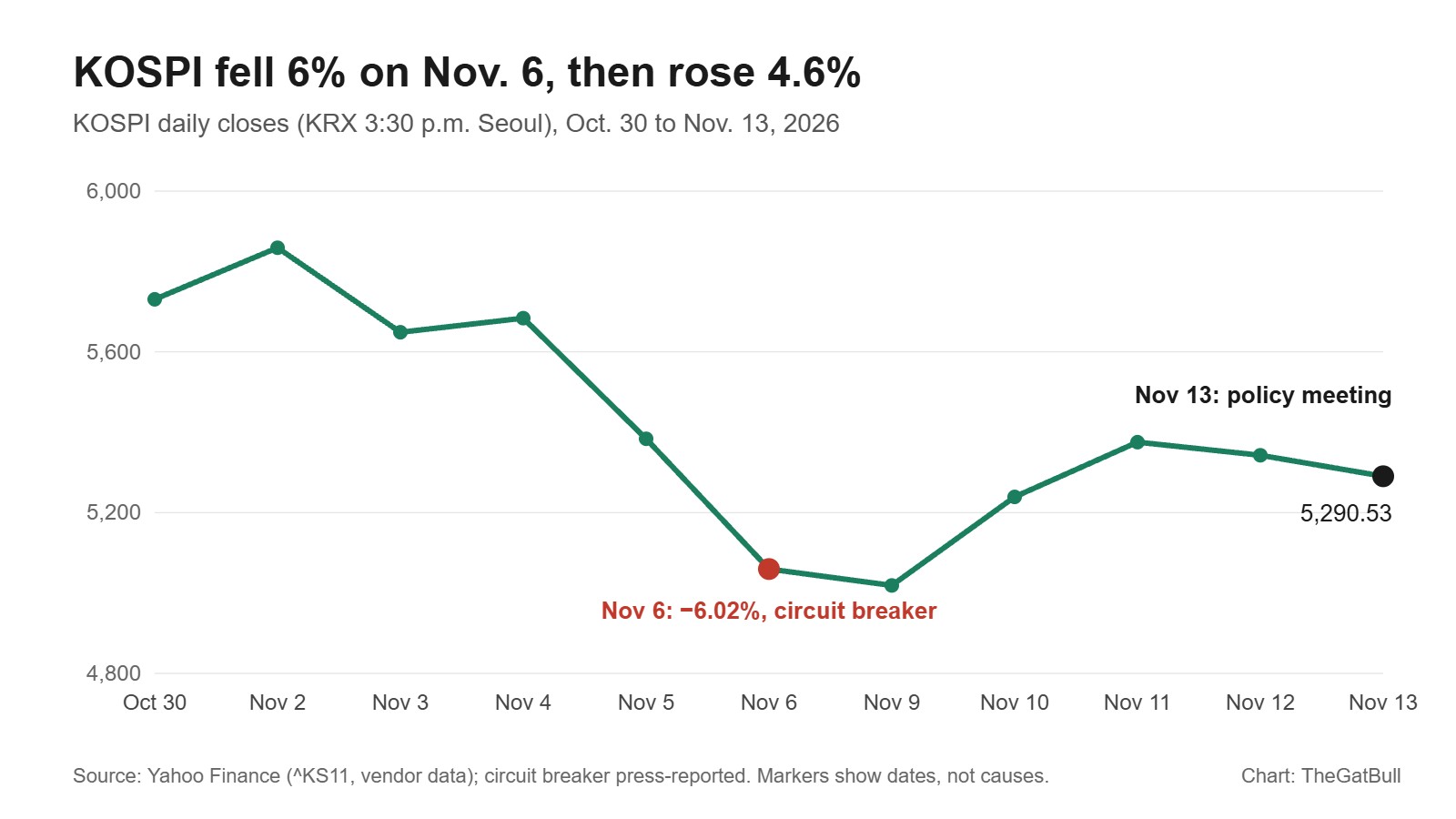
KOSPI closes, Oct. 30 to Nov. 13, 2026. The markers show dates, not causes.
A week earlier, Seoul reached for a credit rule
The fund is new to the conversation, but Seoul did act during the crash week. On Nov. 6, Deputy Prime Minister and Minister of Economy and Finance Lee Hyoung-il chaired an emergency market meeting with the FSC chairman, the Financial Supervisory Service governor and a Bank of Korea senior deputy governor. It suspended, for three months starting Nov. 9, the rule that brokers keep a 140% collateral ratio on margin loans, according to Newspim. The point is to slow the chain in which falling prices force sales of stocks bought with borrowed money. The stabilization fund and a temporary short-selling limit were not announced that day, the same report said.
In the mid-October sell-off, this column recorded that Seoul’s first word was debt, with no mention of the fund that we found. A month later the order held: the credit rule first, then talk of the fund. At the same meeting the president also raised duplicate listings, the subject of our post on the rule that covers U.S. IPOs.
How the Fed’s 2020 bond-buying announcement compares
The closest memory for U.S. readers is the Federal Reserve’s corporate bond facility from March 2020. Many analysts credited the announcement itself with calming markets before much was bought, the same logic as this week’s proposal in Seoul.
Not a perfect parallel. The Fed never bought stocks. Korea’s fund is pledged by financial firms rather than run by the central bank, and it buys stock-index products. A closer precedent for buying stock-index funds as policy is the Bank of Japan’s ETF purchases, which ended in 2024. The U.S. “Plunge Protection Team” is only a nickname for the President’s Working Group on Financial Markets, formed in 1988, which has no fund to buy shares.
If you hold Korea through EWY: the fund does not buy EWY, the iShares MSCI South Korea ETF. If it ever ran, EWY holders would feel it only through Seoul prices. EWY closed at $142.78 on Nov. 13 (U.S. trading day), up 4.21% for the U.S. week in dollar terms, a separate measure from the KOSPI’s won return above. Outside EWY, Korea Exchange stocks are reachable through a broker with Korea Exchange access or a Korean brokerage account.
Where Seoul’s statements stand this week
| Who | What they said this week | How sure |
|---|---|---|
| President Lee Jae-myung | Normalize the asset market, then the financial market; task force ordered; check the fund’s effectiveness and size; leans toward “growing the pie” on tender offers | ✅ On the record, by name; opening remarks confirmed on Korea.kr |
| FSC Chairman Lee Eog-weon | Fund kept on capital-call standby; “Yes” to the president’s question; test is systemic risk | ✅ On the record, by name, matched across two outlets |
| Korea Exchange Chairman Jeong Eun-bo | Considering a once-a-year investor-briefing requirement | ✅ On the record (Newspim) |
| Financial Supervisory Service assistant governor | Proposed earnings calls | ✅ On the record (The Financial News) |
| Deputy Prime Minister Lee Hyoung-il | Chaired a separate emergency economic ministers’ meeting on Nov. 11 (after the Nov. 6 market meeting) | ⚠️ Meeting confirmed by photo report only; we did not find what he said |
| Bank of Korea; U.S. Treasury and Fed; Japan’s Ministry of Finance | Statements on Korea’s market this week | Not checked in this edition; we do not describe them as silent |
Dates to watch
- Nov. 18, 7 a.m. KST (Nov. 17 after the U.S. close): Nvidia’s quarterly results, the next test for the AI-chip sentiment that press reports linked to early November’s drop.
- Nov. 26 (Thursday): the Bank of Korea’s last rate decision of 2026.
- Nov. 30 close (effective Dec. 1): MSCI’s November index changes take effect, bringing rebalancing trades.
- No date yet: who will lead the capital-market task force, and the results of the review of the fund’s design and size.
- Risk: Seoul has not said what measures would define “systemic risk.” Another sharp fall would be the first test of that definition.
What the 2020 fund planned to spend

Mr. Gat: “In 2020, 23 firms pledged ₩10.7 trillion and planned a first call of about ₩3 trillion. The KOSPI rebounded before that call was made. If Seoul ever calls this fund again, that first-call size is the number I would compare against.”
The bottom line
Korea keeps about ₩10 trillion of pledged buying money for its stock market, and it moves only when called. On Nov. 13, the president and the FSC chairman confirmed it can be called and that it has not been. Our interpretation: the next useful fact is how Seoul defines “systemic risk,” which it had not published as of Nov. 13.
The Seoul Seven · how this piece was checked: ✓ Korean original · ✓ Dated sources · ✓ Seoul & New York time · ✓ Beyond EWY · ✓ U.S. anchor · ✓ What to watch · ✓ Corrections kept · what these mean
— Mr. Gat. Stay bullish. (Not a call to buy or sell.)
Related reading: Korea’s crash week: Seoul talked about debt first · Korea’s listing rule and U.S. IPOs · How Korea’s margin cap met a shrinking pile of debt
FAQ
Does South Korea have a government-backed fund to support the stock market?
Yes. The Securities Market Stabilization Fund is a pool of about ₩10 trillion (about $7.5 billion) pledged by financial firms and market institutions. It works on capital calls and, when activated, buys broad index products, according to Korean press reports.
Did Korea use the stabilization fund in the November 2026 sell-off?
Not as of Nov. 13, 2026. The FSC chairman said Korea needs to discuss using it only at the level of systemic risk in the market, and the president asked officials to review how the fund could work and how large it should be.
Has the fund ever actually bought stocks?
According to Korean press reports, the last actual purchases were during the 2008 financial crisis. In 2020 it was formed at ₩10.7 trillion but never deployed after the market rebounded, and in 2022 it was only prepared.
Would the fund buy EWY?
No. It buys Korean market index products, according to press reports. EWY holders would feel any effect only through Seoul prices.
What else came out of the Nov. 13 meeting?
An order to form a capital-market task force, the president saying he leans toward encouraging mergers in the mandatory tender offer debate, a Korea Exchange plan to require annual investor briefings, and a regulator’s proposal for earnings calls.
Sources
- Korea.kr (Korean government policy briefing), “President: trust is the core of the capital market,” Nov. 13, 2026: korea.kr newsId 148975656.
- Newspim, report on the president’s capital-market meeting, Nov. 13, 2026, 1:58 p.m. KST: newspim.com.
- Newspim, “FSC chairman: stabilization fund should run in urgent, exceptional situations,” Nov. 13, 2026, 4:49 p.m. KST: newspim.com.
- The Financial News, “Lee Eog-weon cautious on activating the stabilization fund,” Nov. 13, 2026, 3:40 p.m. KST: fnnews.com.
- Newspim, report on the Nov. 6, 2026 emergency market meeting (140% collateral-ratio suspension), Nov. 6, 2026, 5:14 p.m. KST.
- Prices: Yahoo Finance chart data (^KS11, ^KQ11, EWY; vendor data, not exchange-published figures).
- Won-dollar rate at the Seoul 3:30 p.m. close, Nov. 13: Asia Economy, checked against other press and the previous day’s close.
How sure are we?
| Item | Confidence |
|---|---|
| Meeting held Nov. 13 at the Korea Exchange; president’s opening remarks | ✅ Korean government primary (Korea.kr) |
| FSC chairman’s fund remarks and the president’s question and instruction | ✅ On the record, by name, matched across two outlets; we did not check an official transcript or video |
| Fund size of about ₩10 trillion | ⚠️ Press-reported (president’s figure) |
| 2020 size, 2020 and 2022 non-deployment, 2008 purchases | ⚠️ Press-reported, not confirmed from a primary source |
| Nov. 6 circuit breaker and 140% collateral suspension | ⚠️ Press-reported |
| KOSPI, KOSDAQ and EWY prices | Vendor data (Yahoo) |
| Nov. 13 won-dollar rate | ⚠️ Press-reported |
| Fed 2020 and Bank of Japan comparisons | Background, our framing |
Ticker key: This piece covers no individual stock. 🟢 EWY (NYSE Arca).
Not financial advice. TheGatBull is an independent publication; nothing here is a recommendation to buy or sell any security.
 Written by Mr.Gat — TheGatBull
Korean market coverage from a Seoul-metro-based operator with 15 years of personal investing experience, who reads the filings in the original language. Every price on this site is the KRX regular-session close (15:30 Seoul); every figure states whether it came from a primary filing, the press, or our own calculation. Drafts are AI-assisted, then verified against the original Korean documents and edited by a human before publishing.
Found an error? Tell us — corrections get priority. How we work →