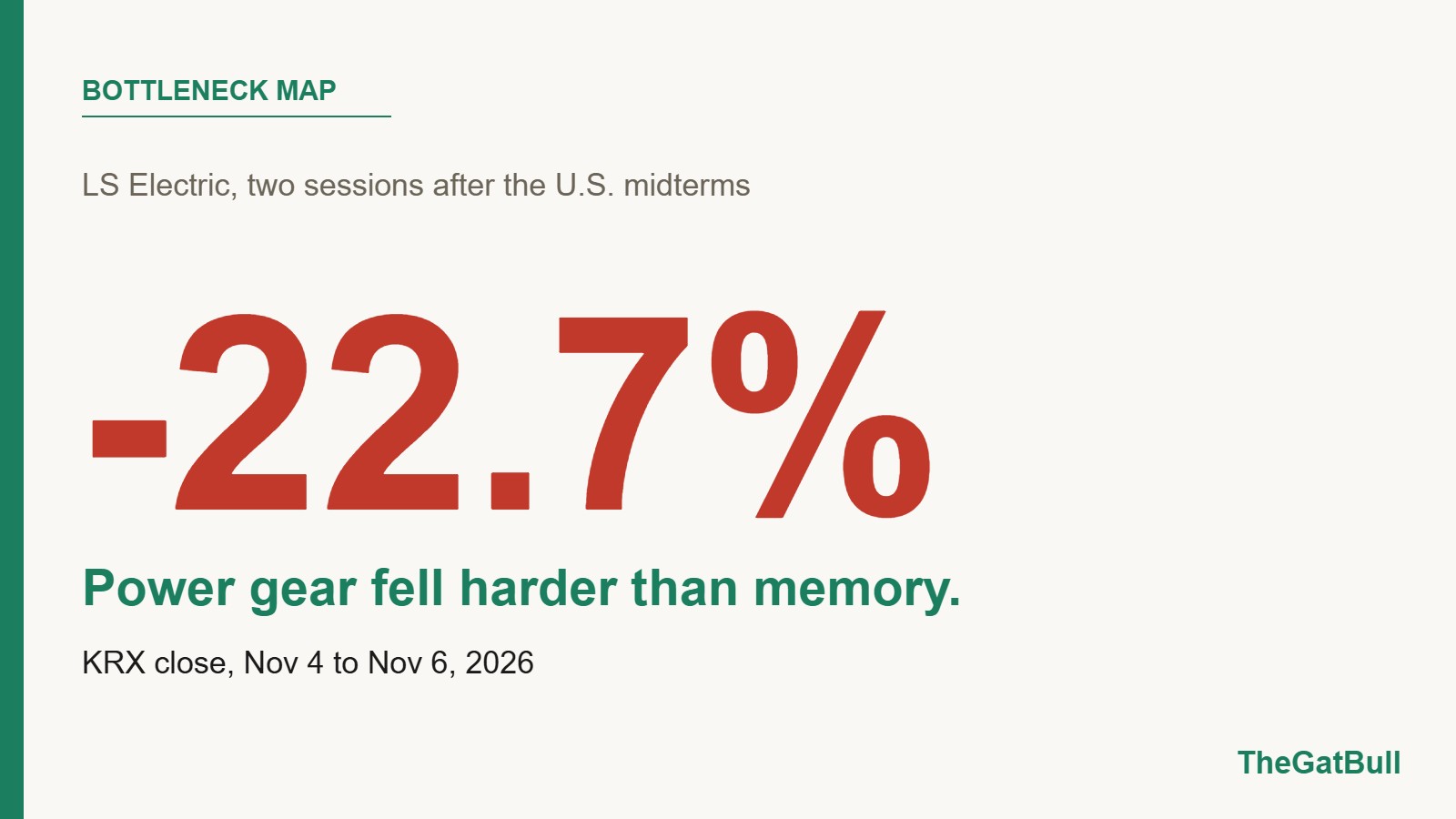
TL;DR — For anyone who saw the Nov. 5–6 selloff described as a chip shock. When U.S. data-center regulation fears reached Seoul on Nov. 5–6, the Korean AI supply-chain stocks that fell hardest over those two sessions were power-equipment makers. Hyosung Heavy Industries fell 23.0% and LS Electric 22.7%, against 18.9% for SK Hynix. LS Electric, whose filings name “U.S. hyperscale data centers,” had recovered the least of the six by the Nov. 10 close.
I’m Mr. Gat, and this is TheGatBull.
Not financial advice.
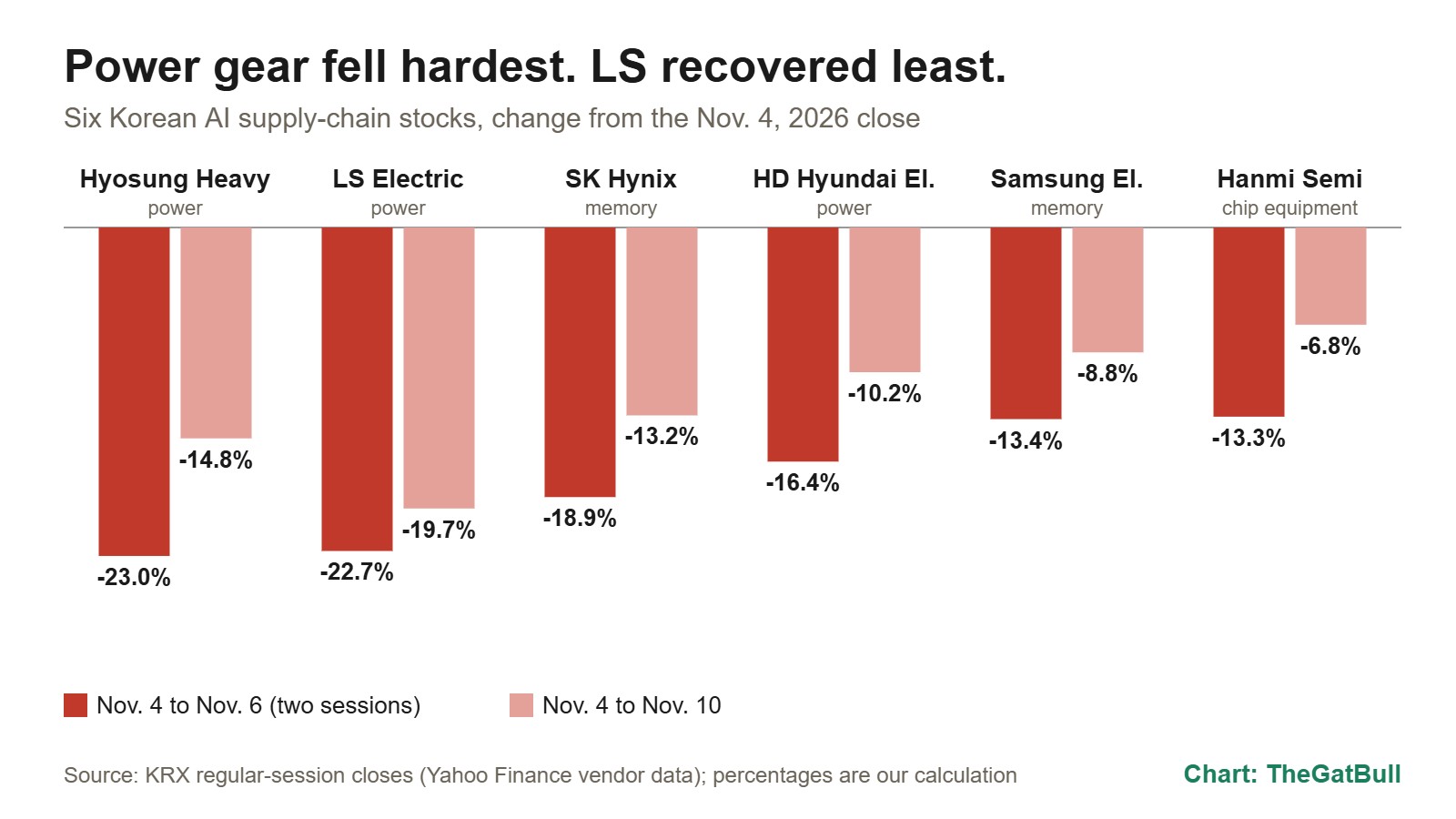
When U.S. hyperscalers (the largest cloud companies, such as Google) spend on data centers, Korea sits at two choke points: memory chips, including HBM (high-bandwidth memory used in AI servers), and power equipment (transformers and switchgear, the gear that switches and protects power circuits). From the Nov. 4 close (the last before the drop) to the Nov. 6 close, SK Hynix fell 18.9% and Samsung Electronics 13.4%, while Hyosung Heavy Industries fell 23.0%, LS Electric 22.7% and HD Hyundai Electric 16.4%. The KOSPI, Korea’s main index, fell 11.0%.
Your Door — what this means for you.
- If you hold EWY: the three power-equipment makers add up to 1.54% of the fund (iShares, as of Nov. 6). Most of the data-center-linked exposure inside EWY sits in Samsung Electronics and SK Hynix, which are 42.30% combined; the power-equipment stage is 1.54%.
- If you hold these stocks in a Korean brokerage account, or through a broker with Korea Exchange access: the three power-equipment makers and the chip-equipment maker Hanmi Semiconductor have no U.S.-listed ADR (a U.S.-traded receipt for a foreign share). These two days hit directly only investors who hold the Seoul shares.
Dates and times are Seoul time (KST) unless marked ET; in November, ET is 14 hours behind Seoul. Stock and index prices are KRX (Korea Exchange) regular-session closes (3:30 p.m. Seoul). Contract values in dollars are as filed; won conversions in filings use the exchange rate on each contract date. Other dollar figures are for scale only, at the Nov. 10 Seoul 3:30 p.m. rate of ₩1,337.5 per dollar.
Alphabet alone spent $51.4 billion on capital projects in one quarter
In the earnings release it filed with the SEC on Oct. 28 (Form 8-K, Exhibit 99.1), Alphabet, Google’s parent, reported purchases of property and equipment of $51.355 billion in the third quarter of 2026, up from $23.953 billion a year earlier (up 114%, our calculation). Quarterly spending rose in each of the last three quarters, from $27.9 billion in Q4 2025 to $35.7 billion, $44.9 billion and $51.4 billion. In the same release, free cash flow was negative in both the second quarter (−$5.9 billion) and the third (−$9.1 billion).
Korean companies sit in two parts of that spending: memory and power equipment, with chip-packaging equipment makers such as Hanmi in between.
Not a perfect parallel: a hyperscaler’s capital spending covers chips, servers, buildings and power gear all at once. It does not map one-to-one onto the Korean contract amounts below. We use it only as a starting point for direction and size.
What was in the news. After the Nov. 3 U.S. midterm elections, Democratic wins in states with many data centers raised the question of limiting new data-center approvals and of higher electricity bills (Fox Business and Investing.com, press-reported). There are also reports that Texas’s governor-elect campaigned on pausing new data-center approvals; we could not confirm this from a primary source. We found no report of a specific federal bill.
On Nov. 5 (ET), the Philadelphia Semiconductor Index fell 12.25% (press-reported). That U.S. close came at 6:00 a.m. Seoul time on Nov. 6. At 9:03 a.m. that morning, a Level 1 circuit breaker (a trading halt) was triggered on the KOSPI (press-reported, citing the Korea Exchange). In New York it was 7:03 p.m. on Nov. 5.
Six Korean companies at three stages of the chain
| Stage | Korean company (code · U.S. access) | What its filings show | Nov. 4–6 (2 sessions) | Confidence |
|---|---|---|---|---|
| Memory (incl. HBM) | SK Hynix (000660 · SKHY ADR on Nasdaq) | Q3 sales ₩104.6 trillion (about $78.2 billion), up 327.9% from a year earlier; no mention of customers or regions | −18.91% | ✅ Company filing (preliminary) |
| Memory (incl. HBM) | Samsung Electronics (005930 · no ADR) | Not checked against filings for this piece | −13.44% | Closing price only |
| HBM and packaging equipment | Hanmi Semiconductor (042700 · Seoul only) | Two orders filed June–Nov.: ₩24.5 billion (about $18 million) from Samsung Electro-Mechanics (equipment for AI chip substrates) and $5.8 million from UTAC in Thailand; no HBM bonder supply filing in this period | −13.27% | ✅ Company filing |
| Power equipment | HD Hyundai Electric (267260 · Seoul only) | Oct. 27: ₩198 billion (about $148 million) facility expansion (9.74% of equity), reason given: “increase in AI data center demand” | −16.42% | ✅ Company filing |
| Power equipment (high-voltage transformers) | Hyosung Heavy Industries (298040 · Seoul only) | Sept. 15: two U.S. transformer orders, $287.1 million in total, described as building a “765kV power grid in parts of the U.S.” | −23.04% | ✅ Company filing |
| Power equipment (switchgear) | LS Electric (010120 · Seoul only) | October: two North American data-center orders, $263.7 million (plus $115.0 million already booked for 2026 delivery), naming “U.S. hyperscale data centers” | −22.69% | ✅ Company filing (via parent LS Corp.) |
The KOSPI fell 10.98% over the same two sessions. “Fell most” in this piece means within these six stocks only.
Only LS Electric and HD Hyundai Electric say “data center” in their filings
The test here is one word: whether the Korean original filing says “data center.”
- LS Electric. The Oct. 19 filing (submitted by parent LS Corp. as a material event at a subsidiary) is titled “2027 North America data center power equipment supply project.” It is worth $125,229,300 (about ₩168.9 billion, 3.40% of recent sales). The filing says LS Electric will supply switchgear for a “U.S. hyperscale data center power equipment supply project,” that it had already won the 2026 delivery of $114,974,772, and that this order covers the following year. A filing six days earlier, on Oct. 13, was a $138,458,284 order for “fuel-cell-based power equipment for North American data centers ordered by Bloom Energy.” (Our translations.)
- HD Hyundai Electric. Its Oct. 27 filing for a ₩198 billion (about $148 million) expansion gives the reason as responding to “Mega Project orders driven by increasing AI data center demand and the continuing trend of packaged orders for distribution equipment.” That was ten days before the Nov. 6 drop.
- Hyosung Heavy Industries. Its two Sept. 15 U.S. transformer filings (765kV, $163,451,870; 345kV, $123,679,452) do not contain the words “data center.” The filing says the order is “to build a 765kV power grid in parts of the U.S.” The filing names a power-grid project as the purpose.
- SK Hynix. Its Oct. 28 preliminary third-quarter results filing contains sales and profit figures only, with no sentence about customers or data centers.
Prices did not follow that line. Hyosung, a “power grid” company on paper, fell the most of the six over the two days (−23.04%). We read that as the market marking down U.S. power infrastructure as one data-center block. We have not confirmed it; it is an observation.
Under the Gat. Companies that wrote “data center” in their filings get priced on data-center news. This time, companies that did not write it were grouped in too. Over two days: −23.0%, −22.7%, −18.9%. Those three drops show how wide that grouping was.
Where U.S. data-center rules would touch the income statement: future orders
The U.S. issues (state-level data-center approvals and power bills) would reach Korean companies through future orders, on the revenue line. Contracts already filed have set amounts and terms, but all three power-equipment companies’ filings say the contract amount and period “may change” as the project proceeds. There is a precedent. On July 31, HD Hyundai Electric amended a filing for a transformer contract with the City of Santa Clara ($60.6 million) and changed the end date to “–”: an extension was expected at the customer’s request, but the amended contract had not been signed yet.
For memory, the path is one step longer. Reports said delayed data-center approvals could push back the timing of server orders (Global Economic, citing Barron’s; press-reported). SK Hynix’s filing contains nothing that confirms that path; we did not check Samsung’s.
On the Korean side, the government said at an emergency market meeting on Nov. 6 that “the domestic stock market over-reacted to external negatives.” It also suspended for three months, from Nov. 9, the rule requiring brokers to keep margin-loan collateral at 140% (press-reported, Newspim). That measure acts on forced selling across the whole market; it does not target any one stage.
What did this selloff show about Korea’s market?
Over these two sessions, Korean companies tied to the same U.S. data-center demand moved differently by stage: two of the three power-equipment makers (Hyosung −23.0%, LS Electric −22.7%) fell more than SK Hynix (−18.9%), while the equipment maker Hanmi (−13.3%) moved about as much as Samsung Electronics (−13.4%).
The rebound came in a different order. On Nov. 10 the KOSPI rose 4.39% to 5,239.13. Measured from the Nov. 4 close again: Hanmi Semiconductor −6.8%, Samsung Electronics −8.8%, HD Hyundai Electric −10.2%, SK Hynix −13.2%, Hyosung Heavy Industries −14.8%, and LS Electric −19.7%, against −7.8% for the KOSPI. The company whose filings name “hyperscale data centers” most directly had recovered the least of the six. We have not confirmed why; this is an observation over the same period.
The lens: in Korea, the stage most directly exposed to U.S. data-center risk may not be the memory giants, but power-equipment makers that are far smaller and barely visible in EWY. Inside EWY, the three are 1.54% combined; Samsung Electronics and SK Hynix are 42.30%. For a U.S. investor who looks at Korea only through EWY, this stage is close to invisible.
What to watch next
- MSCI’s November index review, scheduled for Nov. 11 (U.S. time; announcement time not yet confirmed): changes take effect at the Nov. 30 close (Dec. 1). Watch whether the three power-equipment makers’ EWY weights change.
- Nvidia’s earnings, Nov. 18 at 7:00 a.m. Seoul time (Nov. 17, 5:00 p.m. ET): whether its data-center demand numbers move memory and power equipment in the same direction again.
- Amended U.S. contract filings from the three power-equipment makers: changes to contract amounts or terms appear on DART (Korea’s corporate filing system, the counterpart of the SEC’s EDGAR) as amended “single sales and supply contract” filings. The end-date amendment for HD Hyundai Electric’s Santa Clara contract is the first place to check.
Risk: U.S. state-level restrictions are still campaign pledges and press reports (not confirmed from a primary source), and the Korean contract amounts carry clauses allowing change. The figures here cover only what was on record by Nov. 10.
How can U.S. investors reach these stocks?
| Company | EWY weight (Nov. 6, iShares) | U.S. listing | Korea Exchange |
|---|---|---|---|
| Samsung Electronics | 21.87% (+0.06% preferred) | No ADR | Yes |
| SK Hynix | 20.43% | SKHY (Nasdaq) | Yes |
| LS Electric | 0.55% | None | Yes |
| Hyosung Heavy Industries | 0.51% | None | Yes |
| Hanmi Semiconductor | 0.50% | None | Yes |
| HD Hyundai Electric | 0.48% | None | Yes |
The access path: EWY, then SKHY, which covers SK Hynix only; the other four need a broker with Korea Exchange access or a Korean brokerage account. We did not check, for this piece, whether any U.S.-listed Korea theme ETF holds the power-equipment makers. For the memory side, see how U.S. investors reach Samsung, SK Hynix and Micron; for the power side, Korea’s transformer makers and Korea’s AI power stocks.

The bottom line
The U.S. data-center scare was reported in Seoul as a chip shock. By closing prices, it was a data-center supply-chain shock, and the deepest cuts were in power equipment. The filings show which companies tied themselves to data centers in writing. Our interpretation: the link between filing language and price moves is an observation, and we have not confirmed a cause.
The Seoul Seven · how this piece was checked: ✓ Korean original · ✓ Dated sources · ✓ Seoul & New York time · ✓ Beyond EWY · ✓ U.S. anchor · ✓ What to watch · ✓ Corrections kept · what these mean
— Mr. Gat. Stay bullish. (Not a call to buy or sell.)
Related reading: DRAM stocks: Samsung, SK Hynix, Micron and U.S. access · Korea’s AI power stocks and the discount · Korean transformer stocks and AI
FAQ
Which Korean companies supply U.S. AI data centers, according to their filings?
As of October 2026 filings, LS Electric disclosed contracts for “U.S. hyperscale data center” power equipment and for Bloom Energy’s North American data-center power systems, and HD Hyundai Electric disclosed a facility expansion citing “AI data center demand.” Hyosung Heavy Industries’ U.S. transformer filings describe a 765kV power grid and do not mention data centers.
Why did Korean power equipment stocks fall more than SK Hynix in November 2026?
From the Nov. 4 to the Nov. 6 close, Hyosung Heavy Industries fell 23.0%, LS Electric 22.7% and SK Hynix 18.9%. The drop coincided with reports of U.S. data-center regulation fears after the midterm elections, but the cause for each stock is not confirmed.
Can U.S. investors buy Korean power equipment stocks?
None of the three has a U.S.-listed ADR. The route is a broker with Korea Exchange access or a Korean brokerage account. Inside EWY, the three are about 1.5% combined (as of Nov. 6, 2026).
How much is Alphabet spending on data centers and other capital projects?
Alphabet’s purchases of property and equipment were $51.4 billion in the third quarter of 2026, up from $24.0 billion a year earlier (company 8-K filing).
Sources
- LS Corp. filing on LS Electric, “single sales and supply contract (material event at a subsidiary),” Oct. 19, 2026: DART 20261019800111; Oct. 13, 2026 (Bloom Energy data centers): DART 20261013800056.
- HD Hyundai Electric, new facility investment, Oct. 27, 2026: DART 20261027800235; amended supply contract (Santa Clara), July 31, 2026: DART 20260731801146.
- Hyosung Heavy Industries, supply contracts, Sept. 15, 2026: DART 20260915800147 (765kV) · DART 20260915800149 (345kV).
- SK Hynix, preliminary Q3 2026 results: DART 20261028800036.
- Hanmi Semiconductor, supply contracts: DART 20261006800023 · DART 20260929800083.
- Alphabet Inc., Form 8-K Exhibit 99.1 (Q3 2026 results), filed Oct. 28, 2026, SEC EDGAR.
- iShares MSCI South Korea ETF (EWY) holdings, as of Nov. 6, 2026.
- Prices: Yahoo Finance chart data (^KS11, 005930.KS, 000660.KS, 042700.KS, 267260.KS, 298040.KS, 010120.KS; vendor data, not exchange-published figures).
- Won-dollar rate at the Seoul 3:30 p.m. close, Nov. 10: Asia Economy and News1 (press), checked against the previous day’s close.
- Press: Hankyung (Nov. 6, circuit breaker at 9:03 a.m.); Fox Business (Nov. 5 and 6); Investing.com via Yahoo Finance (Nov. 6); Global Economic (Nov. 9, citing Barron’s); Newspim (Nov. 6, government meeting).
How sure are we?
| Item | Confidence |
|---|---|
| Contract amounts, contract wording, facility expansion, Q3 results | ✅ Company filings on DART |
| Alphabet capital spending | ✅ Company filing with the SEC |
| EWY weights | ✅ iShares holdings file, as of Nov. 6, 2026 |
| Closing prices and percentage changes | Vendor data (Yahoo), KRX regular-session close; percentages are our calculation |
| Midterm-related data-center fears, chip index drop, circuit breaker time, Korean government measures, Nov. 10 won-dollar rate | ⚠️ Press-reported |
| Texas data-center pause pledge; cause of each stock’s drop | Not confirmed |
Not financial advice. TheGatBull is an independent publication; nothing here is a recommendation to buy or sell any security.
 Written by Mr.Gat — TheGatBull
Korean market coverage from a Seoul-metro-based operator with 15 years of personal investing experience, who reads the filings in the original language. Every price on this site is the KRX regular-session close (15:30 Seoul); every figure states whether it came from a primary filing, the press, or our own calculation. Drafts are AI-assisted, then verified against the original Korean documents and edited by a human before publishing.
Found an error? Tell us — corrections get priority. How we work →