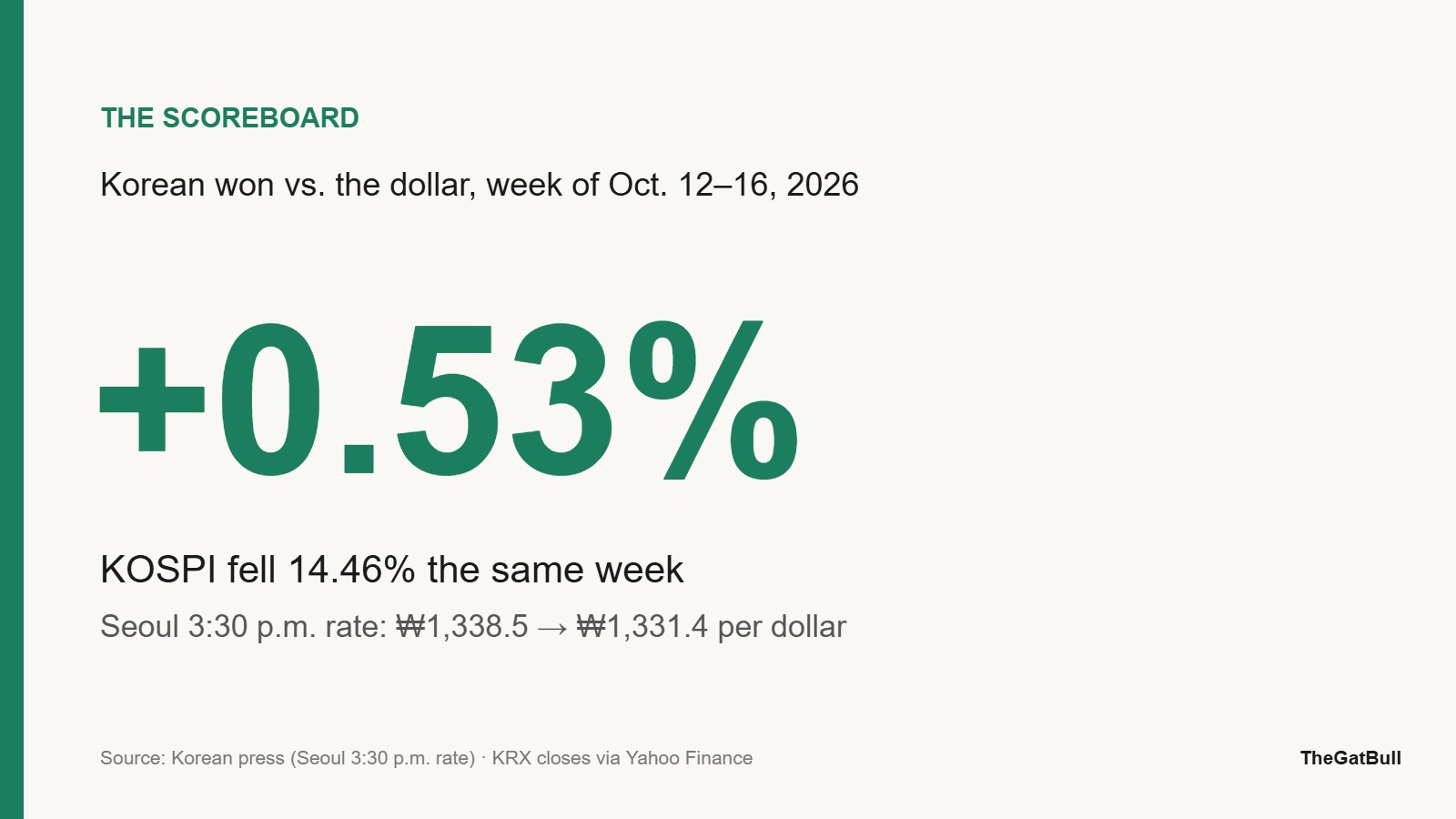
TL;DR — If you own Korean stocks or a Korea fund in dollars. KOSPI fell 14.46% in the five sessions from Oct. 12 to Oct. 16, yet the Korean won ended the week 0.53% stronger against the dollar at the Seoul 3:30 p.m. rate. So far this crash has stayed inside the stock market; it has not looked like a currency crisis, and we found no confirmed explanation for why the won held.
Not financial advice.
KOSPI (Korea’s main index) closed at 5,668.05 on Friday, Oct. 16, down 14.46% from 6,625.93 on Thursday, Oct. 8, the last close of the previous week. Over the same days, the won-dollar rate at the Seoul 3:30 p.m. close went from ₩1,338.5 to ₩1,331.4 per dollar. Fewer won per dollar means a stronger won: up about 0.53%. That happened while foreign investors sold, on net, about ₩11.0 trillion (about $8.3 billion) of KOSPI shares over the week, by our addition of daily press figures. Heavy foreign selling is often expected to weaken the currency. This week it did not.
Your Door — what this means if you hold Korea in dollars (EWY, or an ADR such as SKHY). Check how much of your loss came from prices rather than the currency: this week, most of it. EWY fell 15.12% in dollars over the U.S. week (about $849 left of every $1,000), and Samsung Electronics and SK hynix are 45.61% of the fund (iShares, as of Oct. 14). The next checkpoints are Monday, Oct. 19 (a new cap on margin loans, meaning money borrowed from a broker to buy shares, per stock at Korean brokerages) and Thursday, Oct. 22 (the Bank of Korea rate decision), and the daily Seoul 3:30 p.m. exchange rate.
Dates and times are Seoul time (KST). Stock and index prices are KRX (Korea Exchange) regular-session closes (15:30 Seoul). Exchange rates are the Seoul 3:30 p.m. rate, the rate at the close of Seoul’s stock-market session as reported by Korean outlets, not the overnight or global rate. Dollar conversions are for scale only, at ₩1,331.4 per dollar, the Oct. 16 Seoul 3:30 p.m. rate. U.S.-listed prices (EWY, SKHY) are U.S. closes on U.S. trading days.
What was this week’s scoreboard?
| Session (KST) | KOSPI close | Daily change | Won per dollar, 3:30 p.m. |
|---|---|---|---|
| Thu., Oct. 8 (previous week’s last session) | 6,625.93 | — | 1,338.5 |
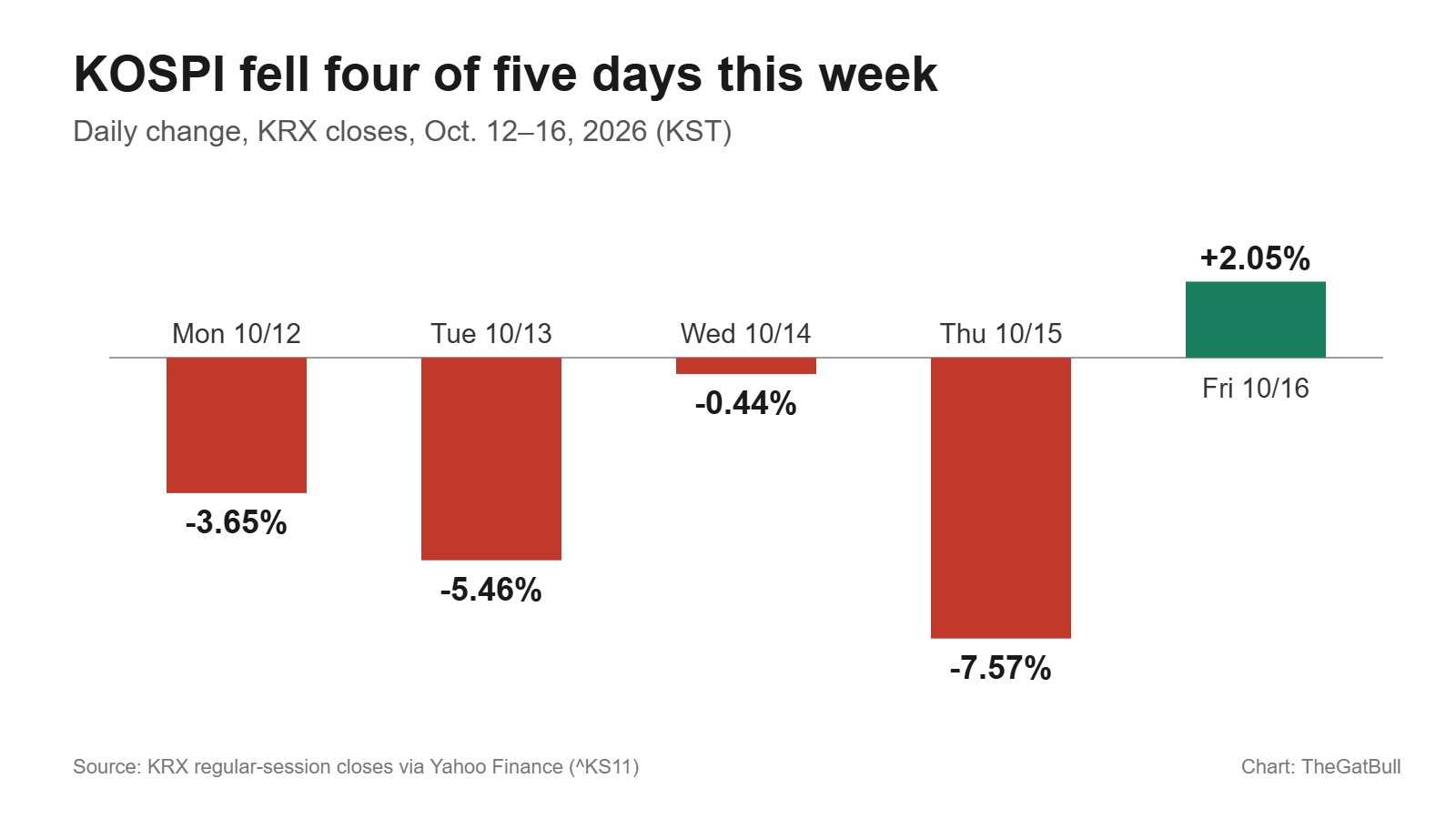
| Mon., Oct. 12 | 6,384.24 | −3.65% | 1,335.1 |
| Tue., Oct. 13 | 6,035.35 | −5.46% | 1,345.1 |
| Wed., Oct. 14 | 6,008.81 | −0.44% | 1,338.3 |
| Thu., Oct. 15 | 5,554.22 | −7.57% | 1,344.6 |
| Fri., Oct. 16 | 5,668.05 | +2.05% | 1,331.4 |
| Week | −14.46% | −7.1 won (won +0.53%) |
| Week in review | Value |
|---|---|
| KOSDAQ (Korea’s smaller-company index) | 892.27 → 794.78, −10.93% |
| Samsung Electronics | ₩262,000 → ₩215,500 (about $162), −17.75% |
| SK hynix | ₩1,681,000 → ₩1,272,000 (about $955), −24.33% |
| KOSPI since Oct. 2 | 7,003.74 → 5,668.05, −19.07% |
| Foreign investors’ net trading (buying minus selling) in KOSPI shares | About −₩11.0 trillion (about $8.3 billion) — our sum of daily press figures; some are preliminary counts taken just after the close |
Friday’s 2.05% gain ended a seven-session losing streak.
Under the Gat (our take). “A won that held up is not a stock market that held up. This week, most of the loss in a dollar-based Korea holding came from prices, not the currency. Mix the two numbers and you get a comforting conclusion that isn’t true.”
Did the won really hold up all week?
Not every day. It wobbled and then finished stronger than it started. The 3:30 p.m. rate moved between ₩1,331.4 and ₩1,345.1 during the week. On the two worst days for stocks, the won weakened too: by 10.0 won on Tuesday, Oct. 13 (KOSPI −5.46%) and by 6.3 won on Thursday, Oct. 15 (KOSPI −7.57%). On Thursday morning it touched ₩1,353.0 during the session, around 11 a.m. (SBS Biz; that is an intraday level, not a close). Then on Friday it strengthened by 13.2 won and closed the week at ₩1,331.4.
So the direction on bad days was normal: stocks fell, the won weakened. What was unusual was the size. Across the whole week, the currency moved about half a percent in the won’s favor while the index lost 14.46%. Half a percent is a small move, smaller than the week’s own range of about 1%. The point is not that the won rallied. It is that the won did not fall while stocks did.
How big was the foreign selling?
| Session (KST) | Foreign net trading, KOSPI | How sure |
|---|---|---|
| Mon., Oct. 12 | About −₩2.02 trillion | Press-reported, one outlet |
| Tue., Oct. 13 | About −₩4.55 trillion | Press-reported, three outlets |
| Wed., Oct. 14 | About −₩1.18 trillion | Press-reported, one outlet; may be a preliminary count |
| Thu., Oct. 15 | About −₩3.62 trillion | Press-reported, two outlets; one other outlet reported a higher figure (see our Oct. 15 article) |
| Fri., Oct. 16 | About +₩0.34 trillion | Preliminary count at 3:35 p.m. (Korea Economic Daily), not the final tally |
| Week | About −₩11.0 trillion (about $8.3 billion) | Our arithmetic from press figures |
On Friday, foreign investors were net buyers for the first time in eight trading days, on that preliminary count. The weekly total is our sum of the daily figures above, not an official weekly number.
Was the dollar itself weak?
Slightly. The U.S. Dollar Index (DXY) went from 102.21 on Oct. 9 to 101.84 on Oct. 16, down 0.36% over the U.S. week. But DXY measures the dollar against a basket of six currencies, such as the euro and the yen. The won is not in it. “A weaker global dollar helped the won” is one possible reading. It is not a confirmed cause.
Why didn’t the selling sink the won?
We don’t know, and we did not find a source this week that shows it. Candidates that could be raised include Korean exporters selling dollars, currency hedging by the National Pension Service (Korea’s state pension fund), the Bank of Korea’s rate increases in July and August (as described by the press), and a softer global dollar. In what we checked, no primary data this week shows which of these mattered, or by how much. So this article only says how the won finished, not why.
What does this week say about Korea’s market?
In March 2020, a big Korean stock crash came with a weak won. On Thursday, March 19, 2020, KOSPI closed at 1,457.64, down 35.03% from 2,243.59 on Feb. 14, 2020 (vendor price data). That day the won closed at ₩1,285.7 per dollar, a level a 2022 news article still used as its benchmark for a weak won (press-reported). We do not show the size of that 2020 currency move here, and 2020 and 2026 exchange-rate levels are not directly comparable.
This October looks different so far. KOSPI is down 19.07% since Oct. 2, while the won went from ₩1,350.6 to ₩1,331.4 over the same period, about 1.44% stronger. That gap is what this week shows about Korea’s market, so far: the October crash has been a crash inside the stock market, centered on two memory-chip stocks and on shares bought with borrowed money (see what Seoul’s officials said about debt this week), not one that pulled the currency down with it.
Why it matters if you invest in dollars: a crash that also breaks the currency hits you twice, once through prices and once through the exchange rate. This week, the hit was mostly once. Converted at each day’s Seoul 3:30 p.m. rate, KOSPI fell about 14.0% in dollar terms over the week (our calculation).
How do you get exposure from the U.S., and is there a U.S. parallel?
How to get exposure: for the whole Korean market, EWY, a U.S.-listed ETF on NYSE Arca. For SK hynix, the ADR SKHY on Nasdaq (a U.S.-traded receipt for SK hynix shares). For other single stocks, direct buying on the Korea Exchange through a broker such as Interactive Brokers.
EWY fell 15.12% in dollars over the U.S. week of Oct. 12–16 (from $177.24 on Oct. 9 to $150.44). Don’t line that up day by day with Seoul: EWY trades in New York after Seoul has closed, so its Friday move (−3.70%) came after Seoul’s Friday close (+2.05%) and carries news Seoul has not traded yet (how EWY trades when Korea is closed). SKHY fell 19.25% over the same U.S. week ($169.03 to $136.49). Samsung Electronics and SK hynix together are 45.61% of EWY (iShares, as of Oct. 14).
- U.S. parallel: when U.S. stocks crash, the dollar often rises, because investors around the world treat it as a safe place to park money. Korea has been on the other side of that: in March 2020, the press reported the won weakening along with stocks. This week, that pattern did not show up. Not a perfect parallel: the won is not a safe-haven currency, and one week is not a pattern.
What dates matter next week?
| Date (KST) | What to watch |
|---|---|
| Mon., Oct. 19 | Brokerages’ cap on margin loans per stock takes effect: loans for any single stock may be no more than 15% of a brokerage’s total margin lending. It acts on borrowing, not on prices |
| Thu., Oct. 22 | Bank of Korea rate decision |
| Wed., Oct. 28, 9 a.m. | SK hynix third-quarter results (DART notice); 8 p.m. Tue., Oct. 27, U.S. Eastern |
| Every session, 3:30 p.m. | Won-dollar rate — this week’s range was ₩1,331.4 to ₩1,345.1 |
Dates only, not predictions.
For the price side of this slide, including the circuit breaker on Oct. 15, see How Korea’s KOSPI Lost 20.7% in Seven Sessions.
Under the Gat (our take). “Next week the first number I’ll check isn’t KOSPI. It’s the 3:30 p.m. exchange rate. If the won weakens back past ₩1,345 and stays there, the conclusion of this article needs a second look. That’s not a forecast; it’s the test of whether this article was wrong.”

The bottom line
Seoul’s scoreboard this week has two lines. Stocks: −14.46%. The won: +0.53%. Foreign investors sold about ₩11.0 trillion of KOSPI shares, and the won still finished the week stronger. The cause is not confirmed, and this is one week of numbers. But so far, October’s crash has not taken the shape of March 2020, when the currency went down with the stocks. For dollar holders, the question is the two memory stocks, not the exchange rate.
FAQ
How much did KOSPI fall this week?
14.46%, from 6,625.93 on Oct. 8 to 5,668.05 on Oct. 16, on KRX 3:30 p.m. closes. Since Oct. 2, it is down 19.07%.
Why did the Korean won get stronger while foreigners sold stocks?
No cause has been confirmed. The Seoul 3:30 p.m. rate went from ₩1,338.5 per dollar on Oct. 8 to ₩1,331.4 on Oct. 16, a 0.53% stronger won. A weaker global dollar, exporters selling dollars and currency hedging are possible candidates, but in what we checked no primary data this week shows which mattered.
How much did EWY fall this week?
15.12% in dollars over the U.S. week of Oct. 12–16, from $177.24 to $150.44. Its last session took place after Seoul’s Friday close.
What dates should I watch next?
Oct. 19, when the margin-loan cap per stock takes effect; Oct. 22, the Bank of Korea rate decision; and Oct. 28 at 9 a.m. Seoul time, SK hynix third-quarter results.
Sources
- KOSPI, KOSDAQ, Samsung Electronics and SK hynix closes (KRX), EWY, SKHY and DXY closes: Yahoo Finance chart data (^KS11, ^KQ11, 005930.KS, 000660.KS, EWY, SKHY, DX-Y.NYB; vendor data, not exchange-published figures).
- Won-dollar rate at the Seoul 3:30 p.m. close: SBS Biz (Oct. 8 and Oct. 15), Asia Economy (Oct. 16), News1 (Oct. 14), Infostock (Oct. 13), BusinessKorea (Oct. 12) (press).
- Foreign net trading: Global Economic (Oct. 12); Infostock, Financial News and Seoul Shinmun (Oct. 13); Wikitree (Oct. 14); Kangwon Domin Ilbo and Joongang Economy News (Oct. 15); Korea Economic Daily (Oct. 16, preliminary) (press).
- EWY weights: iShares MSCI South Korea ETF holdings, as of Oct. 14, 2026.
- SK hynix results date: DART filing 20261014800385.
- March 19, 2020 won close (₩1,285.7): cited as a reference level in a Bloomingbit article of May 11, 2022 (press).
How sure are we?
| Item | Confidence |
|---|---|
| KOSPI, KOSDAQ and stock closes; EWY, SKHY and DXY closes | Computed from vendor price data (Yahoo) |
| Seoul 3:30 p.m. exchange rates | ⚠️ Press-reported; Oct. 13, Oct. 14, Oct. 15 and Oct. 16 cross-checked against the next day’s reported change; Oct. 8 differs between outlets (see note); Oct. 12 from one outlet |
| Foreign net selling of about ₩11.0 trillion | ⚠️ Our arithmetic from press figures; two days from one outlet, some preliminary counts |
| Why the won held up | Not confirmed — candidates only |
| March 19, 2020 won close | ⚠️ Press-reported, cited by a later article |
Note: SBS Biz reported ₩1,338.5 at 3:30 p.m. on Oct. 8. Working back from BusinessKorea’s reported Oct. 12 change gives ₩1,342.8 instead. Using ₩1,342.8, the won’s weekly gain would be about 0.86%, so the 0.53% in this article is the smaller of the two; either way, Oct. 16’s ₩1,331.4 is lower and the conclusion is the same.
Not financial advice. TheGatBull is an independent publication; nothing here is a recommendation to buy or sell any security.
 Written by Mr.Gat — TheGatBull
Korean market coverage from a Seoul-metro-based operator who reads the filings in the original language. Every price on this site is the KRX regular-session close (15:30 Seoul); every figure states whether it came from a primary filing, the press, or our own calculation. Drafts are AI-assisted, then verified against the original Korean documents and edited by a human before publishing.
Found an error? Tell us — corrections get priority. How we work →