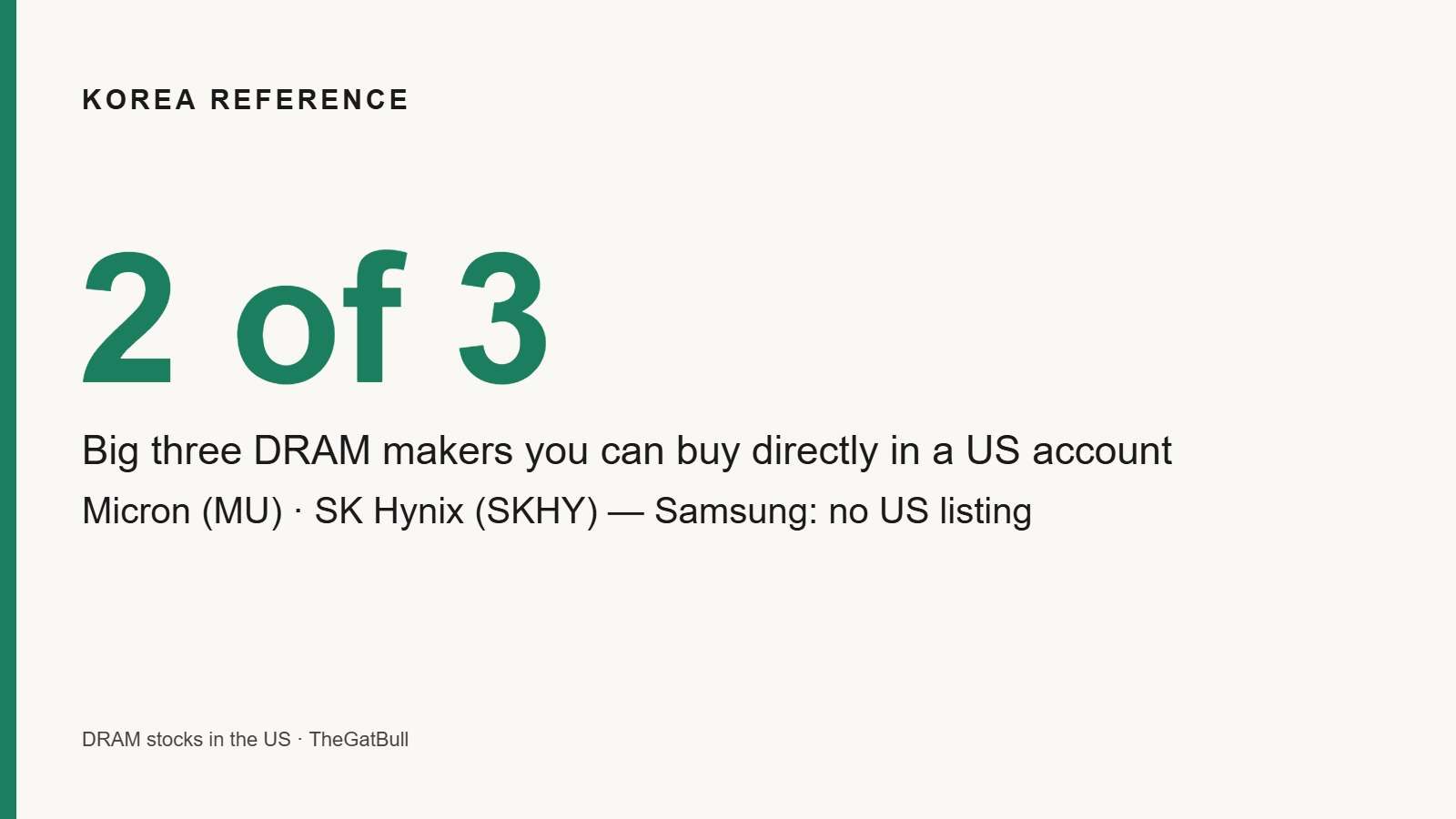
Short answer. Three companies make about 88% of global DRAM revenue. From an ordinary US brokerage account you can buy two of them directly: Micron (Nasdaq: MU) and SK Hynix (Nasdaq: SKHY). The biggest one by DRAM revenue, Samsung Electronics, has no US listing, and the company says it is not reviewing one.
TL;DR — If you hold EWY. You already own Samsung (about 22.77%) and SK Hynix (about 22.05%) indirectly (iShares, as of September 28, 2026). Micron is not in EWY.
Basis: this is a reference page, not a market update. It uses no share prices. Market-share figures are TrendForce estimates for Q2 2026; ETF weights are from the fund issuers as of the dates shown.
Can you buy DRAM stocks in a US brokerage account?
Two of the big three, yes. The largest by DRAM revenue, not directly.
DRAM is the main working-memory chip in phones, PCs and AI servers, and it is, in practice, a three-company industry. Market research firm TrendForce estimates that in the second quarter of 2026, Samsung Electronics took 39.4% of global DRAM revenue, SK Hynix 24.9% and Micron 23.3%, or 87.6% combined. These are analyst estimates, not company disclosures.
| Company | Headquarters | Q2 2026 DRAM revenue share (TrendForce est.) | Direct route in a US account |
|---|---|---|---|
| Micron | US | 23.3% | Nasdaq common stock, MU. An ordinary US stock. |
| SK Hynix | Korea | 24.9% | Nasdaq ADR, SKHY, since July 2026. The Seoul shares (000660) are a separate line. |
| Samsung Electronics | Korea | 39.4% | None. No US exchange listing; the company has said it is not reviewing an ADR. Workarounds only. |
This table answers one question only: is there a direct route from a US account? It says nothing about which stock will do better.
1. Micron: when it is the answer, and when it is not
Many people who search “DRAM stock” are probably US investors looking for Micron. So let’s deal with Micron first.
| Micron is your answer if… | Micron is not your answer if… |
|---|---|
| You want DRAM-cycle exposure through a US company, in dollars, during US market hours | You want to own a Korean company such as Samsung or SK Hynix |
| You want to read the business through US filings (10-K, 10-Q) | Your goal is exposure to the Korean market. Micron is not a Korean stock |
| You want to skip currency conversion, Seoul trading hours and Korean market rules | You want the world’s largest DRAM maker. By Q2 2026 revenue share, that is Samsung |
Micron is the easiest of the three to reach, and it is the only one of the three that is a US stock. We looked at how Micron and the two Korean makers sit in different markets despite making the same product in Micron vs. Korea’s memory lead.
2. SK Hynix: a door that opened recently
SK Hynix began trading on Nasdaq as an American depositary receipt on July 10, 2026, and has traded under the ticker SKHY since July 13 (as reported by Quartz and Morningstar). Before that, the routes were an ETF such as EWY or the Seoul shares.
We laid out the three routes for this one stock (the ADR, an ETF basket, the Seoul shares) in How to buy SK Hynix stock from the US, so we will not repeat them here. One point is worth keeping: an ADR is a depositary receipt, not the Seoul share itself.
3. Samsung Electronics: the one door that is closed
The largest of the three by DRAM revenue is not listed on any US exchange. On July 14, 2026, Samsung Electronics said it was not reviewing the possibility of issuing American depositary receipts, according to Reuters. That was a response to press reports that it had held early talks with banks. Earlier, in March 2026, a manager at Artisan Partners, which holds about 0.7% of Samsung, publicly raised the idea of a Samsung ADR listing in a Bloomberg interview (as reported by SamMobile).
Samsung also has global depositary receipts (GDRs) listed in London, but its own investor-relations page says US residents are prohibited from trading them under Rule 144A, a US securities rule. It tells foreign investors they can buy the Korea Exchange shares directly or through a local securities firm that trades Korean stocks (checked September 30, 2026). From a US account, that leaves four routes:
| Route | What you actually buy | The catch |
|---|---|---|
| 1. Seoul shares directly (KRX: 005930) | Samsung common stock itself, in won, on Seoul hours | You need a broker with Korea Exchange access. Terms and fees vary. Interactive Brokers announced direct KRX access on May 7, 2026; check whether it is open to your account. |
| 2. US over-the-counter (SSNLF) | A Samsung line quoted off-exchange in the US, not on the NYSE or Nasdaq | OTC securities can have wide bid-ask spreads; limit orders are the usual precaution. |
| 3. A Korea ETF such as EWY | A basket of Korean stocks that includes Samsung | You are not buying Samsung alone. Samsung was 22.77% of EWY as of September 28, 2026 (iShares). |
| 4. The DRAM ETF (Roundhill Memory ETF) | A 22-name memory basket built around the big three | Samsung was 25.13%, next to Micron at 26.47% and SK Hynix at 22.35%, as of September 29, 2026, counting stock and swap positions (Roundhill). |
The London GDRs are left out of this table because they are not available to US residents.
4. The ETF routes buy you a basket, not Samsung alone
EWY and DRAM both hold Samsung and SK Hynix and trade during US hours. The Korean stocks inside them trade only in Seoul. So during New York hours, the Korean part of either ETF’s price is in effect the market’s estimate of where those Seoul shares will open next. How the two funds are built differently is covered in the DRAM ETF vs. EWY. Why Samsung and SK Hynix are not the same trade is in Samsung vs. SK Hynix.
5. What this tells you about the Korean market
This is the fact about the Korean market you only see by looking at this industry: three companies make the same product, and they reach a US account through three different doors. Micron is a US company listed on Nasdaq. SK Hynix opened its door this summer. Samsung has kept its door shut.
Whether that access gap affects how Korean stocks are valued is not something this page can settle. What it can say is narrower: from a US account, the routes to Samsung that we found are an ETF basket (EWY or the DRAM ETF), the Seoul shares, or the OTC line.
Not a perfect parallel. The obvious US-side comparison is TSMC, whose ADR trades in New York. But TSMC has had its ADR for a long time, Samsung says it is not reviewing one, and foundry and memory are different businesses. The one thing they share is that the listing structure decides how a US investor gets in.
If you hold EWY. You already own Samsung (about 22.77%) and SK Hynix (about 22.05%) indirectly (iShares, as of September 28, 2026). EWY does not hold Micron. If you want more Samsung on its own, the routes are the Seoul shares or the OTC line.
6. What would change this page
This is a reference page, and the table above changes if any of these happen: (1) Samsung formally announces an ADR or other US listing; (2) Samsung changes its IR guidance for US residents; (3) a new memory ETF launches. We will update the table if one of them does.

Under the Gat. If Micron is your answer, keep in mind it is a US stock, not a Korean one. If Samsung is your answer, the honest reply is that there is no single easy way in today. I am not telling you which to buy. I am telling you that behind the same kind of chip there are three different doors, and it helps to know which one you are walking through.
The conclusion
- About 88% of global DRAM revenue comes from three companies: Samsung, SK Hynix and Micron (TrendForce estimate, Q2 2026).
- Two of them trade directly on Nasdaq: MU and SKHY.
- Samsung, the largest by DRAM revenue, has no US listing and says it is not reviewing an ADR.
- The routes to Samsung from a US account are the Seoul shares, the OTC line, EWY, or the DRAM ETF, and each comes with a catch.
FAQ
Is Micron a Korean stock?
No. Micron Technology is headquartered in Boise, Idaho, and trades on Nasdaq under the ticker MU. It is the only one of the big three DRAM makers that is a US company.
Can I buy Samsung stock on the NYSE or Nasdaq?
No. Samsung Electronics shares are not listed on a US exchange. On July 14, 2026, the company said it was not reviewing the possibility of issuing American depositary receipts, according to Reuters.
Is there a DRAM ETF?
Yes. The Roundhill Memory ETF, ticker DRAM, launched on April 2, 2026. As of September 29, 2026, its three largest positions were Micron (26.47%), Samsung Electronics (25.13%) and SK Hynix (22.35%), counting both stock and swap positions.
Is the SK Hynix ADR the same as the Seoul shares?
It represents the same company, but it is not the same instrument. SKHY is a depositary receipt that trades on Nasdaq in dollars during US hours; the ordinary shares (000660) trade on the Korea Exchange in won.
Sources
DRAM market share: TrendForce press release, September 7, 2026 · Samsung ADR statement: Reuters, July 14, 2026, as carried by Asharq Al-Awsat and SamMobile · Artisan Partners interview: SamMobile, citing Bloomberg · Samsung IR: How to Buy Stock · SK Hynix ADR debut and ticker: Quartz · Morningstar · DRAM ETF holdings: Roundhill, as of September 29, 2026 · EWY holdings: iShares, as of September 28, 2026 · IBKR KRX access: Interactive Brokers press release, May 7, 2026
Confidence
| Item | Strength |
|---|---|
| DRAM revenue shares (39.4 / 24.9 / 23.3%) | [primary] — TrendForce release; these are analyst estimates, not company filings |
| Samsung “not reviewing” an ADR, July 14 | [reported] — Reuters via other outlets; Samsung’s own statement not seen |
| Artisan Partners raising a Samsung ADR | [reported] — Bloomberg interview via SamMobile |
| Samsung IR guidance (GDRs barred for US residents) | [primary] — samsung.com, checked Sept 30, 2026 |
| SKHY debut date and ticker | [reported] — Quartz, Morningstar |
| DRAM ETF and EWY weights | [primary] — Roundhill (Sept 29) and iShares (Sept 28) holdings |
| IBKR KRX access for US-resident accounts · SSNLF OTC tier | not confirmed |
This article is for informational purposes only and is not investment advice. Figures are as of the dates shown. Do your own research.
 Written by Mr.Gat — TheGatBull
Korean market coverage from a Seoul-metro-based operator who reads the filings in the original language. Every price on this site is the KRX regular-session close (15:30 Seoul); every figure states whether it came from a primary filing, the press, or our own calculation. Drafts are AI-assisted, then verified against the original Korean documents and edited by a human before publishing.
Found an error? Tell us — corrections get priority. How we work →