Not financial advice. TheGatBull does not provide investment advice.
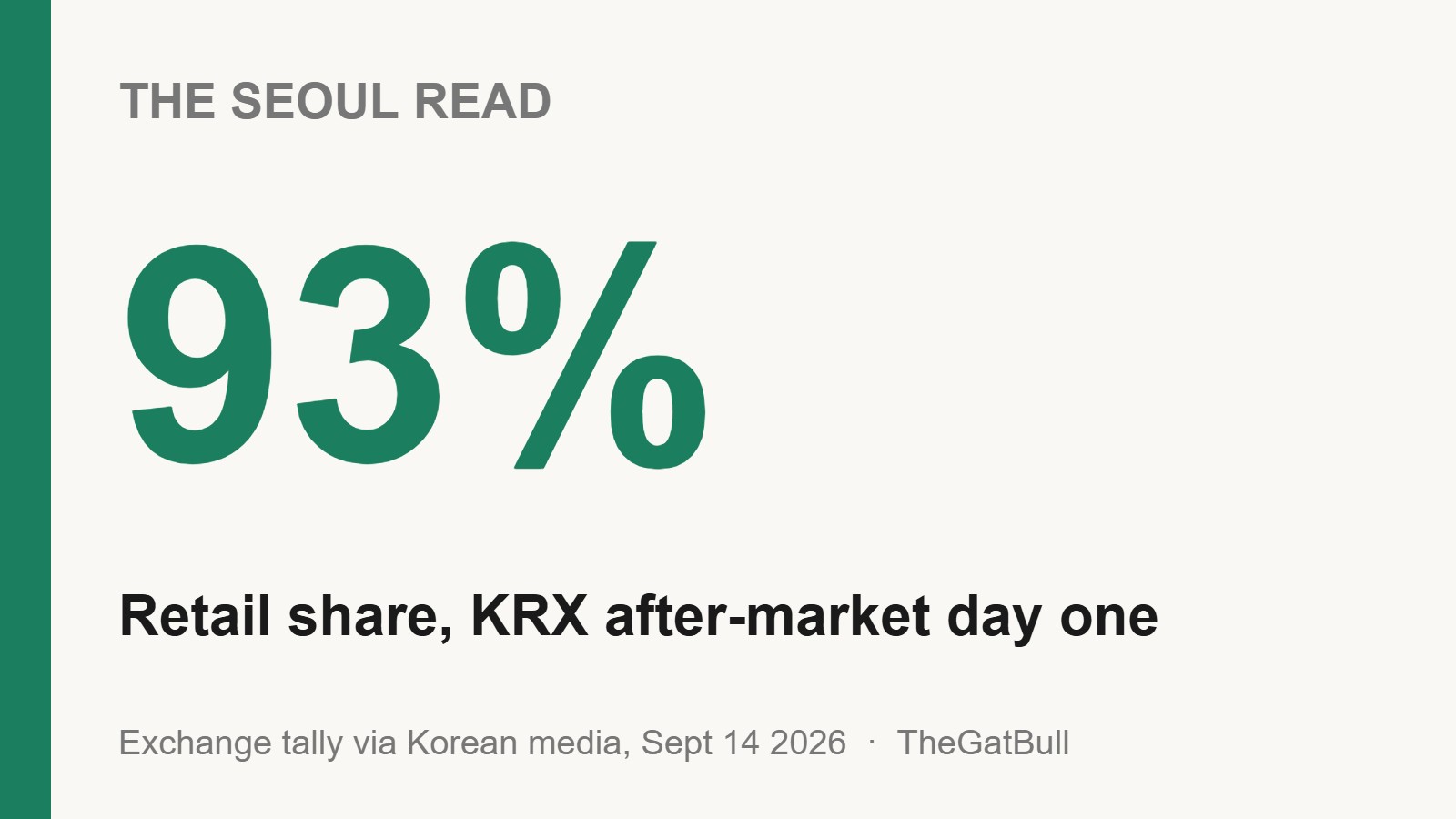
Korea’s first four-hour after-market drew ₩1.8177 trillion on day one. Nine of every ten won came from individual investors — and the session shut two and a half hours before New York opened.
The short answer
On Monday, September 14, the Korea Exchange opened its first after-market: 4 PM to 8 PM Korean time, right after the regular session. Day one moved ₩1.8177 trillion (about $1.34bn — all conversions in this piece use the September 15 Seoul close of ₩1,359.4) on the KRX — 7.04% of that day’s regular-session turnover (some outlets said 6.6% — same number, wider denominator; see Sources) — while Nextrade (NXT) — Korea’s alternative trading venue, the country’s second stock exchange — ran a nearly identical ₩1.7896 trillion in the same four hours.
The demand was real.
But the session closes at 8 PM in Seoul — which is 7 AM in New York, two and a half hours before the NYSE opens. Korea made its trading day four hours longer. Not one of those hours overlaps with the US.
Monday showed exactly what that means. Seoul closed at 3:30, the night session closed at 8 — and then New York opened and moved EWY through a full session. Tuesday morning, Seoul woke up to the result.
What this means for EWY holders
1. The longer trading day is a story for Korean domestic investors. Your trading window did not change: EWY trades on New York hours, same as before. 2. But Seoul’s prices now digest more of the day. Korean corporate news that lands after 4 PM local time gets traded in Korea the same evening — still before the US opens, but no longer waiting overnight.
1. Day one — what four extra hours bought
All official closes in this article are 3:30 PM KST regular-session prices on the KRX. After-market prints are quoted separately and are never used as closing prices. Won-to-dollar conversions use one basis: ₩1,359.4 (Seoul close, September 15).
First, what the session is for. Korea’s official close — the price that indexes, funds and disclosures key off — stays at 3:30 PM; the after-market is a separate four-hour window bolted on after it. We walked through the design five days before launch; this is the sequel — what actually happened on day one.
The exchange’s own case for it, as carried by Korean media: the after-market “allows domestic and overseas developments after the regular session closes to be reflected in stock prices in real time,” and “ETF investors also need to be able to respond when the underlying stocks move.” That is the design intent — shrink the hours during which Korean prices sit frozen while news accumulates.
Now the numbers. One label first: the statistics below are the exchange’s tally as reported by Korean media — we did not confirm them from a KRX primary document. They carry a different confidence grade than the closing prices we pulled directly.
| Day one, 4–8 PM KST | KRX after-market | NXT after-market |
|---|---|---|
| Turnover | ₩1.8177tn (~$1.34bn) | ₩1.7896tn (~$1.32bn) |
| Shares traded | 72.24m | 12.17m |
| Average price per share traded (our calculation) | ~₩25,162 (~$18.5) | ~₩147,050 (~$108) |
Two venues, the same four hours, nearly the same money — and KRX moved 5.9 times as many shares. NXT’s average traded share cost almost six times KRX’s. Same country, same evening, completely different stock.
The KRX side splits into two stories at once:
- By value, the night belonged to the two chipmakers. Samsung Electronics (₩296.0bn) and SK Hynix (₩431.9bn) together took ₩728.0bn — about 55% of the KOSPI-market after-market turnover (₩1.3252tn).
- By share count, it belonged to cheap stocks. The most-traded name was not Samsung — it was Kwangjeonja, a low-priced small cap, at ~29.0m shares against Samsung’s ~17.8m, with more small names behind it.
And who was trading: individuals took 93.0% of the turnover (foreigners 3.9%, institutions 2.1%), and roughly 73% of orders came through mobile apps. Within the session, individuals were net buyers of about ₩53.7bn; foreigners net sellers of about ₩48bn.
That is the lens. When Korea added four trading hours, the people who filled them were not institutions or foreigners. It was retail, after dinner, on their phones — concentrating their money in the two chip giants while churning the share count in low-priced, small-cap names.
One more pair of facts, both press-reported, that point in opposite directions: on average, prices actually swung less than in the regular session (KOSPI names: 2.9% vs 4.1%). And yet volatility interruptions — the per-stock automatic trading pauses Korea calls VIs — triggered about 1,637 times in four hours, versus roughly 400 in the full regular session, with single names like Hanwha Galleria swinging 19%. Thin books stay quiet on average and snap violently in single stocks.
2. Tuesday in Seoul — a fourth straight down day
| Instrument | Sept 14 close | Sept 15 close | Day |
|---|---|---|---|
| KOSPI (main-board index) | 6,684.37 | 6,627.26 | −0.85% |
| KOSDAQ (the smaller growth board) | 806.79 | 812.41 | +0.70% |
| Samsung Electronics | ₩249,000 | ₩248,500 (~$183) | −0.20% |
| SK Hynix | ₩1,697,000 | ₩1,690,000 (~$1,243) | −0.41% |
The KOSPI has now fallen four sessions in a row (September 10, 11, 14, 15) — we re-verified the chain against the closes ourselves. Tuesday’s intraday low reached 6,582.20 before the 6,627.26 close; the low is an intraday print, not an official number. And the KOSDAQ rose while the KOSPI fell — the two boards split again, only this time the smaller one won.
Korean market reports attributed the pressure to the US 10-year Treasury yield touching 5% intraday — the first time since October 2023, an intraday print, not a settle — and to oil holding above $100 a barrel. That attribution is theirs, not ours — we did not confirm the cause independently.
The flow split, per Korean reporting on the main board: foreigners sold a net ₩1.5711tn (~$1.16bn), institutions ₩904.4bn, and individuals bought a net ₩832.4bn. The same retail crowd that owned 93% of Monday’s night session was the buy side of Tuesday’s sell-off. (KOSDAQ flow data we did not obtain, so we are not naming Tuesday’s KOSDAQ buyer.)
3. The policy coordinate — the Fed lands Thursday at dawn
The calendar this week is simple: the FOMC meets September 15–16 US time, and the decision lands Wednesday 2 PM ET — 3 AM Thursday in Seoul. When the KRX opens Thursday at 9 AM, New York is closed. Seoul trades the Fed’s decision before the US does — the same window mechanics as last week’s scoreboard.
Markets are pricing a 0.25-point hike per CME FedWatch — a tally of market expectations, not a Fed statement. One guardrail for reading Thursday: the Bank of Korea already hiked to 3.00% on August 28, ahead of the Fed, and a deputy governor said on September 10 that Korea does not mechanically follow it — we covered that in last Saturday’s piece. Do not pair the two central banks one-to-one.
4. The windows still don’t line up — Seoul → New York → Seoul
Now EWY. How we handle these numbers matters more than the numbers.
| US trading day | EWY close | Day | Volume |
|---|---|---|---|
| Sept 11 (Fri) | $188.72 | +3.25% | 11.8m |
| Sept 14 (Mon) | $176.22 | −6.62% | 24.4m |
Over the same stretch, the KOSPI in dollar terms — index divided by each day’s 3:30 PM Seoul exchange rate, a theoretical value with no fees, tracking error or cash drag — moved:
| Seoul sessions | In won | In dollars |
|---|---|---|
| Sept 11 → 14 | −3.26% | −3.36% |
| Sept 14 → 15 | −0.85% | −1.74% |
| Sept 11 → 15 | −4.09% | −5.04% |
(The won weakened 12.1 to 1,359.4 on Tuesday, which is why the dollar loss runs ahead of the won loss. “Theoretical” means exactly that — a clean index-over-FX division, not something you could have owned.)
⚠️ Here is the sentence you should not write: “EWY fell 6.6% while Seoul fell 3.4% — it dropped twice as hard.” EWY’s US Monday session opens at 9:30 AM ET — after Seoul’s 3:30 PM close, and after the new night session closed too. The two “Mondays” share neither a start nor an end. That is not tracking error; it is a window-definition problem we have covered before.
What we can compute is the basket. EWY is not the KOSPI: its top two holdings are 46.12% of the fund — SK Hynix 24.16%, Samsung Electronics 21.96% (iShares disclosure, as of September 11). Weight just those two, in won, on Seoul sessions:
| Seoul session | EWY top-two weighted (46.12%) | KOSPI |
|---|---|---|
| Sept 11 → 14 | −5.25% | −3.26% |
| Sept 14 → 15 | −0.31% | −0.85% |
The sign flips. On Monday, EWY’s biggest half fell harder than the index; on Tuesday it fell less. What dragged the KOSPI on Tuesday was everything outside the two chip names. (This uses only the top two holdings — the other 53.88% of the fund is not in this calculation. It shows where part of the gap comes from; it does not reconstruct EWY.)
Monday’s sequence, in order: Seoul closes −3.26% → the night session runs and closes → New York marks EWY down 6.62% → Tuesday’s Seoul opens holding the result and closes −0.85%. The new night session did not break a single link in that chain — it ends before New York begins.
5. One small detail worth filing away
In Monday’s night session, Samsung Electronics finished at ₩248,500 — 0.20% under its regular close. On Tuesday, the regular session closed Samsung at… ₩248,500. The same price.
Read that as an observation, not a finding — one stock, one day, quite possibly coincidence. But it is the thing to keep watching as this market matures: does the 8 PM print start carrying information about the next day’s 3:30? An observation, not a confirmed finding.
6. An anchor for US readers — same timetable, opposite asymmetry
US investors know after-hours trading: the session ends at 4 PM ET, extended trading runs to 8, and earnings dropped at 4:05 get digested the same evening. Korea’s after-market has the same shape — 30 minutes after the close, four hours long.
Not a perfect parallel. America’s after-hours sits after its own news and after the world’s biggest market has spoken. Korea’s after-market catches Korean evening news — but it cannot catch American news, because America hasn’t happened yet. The timetable is a copy; the asymmetry runs the other way.
7. How to get exposure
Nothing changed for US-based access. EWY (NYSE Arca) remains the broad door, with 46% of it riding on two chipmakers. SK Hynix has its own Nasdaq-listed shares, SKHY. Samsung has no US listing. None of these trade in Korea’s new night session — the after-market is a market for Korean accounts.

The takeaway
Day one was a real event: ₩1.8177tn traded, 93% retail, 73% on phones — and by value, over half of it in Samsung and SK Hynix alone.
Is the after-market a success? Too early to call — and we mean that as a verdict, not a dodge. One session decides nothing; the evidence above cuts both ways. What would change our read: whether turnover holds after the novelty fades, and whether institutions ever show up — we will run the first-month numbers in mid-October.
🎩 Under the Gat — The exchange gave Korea more hours, not a smaller time difference. When Korea’s day ends at 8 PM, New York’s day has not started. Monday proved it in order: Seoul closed, the night session closed, then EWY moved. Thursday’s pre-dawn Fed decision arrives by the same clock.
A longer day and a smaller time difference are different things. If you hold EWY, the thing to watch this week is not Korea’s night session; it is how Seoul reads the Fed first, on Thursday morning.
FAQ
Can US investors trade Korean stocks at night now?
No. The after-market is an extension of Korea’s domestic exchange hours, reached through Korean brokerage accounts. In US terms it runs roughly 3 AM to 7 AM ET.
Did Korea’s official closing price change?
No. The official close — the basis for indexes, fund net asset values and disclosures — is still the 3:30 PM KST regular-session close. After-market prices are quoted separately.
Who won day one, KRX or NXT?
By money, a near tie (₩1.8177tn vs ₩1.7896tn). By shares, KRX traded 5.9 times more — meaning the two venues traded very different kinds of stock: KRX skewed to low-priced names by count, while over half of KRX’s main-board value sat in Samsung and SK Hynix.
EWY fell 6.6% Monday — does that mean Korea fell 6.6%?
No. Two things are mixed in that number. EWY’s US session opens after Seoul closes, so the two “Mondays” are different windows. And EWY is 46% two stocks — which fell harder than the index in Seoul on Monday (weighted −5.25% vs the index’s −3.26%, in won).
When does the Fed decision hit Korean stocks?
The decision lands Wednesday afternoon US time — around 3 AM Thursday in Seoul. The KRX opens at 9 AM Thursday and trades it before New York does.
Sources
- Regular-session closes and volumes (^KS11, ^KQ11, 005930.KS, 000660.KS and others): market data queried directly, 3:30 PM KST September 15 — KRW · KSC/KOE · Asia/Seoul vendor tags; each day’s move re-verified against the prior close, and the four-day losing streak against the full sequence of closes.
- EWY closes and volume: market data queried directly, US trading days.
- EWY holdings weights: iShares product-page disclosure, as of September 11, 2026.
- USD/KRW 3:30 PM Seoul closes (Sept 11 / 14 / 15 = 1,345.9 / 1,347.3 / 1,359.4): Korean press, multiple outlets, verified by three-day day-change chain arithmetic.
- After-market share of turnover: 7.04% divides after-market value by regular-session value (both KRX). Outlets reporting 6.58% divided by the day’s combined total (regular + after-market). Both are correct; the denominators differ.
- After-market day-one statistics — turnover, share counts, retail 93.0% (cross-checked across Herald Business, Money Today, Hankook Ilbo, Korea Times, JoongAng Daily and others), Samsung/SK Hynix value share (~55% of main-board after-market turnover), volatility-interruption count (~1,637 vs ~400 in the regular session), mobile-order share (~73%), within-session flows: the exchange’s tally as reported by Korean media. Not confirmed from a KRX primary document.
- KRX design-intent statements: exchange remarks as quoted in Korean and English press coverage of the launch.
- Tuesday flows (foreigners −₩1.5711tn, institutions −₩904.4bn, individuals +₩832.4bn, main board): Korean press. KOSDAQ flows not obtained.
- US 10-year at 5% (intraday) and oil above $100: Korean press attribution; the yield is an intraday print, and oil prices differed across outlets so no exact figure is printed.
- FX conversions: single basis ₩1,359.4 (Seoul 3:30 PM, September 15), including prior-day won amounts.
Not financial advice. This article is for information only. TheGatBull and its author hold no position in the securities mentioned unless disclosed. Confidence labels are as of publication.