Not financial advice. TheGatBull does not provide investment advice.
The short answer
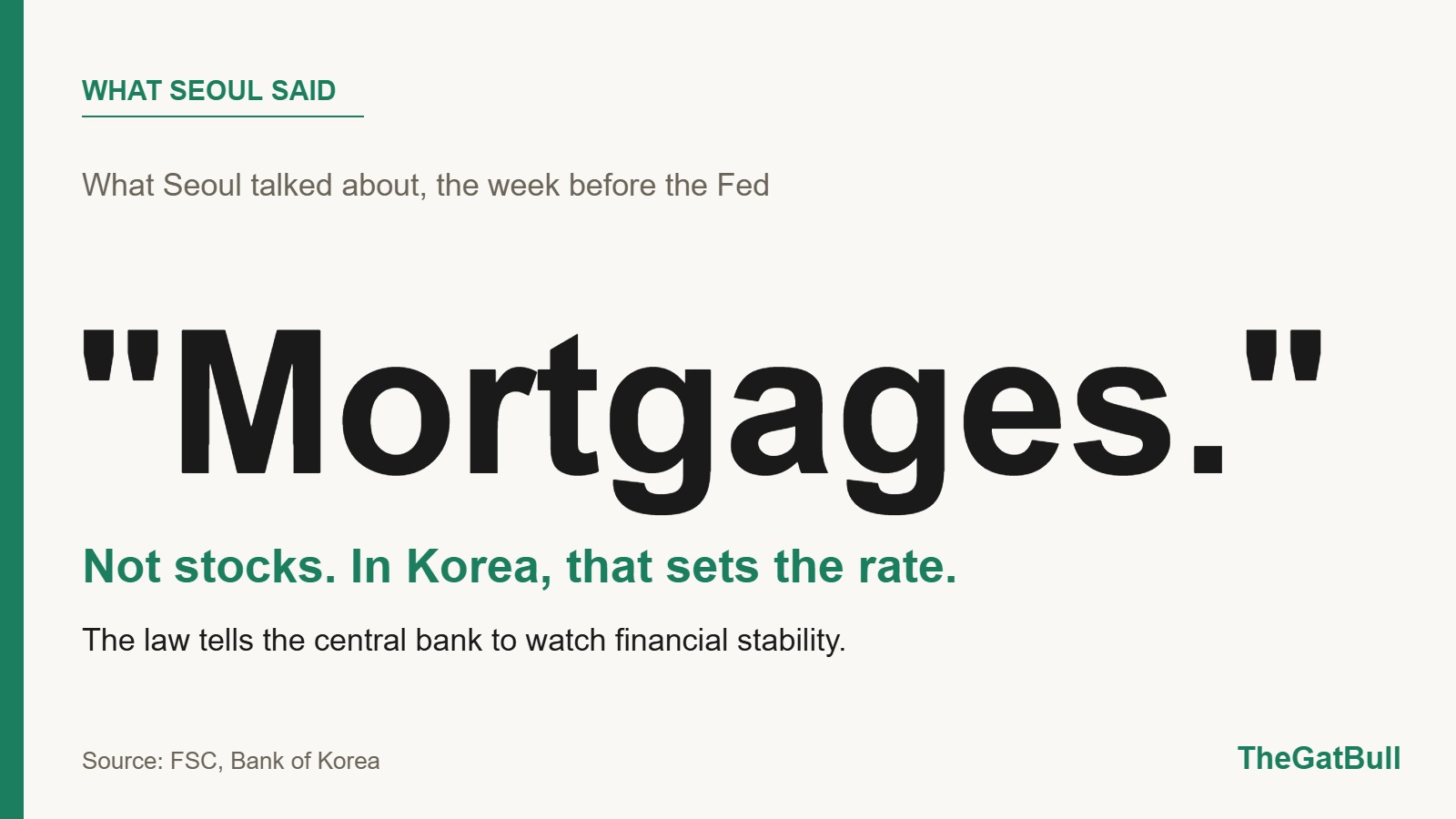
Among the policy remarks out of Seoul this week (September 7–11), there was — as far as we could confirm — no new comment about the stock market. Instead, three separate releases pointed at the same place: household debt.
The Bank of Korea published its September Monetary Policy Report and, in the briefing, called the October rate meeting a “live meeting.” The same day, the Bank issued a separate household-debt risk report tracking 2.06 million households. The day before, the Financial Services Commission (FSC) convened a household-debt review meeting with the relevant agencies.
To a US investor holding Korean stocks, these three feel further away than a semiconductor headline. Yet this is what sets Korea’s next interest rate.
What this means for EWY holders
1. Korea’s policy rate is now 3.00%, and whether the next hike comes rides more on the pace of mortgage lending than on inflation. 2. The Bank of Korea again put in writing — this time in an official publication — that it does not mechanically follow the US Fed. Next week’s FOMC result will not, on its own, set Seoul’s October decision.
1. What the Bank of Korea said — “October is a live meeting”
The Bank of Korea released its September 2026 Monetary Policy Report this week. It framed the last two hikes (July, 2.50%→2.75%; August 27, 2.75%→3.00%) as pre-emptive back-to-back moves against inflation and growth running hotter than expected — on Middle East tension and a strong semiconductor cycle — with financial-stability risk still present.
At the September 10 briefing, Deputy Governor Park Jong-woo spoke to the following effect. These are on-the-record remarks made under name and title, reported the same way by multiple Korean outlets (confirmed on the record).
| Remark | Confidence | Market read |
|---|---|---|
| October’s meeting is a “live meeting” — decided on all data up to the last moment | ✅ on the record | No October hike is pre-booked |
| “Hard to call an October hike” — the effect of two pre-emptive hikes on vulnerable sectors has to be checked first | ✅ on the record | Tones down the three-in-a-row expectation |
| Does not mechanically follow the US Fed; domestic conditions come first | ✅ on the record | FOMC result does not auto-map to the MPC result |
| Current rate assessed as the upper edge of neutral — signaling a slower pace | ✅ on the record | Less room to keep hiking mechanically |
| Watching the chance Middle East tension adds cost pressure | ✅ on the record | Oil is the upside risk to Korean inflation |
The third line is not new. The BOK Governor said much the same at Jackson Hole in late August, and we covered it in last week’s edition of this column. What changed this week is that the stance moved from the Governor’s spoken remarks into the Bank’s regular publication. Words can shift; a report is on the record.
2. Two household-debt releases in the same week
(a) September 9 — the FSC household-debt review meeting. The FSC, chaired by Secretary General Shin Jin-chang, gathered the finance and land ministries, the Bank of Korea, the financial regulator, the banking federation, the second-tier lenders’ associations, and the five major banks. The August figures came in like this (preliminary):
| Item | July 2026 | August 2026 |
|---|---|---|
| Household loans, all lenders (net change) | +₩6.4tn (≈$4.76bn) | +₩2.6tn (≈$1.93bn) |
| — Mortgage loans | +₩3.6tn (≈$2.67bn) | +₩4.3tn (≈$3.19bn) |
| — Other loans (credit, etc.) | +₩2.8tn (≈$2.08bn) | −₩1.7tn (≈−$1.26bn) |
Dollar conversions use the Seoul 3:30 PM close of ₩1,345.9/$ on Sept 11, a single basis.
The total halved, but mortgages actually grew. The FSC put the mortgage rise down to housing transactions pulled forward before a capital-gains-tax surcharge break expires, and to expanded settlement loans (jan-geum daechul — the final chunk of a mortgage a buyer draws when moving into a newly built apartment) as July–August move-in volumes rose. So the drop in the total came from credit loans; the money that goes into buying homes did not shrink. The FSC also held a housing-supply financing meeting the same day. Putting the two on one day is itself the message — manage demand, expand supply-side financing.
(b) September 10 — the BOK issue note, “Household-debt risk assessment using a household database.” The Bank recomputed household debt by household rather than by individual, building a monthly panel that tracks the debt, assets, income, and spending of 2.06 million households.
- Average metrics (debt-service ratio DSR, loan-to-value LTV) improved.
- But the delinquency rate has been rising again since its 2021 low.
- When the head of a household is delinquent, the rate at which other members are too — the conditional delinquency rate — is 11.1%, about ten times the 1.1% average across all households.
- Households that borrowed heavily to buy a home were found most exposed to a rate shock.
Why that last line matters: it means the central bank published a document counting, household by household, where a further rate hike breaks something first — one month before the rate decision.
3. What was not said
An A6 column records absences too — but it does not assert “the authorities were silent.” It means we found nothing in the channels we checked.
- FSC / financial regulator: new comment on the stock market — none within what we checked
- US Treasury: official document on Korea — none within what we checked
- Japan’s MOF / Bank of Japan: new comment on the won or yen — none within what we checked
- The presidential office: new market directive — none within what we checked
And that is despite the KOSPI closing down 1.76% (6,909.91) last Friday. In the July crash, the presidential office and financial authorities came out within days. This week did not rise to that level — the safer read.
4. Tariffs and the US-investment package — the week’s one external thread
The trade and industry minister said US semiconductor tariffs are “being discussed on terms not disadvantageous versus competitors” and that Korea would finalize its first US-investment project within September (confirmed on the record). A specific project has been floated in the Korean press, but the government has not confirmed one (press-reported, not confirmed from a primary source). Follow-up on the Section 301 tariff case and a 15% tariff ceiling was the common thread in Korean coverage this week. The tariff rate and effective date are not yet confirmed — this column does not print an unconfirmed rate as a number.
5. What it means for the Korean market
This is the reason to write the piece.
A US reader knows the Fed has two goals: its dual mandate — maximum employment and price stability. The Fed watches financial stability too, but it is not a statutory objective. The Fed sees it in reports.
Korea’s central-bank law is different. Article 1(1) sets price stability as the purpose, and then 1(2) is written separately:
“The Bank of Korea shall pay attention to financial stability in carrying out its monetary and credit policy.”
One sentence — but it changes the agenda of Seoul’s rate meeting. Because financial stability sits in the statute, home prices and household debt become formal inputs to monetary policy. This week was exactly that structure running: the BOK issued a household-level debt-vulnerability report the same day as its rate report, and the FSC had reviewed total lending the day before.
So three institutions are pressing the same variable with different tools:
- If the FSC curbs home prices with lending rules → the BOK can hike less.
- If the FSC’s rules do not bite → the rate does that job instead.
For someone holding a Korea ETF, that fork is not abstract. The rate is a discount rate, and the discount rate feeds straight into the valuation of the Samsung Electronics and SK Hynix you own through the fund. And one of the variables setting that rate is the settlement-loan statistics on Seoul apartments.
🎩 Under the Gat — A US reader went looking for chips in this week’s Korea news. Seoul’s policymakers were talking about apartment closing loans. The two are on the same screen — because one sets the other’s discount rate.
Not a perfect parallel — the Fed watches financial stability too, more so since 2008. The difference is location: for the Fed it is the realm of supervision and reports; for the Bank of Korea it is an item the law tells it to mind when setting the rate. The same concern written in a different document produces a different decision.
6. What to watch next week
- FOMC (September 15–16, US Eastern) — we do not predict the result. Watch what comes after: does Seoul follow, or prioritize domestic conditions as it wrote down this week? (Do not pair the US result and Korea’s MPC decision one-to-one by date — the two markets run different closing times and meeting calendars.)
- October Monetary Policy Committee — confirm the exact date on the BOK schedule. This week’s briefing labeled that meeting “live.”
- September household-lending data (early October) — whether mortgages grow beyond August’s +₩4.3tn. If they do, the pressure tilts toward the rate.
- The first US-investment project — the government said it would finalize within September.
How it reaches Korean stocks
- EWY (NYSE Arca) — broad Korean large-caps; the rate path enters as the whole index’s discount rate.
- KB (NYSE) — where lending rules land directly. Tighter rules cap loan growth and leave capital behind. How to watch KB to see if value-up works.
- SKHY (Nasdaq) — SK Hynix’s ADR. The memory cycle leads the rate here, but the denominator of the valuation is shared.

The takeaway
This week Seoul did not talk about stocks. It talked about mortgages. In Korea, that is the same conversation — because the law tells the central bank to watch financial stability. Whatever the Fed does next week, Seoul’s October decision rides more on how many people took out settlement loans in August than on anything out of Washington.
FAQ
Does this mean the Bank of Korea won’t follow the Fed?
In this week’s Monetary Policy Report briefing the BOK said it does not mechanically follow the Fed and that domestic conditions come first (on the record). That is not “ignore” — it means the US decision does not automatically set Seoul’s.
What is Korea’s policy rate right now?
3.00%. It was raised twice in a row: July (2.50%→2.75%) and August 27 (2.75%→3.00%).
Will they hike again in October?
The BOK called October a “live meeting” and said it is hard to call a hike. No hike is pre-booked.
Why should a US investor watch Korean mortgages?
Because Article 1(2) of the Bank of Korea Act directs it to mind financial stability when setting policy, household debt and home prices become formal inputs to the rate — and the rate is the discount rate on the Korean stocks you hold.
How did Korean stocks do this week?
On Friday, September 11, the KOSPI closed at 6,909.91, down 1.76% (KRX regular-session close). The won ended at ₩1,345.9 per dollar, up 6.7 (Seoul 3:30 PM close).
Sources
- Bank of Korea, Monetary Policy Report (September 2026) and its Sept 10 briefing (Deputy Governor Park Jong-woo) — cross-reported by multiple Korean outlets (Etoday and others)
- Bank of Korea, BOK Issue Note “Household-debt risk assessment using a household database” (2026-09-10)
- Financial Services Commission, joint household-debt review meeting and August household-lending trends, preliminary (2026-09-09, Secretary General Shin Jin-chang) — Herald / Digital Times / others
- National Law Information Center, Bank of Korea Act, Article 1
- USD/KRW 2026-09-11 Seoul 3:30 PM close 1,345.9 (+6.7); KOSPI close 6,909.91 (−1.76%)
- Trade and industry minister remarks; first US-investment project (project floated in press, not confirmed)
- TheGatBull: WP612 (BOK hike to 3%), WP680 (won, prior A6), WP690 (KB Financial), WP371 (EWY concentration pillar)
Not financial advice. This article is for information only. TheGatBull and its author hold no position in the securities mentioned unless disclosed. Confidence labels are as of publication.