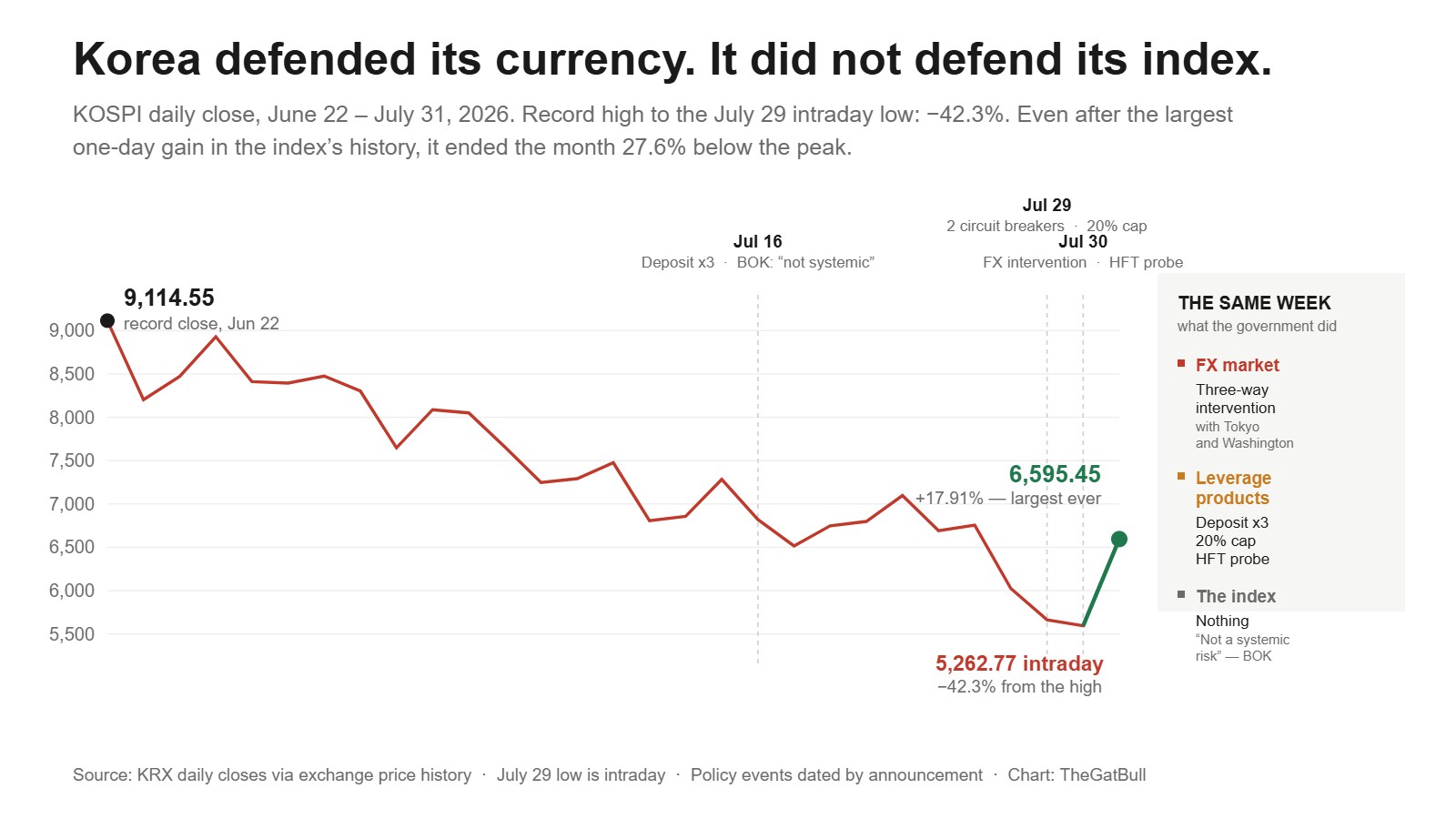
On Friday, July 31, 2026, the KOSPI closed up 17.91% at 6,595.45 — the largest one-day gain in the index’s history. English-language coverage mostly compressed it into one line: chip stocks rebounded.
Start with a different number. The KOSPI set a record closing high of 9,114.55 on June 22. On July 29 it traded as low as 5,262.77 intraday. That is a 42.3% drawdown in five weeks. Even after the biggest up day ever recorded, the July 31 close was still 27.6% below the June peak.
+17.91% was not a recovery. It was a partial retrace.
But the index is not the most interesting thing here. In the same week, the Korean government responded to three markets with three completely different levels of force.
| Market | What the government did |
|---|---|
| Foreign exchange | A three-way action with Tokyo and Washington — reported intervention; the coordination confirmed on the record |
| Equities · leveraged products | Deposit requirement tripled, 20% per-investor cap, new listings suspended, foreign HFT under investigation |
| Equities · the index itself | Nothing |
Korea defended its currency, tightened its derivatives, and left its index alone.
That ordering is the whole article. It is also the single thing American investors most often get wrong about this market — “the Korean government will step in and hold the market up.” It did not. What it held up was the won.
📦 First, if you hold EWY
① The amplifier behind this volatility was not the Korean economy or chip earnings. It was a single-stock leveraged ETF that listed on May 27, 2026 — and it is being regulated out of its current shape right now.
② The government’s intervention priority is the currency, not the share price. When the won moved, three countries moved together. While the index fell 42%, no state institution bought it.
(Won figures are converted at USD/KRW 1,424.0, the Seoul close at 3:30 p.m. on July 31, 2026. Index and share prices are KRX main-session closes throughout. This article is one person’s view, not advice.)
The first market — FX: a first-ever three-way action
Here is what happened on the night of July 30, Seoul time.
- USD/KRW fell from 1,437.40 at the 3:30 p.m. close to 1,419.00 by 10:44 p.m.
- In the same window, USD/JPY dropped from the 163 handle to the 157 handle
- Nikkei reported that the Japanese government and the Bank of Japan had intervened, buying yen and selling dollars
- Korean authorities were reported to have bought won and sold dollars at around the same time
- US monetary authorities ran a “rate check” — polling market participants on dealing levels
A rate check is the warning shot central banks fire before an actual intervention. Whether the US itself sold dollars has not been confirmed.
The next day, a Korean official effectively confirmed the coordination — on the record.
“Korea is in constant coordination with the United States and Japan, and the three countries exchange contact and understanding through hotlines and other channels.”
— Moon Ji-sung, Deputy Minister for International Affairs, Ministry of Economy and Finance
The groundwork had been laid for months. On June 12, Moon met senior US Treasury officials in Washington. On July 7, Japan’s top currency official, Vice Minister of Finance for International Affairs Atsushi Mimura, said at the opening of the Korea Investment Corporation’s Tokyo office that he was “in especially close contact with my Korean counterpart.”
USD/KRW had reached 1,555.80 on July 1. It came down more than 130 won in a month.
📐 A note on reading the won
Korea’s FX market runs extended hours, so a single day has two “last prints.” On July 31 the Seoul main-session close was 1,424.0 at 3:30 p.m.; overnight trading took it to 1,418.0. The “nine-month low” in Korean coverage refers to the overnight figure.
This site quotes the 3:30 p.m. main-session close. It is the same problem as KRX versus Korea’s alternative trading venue in equities — mix the bases and you get two “facts” for one day.
One clarification is owed. Intervention alone did not lift the won. Korean coverage lists four other drivers: won conversion of proceeds from SK Hynix’s US ADR listing; exporters selling dollars ahead of August’s interim corporate tax payment; foreign investors pausing portfolio rebalancing as the equity market fell; and a surprise second-quarter growth print plus July’s rate hike to 2.75%.
🎩 Under the Gat — Let me move the weight of this for an American reader. The US Treasury treated yen and won weakness as a shared problem. Washington lending a hand to soften dollar strength means Korea’s and Japan’s currency defence is no longer each country’s private business. That said — what is confirmed stops at the rate check. “The US intervened” is not a sentence anyone can write yet.
Yesterday I wrote that the won hit a five-month high while stocks fell for a third day. That piece explained the won’s strength through market factors alone — the intervention only surfaced the following morning. This is the follow-up.
The second market — equities: a product that listed on May 27
CXMT listed in Shanghai on July 27. On July 28 came a report that China had developed its own DUV lithography equipment. Korean chip stocks collapsed. That is where most English-language explanations stop.
There is a hole in it. Why did the same news print in double digits only in Korea? Chinese memory competition weighs on Taiwanese and American supply chains too. Yet the KOSPI fell 10.84% on July 28 and 5.98% on July 29, and on the 29th Korea triggered two circuit breakers on consecutive days for the first time in its history.
If the news was the same, what differed was not the news. It was the plumbing the news travelled through.
On May 27, 2026, Korea listed its first single-stock leveraged and inverse ETFs, tracking Samsung Electronics and SK Hynix. This will not be unfamiliar to American readers — TSLL and NVDL have existed in the US since 2022. Three things are different.
- Korea introduced them two months ago. Neither the market nor its investors had a learning period.
- The two underlying stocks are 51.22% of KOSPI market value. In the US a Tesla leveraged product is a bet on Tesla; in Korea, derivatives on these two names are effectively index derivatives.
- Korea has a ±30% daily price limit. An adjustment does not finish in one session — it rolls into the next.
Not a perfect parallel — the US put this product on a wide, shallow market; Korea put it on a narrow, deep one.
And it met a distinctly Korean pool of money. 빚투 (bit-tu) — coined from “debt” and “investing,” it means borrowing to buy stocks. A leveraged ETF produces the same effect without the loan. Which changed how forced liquidation was triggered, and how fast it spread once it was.
The regulatory record tells the story better than any narrative.
| Date | Event |
|---|---|
| May 27 | First single-stock leveraged and inverse ETFs list |
| Jun 12 | Trading halts grow frequent; leveraged ETFs begin to be named as the cause |
| Jun 22 | KOSPI record close, 9,114.55 |
| Jun 22–23 | The head of the Financial Supervisory Service publicly criticises the product |
| Jul 7 | Most of these ETFs fall below their ₩20,000 listing price |
| Jul 14 | Forced liquidation starts compounding the pressure |
| Jul 15 | The President personally directs regulators to act |
| Jul 16 a.m. | Bank of Korea raises rates to 2.75%. Governor: equities are “not a systemic risk” |
| Jul 16, same day | Deputy PM’s meeting triples the cash deposit requirement |
| Jul 21 | A major asset manager’s CEO publicly says: stop buying these |
| Jul 28 | KOSPI −10.84% |
| Jul 29 | Two circuit breakers, two days running — a first. Intraday low 5,262.77 → 20% per-investor cap |
| Jul 30 night | Three-way FX intervention / regulators open a foreign HFT investigation |
| Jul 31 | ₩30 million cash deposit rule takes effect → KOSPI +17.91%, a record |
🎩 Under the Gat — Read that table again. The Chinese memory news appears on July 27–28. Every one of the eight rows above it happened first. What the government spent five weeks working on was not semiconductors — it was leverage plumbing. The China story was a shock entering a pipe that was already under pressure. It did not build the pipe.
July 31 was the first day the deposit requirement stood at ₩30 million in cash. That day the SK Hynix leveraged ETF closed limit up at +59.93% and the same name’s 2x inverse closed limit down at −59.95%. The exact product the rule targeted hit both ceilings on the day the rule began. Calling that a failure is premature — a deposit requirement blocks new entry, not existing positions. What cleared that day was inventory already inside.
Leverage has broken this market before by another route. The stretch where margin-loan balances built the bottom is laid out here.
The third market — the index: nobody bought it
Search for what the government did about the index itself and you find nothing.
On July 29, the day two circuit breakers fired back to back, the message out of the Deputy Prime Minister’s emergency market meeting was “the fundamentals are sound.” Leveraged products were tightened. Nothing was announced to support the index.
And two weeks before that, the central bank had questioned whether there was a case for intervening at all.
Hyun Song Shin, Governor of the Bank of Korea, said this at the Monetary Policy Board press conference on July 16:
“Unlike debt, equities do not have many channels through which they connect to systemic risk.”
“Looking at other countries, even large equity corrections have limited effects on the financial account as a whole. During the Nasdaq bubble in 2000, prices rose sharply and then fell, and the impact on the financial system was limited.”
The same day, the Deputy Prime Minister’s meeting tripled the deposit requirement on leveraged products.
The name may be familiar to American readers. Before Seoul, Hyun Song Shin was Economic Adviser and Head of Research at the Bank for International Settlements, and before that a professor at Princeton. His work on financial intermediation and liquidity has been cited in English-language policy circles for two decades. His reaching for Nasdaq 2000 was not incidental — it is the language his audience already speaks.
🎩 Under the Gat — This may not be a contradiction. The Governor is looking at the financial system — are banks breaking? The Deputy Prime Minister is looking at retail investors. They are answering different questions. But the difference arrives in the market as a signal, and when “this is dangerous” and “this is fine” come out of the same government on the same day, an investor has to decide which one to price.
Judged on actions alone, the priority was not ambiguous. When the won was under pressure, three countries moved together. While the index fell 42%, nobody bought.
One day, five different markets
Five groups told five different stories about July 31.
① Foreign institutions — “the positioning cleared.” JPMorgan wrote in a Friday Korea strategy note that the leveraged-ETF unwind was complete and hedge fund de-leveraging roughly 90% done, leaving Korea’s positioning setup “attractive on balance.”
② Korean media — “foreigners came back.” Foreign investors net bought ₩7.22tn on the KRX main session. (Including Nextrade, Korea’s alternative venue, the figure was ₩8.77tn — the basis on which Korean outlets called it a record.)
③ The Donghak Ants — “this is a casino.” Retail investors net sold ₩8.25tn on the KRX main session that same day.
동학개미 (Donghak Ants) is what Koreans call the retail investors who absorbed foreign selling during the 2020 COVID crash. The name comes from the 1894 Donghak Peasant Revolution — ordinary people standing against a force from outside. For six years it has been this market’s self-image.
Those same Donghak Ants sold in record size on the best day the index has ever had. Forum posts ran “money-copying day” alongside “I can’t stay in the domestic market any more.” One poster called his brokerage app a “state-licensed mobile sports betting service.” The people who once absorbed foreign selling were, this time, selling to foreigners.
④ Financial regulators — “the product is the problem, and foreigners may have amplified it.” On July 30 authorities opened an investigation into whether foreign high-frequency trading amplified the volatility, after program trading roughly doubled following the ETFs’ listing.
⑤ The Bank of Korea — “not a systemic risk.” (above)
🎩 Under the Gat — Put ① and ④ side by side. The same foreign order flow JPMorgan calls “de-leveraging complete,” Korean regulators are investigating as possible amplification. Same trades, opposite readings. And both may be right — amplification and unwinding can be the front and back of one flow. What most American readers saw, though, was only ①.
The scoreboard for that single day — record retail selling, three stocks frozen at 30%, and what Korean investors were writing while they sold — is recorded separately here.
What this means from a US account
📦 ETF box — for EWY holders
US-listed EWY is subject to neither Korea’s price limits nor its deposit rules. But its holdings are a basket in which Samsung and SK Hynix are more than half, and those two are currently absorbing leveraged-liquidation pressure. EWY is also unhedged, so this week’s won strength added directly to the dollar return. What the government defended — the currency — worked in your favour. What it did not defend came through unfiltered.
The concentration problem is broken down in numbers here.
Five checkable items.
① Does the intervention repeat? A three-way action is unprecedented, and intervention only compounds when it recurs. Whether the same move appears in the same window in August is the first tell.
② Do the 20% cap and deposit rule actually get enforced? The per-investor cap has been announced without a calculation basis or start date. The FSC has also suspended new listings and banned advertising and promotional marketing for these products.
③ Where does the HFT investigation go? A finding of “amplification occurred” could change market access rules themselves — direct market access, excessive-order fees. That matters more to direct Korea investors than to EWY holders.
④ What does the National Pension Service do? The real whale in Korean domestic equities is not KIC but the NPS — one of the world’s three largest pension funds, whose domestic equity allocation alone can turn the market. How much of the institutional buying during the selloff was NPS shows up in quarterly disclosure.
⑤ Does the product survive? A president has ordered measures, a regulator has publicly criticised it, and a major asset manager’s CEO has told people not to buy it. Two months after listing, that is an unusual amount of pressure.

The summary
- The drawdown was five weeks, not three days. June 22’s 9,114.55 to July 29’s intraday 5,262.77 — −42.3%. After the largest one-day gain on record, still −27.6% from the high
- The amplifier was a single-stock leveraged ETF listed on May 27, and that is what the government spent five weeks working on
- On the night of July 30, Korea and Japan were reported to have intervened in the currency market, with US authorities running a rate check. A Korean official confirmed the coordination on the record; the interventions themselves have not been officially confirmed
- And nobody intervened in the index. The central bank governor said equities are not a systemic risk
Seen from outside, Korea’s July looks like a semiconductor story. Seen from inside, it is a record of what the government decided to protect and what it decided not to.
The order was not ambiguous. Currency first, derivatives second, share prices last. If you hold Korean equities, knowing that priority will stay useful longer than any index forecast.
This article is a personal view provided for informational purposes and is not investment advice or a solicitation to trade. Index and share prices are KRX main-session closes for the dates stated; intraday and overnight figures are labelled as such. Investor flow figures are KRX main-session values. FX basis: USD/KRW 1,424.0, Seoul close 3:30 p.m., July 31, 2026. Korean authorities have not officially confirmed intervening in the FX market, and whether US authorities directly intervened has not been established. Regulatory items are as announced and may change during implementation.
FAQ
Did Korea intervene in the currency market in July 2026?
On the night of July 30, 2026, Korean and Japanese authorities were reported to have bought their own currencies and sold dollars in the same window, while US monetary authorities ran a “rate check” in support. Moon Ji-sung, Deputy Minister for International Affairs at Korea’s Ministry of Economy and Finance, confirmed that “Korea is in constant coordination with the United States and Japan.” Korean authorities have not officially confirmed the intervention itself, and whether the US directly sold dollars has not been established.
So did the Korean government also prop up the stock market?
No. It regulated leveraged ETFs but took no action to buy the index. On July 29, the day two circuit breakers fired consecutively, the government’s message was “the fundamentals are sound,” and on July 16 Bank of Korea Governor Hyun Song Shin said “unlike debt, equities do not have many channels through which they connect to systemic risk.”
Why did Korean stocks crash in July 2026?
The trigger was Chinese memory competition (July 27–28), but the size of the drawdown came from single-stock leveraged ETFs listed on May 27, 2026. The KOSPI fell from a record close of 9,114.55 on June 22 to an intraday 5,262.77 on July 29 — 42.3% in five weeks.
Does Korea have single-stock leveraged ETFs?
Yes, first listed on May 27, 2026 on Samsung Electronics and SK Hynix. Structurally similar to US products like TSLL and NVDL, but the two underlyings are 51.22% of KOSPI market value, so single-stock derivatives function as index derivatives.
What regulations did Korea impose?
Presidential directive July 15 → deposit requirement tripled July 16 → 20% per-investor cap July 29 → ₩30 million cash deposit requirement effective July 31. New listings have been suspended and advertising and promotional marketing banned.
Is Korea investigating foreign investors?
On July 30, 2026 regulators opened an investigation into whether foreign high-frequency trading amplified volatility, after program trading roughly doubled following the ETFs’ listing. It is at the investigation stage; no conclusion has been reached.
Did the July 31 surge recover the losses?
No. The July 31 close of 6,595.45 remains 27.6% below the June 22 high of 9,114.55.
What are the Donghak Ants?
The Korean retail investors who absorbed foreign selling during the 2020 COVID crash, named after the 1894 Donghak Peasant Revolution. On July 31, 2026 — the largest up day in KOSPI history — retail investors were record net sellers.
 Written by Mr.Gat — TheGatBull
Korean market coverage from a Seoul-metro-based operator who reads the filings in the original language. Every price on this site is the KRX regular-session close (15:30 Seoul); every figure states whether it came from a primary filing, the press, or our own calculation. Drafts are AI-assisted, then verified against the original Korean documents and edited by a human before publishing.
Found an error? Tell us — corrections get priority. How we work →