On Friday, July 31, 2026, the KOSPI closed at 6,595.45. It rose 1,001.89 points, or 17.91% — the largest one-day gain in both percentage and points since the index began in 1983. The previous percentage record was 11.95%, set on October 30, 2008, at the peak of the global financial crisis. The previous points record was 612.52, set just seven weeks earlier on June 9, 2026. Friday erased both.
That is not the number this article is about.
On the same day, the money moved the other way. On the KRX main session, Korean retail investors net sold ₩8.25 trillion (about $5.80 billion) while foreign investors net bought ₩7.22 trillion (about $5.07 billion). Korean media called both figures records, using combined totals that add Nextrade, Korea’s second trading venue — ₩10.38tn and ₩8.77tn. This site quotes KRX main-session values only, for reasons set out below.
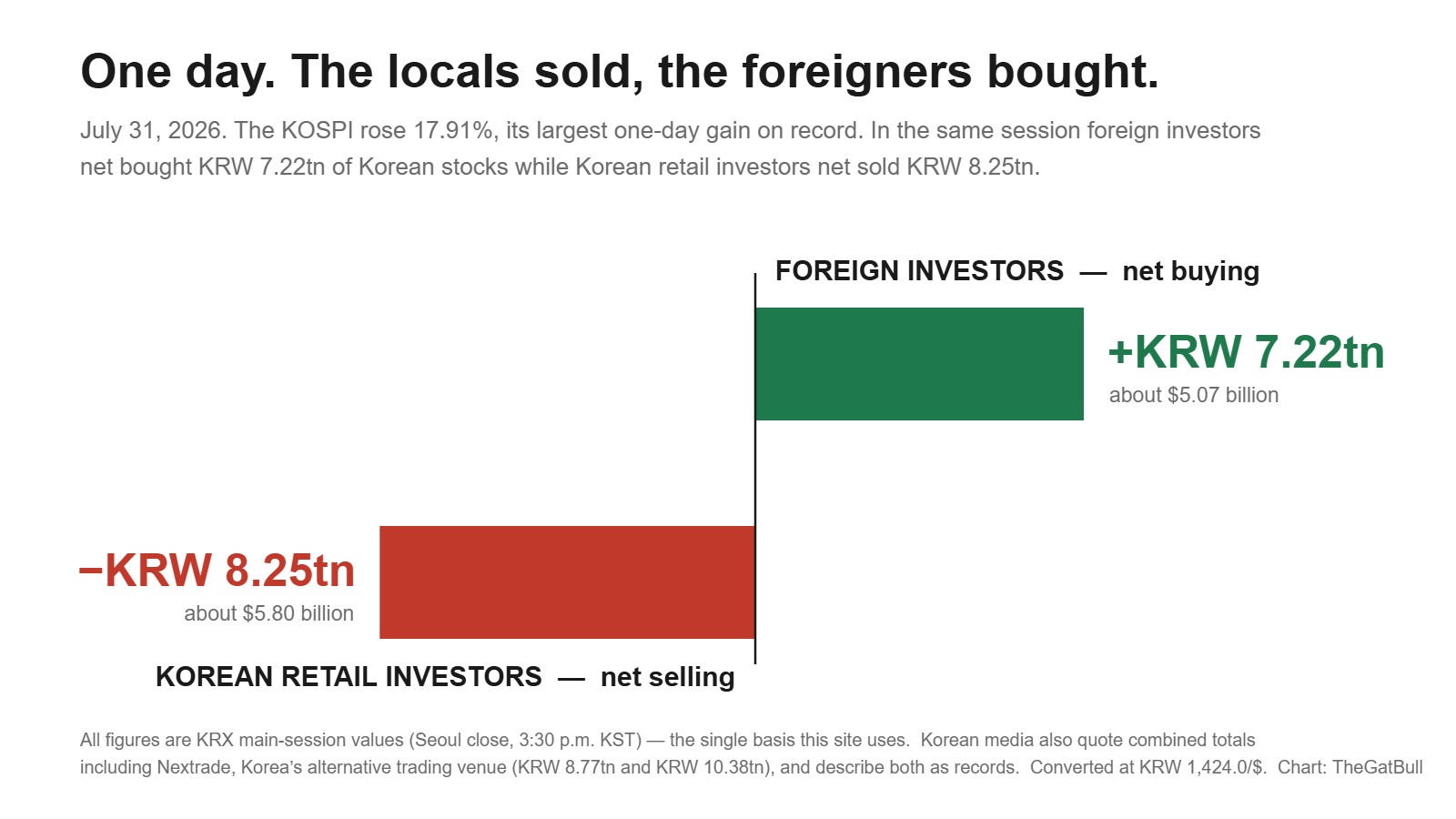
The index went the foreigners’ way. But the most honest sentence available about Friday is not “one side was right.” It is this: two groups looked at the same screen, reached exactly opposite conclusions, and each did so at the largest scale in their own history.
▶ What this means for global investors
① The rally was concentrated, not broad — Samsung Electronics and SK Hynix together are 51.22% of the KOSPI by market value, and most of the foreign buying went to those two names.
② Korean retail did not participate in the best day their market has ever had — they were net sellers of ₩8.25tn. What they wrote while selling is the most useful data in this article, and it is not bullish.
(Won figures are converted at USD/KRW 1,424.0, the Seoul close on July 31, 2026. This article is one person’s view, not advice.)
The scoreboard — July 31, 2026
| Item | Value | Note |
|---|---|---|
| KOSPI close | 6,595.45 (+1,001.89, +17.91%) | Largest one-day gain on record |
| KOSPI open | 5,657.79 (+1.15%) | The open was ordinary |
| KOSPI intraday high | 6,630.77 (intraday) | Briefly above +18% |
| KOSDAQ close | 719.76 (+74.98, +11.63%) | Second-largest gain on record |
| KOSPI 200 futures | +18.79% | Close to its own limit |
| Foreign investors | +₩7.22tn (about $5.07bn) | Reported as a record on a combined basis |
| Retail investors | −₩8.25tn (about $5.80bn) | Reported as a record on a combined basis |
| Foreign buying concentration | SK Hynix ₩3.61tn · Samsung ₩2.12tn | The top two names on the buy list |
| KOSPI market cap | ₩5,445tn | Back above ₩5,000tn after four sessions |
| USD/KRW | 1,424.0 (−13.4) (3:30 p.m.) | Fourth straight session of won strength |
Two structural details worth pausing on.
First, the market opened normally. The open was +1.15%. The surge was built during the session, not priced in overnight. Buy-side sidecars — a five-minute freeze on program trading, triggered when futures move sharply — fired on both the KOSPI and the KOSDAQ shortly after the open. That was the 21st buy-side sidecar on the KOSPI this year, out of 44 sidecars total. This is a market that has been hitting its own circuit-breaking machinery all year, in both directions.
Second, there are two exchanges now — and it changes the numbers. The KRX main session showed foreign net buying of ₩7.22tn. Add Nextrade, Korea’s alternative trading venue, live since 2025, and the figure becomes ₩8.77tn. Both are correct; they count different venues. If you see two Korean articles quoting different “record” figures for the same day, this is usually why.
📐 How this site quotes Korean market data
Every closing figure on TheGatBull is the KRX main session close, 3:30 p.m. Seoul time. That applies to index levels, individual share prices, market capitalisation and investor flows alike. Where Korean media quote a combined KRX-plus-Nextrade total, we give the KRX figure in the text and note the combined one in brackets. We do not mix the two in the same table or sentence, and we do not compare a combined-basis record against a KRX-basis history. US-listed instruments such as EWY are stated separately, on US trading days.
What Korean investors were actually writing
Here is the part that does not show up in the index print. While the KOSPI was posting the best day in its history, Korean stock forums were not uniformly celebrating. Yonhap’s affiliate News1 collected posts during the session. (These quotes are from around midday, while the market was still open — the index was up 14.04% at 11:35 a.m., not yet at its close.)
Some of it was joy:
“Money-copying day. KOSPI, I knew it.”
“I couldn’t concentrate on work for weeks. Today everything anyone does looks bright.”
“I averaged down yesterday while crying, and that choice wasn’t wrong. I’ll trust the KOSPI a bit more.”
Some of it was not:
“My Samsung average cost is ₩80,000. I held well for five years, couldn’t take the volatility, and sold at ₩200,000 two days ago. It hurts.”
That one is worth sitting with. Five years of holding, and the position was closed 48 hours before the largest single-day gain in the market’s history. That poster is what ₩8.25 trillion of retail selling looks like at ground level — not a trading decision so much as an endurance failure at the end of a very long test.
And some of it was exit:
“I don’t have the stomach for it. I can’t stay in the domestic market any more. This won’t end well, so I’m cleaning up as soon as I’ve covered my losses.” — a poster describing himself as an office worker in his 40s
One poster called his brokerage trading app a “state-licensed mobile sports betting service.” Another called the market a “casino for the whole nation.“
📖 Vocabulary, for readers outside Korea
개미 (gaemi, “ants”) — retail investors, collectively. Not derogatory; it is what they call themselves.
국장 / 미장 (gukjang / mijang) — “the domestic market” versus “the US market.” That these are everyday shorthand tells you how routinely Korean retail investors compare the two and move between them.
평단 (pyeongdan) — average cost basis.
물타기 (multagi, “watering down”) — averaging down.
곱버스 (gopbeoseu) — a leveraged inverse ETF. Friday’s SK Hynix 2x inverse product closed at its own −59.95% limit down.
🎩 Under the Gat — Notice what the complaint is not. Nobody in those posts is arguing that Samsung is overvalued or that memory pricing has peaked. The objection is to the ride. “Casino,” “sports betting,” “no stomach for it” — that is a complaint about volatility as an experience, not about valuation. Foreign investors were buying an asset. Korean retail investors were quitting a process. Those are different transactions that happen to clear against each other.
One more thing that was happening in the same session: the government announced a ₩20 trillion strategic sovereign wealth fund for AI infrastructure. I took that apart here. Friday had a lot in it.
Why SK Hynix stopped at 29.95%
Three KOSPI stocks closed limit up on Friday.
| Stock | Close | Move |
|---|---|---|
| SK Hynix | ₩1,718,000 | +29.95% |
| Samsung Electro-Mechanics | ₩1,142,000 | +29.92% |
| SK Square | ₩1,038,000 | +29.91% |
| (for contrast) Samsung Electronics | ₩262,500 | +26.81% — did not hit the ceiling |
Those three numbers sitting at 29.95, 29.92 and 29.91 are not a coincidence. The Korea Exchange caps how far a single stock can move in one day at ±30%. Orders above that line do not execute. The decimals differ only because each stock’s 30% lands on a different tick size.
The US market has no equivalent. Since 2012 the US has used LULD (Limit Up-Limit Down), which pauses trading for five minutes when a price leaves a reference band and then reopens it. There is no “that’s all for today” ceiling. Nothing in US rules stops a stock from rising 40% in a session.
Korea introduced daily limits in 1995, ran them at ±15% from 1998, and widened them to ±30% on June 15, 2015 (the KONEX market still uses ±15%). So SK Hynix’s +29.95% does not tell you what the market decided the stock was worth. It tells you where the buy orders were cut off. For the record, it was SK Hynix’s first limit-up close since 2009.
🎩 Under the Gat — A limit up means “we stopped it here,” not “it stopped here.” Which is why an index print on a limit-up day has to be read twice. Demand blocked at the ceiling does not evaporate — it spills into the neighbours. Some part of Samsung Electronics reaching +26.81%, and of the KOSDAQ chip-equipment names running 20%+, is that spillover. The KOSPI’s +17.91% is a blend of genuine repricing and the side effects of a ceiling.
One more distinction American readers should keep straight: a limit up is not a circuit breaker. A circuit breaker halts the whole market when the index moves too far; a price limit caps one stock. Korea demonstrated both inside five days — the index halted midweek, individual prices froze on Friday.
Why Friday — and why that question is a trap
Korean media attribute the reversal to three things, and it is worth stating them as attributions rather than as findings:
- US semiconductor sentiment recovered overnight. Doubts about the durability of AI infrastructure spending — the doubts that broke Korean chip stocks earlier in the week — eased in New York.
- A bounce off an oversold three sessions. The KOSPI had fallen 10.84%, 5.98% and 1.23% on the three preceding days.
- Foreign investors returned — but overwhelmingly into two stocks.
Here is what makes the causal story uncomfortable. The bad news that broke this market was never resolved. The Chinese memory competition story — CXMT’s Shanghai listing on July 27, the July 28 report of domestic Chinese DUV lithography — is exactly where it was on Thursday. Nothing about Korea’s position changed on Friday. What changed was American news about American companies.
So Friday is less a day when something got better in Korea, and more a day that re-confirmed where the decision rights over this index actually sit. This is the same week in which SK Hynix reported the best quarter in its history and fell 9.61%. Domestic earnings did not move this market. Foreign sentiment did, twice, in both directions.
🎩 Under the Gat — Be careful with the urge to name the cause. This market printed −10.84% on Tuesday, −5.98% on Wednesday and +17.91% on Friday. At that amplitude you can construct any narrative you like from two days of data. I’ll record one thing instead: July will go into the books as a month in which the KOSPI set a record for monthly decline, and the last trading day of that same month set the record for the largest single-day gain. Both in July.
Three questions Friday leaves open
1. Where did the blocked demand go? Buy orders that could not execute at the ceiling do not disappear. They reappear at the next session’s open, or move to substitutes, ETFs, or futures. SK Hynix’s opening price on the first August session is the first evidence of whether Friday’s spillover was real demand or reflexive chasing.
2. Was record retail selling capitulation or liquidation? Retail also sold ₩1.42tn on July 30. Selling two days running — and selling into a violent rally — is at least as consistent with position constraints as with price judgment. Margin-loan and forced-liquidation balances for the week will say more than any survey.
3. Is the foreign return a trend or a retracement? Foreigners were heavy net sellers across July. One day of ₩8.77tn is a fraction of that. Whether they keep buying in the first week of August decides whether Friday was a turning point or a bounce.
If Friday’s concentration surprised you, it shouldn’t have. Samsung and SK Hynix are 51.22% of this index by market value, and what that means for anyone holding the main US-listed Korea ETF is laid out here. Concentration is not only a downside amplifier.

The summary
The KOSPI had the best day in its history, and the people who live in that market sold more of it than they ever have in a single session. Both statements are true, and the second one is the more informative.
What Korean retail investors wrote on Friday was not a valuation argument. It was a description of what holding this market feels like — “casino,” “sports betting,” “I can’t stay in the domestic market any more.” A market can be cheap and still lose its own citizens, and that is a slower problem than any one session’s print, up or down.
Foreign investors bought a record amount of two semiconductor stocks. Korean investors sold a record amount of their own market. The clearing price of those two decisions was the largest gain in KOSPI history. Nobody knows yet which side was buying and which side was leaving.
This article is a personal view provided for informational purposes and is not investment advice or a solicitation to trade. All figures are KRX closing values for July 31, 2026 unless labelled intraday. Community quotations are as reported by News1 during the July 31 session and are presented as sentiment, not as a representative sample. FX basis: USD/KRW 1,424.0, Seoul close 3:30 p.m., July 31, 2026. Responsibility for investment decisions and their outcomes rests with the investor.
FAQ
How much can a Korean stock rise in one day?
Stocks listed on the Korea Exchange are limited to ±30% per session (the KONEX market uses ±15%). Reaching the upper bound is called limit up, the lower bound limit down. The band was widened from ±15% to ±30% on June 15, 2015.
Does the US have the same rule?
No. The US uses LULD (Limit Up-Limit Down), which halts trading for five minutes when a price exits a reference band and then resumes it. There is no daily ceiling.
Is a limit up the same as a circuit breaker?
No. A circuit breaker halts trading across the whole market when the index moves sharply; a price limit caps an individual stock. Korea triggered both in the final week of July 2026.
How much did the KOSPI rise on July 31, 2026?
It rose 1,001.89 points, or 17.91%, to close at 6,595.45 — a record in both percentage and points. The KOSDAQ rose 11.63% to 719.76, its second-largest gain on record.
Why did Korean retail investors sell on the market’s best day?
Retail investors net sold ₩8.25 trillion on the KRX main session (₩10.38 trillion including Nextrade, which Korean media described as a record). Forum posts collected during the session point to exhaustion with volatility rather than a valuation call — several described closing positions held for years, and others said they were leaving the domestic market entirely. Selling on consecutive days into a rally is also consistent with margin and forced-liquidation pressure. Weekly margin-balance data will clarify which dominated.
Why do different articles give different foreign net-buying figures for the same day?
Because Korea now has two trading venues. The KRX main session showed ₩7.22 trillion of foreign net buying; including Nextrade, Korea’s alternative trading venue, the total was ₩8.77 trillion. The “record” descriptions in Korean media refer to the combined total. This article quotes the KRX session figure.
How much did the KOSPI’s two largest stocks matter?
A great deal. Samsung Electronics and SK Hynix together account for 51.22% of KOSPI market value, and they were the top two destinations for foreign buying. Samsung closed +26.81% and SK Hynix limit up at +29.95%.
 Written by Mr.Gat — TheGatBull
Korean market coverage from a Seoul-metro-based operator who reads the filings in the original language. Every price on this site is the KRX regular-session close (15:30 Seoul); every figure states whether it came from a primary filing, the press, or our own calculation. Drafts are AI-assisted, then verified against the original Korean documents and edited by a human before publishing.
Found an error? Tell us — corrections get priority. How we work →