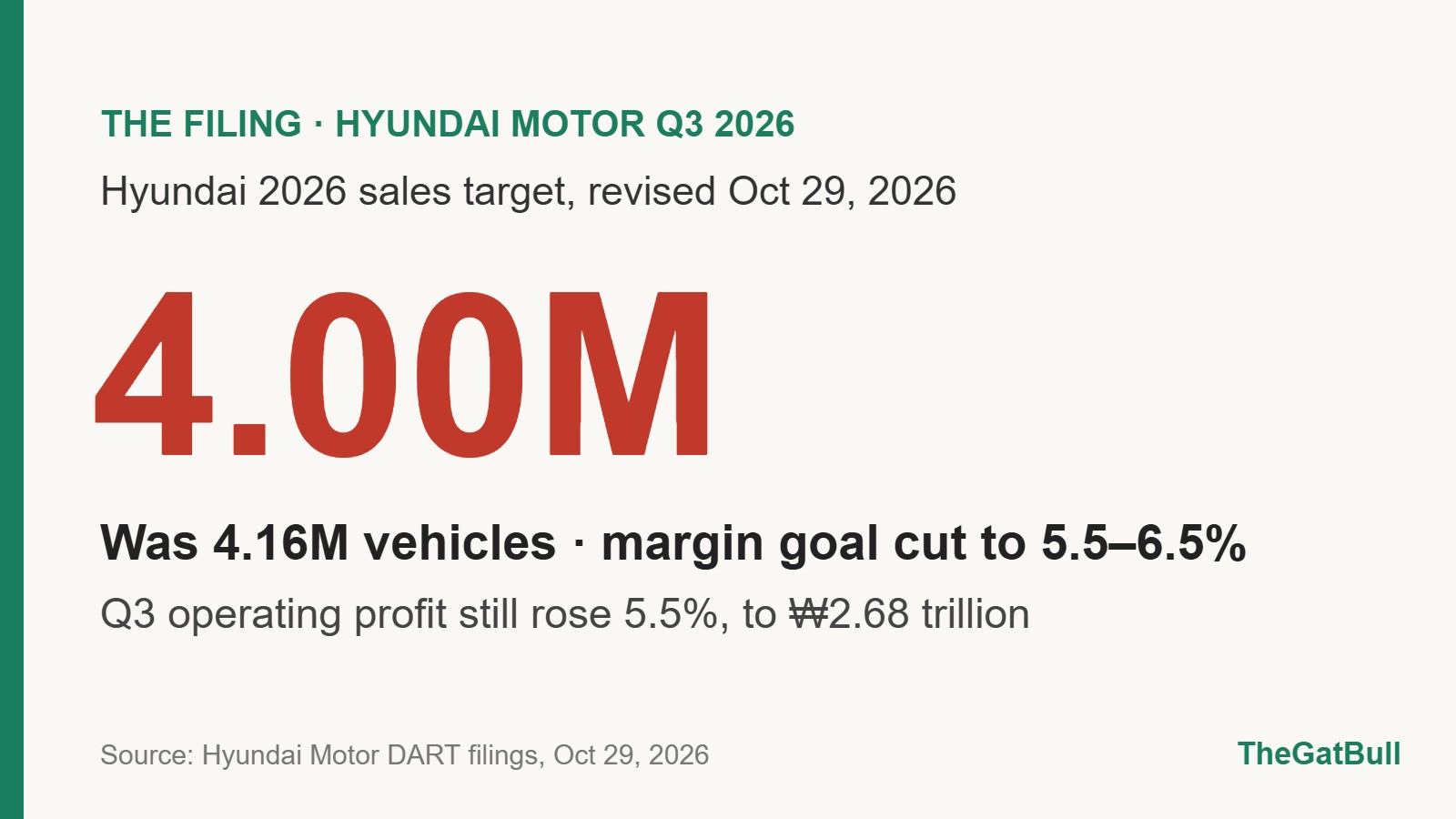
TL;DR — If you own Korean stocks directly or through EWY. Hyundai Motor’s third-quarter operating profit rose 5.5% from a year earlier to ₩2.68 trillion (about $2.0 billion) even though it sold 11% fewer cars, and on the same day it cut its 2026 sales target to 4 million vehicles and lowered its margin goal. The stock rose as much as 4.6% on the day after the numbers came out, then gave all of it back to close down 1.18%.
Your Door — what this means if you hold EWY. Hyundai’s three share classes are 2.28% of EWY and Kia is 1.12% (iShares, as of Oct. 27), while Samsung Electronics and SK hynix together are 46.25%, so today’s move barely registers in the fund. For Hyundai, the exchange rate carries into the fourth quarter: at Thursday’s close a dollar bought about 6% fewer won than the reported third-quarter average (our calculation), so if the rate holds, the currency cushion is thinner.
Not financial advice.
Dates and times are Seoul time (KST). Stock and index prices are KRX (Korea Exchange) regular-session closes (3:30 p.m. Seoul) on Thursday, Oct. 29, 2026, unless marked intraday. Dollar conversions are for scale only, at ₩1,336.8 per dollar, the Oct. 29 Seoul 3:30 p.m. rate. Earnings figures are Hyundai’s preliminary consolidated results.
Hyundai Motor (KRX: 005380) reported third-quarter consolidated operating profit of ₩2.677 trillion (about $2.0 billion), up 5.5% from a year earlier (DART 20261029800228). On the same day it lowered its 2026 sales target from 4.16 million to 4 million vehicles and its consolidated operating-margin goal from 6.3–7.3% to 5.5–6.5%. The shares climbed as high as ₩309,500 during the session after the results were reported, then closed at ₩292,500, down 1.18%.
Five filings in one trading session
On Oct. 29, Hyundai posted a run of filings on DART, Korea’s electronic disclosure system (the counterpart of the SEC’s EDGAR), alongside its results.
| Filing | What it says | Primary source |
|---|---|---|
| Preliminary consolidated results | Revenue ₩45.11 trillion (−3.4%) · operating profit ₩2.677 trillion (+5.5%) · net profit ₩1.932 trillion (−24.2%) | DART 20261029800228 |
| Sales target revision | 4,158,300 → 4,000,000 vehicles (Korea 700,000 → 664,000 · overseas 3,458,000 → 3,336,000) | DART 20261029800240 |
| Business plan revision | Operating-margin goal 6.3–7.3% → 5.5–6.5% · investment ₩17.8 trillion → ₩16 trillion · revenue growth goal of 1.0–2.0% unchanged | DART 20261029800231 |
| Quarterly dividend | ₩2,500 per share (about $1.87), unchanged · record date Nov. 30 · payment Dec. 30 | DART 20261029800269 |
| Treasury share disposal | 917,385 shares handed to 61,159 employees under the wage agreement, with no sale in the market | DART 20261029000247 |
Source: Hyundai Motor filings on DART, Oct. 29, 2026. Year-on-year changes are as filed.
The operating margin was 5.9%, up from 5.4% a year earlier. For January to September, though, operating profit was ₩8.04 trillion, down 17.7% from a year earlier. One quarter improved; the year so far has not.
Fewer cars, more profit per car
Wholesale sales, the vehicles Hyundai shipped to its dealers and distributors, were 920,710, down 11.3%: down 27.2% in Korea and 8.0% overseas. The company gave slower global industry demand, production disruptions and higher raw-material prices as its reasons for cutting the target.
Hybrid sales still grew, to 167,414 vehicles (+3.8%), lifting hybrids to 18.2% of the total. Electric-vehicle sales fell 9.2%. Part of the story is that Hyundai sold fewer, more expensive cars; the other part is the exchange rate.
Where the won and tariffs hit the income statement
- The exchange rate added to profit. Hyundai earns dollars abroad and reports in won, so a weaker won turns the same dollar sales into more won of profit. The won averaged about ₩1,423 per dollar in the third quarter, 2.8% weaker than a year earlier, according to Seoul Economic Daily. Kyunghyang Shinmun put the currency effect in Hyundai’s breakdown of what changed operating profit at ₩1.283 trillion; we have not checked that figure against the company’s investor-relations deck. If the reported figure is right, the currency effect was about nine times the year-on-year increase in operating profit, which was roughly ₩140 billion (our calculation). On that figure, operating profit would have fallen this quarter without the weaker won.
- Tariffs took profit away. On the earnings call, the chief financial officer reportedly said the burden from U.S. tariffs was “about ₩4 trillion last year and a similar level this year.” We could not find a quarterly figure.
Under the Gat (our take). “Read only the Oct. 29 close and you see an earnings letdown of 1.18%. Read the 15-minute bars and you see the shares reach +4.56% on the day by the 1:45 p.m. bar, then a slide that began around the 2:10 p.m. call. Both moves came in the same Oct. 29 session.”
A 45-minute rally inside one session
On a daily chart, results day was simply −1.18%. The 15-minute bars (vendor intraday data) show a different day. In Korean this is a banjjak rally, a brief flash.
| Time (KST) | Hyundai shares | What happened |
|---|---|---|
| 9:00 a.m.–1:00 p.m. | Range of ₩286,500–293,500 | Before the results |
| 1:15–1:30 p.m. bar | High of ₩307,500 · 137,000 shares, about nine times the average morning bar | First press report of the results, 1:25 p.m. (Stockplus) |
| 1:45 p.m. bar | High of ₩309,500 (+4.56% on the day) | Intraday peak |
| 2:10 p.m. | — | Earnings call (time stated in the DART filing) |
| 2:00–3:30 p.m. | ₩301,500 → ₩292,000 → close of ₩292,500 | The whole gain given back |
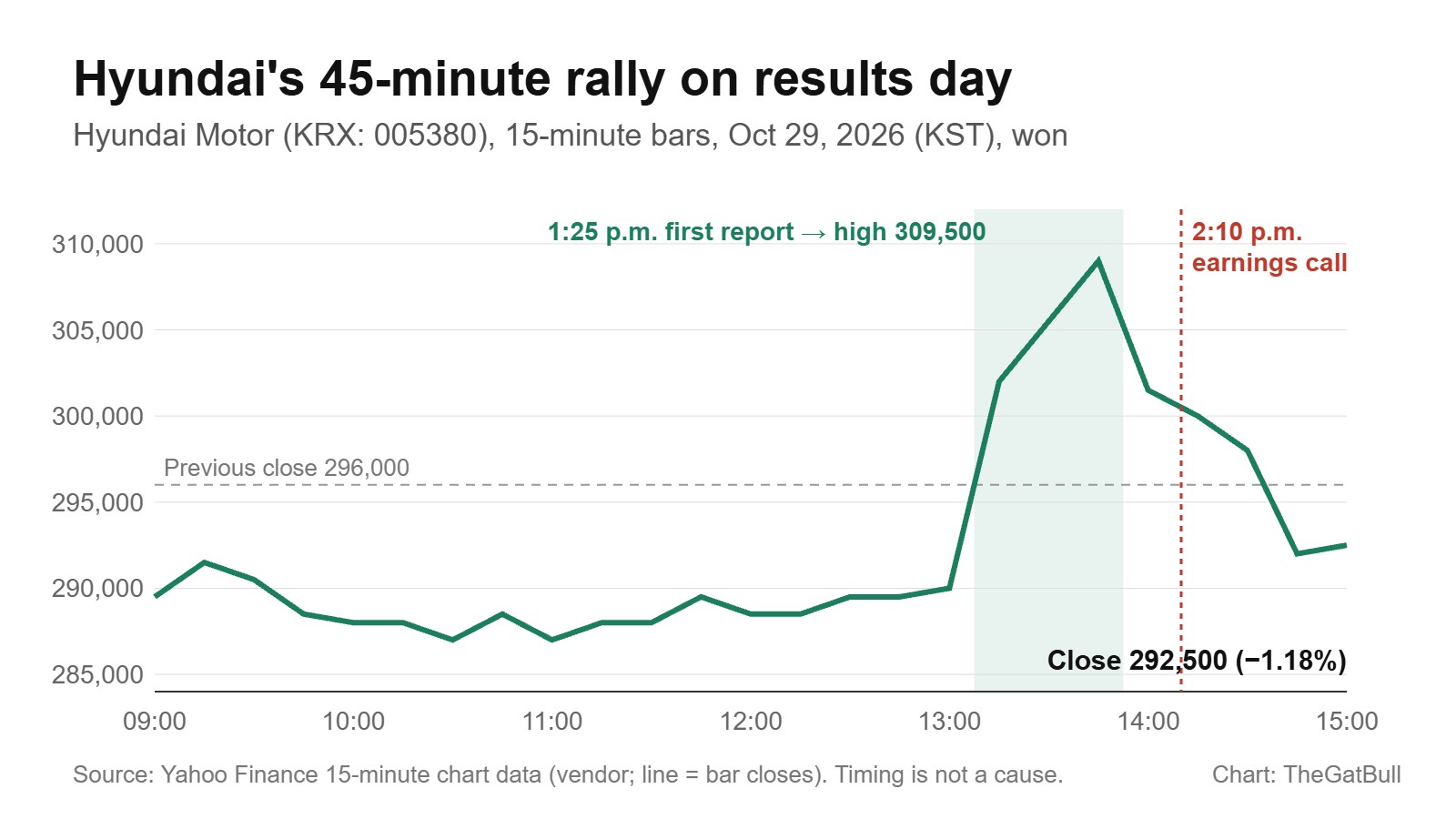
The order of events: the shares rose when the numbers came out and started falling around the time the call began. That is an observation about timing; the cause of the decline is not established. The KOSPI also fell 1.24%, to 5,937.66, the same day, giving back part of the previous day’s 6.64% jump. A market-wide pullback and the company’s lower outlook landed on the same day.
Trading volume was 924,797 shares, about 2.2 times the previous day’s 420,188.
The headlines split as well. One Korean outlet looked at operating profit and wrote that results beat expectations; another looked at earnings per share and revenue and wrote that they missed. Neither named the source of its consensus figure, so this article does not judge a beat or a miss.
Three numbers to watch next
- The won-dollar rate. The Oct. 29 Seoul close was ₩1,336.8. Against the reported third-quarter average of ₩1,423, a dollar earned in the U.S. now converts into about 6% fewer won (our calculation). The cushion that lifted the third quarter is thinner going into the fourth.
- Production in Korea. On the call, the company reportedly said its Korean plants had been running normally since September and that it has more than ten new models due in the fourth quarter. The fourth-quarter numbers will show whether the 27.2% drop in Korea was temporary.
- Kia’s third quarter. As of this writing (Oct. 29, evening Seoul time), Kia had not filed its results on DART. Hyundai books its share of Kia’s profit through its stake in Kia (the equity method), and Kia is 1.12% of EWY.
Hyundai reported in the middle of Seoul’s trading day
Most large U.S. companies report before the market opens or after it closes. Investors absorb the numbers overnight, and the next day’s open delivers the verdict in one move. Hyundai filed its numbers in the middle of Seoul’s regular session, in the 1 p.m. hour, and held its earnings call more than 40 minutes later. One daily candle therefore can hold separate reactions to the numbers and to the outlook, and the −1.18% close shows only the net.
For anyone in the U.S. watching EWY or Korean shares, that has a practical edge. Reading the close alone as “disappointing results” can miss what the market actually marked down that day, which may have been the outlook rather than the quarter. The second point is about size: at Hyundai, the average won-dollar rate can move quarterly profit by large amounts. If the reported bridge is right, about nine times Hyundai’s profit increase came from the currency. A stronger won pushes that line the other way.
Ways in from the U.S., and a Detroit comparison
- Access. The simplest route is EWY, where Hyundai’s three share classes total 2.28%. You can also buy the Seoul common shares (KRX: 005380) through a U.S. broker with Korea Exchange access, or the over-the-counter line HYMTF, which is unsponsored (set up without the company’s participation) and thinly traded.
- U.S. comparison. Ford and General Motors also report the cost of tariffs in their results. Not a perfect parallel: a U.S. carmaker’s profit is counted in dollars, so most of its profit needs no currency translation step, while Hyundai’s profit changes substantially at the moment dollars earned abroad are converted into won.

The bottom line
On the reported currency figure, Hyundai’s third quarter was a quarter in which the exchange rate covered a drop in car sales. The market cheered the numbers for about 45 minutes, then gave the gain back on a day when the company also lowered its full-year targets. Hyundai is a small part of EWY at 2.28%, but it shows how the exchange rate moves one Korean exporter’s profit. Kia’s results come next.
Related reading: Hyundai’s US Bet Grew. Its Stock Did Not. · How Hyundai, Kia and Mobis Each Own the Next One · Hyundai Canceled ₩789bn in Stock. The Price Fell.
FAQ
Were Hyundai’s Q3 2026 results better than expected?
Operating profit (₩2.677 trillion, +5.5%) was higher than a year earlier. Korean outlets disagreed on whether it beat the consensus, and none disclosed its consensus source, so we do not make that call.
Why did Hyundai stock fall on results day?
It rose as much as 4.56% during the session, to ₩309,500, then closed down 1.18%. The same day the company lowered its sales and margin targets, and the KOSPI fell 1.24%. The decline began around the time of the 2:10 p.m. earnings call, but its cause is not established.
How much of EWY is Hyundai?
As of Oct. 27, 2026, the common shares are 1.51% and the two preferred lines 0.77%, for 2.28% in total (iShares holdings file).
Does Hyundai pay a dividend?
Yes. It kept its quarterly dividend at ₩2,500 per share (about $1.87), with a record date of Nov. 30, 2026, and a planned payment date of Dec. 30, 2026 (DART).
Sources
- Hyundai Motor filings on DART, Oct. 29, 2026: preliminary consolidated results 20261029800228 · sales forecast revision 20261029800240 · business plan revision 20261029800231 · cash dividend 20261029800269 · treasury share disposal 20261029000247.
- Hyundai Motor newsroom, 2026 Q3 business results (wholesale sales, hybrid and EV volumes).
- iShares MSCI South Korea ETF (EWY) holdings, as of Oct. 27, 2026.
- Hyundai and KOSPI prices, daily and 15-minute bars: Yahoo Finance chart data (005380.KS, ^KS11; vendor data, not exchange-published figures).
- Third-quarter average exchange rate and currency effect: Seoul Economic Daily and Kyunghyang Shinmun English editions (Oct. 29) (press). First report of the results: Stockplus (Oct. 29, 1:25 p.m.) (press). Call remarks on tariffs and production: Korean press reports (Oct. 29).
- Won-dollar rate at the Seoul 3:30 p.m. close: Asia Economy and Global Economic (Oct. 29) (press).
How sure are we?
| Item | Confidence |
|---|---|
| Revenue, operating profit, net profit, targets, guidance, dividend, share disposal | ✅ Company filings on DART (results are preliminary) |
| Wholesale, hybrid and EV sales | Company results release |
| Margins, nine-times ratio, 6% currency gap, ₩140 billion increase | Our calculation from filed and reported figures |
| Third-quarter average rate (₩1,423) and currency effect (₩1.283 trillion) | ⚠️ Press-reported; not checked against the company’s investor-relations deck |
| CFO tariff comment, plant and new-model remarks | ⚠️ Press-reported from the earnings call |
| Intraday path and timing of the first report | Vendor 15-minute data (Yahoo) and press timestamps; cause of the decline not established |
| Beat or miss against consensus | Not judged; outlets disagreed and cited no source |
| EWY weights | ✅ iShares holdings file, as of Oct. 27, 2026 |
| Seoul 3:30 p.m. exchange rate | ⚠️ Press-reported, checked across two outlets |
Not financial advice. TheGatBull is an independent publication; nothing here is a recommendation to buy or sell any security.
 Written by Mr.Gat — TheGatBull
Korean market coverage from a Seoul-metro-based operator with 15 years of personal investing experience, who reads the filings in the original language. Every price on this site is the KRX regular-session close (15:30 Seoul); every figure states whether it came from a primary filing, the press, or our own calculation. Drafts are AI-assisted, then verified against the original Korean documents and edited by a human before publishing.
Found an error? Tell us — corrections get priority. How we work →