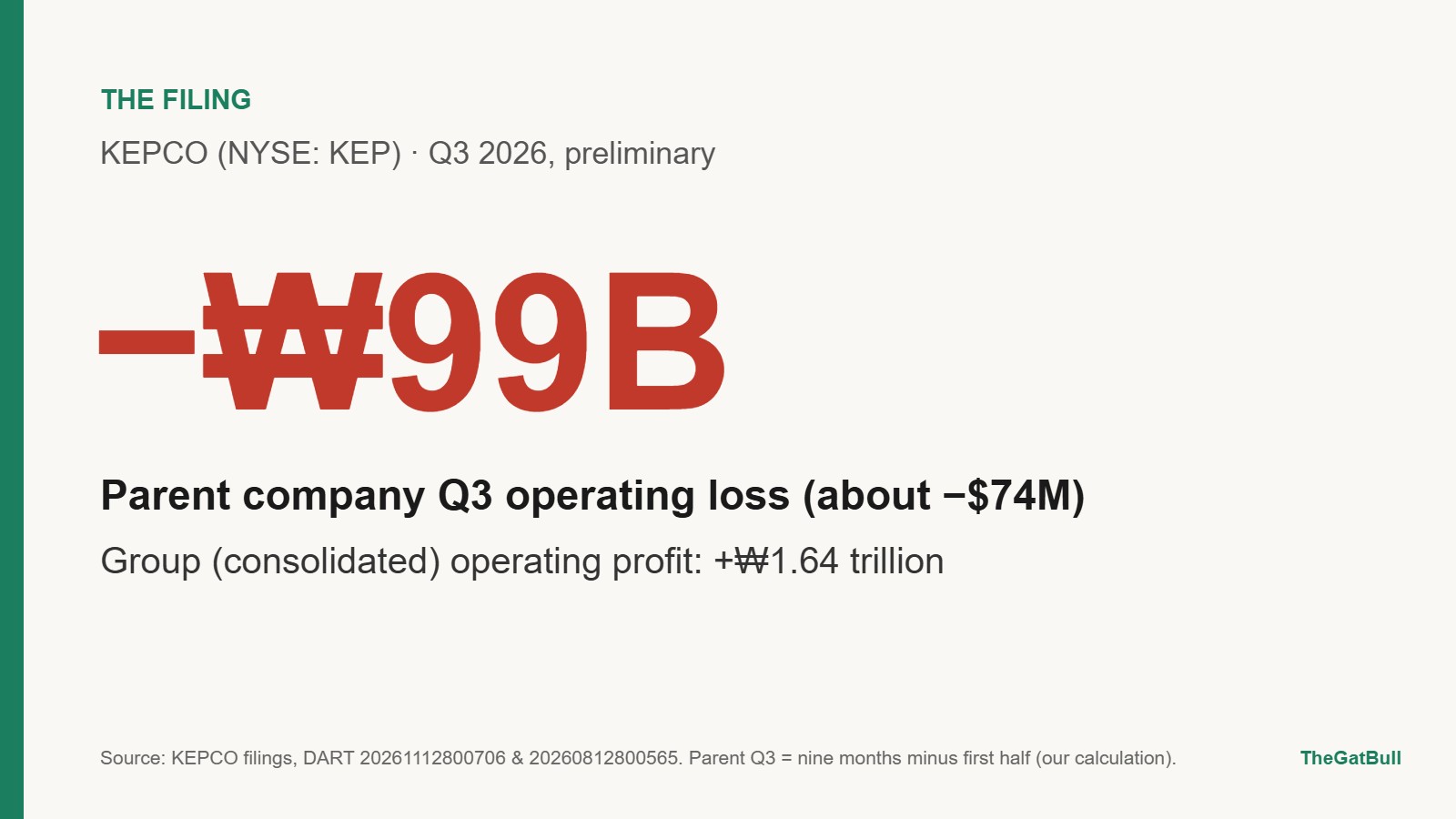
TL;DR — For anyone who holds or follows KEP, the Korea Electric Power ADR on the NYSE. KEPCO’s third-quarter filing shows a group (consolidated) operating profit of ₩1.64 trillion (about $1.24 billion), down 70.9% from a year earlier, and the company calls it a 13th straight profitable quarter. Take the parent company’s nine-month figure from the filing’s footnote, subtract the first-half figure from its August filing, and KEPCO the parent, the company that buys the power and sells it to Korean homes and factories, had an operating loss of about ₩99 billion (about $74 million) in the quarter.
I’m Mr. Gat, and this is TheGatBull.
Not financial advice.
Your Door — if you hold KEP.
- KEP trades on this before Seoul does. The filing came out after the Seoul market closed (1:57 a.m. ET on Thursday, Nov. 12), so Thursday’s NYSE session is the first chance for any market to price it. Seoul opens on it Thursday evening, ET.
- What to check next: not the −71%, but whether the parent’s loss carries into the fourth quarter, and the government’s next decision on electricity rates. One KEP ADR represents 1/2 of a KEPCO ordinary share (our ADR list).
Times are Seoul time (KST) unless marked ET; in November, ET is 14 hours behind Seoul. Stock and index prices are KRX (Korea Exchange) regular-session closes (3:30 p.m. Seoul) on Thursday, Nov. 12, 2026. Dollar conversions are for scale only, at ₩1,330.7 per dollar, the Nov. 12 Seoul 3:30 p.m. rate. All earnings figures are preliminary and not yet reviewed by KEPCO’s auditor.
One filing, 27 minutes after the close
Korea Electric Power Corp. (KRX: 015760; NYSE: KEP), which sells electricity to Korean homes and factories, filed its preliminary third-quarter results at 3:57 p.m. KST on Nov. 12 (DART 20261112800706) and held an investor briefing at 5:00 p.m. The main table is consolidated, meaning KEPCO plus the companies it controls, including its power-generating subsidiaries. Item 4 of the filing, “other matters relevant to investment decisions,” adds the parent company’s own figures on a separate (stand-alone) basis, but only as nine-month totals.
KEPCO’s shares closed at ₩30,650 per ordinary share (about $23; one KEP ADR is half a share), up 0.66%, before the filing came out, so that price does not reflect it. The KOSPI fell 0.61% to 5,342.73 and the KOSDAQ fell 1.22% to 696.53.
What does the table say, and what does the footnote say?
| Consolidated (group) | Q3 2026 | Q2 2026 | Q3 2025 | vs Q2 | vs Q3 2025 |
|---|---|---|---|---|---|
| Revenue | ₩26.85 trillion (about $20.2 billion) | ₩21.92 trillion | ₩27.57 trillion | +22.5% | −2.6% |
| Operating profit | ₩1.64 trillion (about $1.24 billion) | ₩1.13 trillion | ₩5.65 trillion | +45.7% | −70.9% |
| Net income | ₩835.9 billion (about $628 million) | ₩277.5 billion | ₩3.79 trillion | +201.2% | −77.9% |
| Nine-month operating profit | ₩6.56 trillion | — | ₩11.54 trillion | — | −43.2% |
Source: KEPCO preliminary filing, DART 20261112800706 (filed). Percentage changes as stated in the filing.
The headlines used the year-on-year change (−70.9%). The same line of the filing also shows +45.7% against the second quarter. The third quarter includes Korea’s summer cooling season, so revenue usually rises from the second quarter; that is why this piece looks at the year-on-year change and at the parent figures below.
The parent figures come only as running totals. Take the nine-month total from this filing and subtract the first-half total from KEPCO’s Aug. 12 filing (DART 20260812800565), and the third quarter is what is left:
| Parent (KEPCO alone), operating profit | Nine months | First half | Q3 (nine months minus first half) |
|---|---|---|---|
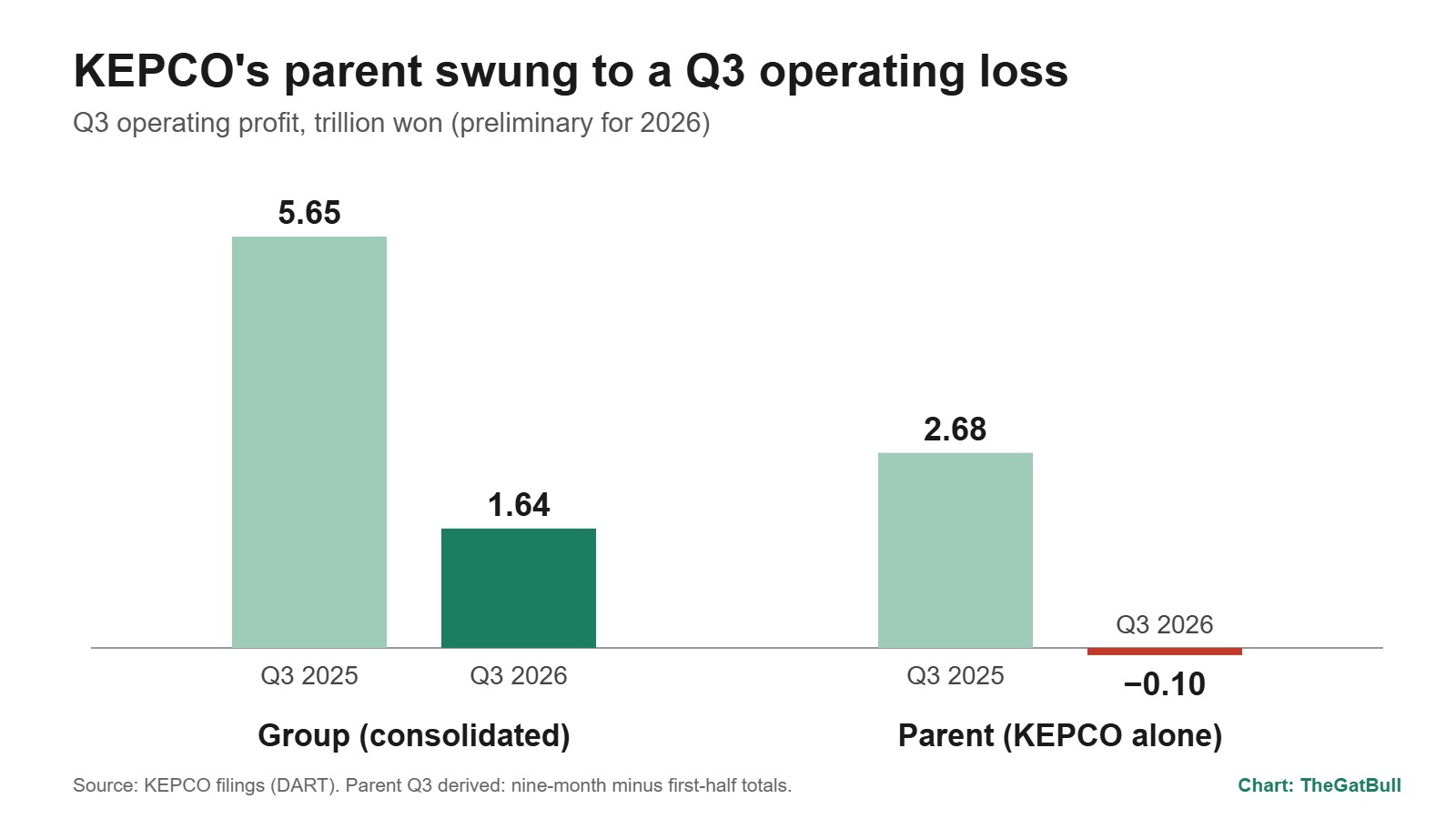
| 2026 | ₩2.024 trillion | ₩2.123 trillion | −₩99.0 billion (about −$74 million) |
| 2025 | ₩5.536 trillion | ₩2.857 trillion | +₩2.68 trillion |
Nine-month and first-half totals: KEPCO filings (filed). Q3 figures: our subtraction (derived). The same method gives a parent net loss of about ₩434 billion (about $326 million) for the quarter.
Under the Gat (our take). “KEPCO’s 13 straight profitable quarters are real. But that number adds in what the subsidiaries that own the power plants earned. The parent, which sells the electricity to the public, lost money this quarter. Once you know who sets the price, you can see why the loss landed there.”
Herald Business and Dealsite also reported a parent operating loss of ₩99 billion in the third quarter, the first quarterly loss on that basis in two years (press-reported). Our figure comes independently from the two filings and matches.
So in the same quarter:
- The group (consolidated): operating profit of +₩1.64 trillion, which the company describes as its 13th straight profitable quarter (company description; we did not confirm where the count starts).
- The parent (separate basis): an operating loss of ₩99 billion.
- The gap of ₩1.74 trillion is the generating subsidiaries’ and other units’ profit plus consolidation adjustments (derived; the filing does not break it down by company).
English and Korean headlines alike led with the consolidated number. That number is correct, because the group is what shareholders own. It just does not show that the unit selling electricity to the public lost money.
Why does the loss land on the parent?
The KEPCO group has two layers. Generating subsidiaries own coal, gas and nuclear plants and sell power into the wholesale market. KEPCO the parent buys that power, along with power from private generators, and sells it to homes and factories. The price the parent charges, the electricity rate, needs government approval.
Nine-month figures that the company released and Korean newspapers reported (company figures via the press: Korea Economic Daily, Segye Ilbo; the reports do not state whether each is consolidated or parent-only):
- Fuel costs at the generating subsidiaries: ₩17.03 trillion, up 14.8%, on higher coal-fired output and higher coal prices.
- Power bought from private generators: ₩27.51 trillion, up 3.4%, as higher LNG prices raised the wholesale price (SMP, the system marginal price) and renewable-energy certificate (REC) costs grew.
- Electricity sales revenue: ₩69.47 trillion, down 1.6%; volume 415.3 TWh, down 1.1%; average selling price down 0.4%.
The reports attribute the squeeze to higher fuel prices after the Middle East war that began in late February 2026, while electricity rates stayed where they were (Herald Business calls it a rate freeze). KEPCO CEO Kim Dong-cheol said at a press briefing on Nov. 4 that at least a minimum adjustment of electricity rates has to be settled with the government (as reported by Herald Business).
Our interpretation: when costs rise, the generating subsidiaries pass part of them on in the price at which they sell power to the parent, and the parent cannot raise its own selling price without government approval. Put the two together and the subsidiaries’ profit offsets the parent’s loss, leaving a group profit. This quarter is the first in two years in which that offset tipped the parent into a loss.
Where it hits the income statement: the operating profit line, which is the margin on selling power. Below it, interest is heavy too: about ₩3.2 trillion over nine months (the reports do not say whether this is group or parent-only), or about ₩11.8 billion (about $8.9 million) a day, with consolidated liabilities of ₩209.6 trillion (about $157.5 billion) and borrowings of ₩132.8 trillion (about $99.8 billion) at the end of September (company figures, reported by Segye Ilbo and Herald Business).
What this piece does not cover
We do not cover trading by investor type, and we do not predict the price reaction. The Nov. 12 Seoul close was set before the filing, so it is not a market reaction.
What KEPCO shows about the Korean market
What KEPCO shows about Korea: where the government sets the price, rising fuel costs hit the company that sells at that price first, while the group total can still look fine. Korean filings show the parent’s figures only in a footnote, as running totals, so an investor reading only English headlines sees only the consolidated number.
Why this matters for a KEP holder (our interpretation): under Korea’s Commercial Act, the profit available for dividends is calculated from the company’s own (separate) financial statements. That ties the parent’s stand-alone results to its capacity to pay dividends. On a nine-month basis the parent’s net income is still positive at ₩2.44 trillion; the third quarter alone is a loss of about ₩434 billion. No dividend has been decided for fiscal 2026.
What to watch
- The KEP session on Nov. 12 (U.S. time) and the Seoul open at 9:00 a.m. KST on Nov. 13: the first prices on this filing.
- KEPCO’s third-quarter report (final figures after the auditor’s review): whether the parent’s third-quarter result changes from the preliminary numbers.
- The next decision on electricity rates and the fuel-cost adjustment rate.
- One risk: if fuel prices rise further or a rate decision is delayed, the parent’s loss could continue into the fourth quarter. If rates are adjusted, this footnote may turn out to be a one-quarter event.
Ways in from the U.S., and an American comparison
Ways in: the NYSE-listed KEP ADR (one ADR = 1/2 ordinary share, per the cover page of KEPCO’s Form 20-F), direct purchase of 015760 on the Korea Exchange, or EWY (the iShares MSCI South Korea ETF), where KEPCO is 0.42% of the fund (iShares, as of Nov. 10, 2026).
American comparison: a U.S. utility holding company such as Southern Company also reports consolidated results, but its state-regulated subsidiaries pass fuel-cost swings through to customers via fuel adjustment clauses with a relatively short lag, and each subsidiary’s financials are published separately. In Korea, the central government’s rate decision sits in that place, and the parent’s stand-alone figures appear only as a running-total footnote. Not a perfect parallel: U.S. utilities also face regulatory lag, and KEPCO’s settlement structure with its generating subsidiaries has no exact U.S. equivalent.

The bottom line
KEPCO’s group stayed profitable in the third quarter, at ₩1.64 trillion, 71% less than a year ago. The parent company that sells electricity at government-approved rates lost about ₩99 billion, a figure you only get by subtracting two of its own filings. For a KEP holder, the next rate decision and the fourth-quarter parent result are what decide whether that loss repeats.
The Seoul Seven · how this piece was checked: ✓ Korean original · ✓ Dated sources · ✓ Seoul & New York time · ✓ Beyond EWY · ✓ U.S. anchor · ✓ What to watch · ✓ Corrections kept · what these mean
— Mr. Gat. Stay bullish. (Not a call to buy or sell.)
Related reading: KEPCO’s second-quarter results · KEPCO vs. Southern Company on dividends
FAQ
Did KEPCO make a profit in Q3 2026?
As a group (consolidated), yes: a preliminary operating profit of ₩1.64 trillion (about $1.24 billion). As a stand-alone parent company, the third-quarter result we calculate from the nine-month and first-half totals in its filings is an operating loss of about ₩99 billion (about $74 million).
Why did KEPCO’s Q3 profit fall 71%?
Company figures reported in the Korean press show nine-month fuel costs up 14.8% and power purchased from private generators up 3.4%, while electricity sales revenue fell 1.6%. The reports point to higher fuel prices since late February 2026 and electricity rates that stayed unchanged.
When does KEPCO report next?
The next filing is KEPCO’s third-quarter report with final figures, after its auditor’s review. We have not confirmed its filing date.
Is KEPCO in EWY?
Yes, at 0.42% of the fund (iShares, as of Nov. 10, 2026). Direct exposure is available through the NYSE-listed KEP ADR (one ADR = 1/2 ordinary share).
Sources
- KEPCO, preliminary consolidated operating results (fair disclosure), filed Nov. 12, 2026, 3:57 p.m. KST: DART 20261112800706.
- KEPCO, preliminary consolidated operating results (fair disclosure), filed Aug. 12, 2026: DART 20260812800565.
- Korea Economic Daily (Hankyung), Segye Ilbo, Herald Business and Dealsite, Nov. 12, 2026 (company figures on costs, sales and debt; CEO remarks; parent quarterly loss).
- Prices: Yahoo Finance chart data (015760.KS, ^KS11, ^KQ11; vendor data, not exchange-published figures).
- Won-dollar rate at the Seoul 3:30 p.m. close, Nov. 12: Asia Economy, checked against other press and the previous day’s close.
- iShares MSCI South Korea ETF (EWY) holdings, as of Nov. 10, 2026.
- KEP ADR ratio: KEPCO Form 20-F for fiscal 2025, cover page (SEC, accession 0001193125-26-190113).
How sure are we?
| Item | Confidence |
|---|---|
| Consolidated Q3 results and nine-month totals, parent nine-month and first-half totals | ✅ Company filings (preliminary, not yet auditor-reviewed) |
| Parent Q3 operating loss of about ₩99 billion | Our calculation from two company filings; matches press reports |
| Fuel costs, power purchases, sales volume, debt, interest | ⚠️ Company figures, press-reported, not confirmed from a primary source |
| “13th straight profitable quarter” and “first parent loss in two years” | ⚠️ Company description and press reports; starting point not confirmed |
| Why the loss sits with the parent | Our interpretation |
| Seoul closing prices and index levels | Vendor data (Yahoo) |
| Nov. 12 won-dollar rate | ⚠️ Press-reported |
| Dividends calculated from separate statements under the Commercial Act | Korean law as we understand it; not re-checked against the statute text for this piece |
Not financial advice. TheGatBull is an independent publication; nothing here is a recommendation to buy or sell any security.
 Written by Mr.Gat — TheGatBull
Korean market coverage from a Seoul-metro-based operator with 15 years of personal investing experience, who reads the filings in the original language. Every price on this site is the KRX regular-session close (15:30 Seoul); every figure states whether it came from a primary filing, the press, or our own calculation. Drafts are AI-assisted, then verified against the original Korean documents and edited by a human before publishing.
Found an error? Tell us — corrections get priority. How we work →