TL;DR — If you hold EWY. EWY touches this contract only through SK Inc. (0.73%) and SK Innovation (0.41%) (iShares, as of September 29, 2026). SK Energy, the signer, is an unlisted SK Innovation subsidiary, and S-Oil (0.51%) is not a party.
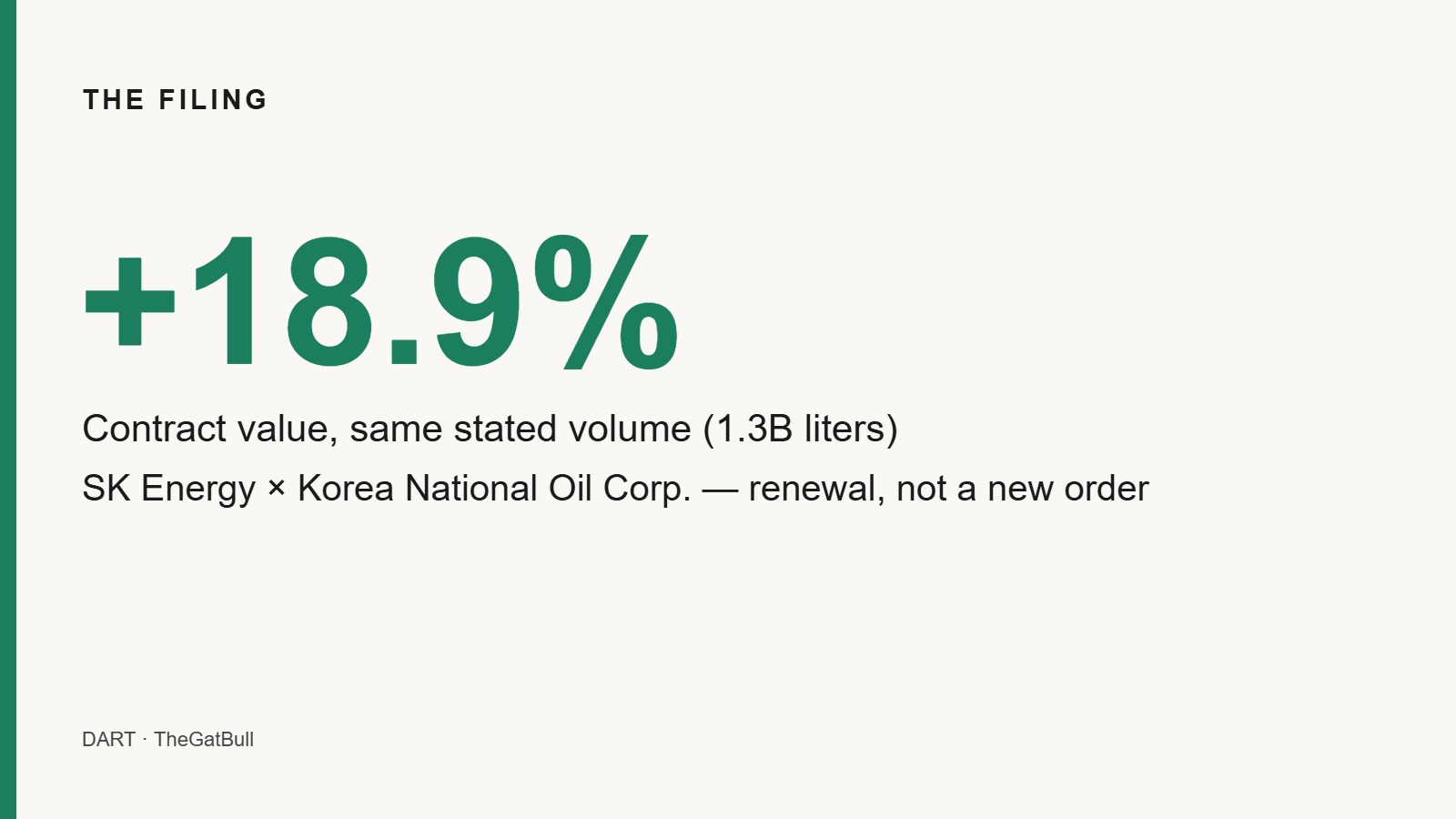
Short answer. On September 28, SK Energy’s fuel supply contract with Korea National Oil Corporation was disclosed at ₩2.207 trillion (about $1.63 billion), up 18.92% from the previous contract. But the 2025 and 2026 filings state the same volume: 1.3 billion liters, plus or minus alpha (“alpha” is the filing’s wording for an unspecified margin). This is a renewal with a bigger number on the same stated volume, not new business.
Basis: contract figures are from the original DART filings and are company-reported. The dollar figure uses ₩1,356.7 per $1, the Seoul 15:30 close on September 29, 2026. No share prices are used in this article.
1. What was filed on September 28
On Monday, September 28, 2026, SK Innovation and SK Inc. each filed a “single sales and supply contract” disclosure, flagged as a subsidiary’s major management matter. The company that actually signed the contract is SK Energy, a subsidiary of SK Innovation. The counterparty is Korea National Oil Corporation (KNOC), a state company whose capital is provided by the Korean government under the Korea National Oil Corporation Act.
The contract is called a “petroleum products joint purchase supply contract.” It covers gasoline, kerosene and diesel for domestic sale nationwide, runs from October 1, 2026, to September 30, 2027, and is valued at ₩2,207,072,053,000 including value-added tax. The filing puts that at 5.62% of revenue. The contract period starts today, October 1.
The filing says this is a renewal of the contract disclosed on July 15, 2025, “automatically extended by agreement of both parties.” It is a renewal, not a new order.
2. Side by side with last year’s contract
| Item | July 15, 2025 filing | Sept 28, 2026 filing |
|---|---|---|
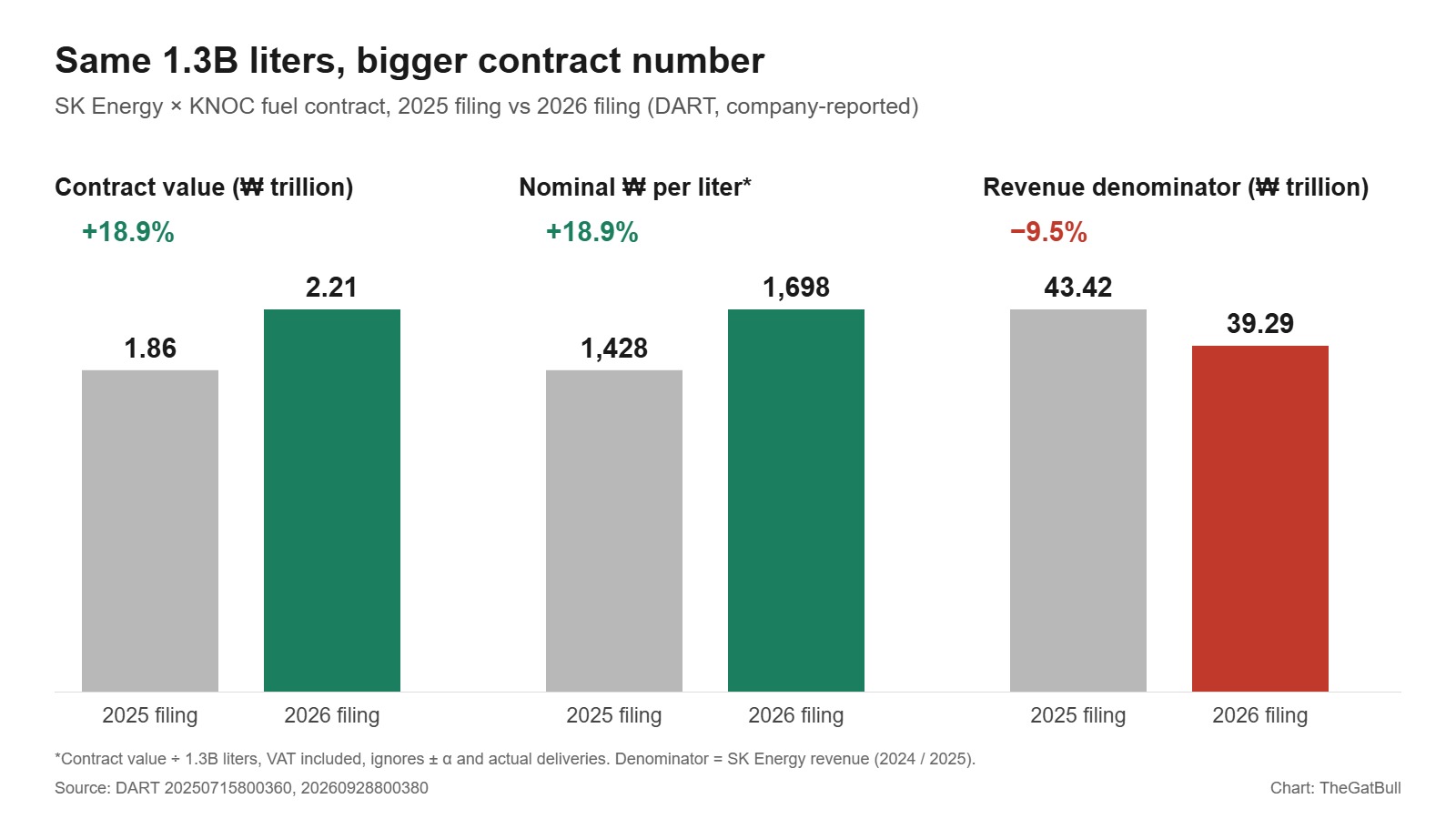
| Contract value | ₩1,855,876,100,000 | ₩2,207,072,053,000 |
| Stated volume | Expected volume 1,300,000,000 L ± α | Bid volume 1,300,000,000 L ± α |
| Period | Oct 1, 2025 – Sept 30, 2026 | Oct 1, 2026 – Sept 30, 2027 |
| How the amount was calculated | Expected volume and 2024 average international product prices | Volume and sales over the prior year |
Source: original DART filings, company-reported.
The arithmetic: the contract value is up 18.92%. Divide each by the same 1.3 billion liters and the nominal amount per liter goes from about ₩1,428 to about ₩1,698. That includes VAT and ignores the “± α” and actual deliveries; it is arithmetic, not a price.
This is where to slow down. The two filings describe the calculation differently. Last year’s says it used 2024 average international product prices. This year’s says only that it was calculated from the bid volume and sales over the prior year. So the filings alone cannot tell you whether the 18.9% comes from higher prices or from a change in how the number was built. Both filings say the reference price is the international oil market price, and that the amount can change with oil prices, actual volumes, selling prices and exchange rates. (Seoul market-close reports on September 29 said oil was above $93 a barrel. That is press-reported, not confirmed from a primary source, and we do not link it to the year this contract was priced on.)
3. One contract, two filings: whose revenue is the 5.62%?
SK Energy signed the contract, but the disclosures came from SK Innovation (the parent) and SK Inc. (the holding company above it). In Korea, a listed parent files major matters of its subsidiaries under its own name (we did not check the rule text); both 2026 filings carry that label.
The two 2026 filings list the same “recent revenue” of ₩39.29 trillion (2025, consolidated), so both show the same 5.62%. That ₩39.29 trillion is not the revenue of SK Innovation or SK Inc., the companies whose names are on the filings. It is the revenue of SK Energy, the subsidiary that signed the contract. SK Innovation’s consolidated revenue was reported at ₩19.7 trillion for the fourth quarter of 2025 alone (Korea Economic Daily), so its full-year figure is far larger than ₩39.29 trillion. So if you read the 5.62% as “5.62% of SK group revenue,” you will be wrong: it is the contract amount divided by SK Energy’s own revenue.
The denominator also moves each year. Last year’s 4.27% was measured against 2024 revenue of ₩43.42 trillion; this year’s 5.62% is against 2025 revenue of ₩39.29 trillion, down 9.5%. The move from 4.27% to 5.62% is the numerator up 18.9% combined with the denominator down 9.5%. Neither part, by itself, shows that more fuel was sold.
4. What the filing does not say
The filing does not say what the fuel is for. It gives only the name “joint purchase” and the counterparty, KNOC, with its relationship to the company listed as “-“. KNOC has in the past picked fuel suppliers for Korea’s government-backed discount gas station network (“Alddle”) through tenders (2019 press report), but that was a different contract in a different year. We could not confirm whether this contract is that supply — not confirmed.
SK Energy also has a separate petroleum joint-purchase contract with Korea Expressway Corporation (filed July 16, 2025, running to September 30, 2027, about ₩1.94 trillion on a one-year basis). That much is visible from the filings alone: two public-sector buyers, KNOC and Korea Expressway, are large customers of this business. The two contracts use different base years for their amounts, so we do not add them up.
One more detail. Last year’s filing said it would be re-filed if the period was extended, and this filing is that re-filing. This year’s filing says the contract “ends on September 30, 2027” and does not repeat the wording about further automatic extension. Whether that is a change in the contract or just different wording is an observation, not a confirmed finding.
5. What this tells you about the Korean market
This is the fact about the Korean market you only see by looking at this contract: in this filing, the big number is not booked revenue. It is a contract amount whose basis the filings describe differently from year to year. A renewal at the same stated volume can still show up as +18.9%, and here one subsidiary’s contract appears in two listed parents’ filings, with a percentage measured against the subsidiary’s revenue.
Korean listed companies must file a single sales or supply contract when it reaches 10% of recent revenue, or 5% for large companies with ₩2 trillion or more in assets (as reported by the Korean press; we did not check the rule text). That is why renewals and new orders appear under the same title. When a Korean headline says “₩2.2 trillion contract,” check three things: Is it a renewal? Did the volume grow? Whose revenue is the percentage measured against? Read together, the filings point to three answers: a renewal, the same stated volume, and a denominator that appears to belong to the subsidiary SK Energy, not the companies on the filing.
6. How a US investor is exposed
- EWY: SK Inc. 0.73% and SK Innovation 0.41% (iShares, as of September 29, 2026). No line in EWY reflects this contract directly, and the weights are small.
- Direct: SK Innovation (096770) and SK Inc. (034730) both trade on the Korea Exchange. We could not confirm a US-listed ADR for either.
Not a perfect parallel. US companies have no fixed revenue-percentage trigger for disclosing a sales contract; they file an 8-K under Item 1.01 when they judge a non-ordinary-course agreement material. So in the US a renewal like this is not automatically disclosed. In Korea, for a large company, crossing 5% of revenue is enough to require a filing, renewal or not (per Korean press; rule text not checked).
7. What to watch
- September 30, 2027: this contract and the Korea Expressway Corporation contract both end the same day. That is the next re-filing point.
- The 2026 annual report (March 2027): the day the denominator for the next filing’s percentage changes.
- Quarterly results: how actual volumes and selling prices, not the contract value, show up in revenue.

Under the Gat. When a big number shows up in a Korean filing, the reflex is to shout “new order.” Today’s number is +18.9%, on the same 1.3 billion liters. The filing does not show more fuel sold; the same stated volume got a bigger number. Remember three questions: Is it a renewal? Did the volume grow? Whose revenue is the denominator?
The conclusion
- The same stated 1.3 billion liters came out 18.9% larger in contract value.
- The filing says it is a renewal but does not say why the amount grew.
- The 5.62% is measured against SK Energy’s revenue, not the revenue of the companies whose names are on the filings.
More on what is inside EWY: EWY’s concentration. Another Korean filing read line by line: Hanwha Aerospace and Korea’s disclosure deadline. Background on Korean refiners: Korean refiners, myth vs. real.
FAQ
Is SK Energy’s ₩2.2 trillion contract a new order?
No. The filing calls it a renewal of the contract disclosed on July 15, 2025, automatically extended by agreement of both sides. It runs from October 1, 2026, to September 30, 2027.
Why did the contract value rise 18.9%?
The filings do not let you break it down. The volume figure is identical in both years; the wording of the calculation basis differs, and so does the volume label (“expected” versus “bid”). The filing itself says the amount can change with oil prices, actual volumes, selling prices and exchange rates.
Is the 5.62% of revenue measured against SK Inc.’s revenue?
No. The ₩39.29 trillion revenue figure in the two 2026 filings (SK Inc. and SK Innovation) is the 2025 consolidated revenue of SK Energy, the subsidiary that signed the contract. SK Innovation’s own consolidated revenue is much larger.
Can a US investor get exposure to this contract?
Only indirectly. Inside EWY, SK Inc. is 0.73% and SK Innovation is 0.41% (iShares, as of September 29, 2026). SK Energy, the contracting company, is not separately listed.
Sources
2026 contract: DART 20260928800431 (SK Inc.) · DART 20260928800380 (SK Innovation) · 2025 contract: DART 20250715800360 · DART 20250715800342 · Korea Expressway contract: DART 20250716800464 · KNOC ownership: Korea National Oil Corporation Act, Article 4 · SK Innovation Q4 2025 revenue: Korea Economic Daily · Disclosure thresholds: Etoday · EWY weights: iShares EWY holdings, as of September 29, 2026 · Alddle supplier tender (2019, different contract): Dailian
Confidence
| Item | Strength |
|---|---|
| Contract values, volume, period, renewal wording, 5.62% and ₩39.29T | [primary] — DART filings, company-reported |
| ₩39.29T is SK Energy’s revenue, not SK Innovation’s | [derived] — subsidiary filing format plus SK Innovation’s reported Q4 2025 revenue |
| KNOC capital contributed by the government | [primary] — KNOC Act, Article 4 |
| Parent files for subsidiary’s major matters | [reported] — filing label; rule text not checked |
| 10% / 5% disclosure thresholds | [reported] — Korean press; rule text not checked |
| EWY weights | [primary] — iShares, as of Sept 29, 2026 |
| What the fuel is used for · US ADR for SK Innovation or SK Inc. | not confirmed |
This article is for informational purposes only and is not investment advice. Figures are as of the dates shown. Do your own research.
 Written by Mr.Gat — TheGatBull
Korean market coverage from a Seoul-metro-based operator who reads the filings in the original language. Every price on this site is the KRX regular-session close (15:30 Seoul); every figure states whether it came from a primary filing, the press, or our own calculation. Drafts are AI-assisted, then verified against the original Korean documents and edited by a human before publishing.
Found an error? Tell us — corrections get priority. How we work →