Not financial advice. TheGatBull does not provide investment advice.
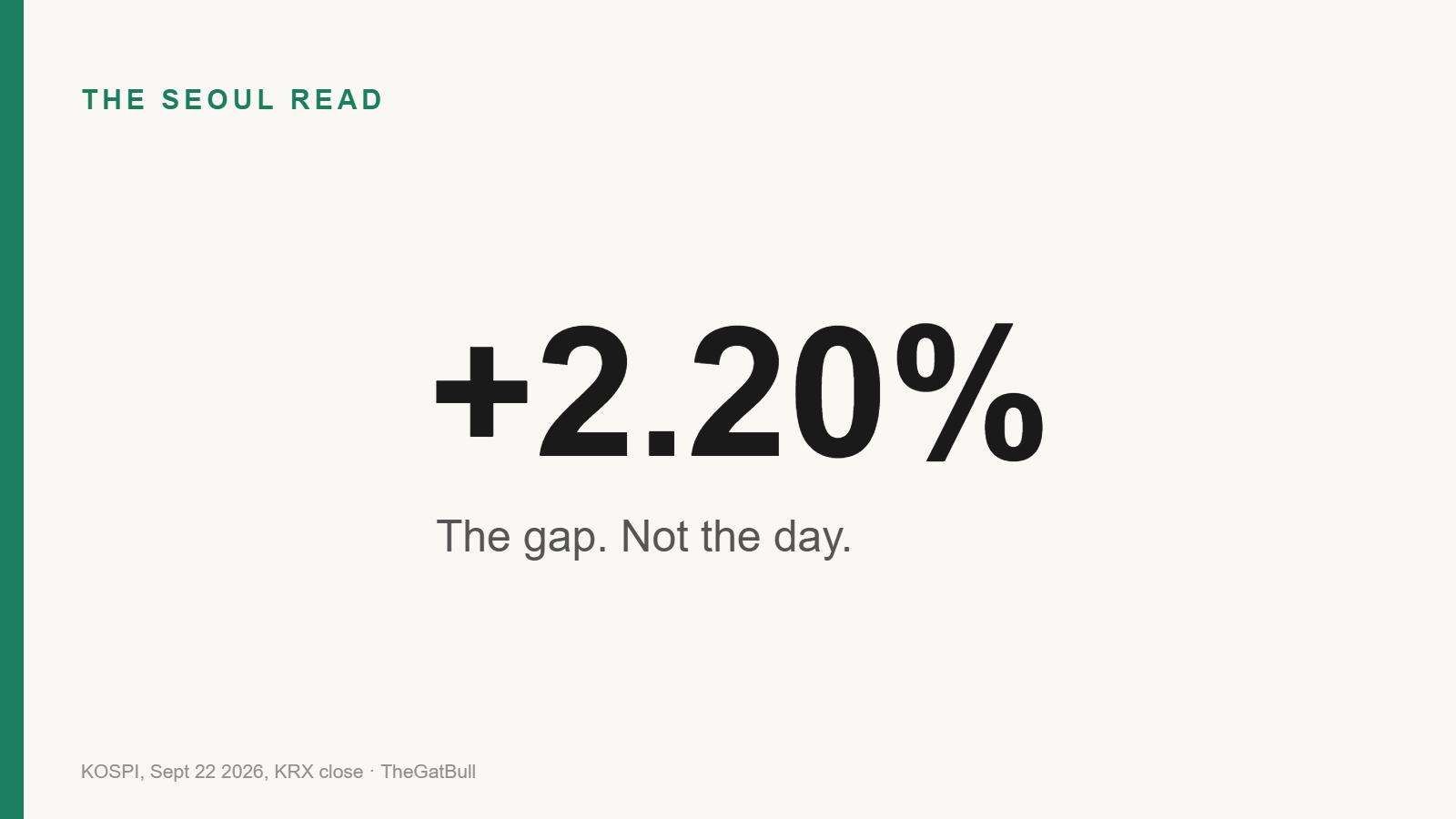
Seoul opened at +2.20% today and closed at +0.15%. The gap was written while the market was shut; the giveback was written while it was open. And the biggest giveback was the index’s largest stock.
The short answer
On Tuesday, September 22, 2026, the KOSPI gapped up from its prior close of 7,007.72 to open at 7,161.61, and closed at 7,017.91. Gap +2.20%, the part Seoul made for itself −2.01%, day +0.15%.
The largest giveback was SK Hynix — it took a +2.19% gap, lost 3.61% in its own session, and finished the day at −1.50%. That stock is 24.54% of EWY.
And on the same day, the Bank of Korea wrote in its September 2026 Financial Stability Report that risk could be amplified if a downturn in IT and semiconductor conditions coincides with worsening external financial conditions. Press-reported, not confirmed from a primary source.
Seoul now has one session left. September 24 (Thursday) and 25 (Friday) are Chuseok closures, and with the weekend that is four consecutive non-trading days, September 24 to 27. Trading resumes Monday, September 28.
What this means for EWY holders
Your EWY rose 4.33% in the US session of Monday, September 21 ($181.31 to $189.16). Seoul took that signal the next morning as a gap up, and gave most of it back during the day. New York’s answer to Seoul’s September 22 does not exist as we write — the US September 22 session has not opened.
From Thursday, Seoul produces no new close for four days. What happens to EWY during those four days is the subject of tomorrow’s piece. Today’s article gives you the dates only.
1. What actually happened in Seoul — one number will not show it
Summarize the session in one line and you get “KOSPI up 0.15%.” That line explains almost nothing about what this market did today.
A Seoul day splits into two pieces.
- The gap — prior close to today’s open. This is what happened while Seoul was shut.
- The own session — today’s open to today’s close. This is the trading Seoul actually did.
Today those two pieces pointed in opposite directions.
| Gap (while closed) | Own session (while open) | Day | |
|---|---|---|---|
| KOSPI | +2.20% | −2.01% | +0.15% |
| KOSDAQ | +1.18% | −1.39% | −0.23% |
| Samsung Electronics | +3.28% | −2.30% | +0.91% |
| SK Hynix | +2.19% | −3.61% | −1.50% |
KRX regular session, 2026-09-22, all won closes. Check: KOSPI 1.0219596 × 0.9799346 = 1.0014540. Gap and session multiply; they do not add.
Not one of the four is an exception. All four opened higher, and all four fell in their own session.
The intraday path is sharper still. The KOSPI’s intraday high was 7,171.44, and the close sits 2.14% below it. The intraday low of 6,986.27 was under the prior close of 7,007.72 — the whole gap was given back and then some, before the last stretch left +0.15% standing. Highs and lows are intraday values and are not promoted to closes.
Why it gave back is not something this article will say. We could not obtain the investor-type flows, and we did not verify any press explanation. What we can tell you is what happened.
2. Under the Gat — Seoul did not write its own opening price
Start with something a US reader knows. The S&P 500 gaps up and gives it back by the close — not a rare day.
The difference is the clock. In the US, overnight futures run continuously and build the opening price. Seoul does not work that way. It opens four hours after the New York regular session closes (16:00 ET = 05:00 KST). In between, there is no US trading left to make a new price.
So Seoul’s opening price is structurally close to an answer sheet for New York’s close. And today that answer sheet looked like this: in the US session of Monday, September 21, EWY rose 4.33% ($181.31 to $189.16, volume 14.655 million), and that session ended at 05:00 KST on September 22. Four hours later, Seoul opened with a +2.20% gap.
The order is settled; the cause is not. This article does not say EWY lifted Seoul. We have no flow data, and the two markets have different participants. What can be said is the time order: the US session ended first, and then Seoul’s gap happened. See the piece where this gap-versus-session split was first laid out.
And today’s real information is not the gap. It is the six and a half hours after it. While Seoul was open, this market handed back 91% of what it was given (−2.01% out of +2.20%). To see the market’s judgment rather than the index print, that is where you look.
🎩 Under the Gat — Today the KOSPI rose 0.15%. But this market opened at +2.20% and cut 2.01% off itself. Look at both numbers and you see the day; look at one and you see nothing. On the same day the Bank of Korea wrote that risk is amplified if semiconductor conditions worsen — and the stock cut most today was this index’s semiconductor. The central bank put it in a document and the market demonstrated it intraday, on the same date. From Thursday, for four days, Seoul answers nothing.
Not a perfect parallel — three things differ. First, an S&P gap is built by continuous overnight futures; Seoul’s gap sits on top of a trading vacuum. Second, the top two names in the S&P 500 have never approached 46.5% combined, so a KOSPI giveback rides far more on two stocks. Third, the US market has no four-day regular-session stop.
3. The same day, the central bank wrote down “semiconductors”
The Bank of Korea published its September 2026 Financial Stability Report on September 22. Everything in this section is press-reported and we could not confirm it from the primary source (the BOK document itself).
According to those reports, the Bank of Korea:
- judged that despite the KOSPI’s sharp late-July fall from above 9,000 in June, there were no notable signs of stress in the short-term funding or FX markets;
- ran a stress scenario assuming an equity decline of about 40% from end-June during the third quarter, and found capital ratios across all sectors would fall but stay well above regulatory minimums;
- expected the Financial Stress Index to rise further if equity stress continues, but saw a low probability of exceeding the crisis threshold of 24;
- said equity volatility alone is unlikely to become a systemic risk, but that risk could be amplified if a downturn in IT and semiconductor conditions coincides with worsening external financial conditions.
Now separate what we can check ourselves from what we cannot. The Bank’s “about 40% from end-June” is an assumption. What actually happened can be counted from market data.
| KOSPI | Date | |
|---|---|---|
| Highest close in window | 9,114.55 | 2026-06-22 |
| End-June close | 8,476.48 | 2026-06-30 |
| Q3 lowest close | 5,593.56 | 2026-07-30 — −34.01% from end-June |
| Q3 intraday low | 5,262.77 | 2026-07-29 (intraday) — −37.91% |
| Today’s close | 7,017.91 | −23.00% from the June 22 closing high |
Window = one-year lookup, 2025-09-22 to 2026-09-22. The window’s first day is a lookup boundary, so we do not use superlatives like “lowest ever.”
So the −40% the Bank of Korea ran as a stress test is something this market did for real, at −34%, two months ago. Assumptions and realized values must not be mixed, so to nail it down again: −40% is the Bank’s assumption, −34.01% is the realized value confirmed on closes.
One note on a figure we did not use. Press coverage of the report described the KOSPI as having fallen to “the 5,000 line” in late July. Our market-data reading puts the Q3 lowest close at 5,593.56 and the intraday low at 5,262.77. We use the market-data values and do not quote the “5,000 line” phrasing.
And today, the exact sector the Bank flagged as a tail risk was the one cut most during the session. SK Hynix, own session −3.61%. This must not be read as causation — the report was published before the close, but there is no evidence the market moved because of it. That two things happened on the same day is where the fact ends.
4. The calendar — Seoul has one session left
| Date | Day | Korea (KRX) |
|---|---|---|
| September 22 | Tue | Traded (today) |
| September 23 | Wed | Last trading day of the week |
| September 24 | Thu | Closed (Chuseok) |
| September 25 | Fri | Closed (Chuseok) |
| September 26–27 | Sat–Sun | Weekend |
| September 28 | Mon | Reopens |
The KRX stop runs four consecutive days, Thursday September 24 through Sunday September 27, and trading resumes Monday, September 28.
Confidence: the September 24 and 25 closures are from our own annual scheduling calendar. The September 28 reopening is press-reported, quoting the exchange — we did not read the primary KRX notice. The 2026 Chuseok holiday falls on Thursday, Friday and Saturday (September 24 to 26) and does not overlap a Sunday, so no substitute holiday applies. Press-reported, not confirmed from a primary source.
One more thing closes earlier. The Korea Exchange announced on September 9 that derivatives night trading, scheduled to run 18:00 on September 23 to 06:00 on September 24, will not operate. Press-reported, quoting the exchange’s own announcement. The reason is straightforward: running it normally would push settlement to September 28, the first trading day after the holiday, leaving investors unable to close positions even if overseas markets move sharply in between. The products covered are KOSPI 200, mini KOSPI 200 and KOSDAQ 150 futures and options, weekly options, USD futures, and 3-year and 10-year government bond futures. Our earlier piece on where Korea’s night session sits against the US clock has the mechanics.
Whether the equity after-market (to 20:00, in force since September 14) runs on September 23 we could not confirm. This article speaks only about derivatives night trading. On the regular close itself, the 15:30 print is the close.
So the thing to watch narrows to one item. Wednesday is the only session in which Seoul has to decide whether to carry four days of risk, and that day’s 15:30 close becomes Korea’s last official price until the first week of October.
What happens to EWY during those four days is tomorrow’s piece. Today’s stops at the dates.
5. How a US investor reaches this market
Three routes. EWY — the NYSE Arca-listed ETF, which as of the iShares holdings dated September 18, 2026 is 24.54% SK Hynix plus 21.97% Samsung Electronics, 46.51% in the top two. ADR and OTC — SK Hynix trades over the counter as an unsponsored line, not a formal ADR. Direct KRX — through a broker with direct Korean market access. The details of each are in our standing guide to buying SK Hynix from the US.
For price sense: SK Hynix ₩1,840,000 is about $1,367 and Samsung Electronics ₩276,500 is about $205, at ₩1,345.9 per dollar (Seoul 15:30 close, September 11, 2026). The September 22 rate could not be obtained.
And returns in different currencies are not subtracted from each other: the KOSPI is +66.53% year to date in won, and EWY is +91.81% year to date as a dollar price return. Setting the two side by side with their labels is the honest display; turning the difference into a number invents a fact that is not there.

6. What this says about the Korean market
The structural fact today gives you is this: Seoul’s daily percentage change was not made by Seoul, and what Seoul actually did was take it back. Read +0.15% plainly and you get a quiet Tuesday. Split it and you get a Tuesday that took +2.20% and cut 2.01% off it — not quiet at all. And the thing cut most was this index’s semiconductor, on the same day the central bank named that sector as the tail risk.
One Wednesday is left, and after that this market answers nothing for four days.
FAQ
Why did the KOSPI open higher and close flat?
Split the day into the gap (prior close to open) and the session itself (open to close). On September 22, 2026 the KOSPI had a gap of +2.20%, an own session of -2.01%, and a day of +0.15%. We do not assert a reason — we could not obtain the investor-type flows.
Does the US market set Seoul’s opening price?
The order looks that way, but the cause is not confirmed. The US session of Monday September 21 ended at 05:00 KST on September 22, and Seoul opened four hours later with a +2.20% gap. EWY was +4.33% in that US session. The time order is settled; whether it is the cause is outside this article.
When does the Korean stock market reopen after Chuseok?
Monday, September 28, 2026. KRX is closed Thursday September 24 and Friday September 25 for Chuseok, and with the weekend that is four consecutive non-trading days, September 24 to 27. The 2026 Chuseok holiday does not overlap a Sunday, so September 28 is not a substitute holiday. Press-reported, not confirmed from a primary source.
Is night trading also closed before the holiday?
Derivatives night trading is closed for the 18:00 September 23 to 06:00 September 24 window. Press-reported, quoting the exchange. The stated reason is to avoid pushing settlement to September 28. All night derivatives products are covered. Whether the equity after-market runs on September 23 we could not confirm.
Did the Bank of Korea say the stock market is dangerous?
That reads too far. Press-reported, not confirmed from a primary source: the Bank of Korea judged that equity volatility alone is unlikely to become a systemic risk, but said the risk could be amplified if a downturn in IT and semiconductor conditions coincides with worsening external financial conditions. That is a conditional warning, not a forecast.
Sources
- KRX regular-session closes and OHLC (KOSPI ^KS11, KOSDAQ ^KQ11, Samsung Electronics 005930.KS, SK Hynix 000660.KS), 2026-09-22 — Yahoo Finance chart API, fetched directly. Currency KRW, exchange tags KSC and KOE, timezone Asia/Seoul, regularMarketTime 2026-09-22 15:32 KST. Confirmed from market data, vendor-tagged — this is a vendor tag, not an exchange-published original.
- EWY closes (2026-09-18 and 09-21) — Yahoo Finance chart API, fetched directly. Confirmed from market data.
- EWY weights (SK Hynix 24.54%, Samsung Electronics 21.97%, as of 2026-09-18) — iShares MSCI South Korea ETF holdings. Confirmed from the issuer.
- Bank of Korea, September 2026 Financial Stability Report (published 2026-09-22) — press-reported, not confirmed from a primary source. We could not read the BOK document itself.
- Derivatives night-trading closure on September 23 and the September 28 first trading day — press-reported, quoting the exchange’s September 9 announcement. We did not read the primary KRX notice.
- No substitute holiday on September 28, 2026 — press-reported, not confirmed from a primary source.
- September 24 and 25 KRX closures — TheGatBull annual scheduling calendar.
- Won–dollar conversion — ₩1,345.9 (Seoul 15:30 close, September 11, 2026). The September 22 rate could not be obtained.
- Not claimed: why the market gave the gap back; the September 22 investor-type flows; whether the equity after-market runs on September 23; any causal link between the Bank of Korea report and the session.
Not financial advice. This article is for information only. TheGatBull and its author hold no position in the securities mentioned unless disclosed. Confidence labels are as of publication.
 Written by Mr.Gat — TheGatBull
Korean market coverage from a Seoul-metro-based operator who reads the filings in the original language. Every price on this site is the KRX regular-session close (15:30 Seoul); every figure states whether it came from a primary filing, the press, or our own calculation. Drafts are AI-assisted, then verified against the original Korean documents and edited by a human before publishing.
Found an error? Tell us — corrections get priority. How we work →