Not financial advice. TheGatBull does not provide investment advice.
On September 21, Seoul took the KOSPI back above 7,000. Hyundai Motor, Kia and Hyundai Mobis all fell. And this is not a one-day story.
The short answer
On Monday, September 21, 2026, the KOSPI closed at 7,007.72, up 1.65% from the previous session (September 18, 6,894.23). That is the first close above 7,000 since September 10 — our lookup window was the last one month, and we did not check further back, so we are not calling it a first or a record.
Same day, same exchange:
| Prev close | Sept 21 close | Change | |
|---|---|---|---|
| KOSPI | 6,894.23 | 7,007.72 | +1.65% |
| Hyundai Motor (KRX: 005380) | ₩365,000 | ₩359,000 | −1.64% |
| Kia (KRX: 000270) | ₩121,900 | ₩120,000 | −1.56% |
| Hyundai Mobis (KRX: 012330) | ₩379,000 | ₩373,000 | −1.58% |
All values are KRX regular-session closes at 3:30 PM KST, in won. At the September 11 Seoul close of ₩1,345.9 per dollar, that is roughly $267, $89 and $277. We could not obtain the September 21 rate, so we hold the September 11 rate fixed and say so.
The index rose 1.65% while all three stocks fell by about 1.6%. The signs are opposite, and the sizes are nearly symmetric.
We are not going to tell you why they fell. We could not obtain that day’s investor-flow breakdown, and we did not confirm any press explanation. Not writing an unconfirmed cause as a cause is the rule here. So instead we write what can be checked — starting with the fact that this was not a one-day event.
What this means for EWY holders
Inside EWY — the iShares MSCI South Korea ETF — Hyundai Motor is 1.53% and Kia is 1.03%, for 2.56% combined. In the same fund, SK Hynix and Samsung Electronics together are 46.51%. Hyundai Mobis is 0% — not a small weight, but absent from the holdings list. (iShares holdings, as of September 18, 2026.)
Not a day — the shape of the whole year
| Dec 30, 2025 close | Sept 21, 2026 close | Year to date | |
|---|---|---|---|
| KOSPI | 4,214.17 | 7,007.72 | +66.29% |
| Hyundai Motor | ₩296,500 | ₩359,000 | +21.08% |
| Kia | ₩121,800 | ₩120,000 | −1.48% |
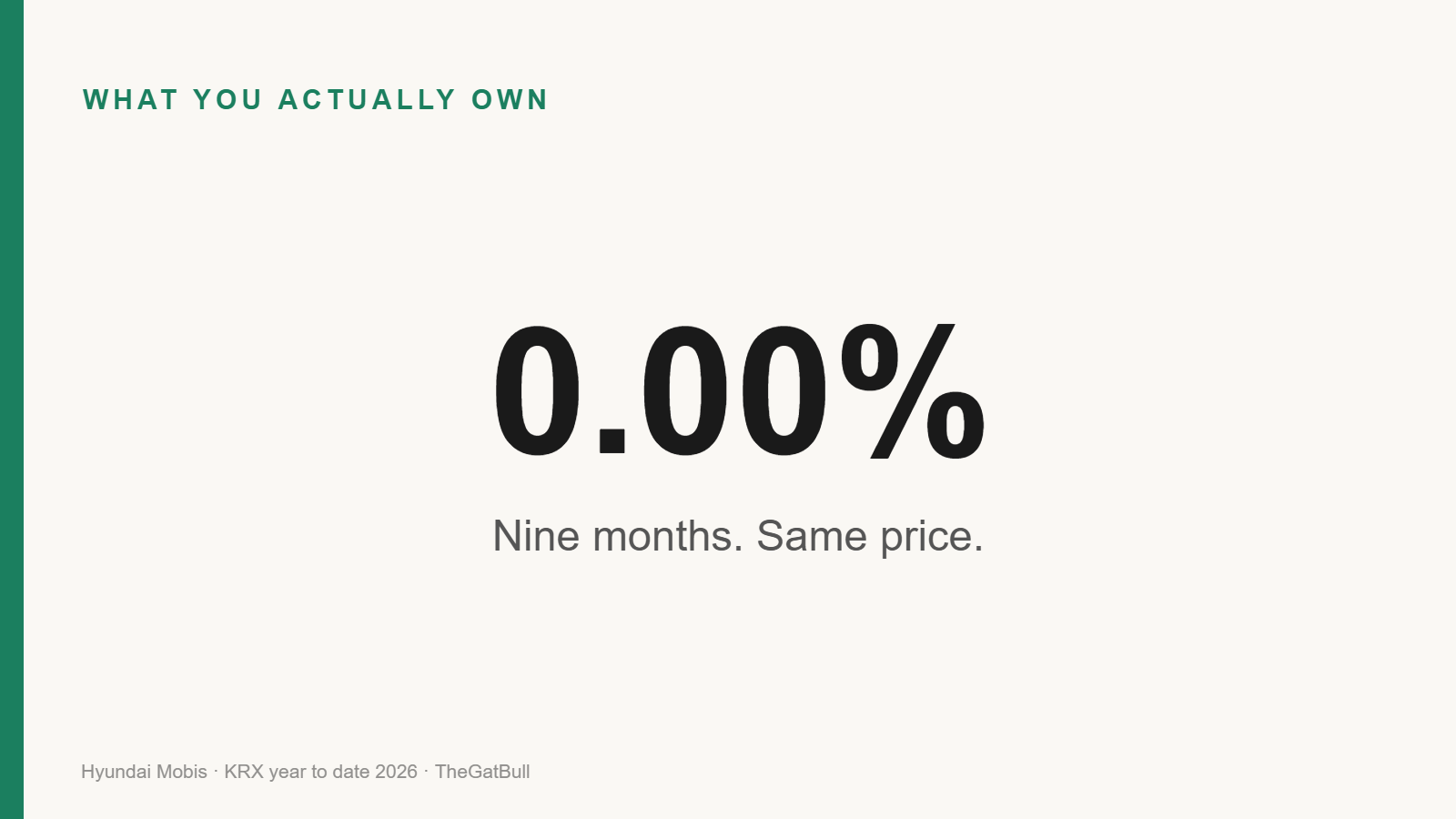
| Hyundai Mobis | ₩373,000 | ₩373,000 | 0.00% |
| KOSDAQ | 925.47 | 836.27 | −9.64% |
Every line is won-denominated, KRX closes, measured from the same December 30, 2025 anchor. One basis, so subtracting them is fair. Which lets us say this: the gap between the KOSPI and Hyundai Motor is 45.21 percentage points.
Now look at Mobis again. It started at ₩373,000 and it is at ₩373,000. Nine months went by and the price is the starting point. Not rounded to zero — the same number.
But the index is also a long way below its own high
Against the highest close of the last year (September 22, 2025 to September 21, 2026):
- KOSPI — 9,114.55 (June 22, 2026), now −23.11%
- Hyundai Motor — ₩750,000 (June 1, 2026), now −52.13%
- Hyundai Mobis — ₩768,000 (May 29, 2026), now −51.43%
- Kia — ₩206,000 (February 26, 2026), now −41.75%
Notice first that the peak dates are all different. Kia peaked in February, Mobis in May, Hyundai Motor on June 1, the index on June 22. Read them as “down from the same day’s high” and you read them wrong. They lived on four different calendars.
We left the lows out. The one-year lowest closes for Hyundai Motor, Kia and the KOSPI all cluster near September 26, 2025, the first day of our window — widen the window by a single day and the numbers change. We do not build phrases like “lowest in a year” out of values sitting on the edge of a lookup window.
The precise sentence: the index is also down 23% from its own high. Hyundai Motor is down 52%.
Split Monday into its two halves
The gap (prior close to open), then the session itself (open to close):
| Gap | Own session | Day | |
|---|---|---|---|
| KOSPI | +0.64% | +1.00% | +1.65% |
| Hyundai Motor | +0.14% | −1.78% | −1.64% |
| Kia | −0.33% | −1.23% | −1.56% |
| Hyundai Mobis | +0.40% | −1.97% | −1.58% |
How to read it: you multiply the gap and the session, you do not add them. Hyundai Motor, 1.001370 × 0.982216 = 0.983562 = −1.64%. All four lines were checked this way.
Hyundai Motor and Mobis both opened higher. Then, across the six and a half hours Seoul actually traded them, they gave up 1.78% and 1.97%. Hyundai Motor’s high for the day was its opening price of ₩365,500 — the first moment of the session was the most expensive moment of the day — and it closed at ₩359,000, near its ₩358,500 low. Mobis’s ₩380,500 open was also its high. (Highs and lows are intraday values and are never mixed with closes.)
We will not tell you what that means. We did not confirm who was selling. It is an observed fact, not a confirmed conclusion.
Which line of the income statement policy sits on
Both items below are as reported by the companies. We did not pull fresh regulatory filings for this piece — these are quoted from previously published, already-verified work.
- Revenue went up, operating profit went down. Kia’s second-quarter 2026 revenue was ₩33.037 trillion (+12.6%, a quarterly record), operating profit ₩2.6285 trillion (−4.9%), operating margin 8.0% (−1.4 percentage points). Company release, July 24, 2026.
- The largest single item behind the difference was tariffs. Kia’s first-half cumulative bridge: tariffs −₩783.0 billion, incentives −₩723.0 billion, FX and warranty −₩372.0 billion, mix −₩178.0 billion. Hyundai Motor carried ₩1.8 trillion in first-half tariff costs.
Look at which line of the income statement a policy sits on and the year explains itself. The US tariff does not sit on the revenue line; it sits on the operating profit line. That is how a company posts record revenue and lower profit in the same quarter.
Korea’s Value-up policy does not sit on the income statement at all — it sits on the equity line. Hyundai Motor cancelled ₩789.0 billion of treasury shares in August, and we recorded at the time that the cancellation used existing treasury stock, creating no new buying demand, and that the stock fell for two sessions straight right after the announcement.
One company sits between two policies. One cuts the profit, the other cuts the share count. This year, the price sided with the first one.
What we can and cannot tell you about the flows
“Who sold today” is a question we do not answer. We could not obtain the net buy and sell figures by investor type, and we do not fill an unobtained number with an estimate.
One thing, in time order: in the US, EWY closed at $181.31 on September 18, down 0.59% from $182.39. That value came from a US session that opened after Seoul’s September 18 session had already closed. And New York’s answer to Seoul’s September 21 does not exist yet as we write — the US market has not opened.
So do not pair EWY’s day with the KOSPI’s day by date and subtract. The two markets’ days do not begin at the same time.
What this says about the Korean market
EWY holdings (iShares disclosure, September 18, 2026): SK Hynix 24.54% · Samsung Electronics 21.97% · SK Square 2.93% · Samsung Electro-Mechanics 2.49% · KB Financial 1.98% · Shinhan 1.61% · Hyundai Motor 1.53% · Hana Financial 1.32% · Doosan Enerbility 1.30% · Kia 1.03% · Hyundai Mobis absent.
Read directly from the fund’s own disclosed holdings file. The 3.10% won cash line is omitted. We do not state a holdings count, because the fund page’s summary number and the row count in the holdings file do not agree.
- Two semiconductor names are 46.51%. A little under half of a fund carrying the name “Korea” is two memory companies.
- The two carmakers of Korea’s largest auto group come to 2.56% combined. One eighteenth of the top two.
- Hyundai Mobis is not there. Not a small weight — not on the list. Why it is not there, and how the MSCI Korea 25/50 inclusion methodology worked in this case, we did not confirm, so we do not write it. What is confirmed is only the absence.
Which explains this year’s numbers. While the KOSPI was +66.29%, EWY’s value rose more — EWY is +83.85% year to date on a dollar price return. The more concentrated side rose more. Different currency, different index, so we read only the direction and do not subtract the two.
Concentration worked in your favor this year. But concentration does not choose the direction. Nothing guarantees that a structure which paid last year pays this year too.

🎩 Under the Gat — When you say you “bought Korea,” 46.5% of what you bought is two memory-chip stocks. Korea’s largest auto group is 2.56% of it, and that group’s parts company is 0%. Today the index rose 1.6% and all three of them fell. The index is not wrong. The label is just not helping you.
How a US investor reaches these three
The structure is not unfamiliar to a US reader. In the S&P 500 too, the index label and the actual engine have been parting ways for several years now.
Not a perfect parallel — three things differ. First, what EWY tracks is not the S&P 500 but the MSCI Korea 25/50 Index. Second, the top two names in the S&P 500 have never approached 46.5% combined. Third, US auto-parts makers are in the S&P 500; Hyundai Mobis is not in EWY. “Small weight” and “not there” are different problems.
- 🟢 EWY — holds Hyundai Motor at 1.53% and Kia at 1.03%, but you are buying 46.51% semiconductors at the same time.
- ⚪ Direct KRX — 005380, 000270, 012330, through a broker with Korean market access.
- 🔴 HYMTF — not an ADR but an unsponsored over-the-counter common share, and we did not verify its liquidity. We do not present it as a route in.
What to watch next: how the tariff cost line moves in third-quarter results, and whether these signs hold when Seoul reopens after the Chuseok break. Regular sessions are closed September 24 and 25, and September 28 is a substitute holiday.
FAQ
Is Hyundai Motor in EWY?
Yes – 1.53% as of September 18, 2026. Kia is 1.03%. Hyundai Mobis is not in the holdings list on that same date.
The KOSPI is up 66% this year — why is Hyundai Motor only up 21%?
We do not assert a cause. Two things are confirmed: a large part of this year’s index gain is concentrated in semiconductors, and the carmakers absorbed US tariff costs on the operating profit line.
What were the KOSPI and the Hyundai group stocks on September 21, 2026?
KOSPI 7,007.72 (+1.65%), Hyundai Motor 359,000 won (-1.64%), Kia 120,000 won (-1.56%), Hyundai Mobis 373,000 won (-1.58%). All are 3:30 PM KRX regular-session closes.
Is Hyundai Mobis really exactly 0% year to date?
The December 30, 2025 close and the September 21, 2026 close are both 373,000 won. In between it reached 768,000 won on May 29 and came back.
Does buying EWY give me exposure to Korean autos?
It does. It gives you 2.56%. Two semiconductor names are 46.51% of the same fund, so EWY’s daily move responds far more to memory than to autos.
Can I buy Hyundai Motor shares in the US?
An OTC symbol, HYMTF, exists, but it is an unsponsored OTC common share rather than an ADR, and we did not verify its liquidity in this piece. Direct KRX purchase through a broker with Korean market access is the route we can verify.
When is the Chuseok market closure?
Regular sessions are closed September 24 and 25, with September 28 a substitute holiday. Including the weekend, that is four consecutive non-trading days, September 24 to 27.
Sources
- Close, open, high and low for five instruments (KOSPI, KOSDAQ, Hyundai Motor, Kia, Hyundai Mobis), September 21, 2026 — direct market-data lookup. Currency KRW, exchange tags KSC and KOE, timezone Asia/Seoul, regular session close 3:30 PM KST. Vendor data, not an exchange-published original document.
- Year-to-date baseline: December 30, 2025 closes. One-year high lookup window: September 22, 2025 to September 21, 2026.
- EWY holdings and weights: iShares MSCI South Korea ETF holdings disclosure, as of September 18, 2026.
- EWY closes (US trading days) September 17 and 18, 2026 — direct market-data lookup, in dollars.
- Won–dollar conversion: ₩1,345.9 (Seoul 3:30 PM close, September 11, 2026 — latest confirmed). The September 21 rate could not be obtained, so the September 11 rate is held fixed.
- Kia second-quarter 2026 results and cost bridge, Hyundai Motor first-half tariff cost, Hyundai Motor treasury share cancellation: company releases and Korean media compilations. No new regulatory filing was cross-checked for this piece.
- Not claimed: the September 21 investor-type flows; the cause of that day’s decline; the reason Hyundai Mobis is not in EWY; the September 21 won–dollar rate; third-quarter results for all three companies.
Not financial advice. This article is for information only. TheGatBull and its author hold no position in the securities mentioned unless disclosed. Confidence labels are as of publication.