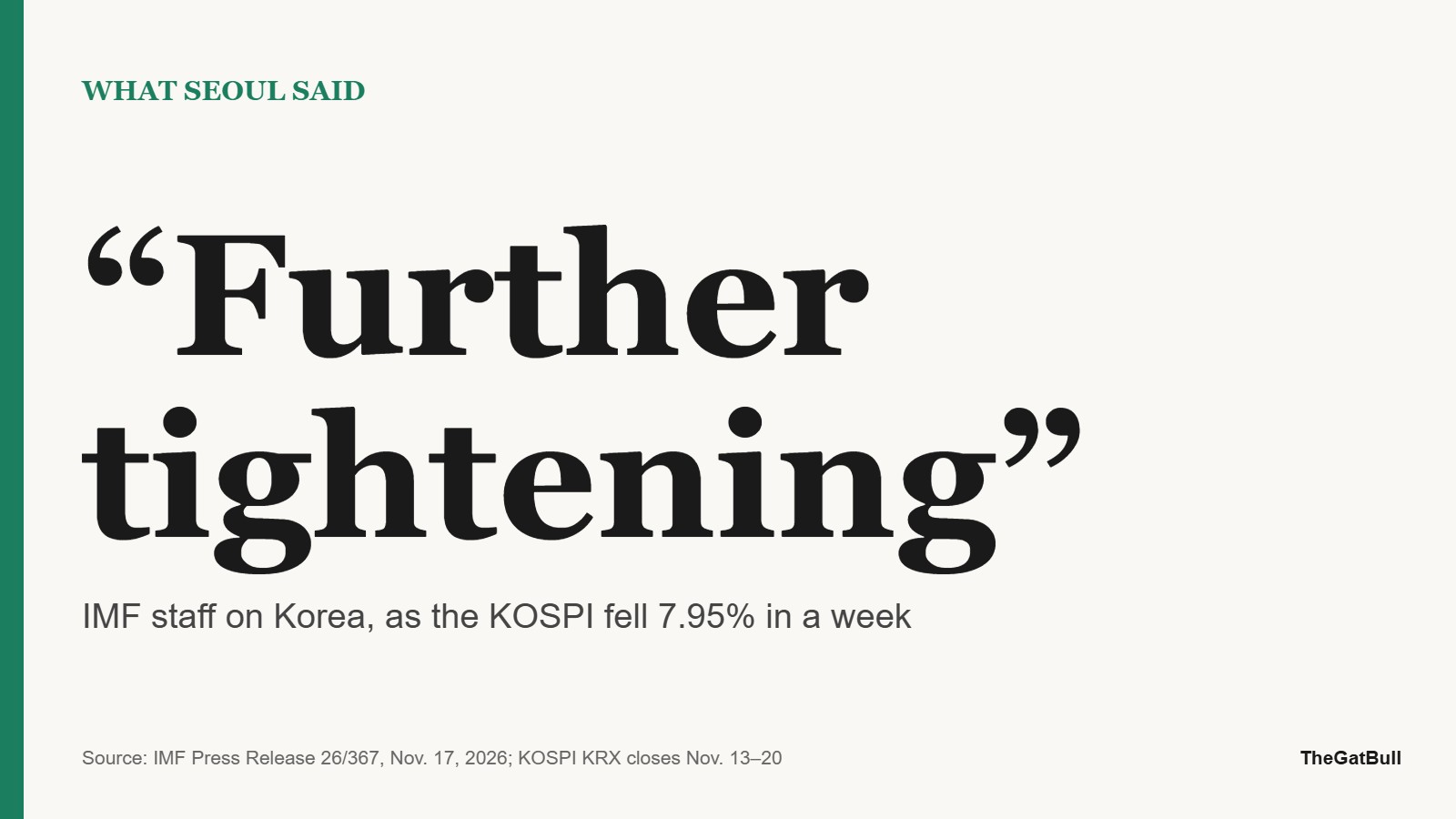
TL;DR — For anyone who holds Korea Exchange stocks or follows Korea’s macro story. Korea’s KOSPI fell 7.95% in the week to Nov. 20 (Seoul close), including a 5.21% drop on Friday that set off automatic five-minute pauses in program selling (“sidecars”) on both the KOSPI and the KOSDAQ. In the same week, IMF staff wrote that “further monetary tightening is appropriate” for Korea, and the Bank of Korea decides on rates on Nov. 26.
I’m Mr. Gat, and this is TheGatBull.
Not financial advice.
Among the official statements we checked, the most consequential on Korea’s economy this week came from the IMF mission on Nov. 17: growth of 3.9% in 2026, inflation above the 2% target, and “further monetary tightening is appropriate.” The KOSPI fell 7.95% that same week. Korean stocks are falling while the economy runs hot, and the next hard data point from Seoul is the Bank of Korea’s rate decision on Nov. 26.
Your Door — if you hold Korea Exchange stocks in a Korean or global brokerage account.
- The Nov. 26 decision is about inflation and growth. Share-price support runs through other tools. Analysts expect a quarter-point hike from 3.00% to 3.25%; that is their estimate, and the Bank of Korea has given no such guidance that we found.
- After the Nov. 6 crash, finance officials held an emergency market meeting the same morning. After the Nov. 20 drop, we found no new government measure as of Saturday morning, Seoul time. We found no date announced for the next one.
Times are Seoul time (KST) unless marked ET; in November, ET is 14 hours behind Seoul. Seoul prices are KRX (Korea Exchange) regular-session closes (3:30 p.m. Seoul) through Friday, Nov. 20, 2026; there is no new close on the weekend. Dollar conversions are for scale only, at ₩1,336.2 per dollar, the Nov. 20 Seoul 3:30 p.m. rate.
How did this week’s sell-off compare with the Nov. 6 crash?
Both Fridays brought drops of similar size, and Seoul handled each day differently.
| Friday, Nov. 6 | Friday, Nov. 20 | |
|---|---|---|
| KOSPI close / day | 5,059.69 / −6.02% | 4,869.96 / −5.21% |
| Market brake | First-stage circuit breaker at 9:03 a.m. (press-reported) | Sell-side sidecars: KOSPI 11:54 a.m., KOSDAQ 1:28 p.m. (press-reported) |
| Government that day | Emergency market meeting of finance officials in the morning; three-month waiver, from Nov. 9, of the rule that brokers hold collateral worth 140% of margin loans | No new meeting, measure or on-the-record market comment that we found, as of Saturday morning, Seoul time |
| Week | Nov. 2–6: −11.71% | Nov. 13–20: −7.95% |
A sidecar pauses computer-driven program orders for five minutes when index futures move 5% or more; a circuit breaker halts all trading. Through the week, the KOSPI closed at 5,100.50 (Monday), 4,968.48, 5,067.44, 5,137.89 and 4,869.96 (Friday). The KOSDAQ fell 7.72% for the week to 645.68. Foreign investors were net sellers of more than ₩1 trillion (about $0.75 billion) of KOSPI stocks on Friday, according to press figures that differ by outlet. Korean media tied the drop to Wall Street losses and worries about AI spending hitting Samsung Electronics and SK Hynix; that explanation is theirs.
Under the Gat (our take). “The two Fridays fell by about the same amount: 6.02% and 5.21%. Seoul’s support measures from the first one are still in place. The margin waiver lasts three months, and on Nov. 13 the Financial Services Commission chairman tied using the stabilization fund to systemic risk. So Seoul may have had nothing new to announce. That is our interpretation; we found no official saying so.”
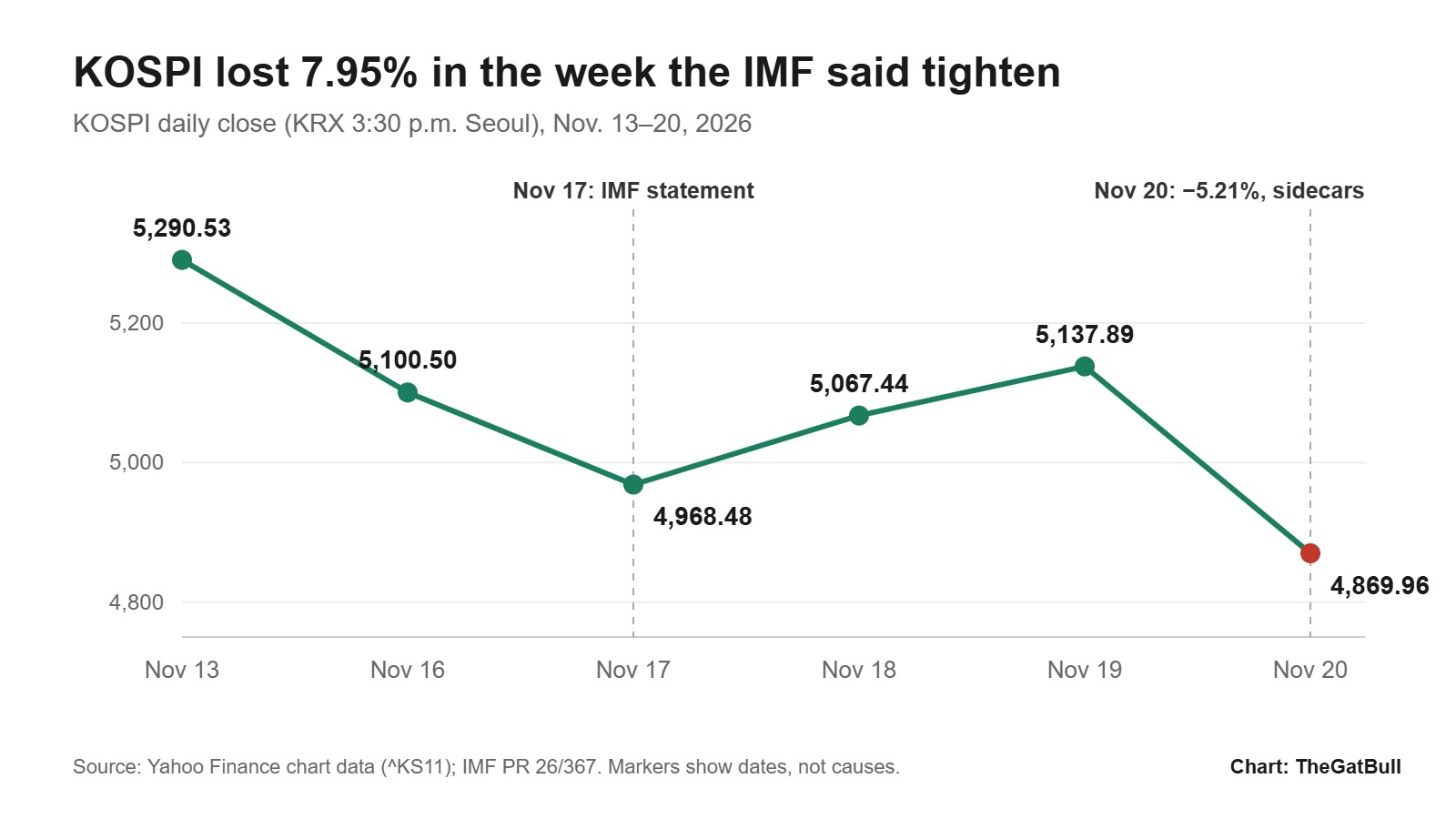
KOSPI closes, Nov. 13 to Nov. 20, 2026. The markers show dates, not causes.
What did the IMF tell Seoul this week?
An IMF team led by Mission Chief Corinne Deléchat held its annual Article IV consultation (the IMF’s yearly check-up of a member economy) in Korea from Nov. 3 to 17, meeting the government, the Bank of Korea and others, and issued its closing statement on Nov. 17. Korea’s Ministry of Economy and Finance published the results the same day. The lines that touch markets:
- Growth: 3.9% in 2026, up from 1.1% in 2025, and 3.3% in 2027. Korean press report the IMF’s October forecasts as 3.3% and 2.8%.
- Inflation: 2.7% in 2026 and 2.3% in 2027, above the 2% target.
- Rates: “Further monetary tightening is appropriate to prevent inflationary pressures from becoming entrenched.”
- Budget: a “somewhat more contractionary fiscal stance” (a tighter budget), with a welcome for Korea’s new Future Response Fund.
- Currency: exchange-rate flexibility should stay the main shock absorber, with intervention limited to preventing disorderly markets.
- Markets: against “heightened financial market volatility,” the authorities’ housing and investor-protection steps helped preserve financial stability.
These are preliminary findings by IMF staff. The IMF Executive Board has not yet weighed in and is scheduled to discuss the report in January 2027. A day later, on Nov. 18, Korea’s state think tank, the Korea Development Institute (KDI), raised its 2026 growth forecast to 3.8% from 3.2% in August, according to Money Today.
Why might the Bank of Korea say little before Nov. 26?
The Bank of Korea’s governor and the members of its rate-setting Monetary Policy Board customarily avoid public comment on policy in roughly the week before a rate meeting; Korean media call it the “silent period.” We did not check a written Bank of Korea rule. With the meeting on Nov. 26, the end of this week falls inside that window, so a lack of Bank of Korea comment says little this week.
The base rate is 3.00%, after hikes in July and August and a hold on Oct. 22. Korean press reported that the October statement kept language on the timing and pace of further hikes. Analysts lean toward a hike: Citi’s Nov. 17 report expects a unanimous quarter-point move on Nov. 26 and another in February 2027, to 3.5%. That is an analyst estimate.
Why would Seoul tighten while stocks fall?
IMF staff’s argument runs like this. Chip exports are lifting growth above the economy’s potential, and October consumer prices rose 2.8% (core also 2.8%), above target. Cutting rates to match a falling stock market could lock in inflation. Stock-market swings belong to other tools, such as the margin waiver and the standby stabilization fund. Seoul’s tools from Nov. 6 and Nov. 13 fit that split; the split itself is our reading.
What the market side worries about
The other side reads the same data. Citi’s report, as carried by Yonhap Infomax, says the KOSPI’s fall has wiped out household stock gains, which could reverse the wealth effect and weigh on spending on durable goods. KDI puts chips at about half of 2026 growth and about two-thirds of 2027 growth, according to Money Today. So Korea now has falling chip stocks and chip-driven growth numbers at the same time. This column does not judge which side is right; what to watch is whether the Nov. 26 statement puts more weight on inflation or on growth risks.
What do Korean investors say about weeks like this?
Korean investors have a saying they reach for in weeks like this: “The higher the mountain, the deeper the valley” (sani nopeumyeon goli gipda). It began as an everyday proverb about fortune and family, meaning that the bigger the gain, the bigger the possible fall, and moved into market talk.
It is close to “what goes up must come down,” but it adds a size: the bigger the rise, the bigger the fall. Korea is a mostly mountainous country where weekend hiking is a national habit, so many investors picture the image literally.
| KOSPI in 2026 (KRX closes) | Move |
|---|---|
| The mountain: Dec. 30, 2025 to the June 22 closing high | 4,214.17 → 9,114.55 (+116.3%) |
| The valley so far: June 22 to Nov. 20 | 9,114.55 → 4,869.96 (−46.6%) |
| Still, versus the end of 2025 | 4,214.17 → 4,869.96 (+15.6%) |
Korean retail investors use the phrase both ways. Near a peak it is a warning: it has run too far. In a valley it turns into comfort, often flipped as “the deeper the valley, the higher the next mountain.” But the saying describes the terrain. It does not say how high the next peak is or when it comes, and this column does not read a deep valley as a signal to buy.
How Seoul’s position compares with the Fed in 2022
U.S. readers know this picture. In 2022 the Federal Reserve kept raising rates even as the S&P 500 fell into a bear market. The shared logic: when inflation is the problem, a central bank can keep tightening while stocks fall.
Not a perfect parallel. U.S. inflation peaked above 9% in 2022; Korea’s is in the high 2% range. And many Korean outlets attribute this sell-off less to recession fears than to a market whose value is concentrated in two chip stocks. Korea now has a hot economy and a falling stock market at the same time.
If you hold Korea through EWY: the Nov. 26 decision does not change what the iShares MSCI South Korea ETF holds. Rates do move the won, and EWY returns are in dollars, so the currency rides along. This week the won barely moved: ₩1,336.7 per dollar at the Nov. 13 Seoul 3:30 p.m. close and ₩1,336.2 on Nov. 20. Outside EWY, Korea Exchange stocks are reachable through a broker with Korea Exchange access or a Korean brokerage account.
Where Seoul’s statements stand this week
| Who | What they said this week | How sure |
|---|---|---|
| IMF mission (Nov. 17) | Growth 3.9% in 2026; “further monetary tightening is appropriate”; keep the exchange rate flexible | ✅ On the record (IMF press release; Finance Ministry release) |
| KDI (Nov. 18) | 2026 growth forecast raised to 3.8% | ⚠️ Press-reported; we did not read the KDI report |
| Bank of Korea | No public comment we found ahead of Nov. 26; customary quiet period | None found in what we checked; absence is not proof |
| Finance Ministry, Financial Services Commission, Financial Supervisory Service | No new measure or market comment we found after the Nov. 20 drop | None found in what we checked; absence is not proof |
| Analysts | Quarter-point hike expected Nov. 26 | ⚠️ Analyst estimates; no official guidance |
Dates to watch
- Nov. 26 (Thursday), morning in Seoul (evening of Nov. 25 in New York; U.S. markets close Nov. 26 for Thanksgiving): the Bank of Korea’s rate decision, whether its statement keeps its language on further hikes, and its revised growth and inflation forecasts.
- Nov. 30: MSCI’s November index review takes effect, a date when passive funds rebalance.
- Risk: if another 5% day comes, the next edition will record whether Seoul follows the Nov. 6 pattern (a same-day meeting) or the Nov. 20 one (nothing new that we found).
What Korea’s numbers said this week
The economy and share prices are pointing in opposite directions, and the official language this week sided with the economy (3.9% growth, inflation above target, tighten). Support for share prices is left to separate tools, the margin waiver and the standby stabilization fund, and as far as we found, neither moved on Nov. 20.

Mr. Gat: “Seoul has a saying for weeks like this: the higher the mountain, the deeper the valley. This year the KOSPI’s mountain was 116%, and the valley so far is 47%. The weightiest official statement on Korea this week said ‘tighten,’ and it came from the IMF, while Korea’s rate-setters are, by custom, in their pre-meeting quiet window. The proverb shows how far stocks have fallen so far, 47%. It does not say where they stop; the next dated item is Nov. 26.”
The bottom line
This week Korea gave two signals at once: stocks falling, the economy running hot. The official sentences were written about the hot economy. Our interpretation: the official words so far are framed around inflation and growth rather than the KOSPI. Whether the Nov. 26 statement reads the same way is what to watch; we make no call on the decision.
The Seoul Seven · how this piece was checked: ✓ Korean original · ✓ Dated sources · ✓ Seoul & New York time · ✓ Beyond EWY · ✓ U.S. anchor · ✓ What to watch · ✓ Corrections kept · what these mean
— Mr. Gat. Stay bullish. (Not a call to buy or sell.)
Related reading: Korea’s Stock Rescue Fund: Seoul Says It’s for Emergencies · Korea’s crash and the October rate decision · The Bank of Korea’s hike to 3%
FAQ
Will the Bank of Korea raise rates on Nov. 26, 2026?
The decision has not been made. The base rate is 3.00%, and analysts such as Citi expect a quarter-point hike. That is an estimate; we found no Bank of Korea signal on it. On Nov. 17, IMF staff wrote that further monetary tightening is appropriate for Korea.
Why did the KOSPI fall more than 5% on Nov. 20, 2026?
Korean media pointed to Wall Street losses and worries about AI spending, which hit Samsung Electronics and SK Hynix; that is the press reading. The KOSPI closed at 4,869.96, down 5.21%, and sell-side sidecars were triggered on both the KOSPI and the KOSDAQ.
What does “the higher the mountain, the deeper the valley” mean in Korean investing?
It is a Korean proverb that a big rise can be followed by an equally deep fall, used in markets for sharp corrections after rallies. The KOSPI rose 116.3% from the end of 2025 to its June 22 closing high, then fell 46.6% by Nov. 20 (KRX closes). It does not predict when a rebound comes.
Did the Korean government respond to the Nov. 20 drop?
We found no new meeting, measure or on-the-record market comment as of the morning of Nov. 21, Seoul time. After the Nov. 6 crash, finance officials met the same day and waived a margin-collateral rule for three months from Nov. 9.
What did the IMF say about Korea in November 2026?
IMF staff forecast growth of 3.9% in 2026 and 3.3% in 2027, with inflation of 2.7% and 2.3%, and recommended further monetary tightening and a somewhat tighter budget. They said the exchange rate should stay flexible, with intervention limited to disorderly markets.
Sources
- IMF, Press Release No. 26/367, “IMF Staff Completes 2026 Article IV Mission to the Republic of Korea,” Nov. 17, 2026: imf.org.
- Ministry of Economy and Finance, press reference “Results of the 2026 IMF Article IV Consultation” (Korean), Nov. 17, 2026, via Korea.kr: korea.kr newsId 156789601.
- Hankyung, IMF forecast report with prior October figures, Nov. 17, 2026, 2:27 p.m. KST: hankyung.com.
- Money Today, KDI economic outlook, Nov. 18, 2026: mt.co.kr.
- Yonhap Infomax via KB Think, Citi’s November rate forecast, Nov. 17, 2026: kbthink.com.
- Seoul Economic Daily, Bank of Korea hold at 3.00%, Oct. 22, 2026: sedaily.com.
- Asia Business Daily, sidecar times citing the Korea Exchange, Nov. 20, 2026, 1:53 p.m. KST: asiae.co.kr.
- Seoul Economic Daily, Nov. 6, 2026 meeting and 140% collateral waiver: sedaily.com.
- Prices: Yahoo Finance chart data (^KS11, ^KQ11; vendor data, not exchange-published figures). Won-dollar rate at the Seoul 3:30 p.m. close: Korean press, checked against the previous day’s close.
How sure are we?
| Item | Confidence |
|---|---|
| IMF forecasts and policy wording | ✅ Primary source (IMF release, read in full) |
| IMF’s prior October forecasts; KDI forecast | ⚠️ Press-reported |
| Base rate 3.00% and the Oct. 22 hold | ⚠️ Press-reported; we did not read the Bank of Korea statement |
| Bank of Korea quiet period | ⚠️ Custom as described by Korean media; written rule not checked |
| Sidecar times; foreign selling; Nov. 6 meeting and waiver | ⚠️ Press-reported, citing the Korea Exchange and officials |
| No new government measure after Nov. 20 | Absence we observed in Korean press through the morning of Nov. 21; not proof |
| KOSPI and KOSDAQ prices | Vendor data (Yahoo) |
| Won-dollar rate | ⚠️ Press-reported |
| Fed 2022 comparison; the proverb | Background, our framing |
Ticker key: This piece covers no individual stock. 🟢 EWY (NYSE Arca).
Not financial advice. TheGatBull is an independent publication; nothing here is a recommendation to buy or sell any security.
 Written by Mr.Gat — TheGatBull
Korean market coverage from a Seoul-metro-based operator with 15 years of personal investing experience, who reads the filings in the original language. Every price on this site is the KRX regular-session close (15:30 Seoul); every figure states whether it came from a primary filing, the press, or our own calculation. Drafts are AI-assisted, then verified against the original Korean documents and edited by a human before publishing.
Found an error? Tell us — corrections get priority. How we work →