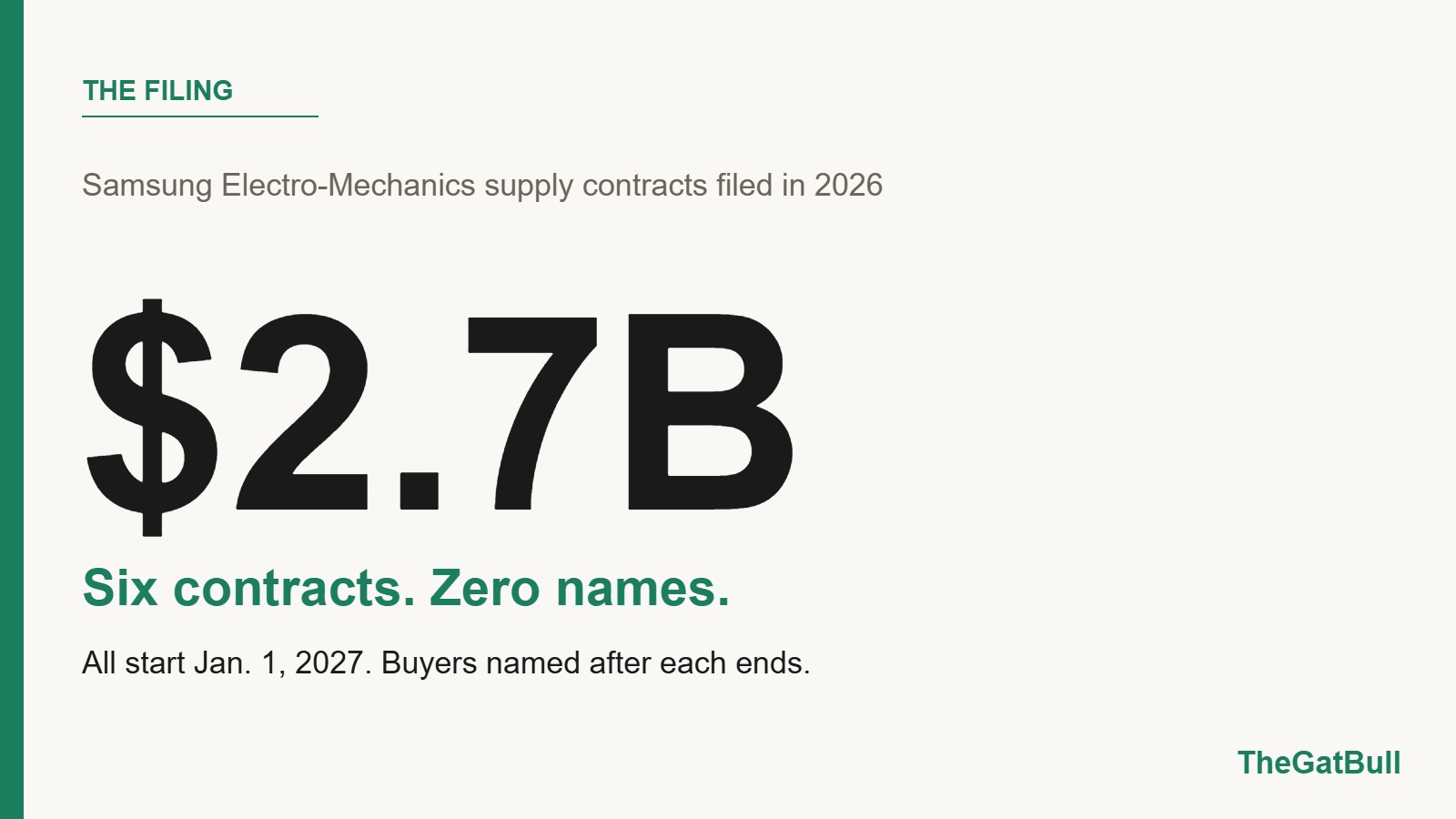
TL;DR — If you hold EWY. Samsung Electro-Mechanics, a Korean parts maker and about 2.75% of EWY 🟢, has filed six supply contracts in 2026 worth about $2.73 billion in total. All six begin deliveries on Jan. 1, 2027, and none names the buyer. Korea’s disclosure rules make the company publish the amount, the share of revenue and the contract period when it signs, but let it keep the customer’s name secret until the next business day after each contract ends — early 2028 at the earliest.
Not financial advice.
Who is buying $2.7 billion of parts from Samsung Electro-Mechanics? The filings don’t say.
Samsung Electro-Mechanics (KRX: 009150 🔴; KRX is the Korea Exchange) is not Samsung Electronics. It is a separately listed company that makes small electronic components. Between May 20 and Oct. 6, 2026, it filed six supply contracts with Korea’s electronic disclosure system, DART. Each one lists the buyer only as “a large global company” (our translation of the Korean wording). The same filings say the buyer’s name and main terms will be published on the next business day after the contract ends. For the earliest of them, that is early 2028.
Meanwhile, on Sept. 28, the company’s board approved ₩6.78 trillion (about $5.06 billion) to expand its factories for package substrates, the boards that connect chips to the rest of a device. The amounts and the dates are all public. The customer is not.
What this means if you hold EWY. Samsung Electro-Mechanics is about 2.75% of EWY (iShares, as of Sept. 29), in the row right after Samsung Electronics and SK hynix. It is a second route by which demand for AI-server parts reaches a Korea fund. For scale: if the stock moved 20%, that alone would move EWY by roughly 0.55% (2.75% × 20%), all else equal. Who that demand comes from can’t be confirmed from the filings. (How EWY’s weights stack up: EWY’s concentration explained.)
Contract amounts are the U.S.-dollar figures stated in each filing. Other dollar conversions are for scale only, at the Oct. 7 Seoul 15:30 rate of ₩1,340.4 per dollar (press-reported). Stock prices are KRX regular-session closes (15:30 Seoul time).
The ledger: six contracts, one line each
| Filed (2026) | Product | Amount (USD) | Share of 2025 revenue* |
|---|---|---|---|
| May 20 | Silicon capacitors (2027–2028) | $1,035.4M | 13.8% |
| June 30 | MLCCs | $294.0M | 4.0% |
| July 23 | MLCCs | $200.0M | 2.6% |
| Sept. 1 | MLCCs | $778.9M | 9.5% |
| Sept. 29 | MLCCs and inductors | $210.8M | 2.5% |
| Oct. 6 | MLCCs | $210.2M | 2.5% |
*As stated in each filing, against 2025 consolidated revenue of ₩11.31 trillion. For example, the May 20 contract alone equals 13.8% of everything the company sold in 2025. The silicon-capacitor contract runs for two years; the other five each cover calendar 2027 only. All six: buyer listed as “a large global company,” no down payment, and the name withheld for “business confidentiality.” (Confirmed from the six DART filings.)
What’s an MLCC? A multilayer ceramic capacitor: a part smaller than a grain of rice that stores a little electricity and releases it to keep voltage steady. Industry accounts say an AI server holds many more than an ordinary server (press-reported). An inductor is a related part that smooths electric current; a silicon capacitor is a capacitor built on silicon instead of ceramic.
We covered the Sept. 1 contract on its own in early September (The AI Boom Reached Korea’s Parts Bin). Two more have been filed since. The last two are $210.80 million and $210.24 million: a difference of $0.56 million.
The factories: ₩6.78 trillion, finishing in 2028
- Sept. 28, Sejong (Korea): ₩4.27 trillion (about $3.19 billion) to expand package-substrate production. That is 43.6% of the company’s equity (its net worth on the books), so this one project equals more than two-fifths of it. Period: through May 31, 2028.
- Same day, Vietnam: ₩2.51 trillion (about $1.87 billion) to expand the package-substrate plant of its Vietnamese subsidiary, equal to 103.4% of that subsidiary’s total assets: the expansion costs slightly more than everything that subsidiary owned at the end of 2025. Expected completion: April 30, 2028.
- July 2: ₩319.1 billion (about $238 million) for a 66.2% stake in a new glass-core substrate joint venture with Dongwoo Fine-Chem.
The Sejong filing gives the purpose only as expanding “production capacity.” It does not say which chips or which customers the new capacity is for, and we haven’t confirmed that from a primary source.
Under the Gat (our take). “Korean filings hand you the receipt and keep the customer’s name. The numbers still say something: six contracts that all start on the same day, and a factory bet worth 43.6% of equity that finishes in 2028. The company is putting real money behind 2027–2028 demand. What the filings can’t tell you is whether that demand comes from one customer or six.”
Two sides of the secrecy
The company and its customer. The filings give two reasons: “business confidentiality” and a request from the buyer to protect its trade secrets. A named buyer would show competitors that buyer’s supply chain and volume plans. By publishing the amount and the period, the company meets its disclosure duty.
The investor. Whether $2.73 billion comes from one customer or six changes the risk. The filings warn about this themselves: because the main terms are undisclosed, investors should invest carefully, “considering the possibility that the contract may change or be terminated.” None of the six includes a down payment, so the buyers have not paid anything up front under these contracts.
The stock: numbers only
| Samsung Electro-Mechanics (KRX close) | Price |
|---|---|
| Oct. 7, 2026 | ₩1,604,000 (≈$1,197), −4.24% on the day |
| Dec. 30, 2025 (last close of 2025) | ₩255,000 |
| Change in 2026 so far | +529%, about six times the end-2025 price (KOSPI, Korea’s main index: +61.45%, both in won) |
| Highest close in the past six months | ₩2,270,000 on June 19; the Oct. 7 close is 29.3% below it |
We don’t pair filing dates with daily price moves. We couldn’t confirm whether each filing came out during or after trading hours, and on many of those days the whole market also moved.
What the press says about the six-fold rise
The filings don’t explain the share price, so this section reports how Korean media and brokers have described it. These are their accounts, not facts we confirmed, and none of them proves cause.
- Most of the rise came before the first contract. From ₩255,000 at the end of 2025, the stock had already reached ₩987,000 on May 19 (+287%), the day before the first supply contract was filed. (Computed from KRX closes; a timing comparison, not a causal claim.)
- Feb. 19: Hankyung tied an 11.47% jump to comments by the head of Japan’s Murata, a rival MLCC maker, that AI-server MLCC orders were running at about twice production capacity, raising hopes of price increases (press-reported).
- Spring: reports said the company’s AI-server MLCC lines were running at full capacity (Newsis, April 6, press-reported).
- Sept. 22: Financial News tied a 6% intraday jump to Nvidia’s new “Vera Rubin” server platform and big-tech spending, and to expectations of an MLCC shortage (press-reported).
- The fall: the stock fell 40.7% from its June 19 peak to ₩1,345,000 on July 22. Over a similar stretch, KOSPI fell 38.6% (June 22 to July 30). (Computed from KRX closes; no cause is claimed.)
Earnings and valuation
| Period (company preliminary figures) | Revenue | Operating profit |
|---|---|---|
| 2025 full year | ₩11.31T (≈$8.44B) | ₩913.3B (≈$681M) |
| Q1 2026 | ₩3.21T (+17.2% y/y) | ₩280.6B (+39.9% y/y) |
| Q2 2026 | ₩3.46T (+24.2% y/y) | ₩440.4B (≈$329M), +106.7% y/y |
(Confirmed from the company’s DART earnings filings. Operating profit is profit from core operations.)
Brokers forecast much more. After the Sept. 28 factory decision, Mirae Asset, Kiwoom and Hana Securities forecast 2027 operating profit of ₩4.54–4.75 trillion (about $3.4–3.5 billion), roughly five times 2025’s. The same report put the stock at 66–72 times estimated 2026 earnings (a price-to-earnings, or P/E, ratio: the share price divided by one year’s profit per share) as of the report date (Junggi Economy, press-reported analyst estimates, not company guidance). Our reading of a multiple that high: the price reflects expectations that the 2027 growth arrives.
One more broker claim matters for the factory bet. Meritz Securities estimated that 70% or more of the ₩6.78 trillion factory spending would be funded by customers paying in advance to reserve future substrate supply (Business Watch, Sept. 29, press-reported; the company has not confirmed it). The six supply contracts themselves carry no down payment; any prepayment would come from separate arrangements the filings don’t show.
Who might the buyer be? (Press speculation, not confirmed)
We keep two ledgers: what the filings confirm, and press speculation. This is the second. Nothing here is confirmed by the company’s filings.
- Silicon capacitors (May 20): Seoul Economic Daily reported the buyer is believed to be a U.S. big-tech company developing its own AI chips and listed Nvidia, Google, Amazon, Apple and Broadcom as possibilities, without naming one (press-reported).
- Substrates (not one of the six contracts): KED Global reported in April that Broadcom had become a new customer for the company’s AI chip substrates. The report gave no source, and the company has not confirmed it.
- The Sept. 1 MLCC deal: Business Watch called the buyer a “global large AI chip company,” again without a name. Financial News reported that the company described the Oct. 6 contract as high-performance MLCCs for AI servers (press-reported; the DART filing names no buyer).
Why does the name matter so much? If one customer stands behind most of the $2.73 billion, a single change in that customer’s plans would hit the whole ledger. If it’s several, the risk is spread out. Until the names come out, the market is guessing which.
What this company shows about Korea’s market
Korea’s disclosure system is strong on “how much” and “when,” and weak on “who.” Because a supply deal must be filed with its size and period, a Korean parts maker’s orders show up early and in small pieces: here, six filings over five months. (We read another filing of this type, a state fuel-purchase deal, in Korea’s State Fuel Deal Grew 19%.) The buyer’s name comes only after the contract is over. So the share prices of Korean component makers tend to carry some guessing about who the customer is.

Under the Gat. “We keep two ledgers. The first holds what the filings confirm: amounts, periods, factory sizes. The second holds press speculation about the customer. We don’t let the second leak into the first.”
How the U.S. does it
A U.S.-listed company files a Form 8-K only for a contract it judges “material.” Routine supply deals usually aren’t filed, and when one is, the buyer is typically named while terms such as price are blacked out. Not a perfect parallel: Korea runs the other way. The amount is shown and the name is hidden, and the filing trigger is a set share of revenue (we haven’t confirmed the exact threshold, so we don’t state it).
How to get exposure
- Simplest route: EWY (NYSE Arca), which holds Samsung Electro-Mechanics at about 2.75% (Sept. 29).
- Direct on the KRX: 009150, through a broker that supports direct overseas trading (for example, IBKR).
- Similar U.S.-traded companies (not the same thing): Murata Manufacturing (U.S. over-the-counter ADR: MRAAY 🟢) and Vishay Intertechnology (NYSE: VSH 🟢) also make passive components such as capacitors and inductors. For how Korea’s two chip giants compare on U.S. access, see Can You Buy DRAM Stocks in the US?
What to watch (dated items only)
- Jan. 1, 2027: deliveries begin under all six contracts.
- The business day after Dec. 31, 2027: scheduled disclosure of the buyers in the five MLCC and inductor contracts.
- April 30 and May 31, 2028: scheduled completion of the Vietnam and Sejong expansions.
- The business day after Dec. 31, 2028: scheduled disclosure of the silicon-capacitor buyer.
The bottom line
Confirmed: about $2.73 billion in contracts starting in 2027, ₩6.78 trillion of substrate capacity due in 2028, operating profit more than doubling year on year in Q2, and the size of each relative to the company. Not confirmed: who the buyers are, how many there are, what the new substrate capacity will serve, and whether brokers’ 2027 forecasts, which the valuation depends on, come true. For an EWY holder, Samsung Electro-Mechanics is an AI-parts exposure in the row behind the two chip giants, and its source is still unnamed.
FAQ
Is Samsung Electro-Mechanics the same as Samsung Electronics?
No. It is a separately listed company (KRX: 009150) that makes components such as MLCCs, package substrates and camera modules.
Who is Samsung Electro-Mechanics’ customer for these contracts?
The filings name only “a large global company.” Each buyer is scheduled to be disclosed on the next business day after its contract ends. Korean and trade press have floated several U.S. big-tech and AI chip companies; none is confirmed.
Can I buy Samsung Electro-Mechanics in the U.S.?
The shares trade on the KRX, which you can reach through a broker with direct overseas trading. The one-click route in a U.S. account is EWY, where it is about 2.75%.
Sources
- DART, Samsung Electro-Mechanics single sales and supply contract filings: May 20, June 30, July 23, Sept. 1, Sept. 29, Oct. 6.
- DART, new facility investment (Sept. 28), subsidiary asset acquisition (Sept. 28), and joint-venture stake (July 2).
- Prices: Yahoo Finance chart data (009150.KS, ^KS11), KRX 15:30 regular-session closes. Won rate: Businesskorea and Maeil Ilbo (Oct. 7).
- Earnings: DART preliminary results filings (Jan. 23, April 30, July 30).
- Press: Seoul Economic Daily (May 20), KED Global (April 21), Business Watch (Sept. 29), Junggi Economy, Hankyung (Feb. 19), Newsis (April 6), Financial News (Sept. 22), Financial News (Oct. 6).
- EWY weight: iShares EWY holdings, as of Sept. 29.
How sure are we?
| Item | Confidence |
|---|---|
| Contract amounts, periods, terms, confidentiality wording | Confirmed from the original DART filings |
| Factory investments and JV stake | Confirmed from the original DART filings |
| Stock prices and returns | Computed from vendor price data (Yahoo), KRX closes |
| MLCC use in AI servers | Press-reported industry accounts, not a company figure |
| Quarterly revenue and operating profit | Confirmed from the company’s preliminary DART filings |
| 2027 forecasts, P/E, customer-funded capex, reasons for the rally | Press-reported analyst estimates and media accounts, not company guidance |
| Customer names floated in the press | Press speculation, not confirmed |
| Who the buyers are; what the new substrate capacity serves | Not confirmed |
Ticker key. 🟢 US-listed — buy in a US brokerage. 🔴 Seoul-listed only — no US ADR; watch, not buy directly.
Not financial advice. TheGatBull is an independent publication; nothing here is a recommendation to buy or sell any security.
 Written by Mr.Gat — TheGatBull
Korean market coverage from a Seoul-metro-based operator who reads the filings in the original language. Every price on this site is the KRX regular-session close (15:30 Seoul); every figure states whether it came from a primary filing, the press, or our own calculation. Drafts are AI-assisted, then verified against the original Korean documents and edited by a human before publishing.
Found an error? Tell us — corrections get priority. How we work →