On Tuesday, July 28, the KOSPI closed at 6,023.66 — down 732.09 points, or 10.84%. It was the index’s steepest one-day fall since March 4, when it dropped 12.06%. At 10:13 a.m. Seoul time, with the index down 8.04%, a circuit breaker halted trading until 10:33 — the eighth this year. The KOSDAQ closed down 59.01 points, or 7.72%, at 705.85. The KOSPI held 6,000 at the close; retail investors bought roughly ₩4.3 trillion on the day.
If you hold Korea through a U.S. brokerage account, that number does not reach you intact. One more calculation sits in between: the loss is priced in won, and the won has to be converted.
Today, that conversion worked in your favor.
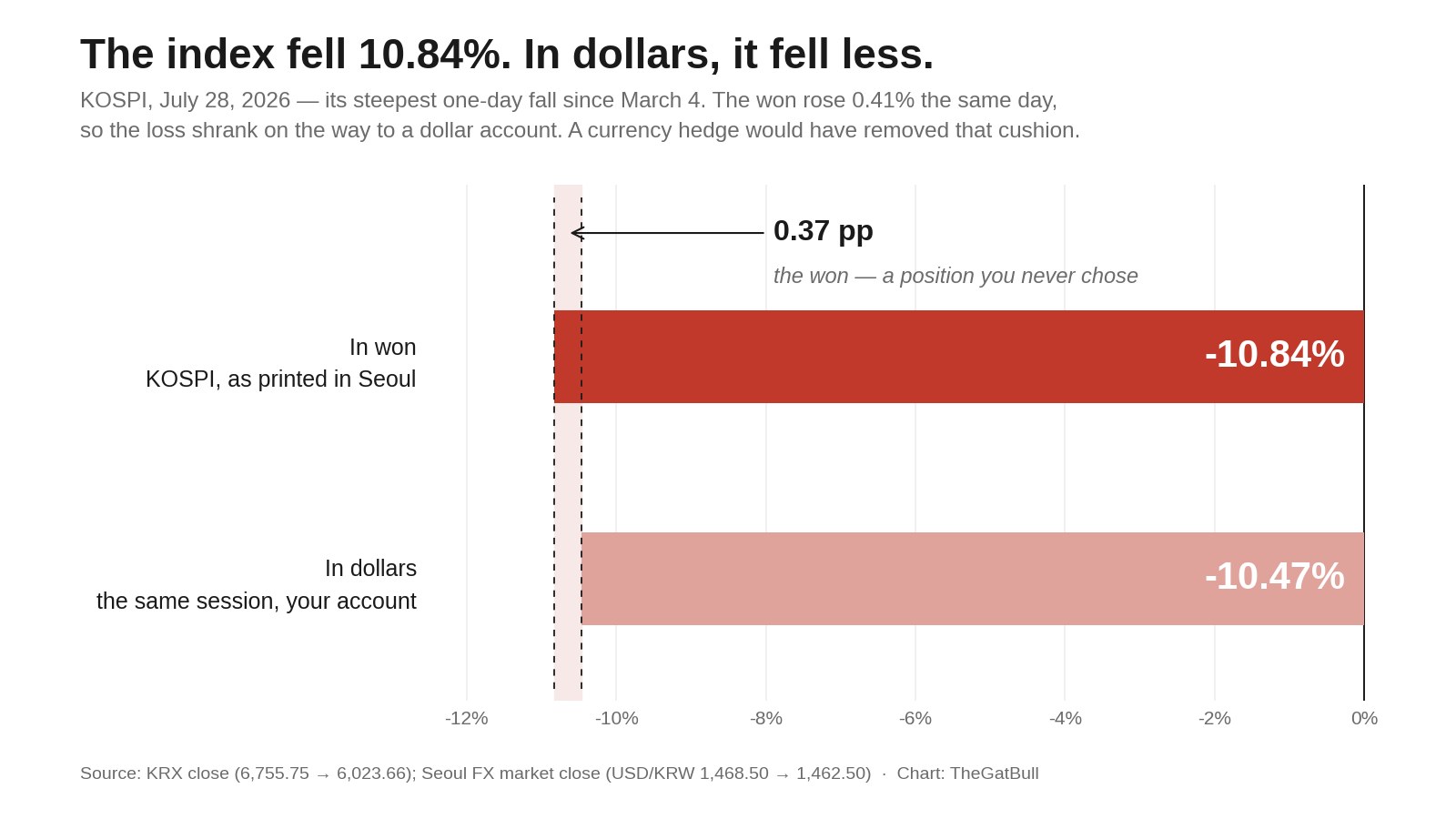
The won closed at 1,462.50 per dollar — six won stronger than Monday’s 1,468.50, and its firmest level in two months and twenty days. Falling oil prices and month-end exporter selling did the work. So while Seoul equities fell 10.84%, the currency they are priced in gained 0.41%. Translated into dollars, the same session was a 10.47% decline. (In offshore trading after the Seoul close, the won firmed a little further, toward 1,460.)
The gap is 0.37 percentage points. Small. But the direction is the part worth sitting with, because most U.S. readers expect the opposite. “Crash equals currency crash” is the default grammar of emerging markets. Korea did not follow it today.
What this means for EWY and global ETF holders
1. Your Korea position is an equity bet and a won bet welded into one ticker. There is currently no U.S.-listed product that lets you buy them separately.
2. Today that absence helped. A hedged position would not have received the won’s 0.4-point cushion. A hedge is not a loss-prevention device — it is a two-way trade.
All conversions use USD/KRW 1,462.50, the Seoul foreign exchange market close at 3:30 p.m. on July 28, 2026. This is one person’s view, not advice.
What actually happened in Seoul today
The trigger was not Korean earnings.
Semiconductors broke in New York overnight — ASML’s ADR fell 5.8%, Nvidia 4.99%, the Philadelphia Semiconductor Index 2.23%. On top of that, the tech outlet The Information reported that China has begun developing its own DUV (deep ultraviolet) lithography equipment. Lithography machines etch circuit patterns onto wafers; if China can source them domestically, the pace at which it can add memory capacity changes. And the day before, Chinese memory maker CXMT listed in Shanghai, attaching a live ticker to the competition story.
Seoul’s response was mechanical. Sell-side sidecars — a five-minute freeze on program sell orders — triggered on both the KOSPI and the KOSDAQ within the first quarter-hour. The circuit breaker followed at 10:13 with the index at 6,212, down 8.04%; it halts all trading for twenty minutes once the index has been down 8% or more for a full minute. Samsung Electronics and SK Hynix both fell double digits and dragged the index down with them.
If you want the mechanics of why these halts fire more often here than in the U.S., and how forced selling sets prices behind them, I took apart July’s margin-call ledger in this piece.
English-language coverage will get you that far. Here is the line it will not print:
At the same time, the won went the other way. It traded as weak as 1,472.4 intraday, then strengthened to 1,461.4 before settling at 1,462.50. Equities collapsed and the currency held. Seen from a dollar account, today was not a day when a second layer of loss was added — it was a day when one was subtracted.
🎩 Under the Gat — A U.S. reader sees “KOSPI −10.84%,” checks their EWY balance, and finds the numbers don’t match. The usual conclusion is that the ETF fails to track the index. Usually it isn’t tracking error. It’s the currency and the clock. Seoul has already closed and New York hasn’t opened — and in between, the exchange rate does the math one more time.
“South Korea ETF currency hedged” — why the search returns a dead ticker
Once a U.S. investor notices this problem, the search is predictable: currency hedged South Korea ETF. And the result is a ticker — HEWY, the iShares Currency Hedged MSCI South Korea ETF. Launched in June 2015, it tracked the MSCI Korea 25/50 100% Hedged to USD Index, neutralizing won exposure on a monthly basis.
The problem is that the fund no longer exists. It was liquidated on August 20, 2020. Data pages, screeners and old blog posts stayed up, so from the search results it still looks alive.
Why did it close? Issuers wind down funds for one reason, more or less: assets never justified the cost of running it. Which is to say the demand — “give me Korean equities without the won” — existed in conversation but not in dollars.
So what made Japan and Europe different? Japan still has WisdomTree’s DXJ and iShares’ HEWJ. Europe still has WisdomTree’s HEDJ. In Japan’s case, “weak yen → better exporter earnings” hardened into an actual trade among U.S. investors, and the hedged products found scale on the back of it.
Not a perfect parallel, though. Korea has a similar story — a weak won helps exporters — and it gets told constantly. It simply never gathered enough money to keep a product alive. And a day like today shows the story runs in both directions anyway. The won does not have to fall just because stocks do.
🎩 Under the Gat — Reading “the product died” as “nobody wanted it” is half the story. The other half is that an option was quietly withdrawn. Anyone who has bought Korea from a U.S. account since 2020 never chose their currency exposure. It came attached. Today it happened to help — but helping and being chosen are different things.
So how much of your Korea position is a currency bet? Here’s the arithmetic
Two numbers, multiplied.
① the move in won-denominated prices × ② the move in USD/KRW = what lands in your dollar account.
Today, worked out:
| Layer | Number | For a dollar investor |
|---|---|---|
| KOSPI, in won | −10.84% (6,755.75 → 6,023.66) | the number printed in Seoul |
| USD/KRW | 1,468.50 → 1,462.50 (−0.41%) | a stronger won adds back on conversion |
| In dollars | −10.47% | the number in your account |
The difference is 0.37 points. Small. But had the direction been reversed — had the won slipped to 1,480 — the same session would have been −11.7%. On any single day this is a rounding error. The multiplication, however, happens every day you hold.
Stretch it to a month and the range widens considerably. USD/KRW was around 1,549 at the start of July; it closed today at 1,462.50 — roughly 5.6% of won strength in four weeks. For a dollar investor, July’s currency layer was a substantial tailwind: your account hurt less than Seoul did. A hedge would have removed that tailwind too.
There’s one more layer underneath: concentration. EWY is nominally a Korean large- and mid-cap fund — 79 holdings, $24.1 billion in assets, a 0.59% expense ratio — but in practice two names carry it: SK Hynix at 22.57% and Samsung Electronics at 21.67% — 44.24% of the fund between them. On a semiconductor rout like today’s, that weight shrinks by itself, which is also part of the structure.
Why a country ETF tracks two chip stocks so closely — I laid out the holdings with numbers in this breakdown of what’s actually inside EWY. The currency layer this piece is about sits one level above that one.
So a Korea position in a U.S. account is three layers:
- two semiconductor names (~45%)
- the rest of Korean large caps (~55%)
- the won (100% — it multiplies all of the above)
There is currently no U.S.-listed way to strip out layer three on its own.
If you still want to manage it — the ladder that’s left
I’m not going to end on “you can’t buy it.” What’s missing is a product that reduces currency exposure, not a way to deal with it. Here they are in order of effort. None of this is a recommendation.
① What you can do in one click — change the size, not the exposure
With no hedged product, the remaining lever is weight. Reduce the Korea allocation, or blend it with regions in other currencies so the won is a smaller share of the whole portfolio. Broad Asia and emerging-market ETFs hold only a slice of Korea, so the won dilutes as a byproduct. (Of course, your Korea exposure shrinks along with it. There is no free adjustment.)
② Change the currency layer at the stock level — ADRs
For Korean companies with U.S. depositary receipts, you trade in dollars but the underlying asset is still a won asset. An ADR changes your trading currency; it does not remove your economic won exposure. This gets misread constantly. ADRs also add a layer of their own: the premium or discount to the Seoul-listed shares. SK Hynix is a live case — two-way conversion between its Korean common shares and its ADSs opens July 29, with ten ADSs equal to one common share. The ADR premium has run as wide as 51% and sits near the low 30s, and conversion is capped at 2.5% of shares outstanding, so the gap may not close as fast as the arbitrage math suggests. Worth watching from tomorrow.
③ Direct access — buying KRX shares through IBKR and similar
Here the currency exposure becomes more explicit, not less: you can see the dollars being converted into won in your own account. The exposure isn’t reduced, but you know how much you converted and at what rate — which is a real difference.
How the three routes differ on account opening, fees and tax treatment is in this step-by-step guide.
④ Watchlist — signs the door is reopening
A Korea-specific hedged ETF returns when the money justifies it. If U.S. flows into Korean assets keep growing — SK Hynix’s ADR listing was an event in that direction — issuers have a reason to revisit a hedged launch. The absence of a product today isn’t a dead end so much as a signal that American money hasn’t fully arrived yet. Which is usually where the informational edge is.
🎩 Under the Gat — The question needs changing. Not “where do I buy a hedged Korea ETF,” but “do I know what percentage of my portfolio is in won?” The first has no answer. The second you can answer tonight. And only the people who have answered the second one aren’t confused when their account doesn’t match the headline.
Counting the day again
The KOSPI printed −10.84% in won. The number in a U.S. account was different — today, smaller. What made the difference was the won, and the won is a position you never chose.
This isn’t purely good news. What helped today can hurt tomorrow. Currency exposure is a cushion and an amplifier, and which one it turns out to be is decided that morning. The problem isn’t that it’s risky. The problem is that it’s not a decision. Leaving something to chance and knowing you’re leaving it to chance are two different postures.
Tomorrow SK Hynix reports second-quarter earnings. Whether what broke today was demand or sentiment — the first piece of that answer arrives there. And the numbers that come out of Seoul that day will go through the same multiplication before they reach a dollar account.
This article is a personal opinion written for informational purposes. It is not financial advice and not a solicitation to buy or sell. ETFs and securities mentioned are examples, not recommendations. FX basis: USD/KRW 1,462.50, Seoul FX market close, 3:30 p.m., July 28, 2026. Index figures are KRX closing values. Responsibility for investment decisions and their outcomes rests with the investor.
FAQ
Is there a currency-hedged South Korea ETF?
Not at the moment. iShares HEWY was the only one, and it was liquidated on August 20, 2020. Hedged versions still exist for Japan (DXJ, HEWJ) and Europe (HEDJ).
Does a weak Korean won hurt my EWY returns?
In dollar terms, yes — and the reverse holds too. On July 28, 2026, the KOSPI fell 10.84% while the won strengthened, so the decline in dollars was about 10.47%. It runs both ways.
Why does EWY sometimes fall less than the KOSPI?
Three things overlap: the exchange rate (a stronger won improves the dollar conversion), the time difference between the Seoul close and the New York close, and composition — EWY does not hold every KOSPI constituent.
Does buying an ADR remove my won exposure?
No. The trading currency is dollars, but the underlying asset is a won asset, so the economic exposure remains. ADRs also introduce a separate variable: the premium or discount to the Seoul-listed shares.
Then how do I manage won exposure?
Rather than removing it with a product, you adjust it by weight — a smaller Korea allocation, multi-region diversification, or direct conversion you record yourself. None of these are costless.
Why did the KOSPI crash on July 28, 2026?
Reports that China had begun developing DUV lithography equipment, plus CXMT’s Shanghai listing, intensified fears of memory competition, compounding an overnight fall in U.S. semiconductor stocks. The KOSPI closed down 732.09 points (10.84%) at 6,023.66 — its steepest one-day fall since March 4 — and a circuit breaker halted trading from 10:13 to 10:33 a.m.
 Written by Mr.Gat — TheGatBull
Korean market coverage from a Seoul-metro-based operator who reads the filings in the original language. Every price on this site is the KRX regular-session close (15:30 Seoul); every figure states whether it came from a primary filing, the press, or our own calculation. Drafts are AI-assisted, then verified against the original Korean documents and edited by a human before publishing.
Found an error? Tell us — corrections get priority. How we work →