This article is for informational purposes only and is not financial advice. TheGatBull may earn a commission from some links at no cost to you — see our disclosure and full disclaimer.
On July 27, Nvidia agreed to become the No. 3 shareholder of Korea’s largest internet company. The market cheered — Naver jumped 8.43%. But the most interesting document of the day isn’t the fundraising. It’s the amendment filed alongside it, where one sentence quietly disappeared. This is not financial advice — a view from Seoul, not a recommendation to buy or sell anything. (Won-to-dollar at ₩1,468.50/$, the July 27 Seoul close.)
The one-paragraph answer. Naver (KRX: 035420) will issue new shares to Nvidia in a third-party allotment — ₩1.4809tn (~$1.01B), 7,241,564 shares at ₩204,500 (~$139), payment due October 30 — Naver’s first third-party share issuance in 22 years (Hankyung). After closing, the register reads: National Pension Service 8.8%, BlackRock 6.0%, Nvidia 4.5% — founder Lee Hae-jin holds 3.8%. The same day, Naver amended its June business-plan disclosure: in June, Nvidia’s role read GPU supply + finding global customers + jointly bearing revenue and business risk. In the amendment, everything but GPU supply is gone (FN News). When a sentence disappears from a filing, the risk it described doesn’t disappear — it moves to one side’s ledger.
🎩 Under the Gat — read it as “Nvidia bought shares” and it’s complicated; read it as “Nvidia reserved demand” and it’s simple. But the land, power, permits and project financing that make that reservation deliverable stay on Seoul’s books. The deal’s name isn’t decided by the press release — it’s decided by whichever ledger ends up holding the risk.
1. What the filing actually says — numbers first
| Item | Detail |
|---|---|
| Structure | Third-party allotment of new shares (closest US analog: a PIPE — but see §4) |
| Investor | NVIDIA |
| Size | ₩1,480,899,999,999 ≈ $1.01B |
| New shares | 7,241,564 common shares |
| Issue price | ₩204,500 (~$139) |
| Stake | ~4.5% — No. 3 on the register |
| Payment date | October 30, 2026 |
| Day’s close | ₩225,000 (~$153), +8.43% (intraday high ₩234,500) |
Two details worth holding. First, the issue price sits below the day’s close (₩204,500 vs ₩225,000). Third-party issue prices are set off the board-resolution reference price, so a post-announcement pop naturally opens that gap — “Nvidia bought cheap” is premature. But note the three months between contract and cash (payment lands October 30). Second, dilution and cancellation arrived as a pair: the 4.5% issuance dilutes existing holders, while Naver separately resolved to cancel ~4.9M treasury shares (~₩1tn / ~$681M) on August 3. One hand dilutes, one hand retires — a very value-up-era Korean package. Net effect is the reader’s homework.
2. The vanished sentence — the real autopsy point
June’s forward-looking business plan described Nvidia’s role in four parts: GPU supply, finding global customers, jointly bearing revenue risk, jointly bearing business risk. The July 27 amendment keeps GPU supply — and deletes the rest. The roles now split like this:
| Naver provides | Nvidia provides | |
|---|---|---|
| Physical | Data center sites | — |
| Capital works | Build & operate | GPU supply |
| Administrative | Permits | — |
| Power | Contracts & procurement | — |
| Financing | Leads project financing (Brookfield talks) | $1B equity |
| Demand | ? | ? |
The last row being empty is the point — the deleted sentence used to fill it. This isn’t proof the deal soured: language gets tidied as negotiations firm up, and June’s document was a forward-looking plan, not a binding contract. But it reorders the investor’s questions — from “how much did Nvidia put in?” to “if utilization disappoints, whose books take the hit?” The public documents can’t answer that yet. So this piece gives you the checkpoints instead (§6).
3. From 55MW to gigawatt-scale — the ramp in numbers
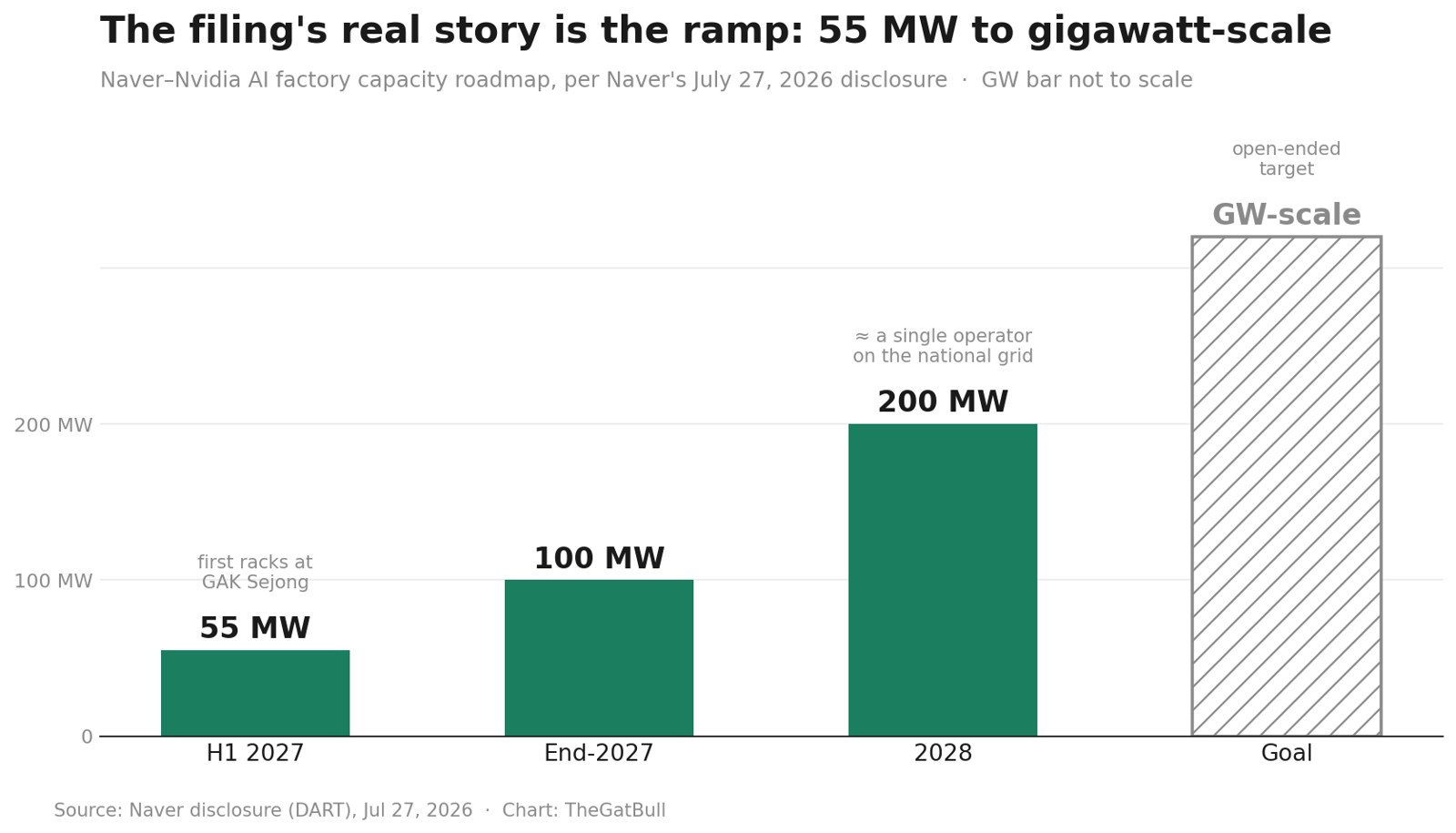
The first site is GAK Sejong — Naver’s hyperscale data center in Sejong City (opened 2023; Korea’s largest single-company facility at up to 600,000 servers and 270MW of secured power). The name is a detail worth knowing: Naver calls its data centers GAK, after the pavilion that preserved Korea’s 800-year-old Tripitaka Koreana woodblocks — “a house that keeps knowledge” (DCD). The computing infrastructure — roughly $9B — is under discussion for project financing led by Brookfield, which Naver named preferred negotiating partner with a 12-week exclusive window; Naver’s own direct investment is not yet fixed.
To a US reader this table sounds like Stargate and hyperscaler capex guidance. The difference is the denominator: Korea’s grid is small and short. 200MW is big-but-not-shocking in the US; in Korea it’s a single operator showing up in national grid planning — which is why this filing lands on the books of transformer, distribution and generation names too (see the AI power valuation gap). Same day, for context: the KOSPI fell as much as 1.99% intraday on China memory maker CXMT’s Shanghai listing before closing +0.97% at 6,755.75 — foreigners sold a net ₩2.885tn (~$1.96B); individuals and institutions bought the dip.
4. The angle America doesn’t have — what a “third-party allotment” is
Translating this as a PIPE is roughly right, with two differences. (1) It’s an exception to shareholders’ preemptive rights. Under Korean corporate law, existing holders have first claim on new shares; a third-party allotment is allowed only with a charter basis and a recognized “management purpose” — meaning the company must explain, in writing, why this investor instead of its own shareholders. That explanation is the deal’s logic; the original filing is worth reading. (2) The target is different. Nvidia’s equity checks have mostly gone to private AI startups or pure GPU clouds. This one makes it the registered No. 3 shareholder of a listed platform conglomerate — behind only the National Pension Service and BlackRock. Same strategy, different weight class.
5. What you can actually do from a US account
Naver has no US ADR — type the name into your brokerage and nothing comes up. That’s not a wall; it’s a route choice: direct KRX shares via Interactive Brokers (see how to buy Korean stocks from the US), or indirect via a Korea ETF — noting EWY is roughly half memory chips, so buying it “for Korean AI platforms” mostly buys the chip cycle. Watching Nvidia (NVDA) itself is the demand-side stand-in. Full routes, tickers and tax: how US investors actually play Korea.
6. Verdict — and four checkpoints
Verdict: this is a role-allocation story wearing a fundraising headline. The $1B that came in says less than the one sentence that went out. Whether this is an alliance or a pre-order will be decided by the documents still to come:
- October 30 payment — three months sit between contract and cash; watch for changed terms.
- The final Brookfield PF structure — when the 12-week exclusivity ends, Naver’s direct investment and recourse terms get their first hard numbers. That’s where the risk split shows.
- Power contracts — even 55MW is paper without grid connection; watch the KEPCO/ministry permitting track.
- Whether the deleted sentence returns — in what form “revenue and risk sharing” reappears (or doesn’t) in the definitive agreements.
This is not financial advice. Won-to-dollar conversions use ₩1,468.50/$ (July 27, 2026 Seoul close). Figures are per Naver’s July 27 disclosures (DART) and same-day reporting; the share-cancellation date, stake percentages and the Brookfield structure should be re-verified against primary filings before acting. Tickers are identifiers, not recommendations.
Frequently Asked Questions
Why did Nvidia buy a stake in Naver?
Per the July 27, 2026 filings, the structure is: Naver secures the data center sites, builds and operates them, arranges permits, power and project financing; Nvidia supplies the GPUs — and anchors the partnership with a ₩1.48tn (~$1.01B) equity stake (about 4.5%) via a third-party share issuance priced at ₩204,500, payment due October 30. The equity is the capital seal on the partnership. This is not financial advice.
What is Naver’s AI factory — and what is GAK Sejong?
An AI factory is a data center specialized for training and serving AI models. Naver’s first site is GAK Sejong — its hyperscale data center in Sejong City (opened 2023; Korea’s largest single-company facility, up to 600,000 servers with 270MW of secured power). ‘GAK’ is named after the pavilion that preserved Korea’s 800-year-old Tripitaka woodblocks — ‘a house that keeps knowledge.’ The roadmap runs 55MW (H1 2027) → 100MW (end-2027) → 200MW (2028) → gigawatt-scale.
What changed in the amended disclosure?
In the June filing, Nvidia’s role included GPU supply, finding global customers, and jointly bearing revenue and business risk. In the July 27 amendment, everything but GPU supply was deleted. That doesn’t prove the deal got worse — terms get tidied during negotiations — but it moves the key investor question from “how much did Nvidia put in” to “whose books absorb the miss if utilization disappoints.” Not financial advice.
Can US investors buy Naver?
Naver has no US ADR. The realistic routes: direct KRX shares via Interactive Brokers, or indirect exposure through a Korea ETF — noting that EWY is roughly half memory chips, so a “Korean AI platform” bet via EWY is mostly a chip-cycle bet. Full routes in our access hub. Not financial advice.
This article is for informational purposes only and is not financial advice. TheGatBull may earn a commission from some links at no cost to you — see our disclosure and full disclaimer.
 Written by Mr.Gat — TheGatBull
Korean market coverage from a Seoul-metro-based operator with 15 years of personal investing experience, who reads the filings in the original language. Every price on this site is the KRX regular-session close (15:30 Seoul); every figure states whether it came from a primary filing, the press, or our own calculation. Drafts are AI-assisted, then verified against the original Korean documents and edited by a human before publishing.
Found an error? Tell us — corrections get priority. How we work →