This article is for informational purposes only and is not financial advice. TheGatBull may earn a commission from some links at no cost to you — see our disclosure and full disclaimer.
If you only saw the Friday headline — Korea down 5.72%, back below 7,000 — you’d conclude the Korean market is coming apart. The full week says something more interesting. This is not financial advice — a view from Seoul, not a recommendation to buy or sell anything. (Won-to-dollar at ~₩1,480/$; verify at the time of reading.)
The one-paragraph answer. The KOSPI moved more than 3.5% in four of five sessions this week — down 4.46% Monday, up 4.40% Thursday to retake 7,000 for the first time in six sessions, then down 5.72% Friday. Yet in the middle of that, foreign investors net bought about ₩5.62 trillion (~$3.8B) over four straight sessions. The story of this week isn’t the direction. It’s who was selling and who was buying.
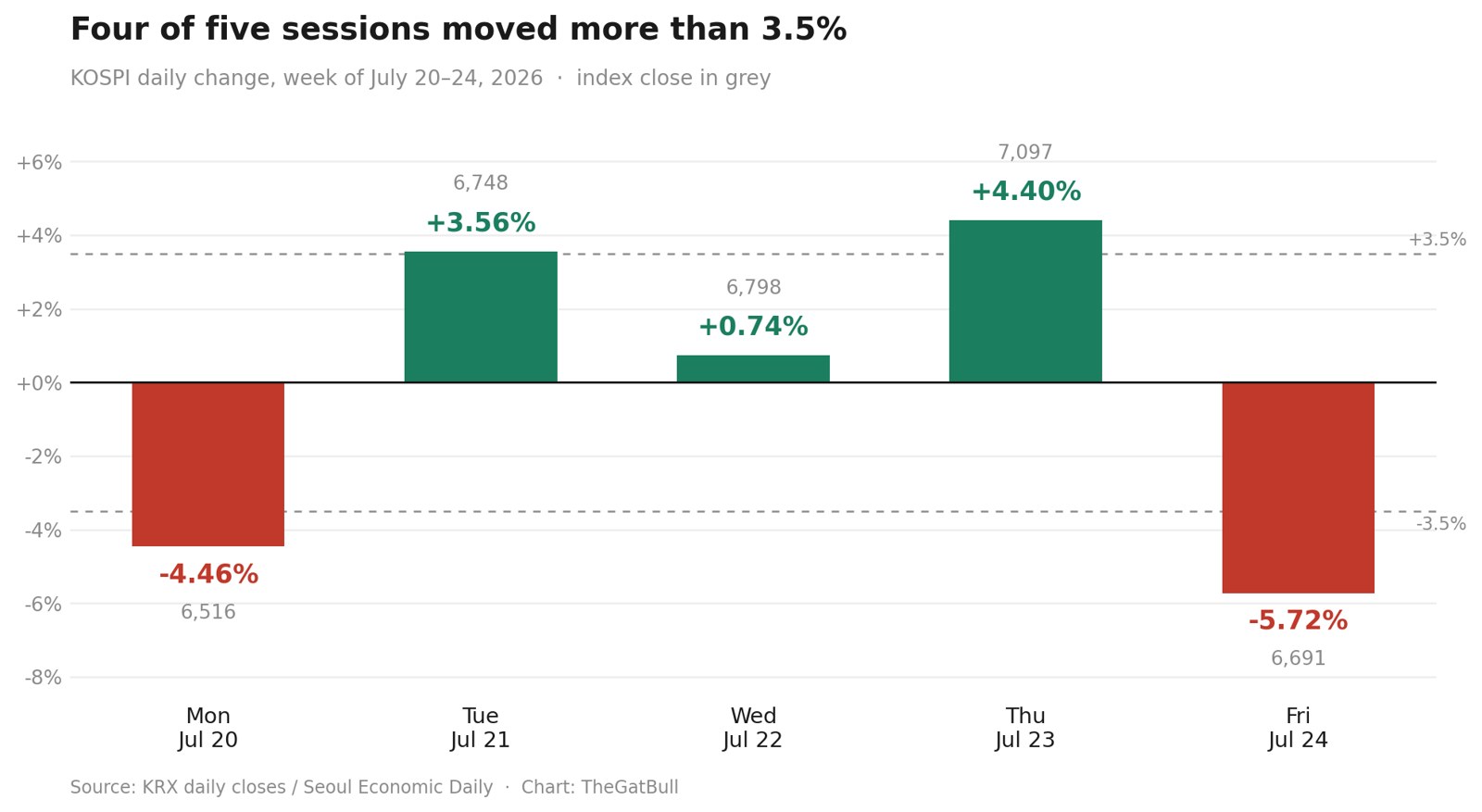
The week in seven numbers
| # | Number | What happened |
|---|---|---|
| 1 | −4.46% (Mon, 6,516.27) | Selling deferred by the Constitution Day holiday all landed at once |
| 2 | +3.56% (Tue, 6,747.95) | A buy-side sidecar tripped; first big bounce after the rate-hike shock |
| 3 | +0.74% (Wed, 6,797.70) | Touched 7,100 intraday, gave almost all of it back |
| 4 | +4.40% (Thu, 7,096.89, +299.19pt) | Back above 7,000 for the first time in six sessions as AI/data-center sentiment recovered |
| 5 | −5.72% (Fri, 6,690.62, −406.27pt) | Sell-side sidecar; 7,000 lost again |
| 6 | ₩5.62tn (~$3.8B) | Foreign net buying across four straight sessions (Jul 20–23) — into the decline |
| 7 | −30% | Peak-to-trough from the June 19 high: a technical bear market |
Sources: daily closes and foreign flows, Seoul Economic Daily.
What it means
① This volatility is the sound of positioning, not valuation. To print ±4% four times in a week, it isn’t earnings that have to move — it’s who owns the shares. Forced deleveraging is still working through record margin debt, and on top of that sits a live reassessment of AI capital spending (US hyperscalers are reporting now) plus Middle East-driven oil and risk-aversion flows.
② And foreigners bought the decline. ₩5.62tn of net buying across July 20–23 is the opposite of a “get me out of Korea” tape. The sellers were largely domestic leveraged and institutional positions; the buyers were foreign. Same screen, opposite conclusions.
③ Then Friday happened. A 5.72% drop is also the evidence that foreign buying doesn’t mark a bottom. This week ended with the argument unresolved.
🎩 Under the Gat — the question a US reader reaches for in a week like this is “is Korea done?” But an index swinging 4% in both directions isn’t the sound of a market dying — it’s closer to the sound of ownership changing hands. What to track isn’t the direction of the index but ① how much leverage is left to unwind ② whether foreign net buying continues next week ③ whether the July 29 earnings justify it. Next week casts the deciding vote.
Two things that happened off the index
- The San Francisco AI Declaration (Jul 24 local). President Lee Jae-myung declared Korea a “trusted AI semiconductor production base that keeps producing through any crisis,” with the CEOs of Nvidia, OpenAI, Anthropic and Broadcom in the room — and a reported $500B+ Nvidia–SK AI initiative on the sidelines (verify). The structural read is in Korea’s national claim on the AI supply chain.
- Next week’s main event: SK Hynix Q2 results, July 29 (D-3). The very debate that shook the index this week — does AI capex hold? — gets its first hard number. What to watch is in the expectations checkpoint.
In fairness — the other side
Reading foreign net buying as “smart money bought the bottom” is premature. Foreign inflows during sharp declines mix in passive/ETF rebalancing and FX-hedging demand, and Friday’s 5.72% drop immediately reversed the week’s gains. The −30% drawdown also says the June peak was that stretched — measured from January, the index is still far higher.
The exposure ladder for a US investor
Ways to reach Korea in a week like this: ① one click — a Korea index ETF (EWY, or the cheaper FLKR), which is chip-heavy and therefore rides exactly this volatility; ② direct — individual names on the KRX via Interactive Brokers; ③ watch — waiting for the July 29 print and the flow data is itself a position. Full routes, tickers and tax: how US investors actually play Korea.
This is not financial advice. Won-to-dollar conversions use USD/KRW ≈ 1,480 (July 26, 2026, provisional — verify at the time of reading). Index levels and flows are per exchange data and press reports as of the July 24 close; the Nvidia–SK initiative figure is as reported and should be re-verified against company releases before acting.
Frequently Asked Questions
What happened to the Korean stock market this week?
A whipsaw week: the KOSPI fell 4.46% Monday (6,516.27), rose 3.56% Tuesday, added 0.74% Wednesday, jumped 4.40% Thursday to 7,096.89 — reclaiming 7,000 for the first time in six sessions — then dropped 5.72% Friday to 6,690.62. Four of five sessions moved more than 3.5%. At its low the index was about 30% below its June 19 peak, a technical bear market. This is not financial advice.
Are foreign investors leaving Korea?
Not this week — the opposite. Foreign investors net bought about ₩5.62 trillion (~$3.8B) on the main board over four consecutive sessions from July 20 to 23, buying into the decline. Friday’s 5.72% drop means that bet hasn’t been vindicated yet. Not financial advice.
Why is the Korean market so volatile right now?
Moves of this size are driven by positioning rather than fundamentals: forced deleveraging after record margin debt, a reassessment of AI capital spending as US hyperscalers report, and Middle East-driven oil and risk-aversion flows. A view, not advice.
What should I watch next week?
SK Hynix’s Q2 results on July 29 — the first hard numbers in the AI-capex debate that drove this week’s swings — plus whether foreign net buying continues and how much leveraged positioning is left to unwind. Not financial advice.
This article is for informational purposes only and is not financial advice. TheGatBull may earn a commission from some links at no cost to you — see our disclosure and full disclaimer.
 Written by Mr.Gat — TheGatBull
Korean market coverage from a Seoul-metro-based operator with 15 years of personal investing experience, who reads the filings in the original language. Every price on this site is the KRX regular-session close (15:30 Seoul); every figure states whether it came from a primary filing, the press, or our own calculation. Drafts are AI-assisted, then verified against the original Korean documents and edited by a human before publishing.
Found an error? Tell us — corrections get priority. How we work →