This article is for informational purposes only and is not financial advice. TheGatBull may earn a commission from some links at no cost to you — see our disclosure and full disclaimer.
To a US investor, the AI trade means demand: buy Nvidia and you own GPU demand; buy the hyperscalers and you own data-center capex. AI is the side that designs the chips and drinks the power. But who actually makes those chips — and keeps making them through a crisis? Yesterday, one country answered that question at the national level. This is not financial advice — a view from Seoul, not a recommendation to buy or sell anything. (Won-to-dollar at ~₩1,480/$; verify at the time of reading.)
While New York buys the demand, Seoul just declared the supply
On July 24 (local time), President Lee Jae-myung unveiled the “San Francisco AI Declaration” (Nikkei, JoongAng). The thesis is one sentence: make Korea the “trusted AI semiconductor production base that keeps producing through any crisis — an irreplaceable pillar of the global AI supply chain.” If America owns AI’s brain and its demand, Korea just formally claimed the layer underneath: production and supply.
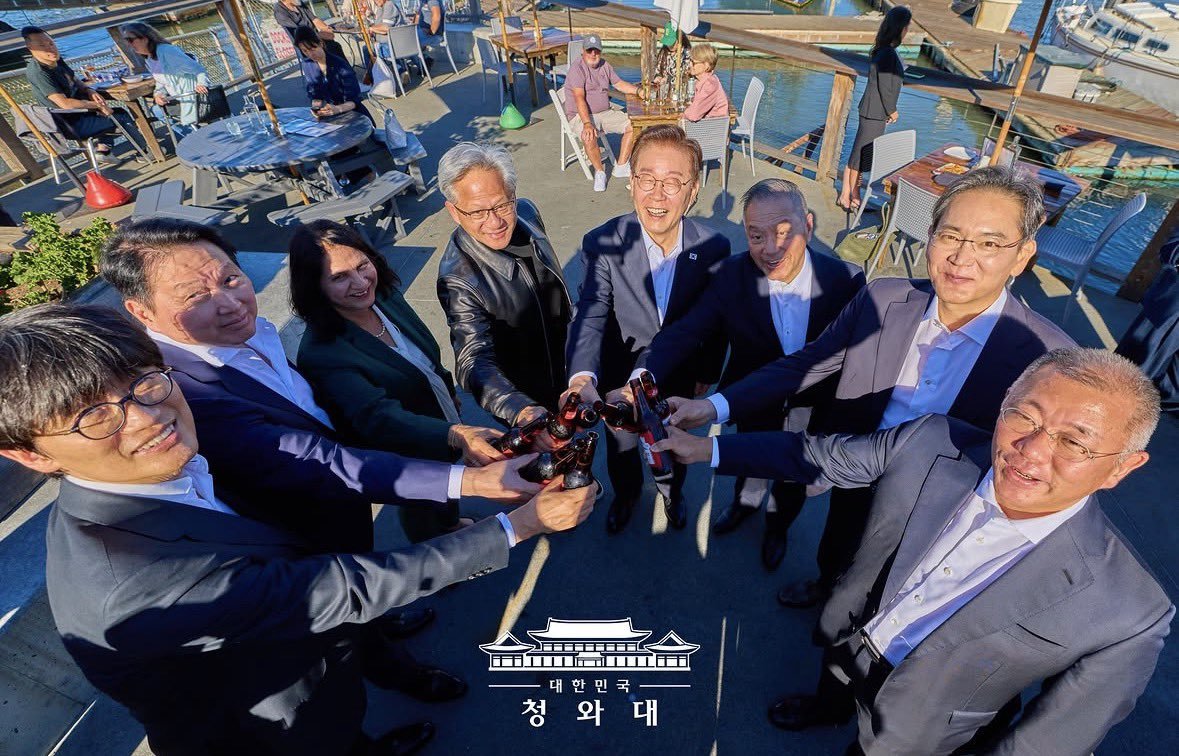
The weight is in the room. Before the summit, Lee met the CEOs of Nvidia (Jensen Huang), OpenAI (Sam Altman), Anthropic (Dario Amodei) and Broadcom (Hock Tan); at the summit sat the heads of Samsung (Lee Jae-yong), SK (Chey Tae-won), Hyundai Motor (Chung Euisun) and Naver (Lee Hae-jin) (JoongAng). The top of US AI demand and the top of Korean supply, in one room.
Our turf — what the declaration actually points at
① The position: the opposite side of the Taiwan risk. The declaration’s key words are trusted and uninterrupted. With Taiwan concentration flagged as the AI supply chain’s biggest single point of failure, Korea is bidding for the seat labeled “the production base that doesn’t stop.” That’s the backdrop to the big-tech pledges of expanded investment and cooperation with Korean AI.
② The capital: a multi-hub buildout, anchored by Gwangju. Lee described a shift from capital-region-only production to a multi-polar fab map — citing the plan announced June 29 under which Samsung Electronics and SK Hynix together invest a combined ₩800tn (~$540B) over many years to build four memory fabs (two each) in the southwest around Gwangju (Hankyung, Seoul Economic Daily). Note the shape of that number: combined, multi-year, two companies — not one firm’s annual capex. The motivation is physical: power, water and land around Seoul are running out.
③ The link to the trade you already own. If you bought Nvidia, you bought the demand. This declaration marks where that demand’s supply leg stands: memory (HBM), foundry, and the picks-and-shovels underneath (power gear, equipment). The same boom already revived rate hikes — see the AI boom just brought back rate hikes — and left Korea’s power suppliers at a discount — see the AI power valuation gap.
④ And the speed — this government’s declarations have been starting guns, not press releases. A US reader’s reflex on national industrial “declarations” is healthy skepticism: years usually separate the podium from the groundbreaking. This administration’s track record argues for recalibrating that reflex. Its third Commercial Act amendment — mandating treasury-share cancellation — went from bill (Nov 25, 2025) to National Assembly passage (Feb 25, 2026) to effect (Mar 6, 2026) (Kim & Chang), and within roughly three months cancellation filings had overtaken disposals for the first time — a market-behavior flip we covered in cancellations just overtook disposals. Declaration → legislation → changed market behavior, on a cadence of quarters, not years. Read yesterday’s San Francisco speech as diplomatic garnish and — with this government — you’ll probably be wrong. Read it as the starting gun of a 100-meter sprint, and the data so far is on your side. What follows a starting gun is budgets, permits and groundbreakings.
🎩 Under the Gat — a declaration isn’t a stock price. But who declared it is a probability. With most governments, “it’s just an MOU” is the right discount. This one turned mandatory cancellation into market statistics in three months — so keep the same checklist but reset the clock: ① how fast the ₩800tn attracts groundbreakings and equipment orders (assume quarters, not years, until proven otherwise); ② whether big tech’s “expanded cooperation” converts from MOU to contract; ③ whether the “trusted production base” narrative converts into actual orders and share. The state has set the direction — and this time the state may be the one sprinting. Just remember: a government that runs fast brings policy risk fast, too. Hold both edges.
In fairness — the other side
Declarations and MOUs aren’t numbers until executed. Mega-figures like ₩800tn are combined, multi-year and budget-dependent. The “fast government” argument has a flip side, too: mandatory cancellation was done with a legislative vote, but a fab complex needs land, power, water and people — physical execution that no legislature can compress the same way. Fast decisions are also the other name for fast reversals (policy risk). Memory and foundry remain cyclical — if the AI narrative cools, oversupply risk is standard issue. And the weak won (~₩1,480) cuts both ways for dollar-based investors.
The exposure ladder for a US investor
The beneficiary here isn’t one ticker — it’s Korea’s AI supply chain broadly. The ladder: ① one click — a Korea index ETF (EWY, or the cheaper FLKR); for once the index’s chip-heaviness fits the theme. ② direct — individual supply-chain names via KRX through Interactive Brokers. ③ cousins — the demand side you can buy in New York today (NVDA, AVGO). Full routes, tickers and tax: how US investors actually play Korea.
This is not financial advice. Won-to-dollar conversions use USD/KRW ≈ 1,480 (July 25, 2026, provisional — verify at the time of reading). The declaration, meeting lineups and investment figures are per official statements and press reports within a day of the event; details (especially the combined ₩800tn plan’s scope and timeline) should be re-verified against primary sources before acting. Tickers are identifiers, not recommendations.
Frequently Asked Questions
What is Korea’s San Francisco AI Declaration?
A national AI strategy unveiled by President Lee Jae-myung in San Francisco on July 24, 2026, declaring Korea’s aim to be the “trusted, uninterruptible” production base of the global AI semiconductor supply chain. Lee met the CEOs of Nvidia, OpenAI, Anthropic and Broadcom before the summit, with the heads of Samsung, SK, Hyundai Motor and Naver in attendance. This is not financial advice.
What is the ₩800 trillion Gwangju fab plan?
A plan announced June 29 under which Samsung Electronics and SK Hynix would together invest a combined ₩800tn (~$540B) over many years to build four memory fabs (two each) in Korea’s southwest around Gwangju — a second production hub beyond the capital region, motivated by power, water and land limits around Seoul. It is a combined, multi-year figure, not one company’s annual capex. Not financial advice.
Why treat this declaration as more than words?
Because this administration’s declarations have converted to law and then to market behavior unusually fast. Its third Commercial Act amendment — mandating treasury-share cancellation — went from bill (Nov 25, 2025) to passage (Feb 25, 2026) to effect (Mar 6, 2026), and within about three months cancellation filings overtook disposals for the first time. Speed cuts both ways: fast policy also means fast policy risk. A view, not advice.
How can a US investor get exposure to Korea’s AI supply chain?
Broad: a Korea index ETF (EWY, or the cheaper FLKR) — conveniently chip-heavy, which fits this theme. Direct: individual supply-chain names via KRX through Interactive Brokers. Demand-side stand-ins: US-listed NVDA or AVGO. The full access map is in our ‘how US investors actually play Korea’ guide. Not financial advice.
This article is for informational purposes only and is not financial advice. TheGatBull may earn a commission from some links at no cost to you — see our disclosure and full disclaimer.
 Written by Mr.Gat — TheGatBull
Korean market coverage from a Seoul-metro-based operator with 15 years of personal investing experience, who reads the filings in the original language. Every price on this site is the KRX regular-session close (15:30 Seoul); every figure states whether it came from a primary filing, the press, or our own calculation. Drafts are AI-assisted, then verified against the original Korean documents and edited by a human before publishing.
Found an error? Tell us — corrections get priority. How we work →